







Different Theories and
Models of Organizational
        Behavior
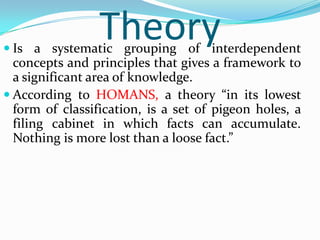
Theory
 Is a systematic grouping of interdependent
  concepts and principles that gives a framework to
  a significant area of knowledge.
 According to HOMANS, a theory “in its lowest
  form of classification, is a set of pigeon holes, a
  filing cabinet in which facts can accumulate.
  Nothing is more lost than a loose fact.”
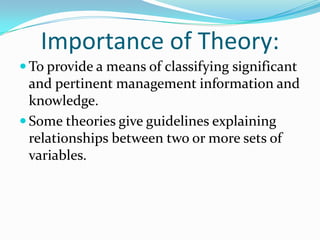
Importance of Theory:
 To provide a means of classifying significant
  and pertinent management information and
  knowledge.
 Some theories give guidelines explaining
  relationships between two or more sets of
  variables.
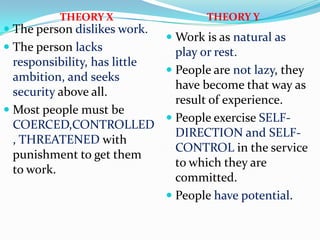
THEORY X                    THEORY Y
 The person dislikes work.
                                Work is as natural as
 The person lacks               play or rest.
  responsibility, has little
                                People are not lazy, they
  ambition, and seeks
                           have become that way as
  security above all.
                           result of experience.
 Most people must be
                          People exercise SELF-
  COERCED,CONTROLLED
                           DIRECTION and SELF-
  , THREATENED with
                           CONTROL in the service
  punishment to get them
                           to which they are
  to work.
                           committed.
                          People have potential.
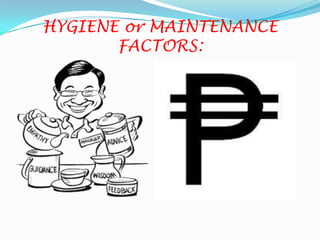
HYGIENE or MAINTENANCE
       FACTORS:
MOTIVATOR or JOB
CONTENT FACTORS:
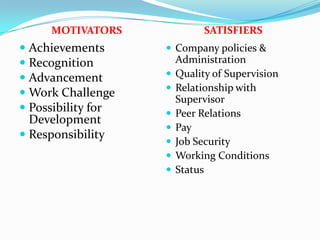
MOTIVATORS               SATISFIERS
 Achievements       Company policies &
 Recognition           Administration
 Advancement          Quality of Supervision
                       Relationship with
 Work Challenge
                        Supervisor
 Possibility for      Peer Relations
  Development
                       Pay
 Responsibility
                       Job Security
                       Working Conditions
                       Status
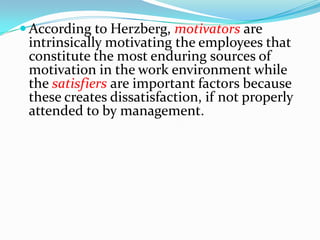
 According to Herzberg, motivators are
 intrinsically motivating the employees that
 constitute the most enduring sources of
 motivation in the work environment while
 the satisfiers are important factors because
 these creates dissatisfaction, if not properly
 attended to by management.
 “People who are high in need
 achievement are highly motivated
 to strive for satisfaction that is
 derived from accomplishing some
 challenging tasks. These people
 also       prefer         obtaining
 specific, timely criticism and
 feedback about their performance.”
BASIC NEEDS TO DRIVE PEOPLE:
Need for Achievement
Need for Power
Need for Affiliation
Need for Competence
 Skinner believed that “the environment
  determines the individual behavior
  event if he alters the environment.”
 Rewards or any Stimuli that serve as
  positive reinforcers of certain behavior
  are found to be more powerful than the
  negative and neutral reinforcers, even
  if both sets of rein forcers may be used.
OPERANT or OPERANT
        CONDITIONING
Is a kind of learning in
 which behavior is shaped
 by selective reinforcement.
BEHAVIOR MODIFICATION:
The process of systematically
 reinforcing positive behavior
 while at the same time
 ignoring negative
 reinforcements to eliminate
 unwanted behavior.
6 Consideration for the Use of Positive
     Reinforcements in Modifying Motivational
               Behaviors of Workers:
 Do not reward equally.
 Failure to reinforce may encourage poor subsequent
    performance.
   Inform workers about what they can do to get
    reinforcement.
   Tell workers when and what they are doing wrong.
   Do not punish a subordinate in front of other workers.
   Be fair.
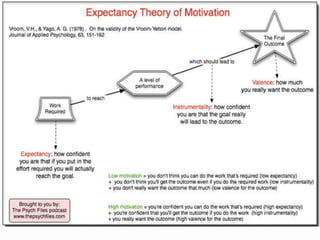
EXPECTANCY:
Refers to the degree of an
 individual’s anticipatory
 belief that his specific action
 will certainly end in a
 particular result or outcome.
This theory is based on the
 assumption that MONEY is
 the primary motivation of
 increasing the productivity
 level of performance of
 workers-that if the reward is
 greater enough, workers will
 naturally produce more.
Focuses on the content or nature
 of items that motivate an
 individual.
 It relates the individual’s inner
 self and how that individual’s
 internal state of needs determine
 behavior.
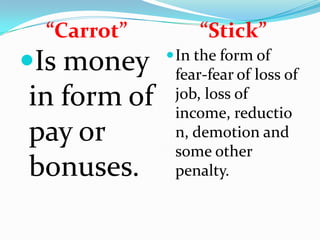
“Carrot”         “Stick”
Is money     In the form of
              fear-fear of loss of
in form of    job, loss of
              income, reductio
pay or        n, demotion and
              some other
bonuses.      penalty.
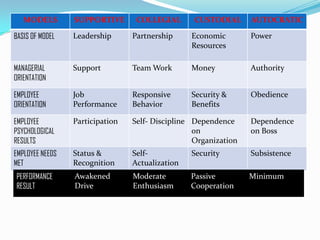
MODELS        SUPPORTIVE       COLLEGIAL       CUSTODIAL      AUTOCRATIC

BASIS OF MODEL   Leadership      Partnership     Economic        Power
                                                 Resources

MANAGERIAL       Support         Team Work       Money           Authority
ORIENTATION

EMPLOYEE         Job             Responsive      Security &      Obedience
ORIENTATION      Performance     Behavior        Benefits

EMPLOYEE         Participation   Self- Discipline Dependence     Dependence
PSYCHOLOGICAL                                     on             on Boss
RESULTS                                           Organization
EMPLOYEE NEEDS   Status &        Self-           Security        Subsistence
MET              Recognition     Actualization
PERFORMANCE      Awakened        Moderate        Passive         Minimum
RESULT           Drive           Enthusiasm      Cooperation

Human behavior report chapter 2

  • 1.
    Different Theories and Modelsof Organizational Behavior
  • 2.
    Theory  Is asystematic grouping of interdependent concepts and principles that gives a framework to a significant area of knowledge.  According to HOMANS, a theory “in its lowest form of classification, is a set of pigeon holes, a filing cabinet in which facts can accumulate. Nothing is more lost than a loose fact.”
  • 3.
    Importance of Theory: To provide a means of classifying significant and pertinent management information and knowledge.  Some theories give guidelines explaining relationships between two or more sets of variables.
  • 6.
    THEORY X THEORY Y  The person dislikes work.  Work is as natural as  The person lacks play or rest. responsibility, has little  People are not lazy, they ambition, and seeks have become that way as security above all. result of experience.  Most people must be  People exercise SELF- COERCED,CONTROLLED DIRECTION and SELF- , THREATENED with CONTROL in the service punishment to get them to which they are to work. committed.  People have potential.
  • 8.
  • 9.
  • 10.
    MOTIVATORS SATISFIERS  Achievements  Company policies &  Recognition Administration  Advancement  Quality of Supervision  Relationship with  Work Challenge Supervisor  Possibility for  Peer Relations Development  Pay  Responsibility  Job Security  Working Conditions  Status
  • 11.
     According toHerzberg, motivators are intrinsically motivating the employees that constitute the most enduring sources of motivation in the work environment while the satisfiers are important factors because these creates dissatisfaction, if not properly attended to by management.
  • 13.
     “People whoare high in need achievement are highly motivated to strive for satisfaction that is derived from accomplishing some challenging tasks. These people also prefer obtaining specific, timely criticism and feedback about their performance.”
  • 15.
    BASIC NEEDS TODRIVE PEOPLE: Need for Achievement Need for Power Need for Affiliation Need for Competence
  • 17.
     Skinner believedthat “the environment determines the individual behavior event if he alters the environment.”  Rewards or any Stimuli that serve as positive reinforcers of certain behavior are found to be more powerful than the negative and neutral reinforcers, even if both sets of rein forcers may be used.
  • 18.
    OPERANT or OPERANT CONDITIONING Is a kind of learning in which behavior is shaped by selective reinforcement.
  • 19.
    BEHAVIOR MODIFICATION: The processof systematically reinforcing positive behavior while at the same time ignoring negative reinforcements to eliminate unwanted behavior.
  • 20.
    6 Consideration forthe Use of Positive Reinforcements in Modifying Motivational Behaviors of Workers:  Do not reward equally.  Failure to reinforce may encourage poor subsequent performance.  Inform workers about what they can do to get reinforcement.  Tell workers when and what they are doing wrong.  Do not punish a subordinate in front of other workers.  Be fair.
  • 22.
    EXPECTANCY: Refers to thedegree of an individual’s anticipatory belief that his specific action will certainly end in a particular result or outcome.
  • 25.
    This theory isbased on the assumption that MONEY is the primary motivation of increasing the productivity level of performance of workers-that if the reward is greater enough, workers will naturally produce more.
  • 28.
    Focuses on thecontent or nature of items that motivate an individual.  It relates the individual’s inner self and how that individual’s internal state of needs determine behavior.
  • 31.
    “Carrot” “Stick” Is money  In the form of fear-fear of loss of in form of job, loss of income, reductio pay or n, demotion and some other bonuses. penalty.
  • 33.
    MODELS SUPPORTIVE COLLEGIAL CUSTODIAL AUTOCRATIC BASIS OF MODEL Leadership Partnership Economic Power Resources MANAGERIAL Support Team Work Money Authority ORIENTATION EMPLOYEE Job Responsive Security & Obedience ORIENTATION Performance Behavior Benefits EMPLOYEE Participation Self- Discipline Dependence Dependence PSYCHOLOGICAL on on Boss RESULTS Organization EMPLOYEE NEEDS Status & Self- Security Subsistence MET Recognition Actualization PERFORMANCE Awakened Moderate Passive Minimum RESULT Drive Enthusiasm Cooperation