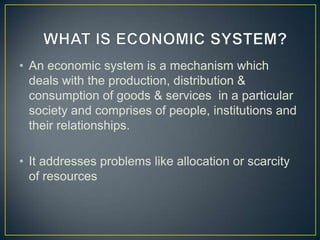
• An economic system is a mechanism which
  deals with the production, distribution &
  consumption of goods & services in a particular
  society and comprises of people, institutions and
  their relationships.

• It addresses problems like allocation or scarcity
  of resources
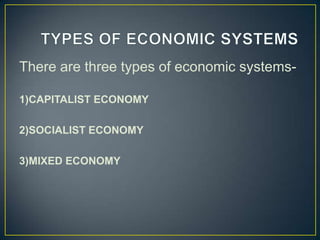
There are three types of economic systems-

1)CAPITALIST ECONOMY

2)SOCIALIST ECONOMY

3)MIXED ECONOMY
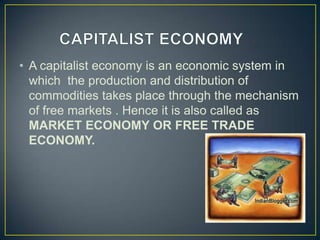
• A capitalist economy is an economic system in
  which the production and distribution of
  commodities takes place through the mechanism
  of free markets . Hence it is also called as
  MARKET ECONOMY OR FREE TRADE
  ECONOMY.
• RIGHT TO PRIVATE PROPERTY.

• PROFIT MOTIVE

• FREEDOM OF CHOICE

• MARKET FORCES.

• MINIMAL ROLE OF GOVERNMENT
• THE US ECONOMY-Private businesses produce most
  goods and services. Almost two third of the nation’s
  total output goes to individuals for personal use.
• Consumers role in US economy is very significant.
  (CONSUMER’S ECONOMY)
• Americans believe that an economy characterized by
  private ownership is likely to operate more efficiently
  than the one with government ownership.
• Federal government is responsible for the nation’s
  defence system , research, road projects, education
  system , law and order mechanism.it also lends help
  to businesses and individuals (social
  security, medicaid etc.).
• Many private enterprises run educational institutions
  and universities.
• Managers respond to the signals from the markets
  and perform the function of organizing and directing
  resources as efficiently as possible.
• Other examples of capitalist economy are CANADA
  , FRANCE etc.
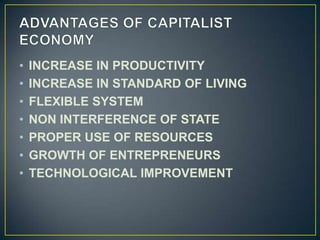
•   INCREASE IN PRODUCTIVITY
•   INCREASE IN STANDARD OF LIVING
•   FLEXIBLE SYSTEM
•   NON INTERFERENCE OF STATE
•   PROPER USE OF RESOURCES
•   GROWTH OF ENTREPRENEURS
•   TECHNOLOGICAL IMPROVEMENT
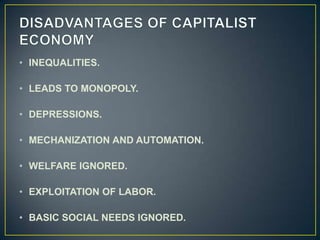
• INEQUALITIES.

• LEADS TO MONOPOLY.

• DEPRESSIONS.

• MECHANIZATION AND AUTOMATION.

• WELFARE IGNORED.

• EXPLOITATION OF LABOR.

• BASIC SOCIAL NEEDS IGNORED.
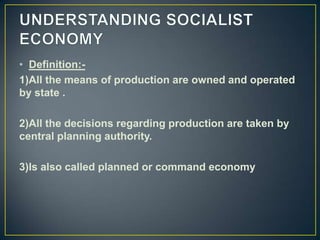
• Definition:-
1)All the means of production are owned and operated
by state .

2)All the decisions regarding production are taken by
central planning authority.

3)Is also called planned or command economy
• Social welfare motive


• Limited right to private motive


• Central planning
• Economic stability

• Maximization of social welfare

• Absence of monopoly

• Basic needs are met

• No extreme inequality
• Bureaucratic expansion.

• No freedom.

• Absence of technology.

• Absence of competition.
• A mixed economy is an economic system that
  incorporates aspects of more than one economic system.
  This usually means an economy that contains both
  private and state owned enterprises or that combine
  element of the capitalism and socialism

• Most countries fall in this category

• Examples: India , Poland etc.
• Resources are owned both by the government as
  well as private individuals.

• Private and public sector exist side by side.

• All basic and heavy industries and other strategic
  sector of an economy e.g., banking, transport, energy
  etc. are controlled by the government.
  Agriculture, consumer goods and other industries
  trade are left for the private sector.
• Who decides what to produce?
  • Businesses


• Who decides how to produce goods and services?
  • Businesses, but the government regulates certain industries


• Who are the goods and services produced for?
  • consumers
• Producers and consumer have sovereignty to
  choose what to produce and what to consume but
  production and consumption of harmful goods and
  services may be stopped by the government.

• The mixed economy is helpful in increasing national
  production in the country. Both public and private
  sector work hard to bring about more production
• A mixed economy may have less income inequality
  due to the role played by the government.


• Consumers are protected from consumption of
  harmful products.
• Under mixed economy private enterprises have to
  face lot of difficulty because of various government
  interference.

• Since welfare of society is important in a mixed
  economy it leads to lower than optimum use of the
  resources because government mobilize the
  resources towards the production of those goods
  and services which are beneficial for the society as a
  whole rather than producing those goods and
  services which in economic terms are more
  beneficial for an economy.
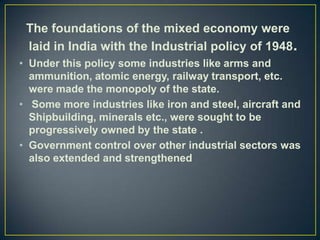
The foundations of the mixed economy were
 laid in India with the Industrial policy of 1948.
• Under this policy some industries like arms and
  ammunition, atomic energy, railway transport, etc.
  were made the monopoly of the state.
• Some more industries like iron and steel, aircraft and
  Shipbuilding, minerals etc., were sought to be
  progressively owned by the state .
• Government control over other industrial sectors was
  also extended and strengthened
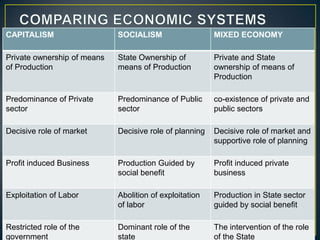
CAPITALISM                   SOCIALISM                   MIXED ECONOMY

Private ownership of means   State Ownership of          Private and State
of Production                means of Production         ownership of means of
                                                         Production

Predominance of Private      Predominance of Public      co-existence of private and
sector                       sector                      public sectors

Decisive role of market      Decisive role of planning   Decisive role of market and
                                                         supportive role of planning

Profit induced Business      Production Guided by        Profit induced private
                             social benefit              business

Exploitation of Labor        Abolition of exploitation   Production in State sector
                             of labor                    guided by social benefit

Restricted role of the       Dominant role of the        The intervention of the role
government                   state                       of the State
PRESENTED BY,
  ASHIMA
  AAYUSH
  ARPIT
  BHAGYA

Economic System

  • 2.
    • An economicsystem is a mechanism which deals with the production, distribution & consumption of goods & services in a particular society and comprises of people, institutions and their relationships. • It addresses problems like allocation or scarcity of resources
  • 3.
    There are threetypes of economic systems- 1)CAPITALIST ECONOMY 2)SOCIALIST ECONOMY 3)MIXED ECONOMY
  • 4.
    • A capitalisteconomy is an economic system in which the production and distribution of commodities takes place through the mechanism of free markets . Hence it is also called as MARKET ECONOMY OR FREE TRADE ECONOMY.
  • 5.
    • RIGHT TOPRIVATE PROPERTY. • PROFIT MOTIVE • FREEDOM OF CHOICE • MARKET FORCES. • MINIMAL ROLE OF GOVERNMENT
  • 6.
    • THE USECONOMY-Private businesses produce most goods and services. Almost two third of the nation’s total output goes to individuals for personal use. • Consumers role in US economy is very significant. (CONSUMER’S ECONOMY) • Americans believe that an economy characterized by private ownership is likely to operate more efficiently than the one with government ownership. • Federal government is responsible for the nation’s defence system , research, road projects, education system , law and order mechanism.it also lends help to businesses and individuals (social security, medicaid etc.). • Many private enterprises run educational institutions and universities.
  • 7.
    • Managers respondto the signals from the markets and perform the function of organizing and directing resources as efficiently as possible. • Other examples of capitalist economy are CANADA , FRANCE etc.
  • 8.
    INCREASE IN PRODUCTIVITY • INCREASE IN STANDARD OF LIVING • FLEXIBLE SYSTEM • NON INTERFERENCE OF STATE • PROPER USE OF RESOURCES • GROWTH OF ENTREPRENEURS • TECHNOLOGICAL IMPROVEMENT
  • 9.
    • INEQUALITIES. • LEADSTO MONOPOLY. • DEPRESSIONS. • MECHANIZATION AND AUTOMATION. • WELFARE IGNORED. • EXPLOITATION OF LABOR. • BASIC SOCIAL NEEDS IGNORED.
  • 10.
    • Definition:- 1)All themeans of production are owned and operated by state . 2)All the decisions regarding production are taken by central planning authority. 3)Is also called planned or command economy
  • 11.
    • Social welfaremotive • Limited right to private motive • Central planning
  • 12.
    • Economic stability •Maximization of social welfare • Absence of monopoly • Basic needs are met • No extreme inequality
  • 13.
    • Bureaucratic expansion. •No freedom. • Absence of technology. • Absence of competition.
  • 14.
    • A mixedeconomy is an economic system that incorporates aspects of more than one economic system. This usually means an economy that contains both private and state owned enterprises or that combine element of the capitalism and socialism • Most countries fall in this category • Examples: India , Poland etc.
  • 15.
    • Resources areowned both by the government as well as private individuals. • Private and public sector exist side by side. • All basic and heavy industries and other strategic sector of an economy e.g., banking, transport, energy etc. are controlled by the government. Agriculture, consumer goods and other industries trade are left for the private sector.
  • 16.
    • Who decideswhat to produce? • Businesses • Who decides how to produce goods and services? • Businesses, but the government regulates certain industries • Who are the goods and services produced for? • consumers
  • 17.
    • Producers andconsumer have sovereignty to choose what to produce and what to consume but production and consumption of harmful goods and services may be stopped by the government. • The mixed economy is helpful in increasing national production in the country. Both public and private sector work hard to bring about more production
  • 18.
    • A mixedeconomy may have less income inequality due to the role played by the government. • Consumers are protected from consumption of harmful products.
  • 19.
    • Under mixedeconomy private enterprises have to face lot of difficulty because of various government interference. • Since welfare of society is important in a mixed economy it leads to lower than optimum use of the resources because government mobilize the resources towards the production of those goods and services which are beneficial for the society as a whole rather than producing those goods and services which in economic terms are more beneficial for an economy.
  • 20.
    The foundations ofthe mixed economy were laid in India with the Industrial policy of 1948. • Under this policy some industries like arms and ammunition, atomic energy, railway transport, etc. were made the monopoly of the state. • Some more industries like iron and steel, aircraft and Shipbuilding, minerals etc., were sought to be progressively owned by the state . • Government control over other industrial sectors was also extended and strengthened
  • 21.
    CAPITALISM SOCIALISM MIXED ECONOMY Private ownership of means State Ownership of Private and State of Production means of Production ownership of means of Production Predominance of Private Predominance of Public co-existence of private and sector sector public sectors Decisive role of market Decisive role of planning Decisive role of market and supportive role of planning Profit induced Business Production Guided by Profit induced private social benefit business Exploitation of Labor Abolition of exploitation Production in State sector of labor guided by social benefit Restricted role of the Dominant role of the The intervention of the role government state of the State
  • 22.
    PRESENTED BY, ASHIMA AAYUSH ARPIT BHAGYA