chapter
2
The External and
Internal Environment
McGraw-Hill/Irwin
Principles of Management © 2008 The McGraw-Hill Companies, Inc., All Rights Reserved.
2 - 2
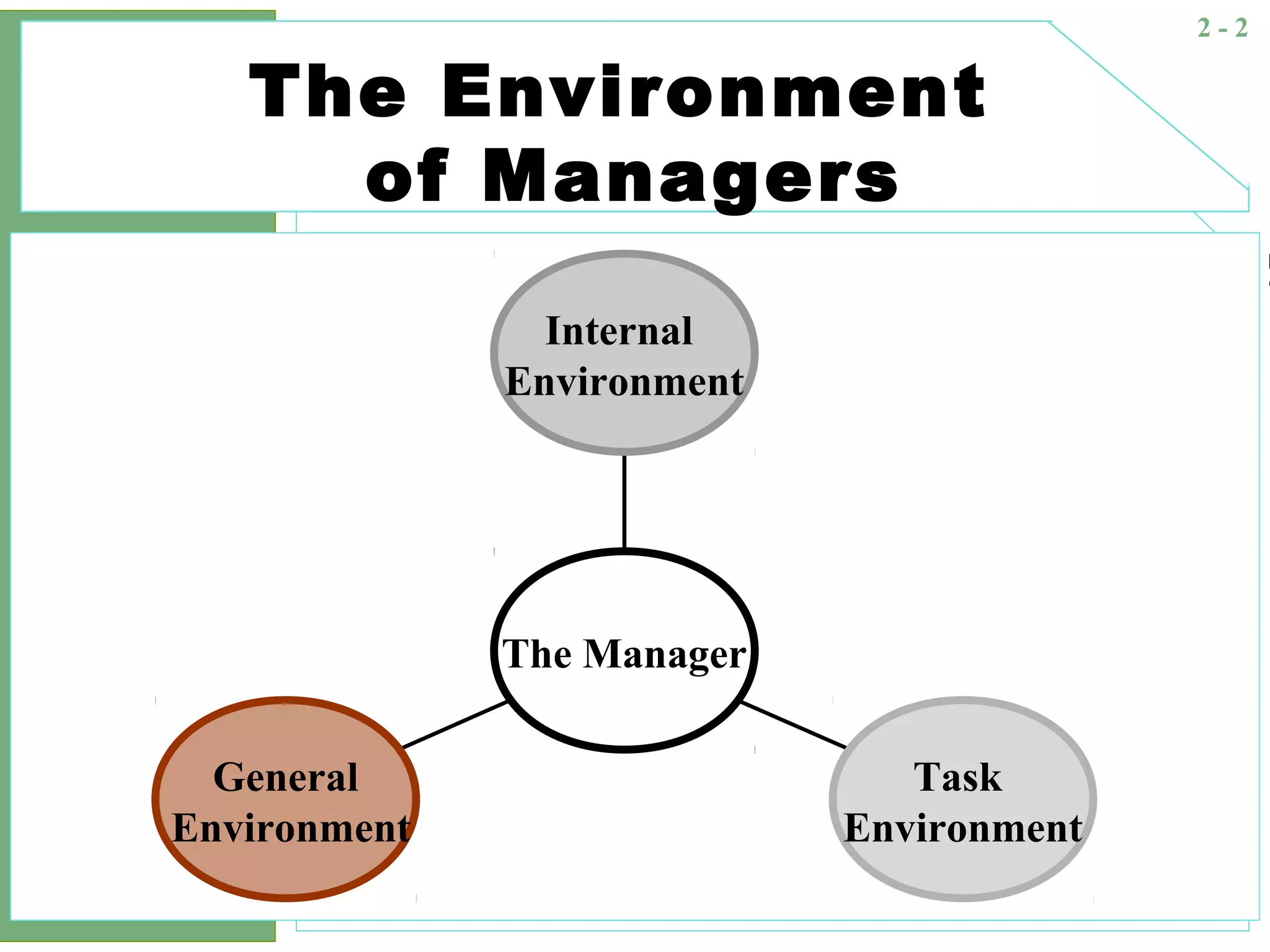
The Environment
of Managers
General
Environment
Task
Environment
Internal
Environment
The Manager
2 - 3
Task Environment
Bargaining Power
of Suppliers
Threat of Entry
Threat of
Substitutes
Bargaining Power
of Buyers
Intensity
of
Rivalry
Porter’s
Competitive
Forces Model
2 - 4
Threat of Entry
• Barriers to entry – factors that might make it costly
for potential competitors to enter an industry and
compete with firms already in the industry
• Economies of scale – cost reduction associated
with large output
• Brand loyalty – the preference of consumers for
the products of established companies
2 - 5
Bargaining Power
of Buyers
• Buyers are most powerful when:
- They are few in number and purchase large quantities
- They can choose between equivalent products from many
different firms
- They can switch easily between the offerings of different firms
• Buyers are least powerful when:
- They are plentiful and purchase in small quantities
- They have little choice
- They cannot switch easily between the offerings of
different firms
• Switching Costs
2 - 6
Bargaining Power of
Suppliers
• Firm has greater power over suppliers when:
- The firm purchases in large quantities
- It can choose between multiple suppliers
- The costs of switching between suppliers is low
- The firm is not dependant on any single
supplier for important inputs
2 - 7
The Threat of
Substitutes
• The goods or services of different businesses or
industries that can satisfy similar customer needs
• The existence of substitutes is a strong competitive
threat because it limits the price that companies in
one store can change
• If there are few substitutes, firms have the
opportunity to raise prices
2 - 8
The Intensity
of Rivalry
• The nature of the product
- The intensity of rivalry depends on how close the
product is to a commodity (a product that is difficult to
differentiate from those produced by rivals).
2 - 9
The Sixth Force
Bargaining Power
of Suppliers
Threat of Entry
Threat of
Substitutes
Bargaining Power
of Buyers
Intensity
of
Rivalry
Complements
•Availability
•Price
2 - 10
The General
Environment
Technological
Forces
Sociocultural
Forces
Demographic
Forces
Macroeconomic
Forces
Political & Legal
Forces
International
Forces
2 - 11
The Internal
Environment
Employees Resources
Organization
of the firm
2 - 12
Culture
• The basic pattern of values and
assumptions shared by
employees within an
organization.
• Important because it influences
what a manager can and cannot
do and what is encouraged or
discouraged by the organization
2 - 13
Human Capital
Knowledge Skills
Capabilities
2 - 14
Resources
•Tangible resources
– physical assets
•Intangible
resources – non
physical assets

External and internal enviornment (management)

  • 1.
    chapter 2 The External and InternalEnvironment McGraw-Hill/Irwin Principles of Management © 2008 The McGraw-Hill Companies, Inc., All Rights Reserved.
  • 2.
    2 - 2 TheEnvironment of Managers General Environment Task Environment Internal Environment The Manager
  • 3.
    2 - 3 TaskEnvironment Bargaining Power of Suppliers Threat of Entry Threat of Substitutes Bargaining Power of Buyers Intensity of Rivalry Porter’s Competitive Forces Model
  • 4.
    2 - 4 Threatof Entry • Barriers to entry – factors that might make it costly for potential competitors to enter an industry and compete with firms already in the industry • Economies of scale – cost reduction associated with large output • Brand loyalty – the preference of consumers for the products of established companies
  • 5.
    2 - 5 BargainingPower of Buyers • Buyers are most powerful when: - They are few in number and purchase large quantities - They can choose between equivalent products from many different firms - They can switch easily between the offerings of different firms • Buyers are least powerful when: - They are plentiful and purchase in small quantities - They have little choice - They cannot switch easily between the offerings of different firms • Switching Costs
  • 6.
    2 - 6 BargainingPower of Suppliers • Firm has greater power over suppliers when: - The firm purchases in large quantities - It can choose between multiple suppliers - The costs of switching between suppliers is low - The firm is not dependant on any single supplier for important inputs
  • 7.
    2 - 7 TheThreat of Substitutes • The goods or services of different businesses or industries that can satisfy similar customer needs • The existence of substitutes is a strong competitive threat because it limits the price that companies in one store can change • If there are few substitutes, firms have the opportunity to raise prices
  • 8.
    2 - 8 TheIntensity of Rivalry • The nature of the product - The intensity of rivalry depends on how close the product is to a commodity (a product that is difficult to differentiate from those produced by rivals).
  • 9.
    2 - 9 TheSixth Force Bargaining Power of Suppliers Threat of Entry Threat of Substitutes Bargaining Power of Buyers Intensity of Rivalry Complements •Availability •Price
  • 10.
    2 - 10 TheGeneral Environment Technological Forces Sociocultural Forces Demographic Forces Macroeconomic Forces Political & Legal Forces International Forces
  • 11.
    2 - 11 TheInternal Environment Employees Resources Organization of the firm
  • 12.
    2 - 12 Culture •The basic pattern of values and assumptions shared by employees within an organization. • Important because it influences what a manager can and cannot do and what is encouraged or discouraged by the organization
  • 13.
    2 - 13 HumanCapital Knowledge Skills Capabilities
  • 14.
    2 - 14 Resources •Tangibleresources – physical assets •Intangible resources – non physical assets

Editor's Notes

  • #3 See Learning Objective 1: Identify the major components of an organization’s task environment. See text page: 28
  • #4 See Learning Objective 1: Identify the major components of an organization’s task environment. See text pages: 29
  • #5 See Learning Objective 2: Explain how each component in the task environment impacts the organization. See text page: 30
  • #6 See Learning Objective 2: Explain how each component in the task environment impacts the organization. See text page: 31
  • #7 See Learning Objective 2: Explain how each component in the task environment impacts the organization. See text page: 32
  • #8 See Learning Objective 2: Explain how each component in the task environment impacts the organization. See text page: 32
  • #9 See Learning Objective 2: Explain how each component in the task environment impacts the organization. See text page: 33
  • #10 See Learning Objective 2: Explain how each component in the task environment impacts the organization. See text page: 37
  • #11 See Learning Objective 3: Identify the major components of an organization’s general environment. See text page: 38
  • #12 See Learning Objective 6: Outline the main components of the internal environment of an organization and articulate their implications for managerial actions. See text page: 44
  • #13 See Learning Objective 6: Outline the main components of the internal environment of an organization and articulate their implications for managerial actions. See text page: 45
  • #14 See Learning Objective 6: Outline the main components of the internal environment of an organization and articulate their implications for managerial actions. See text page: 45
  • #15 See Learning Objective 6: Outline the main components of the internal environment of an organization and articulate their implications for managerial actions. See text page: 46