Motivation
Dr. Ahmedur Rahman Sabuj
3/10/2019 sabuj.mmc@gmail.com 1
Session outline:
• What is motivation?
• Why motivation?
• Type of motivation
• Motivating factors
• Theories of motivation
• Rules of motivation
• Creating motivational climate
• Some tips for motivation
3/10/2019 sabuj.mmc@gmail.com 2
What is motivation?
• Motivation means desire, wants of drives within the
individuals. The word motivation is the process of stimulating
people to action to accomplish the goal.
• To achieve the goal the psychological factors stimulate the
people’s behavior. These are:
• Desire for money
• Success
• Job satisfaction
• Teamwork, etc.
3/10/2019 sabuj.mmc@gmail.com 3
What is motivation? (Cont.)
• One of the most important functions of management is to
create willingness among the employees to perform in the
best of their abilities.
• The role of a leader is to arouse interest in the performance
of employees in the jobs. That can be down in the process of
motivation.
• Therefore, we can say that motivation is a psychological
phenomenon, which means needs, and wants of the
individuals have to tackle by framing and incentive plan.
3/10/2019 sabuj.mmc@gmail.com 4
Motivational Illustration:
Misconceptions about motivation:
• Current generation has no work ethic
• Some people are born “lazy”
• Most people are motivated by the same thing
3/10/2019 sabuj.mmc@gmail.com 5
Why motivation needed?
• Motivation is a management tool to increase the behaviour of
an individual.
• It can compel an employee to act to meet the organizational
goal.
• It is securing commitment and willingness of the people
towards the organization.
• It can act as an incentive for workers to achieve defined
objectives.
• It is an energy directed towards goal.
3/10/2019 sabuj.mmc@gmail.com 6
Importance of motivation:
Motivation is very important for an organization because of the
following benefits:
• Puts human resources into action.
• Improves level of efficiency of employees
• Leads to achievement of organizational goals
• Builds friendly in relationships
• Leads to stability of workforce
3/10/2019 sabuj.mmc@gmail.com 7
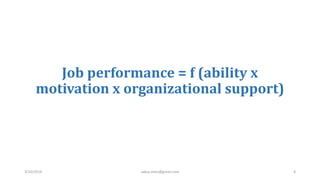
Job performance = f (ability x
motivation x organizational support)
3/10/2019 sabuj.mmc@gmail.com 8
Type of motivation:
Primary motivation:
• It is an intrinsic rewards derived from activity itself. (eg. place
of posting, any special taskaa)
Secondary motivation:
• It is an extrinsic rewards influence from outside the activity.
(eg. praise and other rewards)
3/10/2019 sabuj.mmc@gmail.com 9
Type of motivation: (cont.)
Positive motivation:
• Primary: How well I am doing (intrinsic).
• Secondary: Positive comments and encouragement from
others (extremes).
Negative motivation:
• Primary: Feeling bad about what you are attempting.
• Secondary: Bad mark for the work.
3/10/2019 sabuj.mmc@gmail.com 10
Important theories:
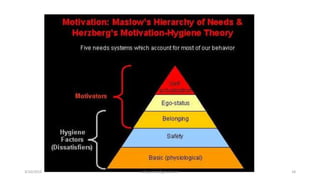
• Maslow’s Hierarchy of needs
• McGregor's theory X and Y management styles
• Herzberg’s Motivation-Hygiene Theory
• Vroom’s Expectancy Theory
3/10/2019 sabuj.mmc@gmail.com 11
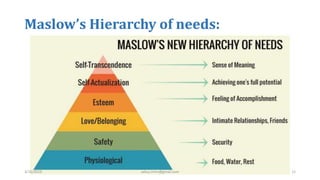
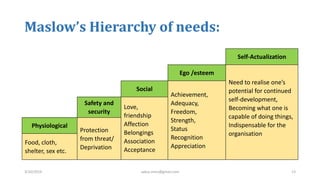
Maslow’s Hierarchy of needs:
3/10/2019 sabuj.mmc@gmail.com 12
Maslow’s Hierarchy of needs:
Self-Actualization
Ego /esteem
Need to realise one’s
potential for continued
self-development,
Becoming what one is
capable of doing things,
Indispensable for the
organisation
Social
Achievement,
Adequacy,
Freedom,
Strength,
Status
Recognition
Appreciation
Safety and
security
Love,
friendship
Affection
Belongings
Association
Acceptance
Physiological
Protection
from threat/
Deprivation
Food, cloth,
shelter, sex etc.
3/10/2019 sabuj.mmc@gmail.com 13
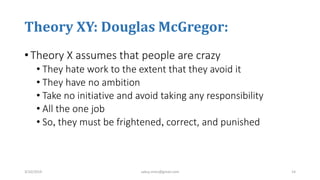
Theory XY: Douglas McGregor:
• Theory X assumes that people are crazy
• They hate work to the extent that they avoid it
• They have no ambition
• Take no initiative and avoid taking any responsibility
• All the one job
• So, they must be frightened, correct, and punished
3/10/2019 sabuj.mmc@gmail.com 14
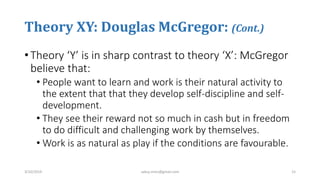
Theory XY: Douglas McGregor: (Cont.)
• Theory ‘Y’ is in sharp contrast to theory ‘X’: McGregor
believe that:
• People want to learn and work is their natural activity to
the extent that that they develop self-discipline and self-
development.
• They see their reward not so much in cash but in freedom
to do difficult and challenging work by themselves.
• Work is as natural as play if the conditions are favourable.
3/10/2019 sabuj.mmc@gmail.com 15
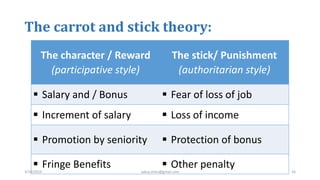
The carrot and stick theory:
The character / Reward
(participative style)
The stick/ Punishment
(authoritarian style)
 Salary and / Bonus  Fear of loss of job
 Increment of salary  Loss of income
 Promotion by seniority  Protection of bonus
 Fringe Benefits  Other penalty3/10/2019 sabuj.mmc@gmail.com 16
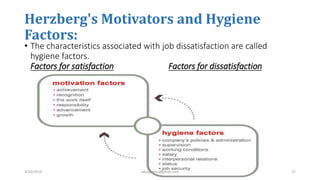
Herzberg's Motivators and Hygiene
Factors:
• The characteristics associated with job dissatisfaction are called
hygiene factors.
Factors for satisfaction Factors for dissatisfaction
3/10/2019 sabuj.mmc@gmail.com 17
3/10/2019 sabuj.mmc@gmail.com 18
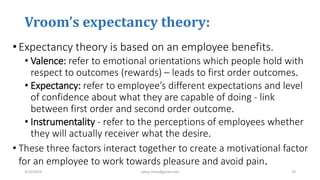
Vroom’s expectancy theory:
•Expectancy theory is based on an employee benefits.
• Valence: refer to emotional orientations which people hold with
respect to outcomes (rewards) – leads to first order outcomes.
• Expectancy: refer to employee’s different expectations and level
of confidence about what they are capable of doing - link
between first order and second order outcome.
• Instrumentality - refer to the perceptions of employees whether
they will actually receiver what the desire.
• These three factors interact together to create a motivational factor
for an employee to work towards pleasure and avoid pain.
3/10/2019 sabuj.mmc@gmail.com 19
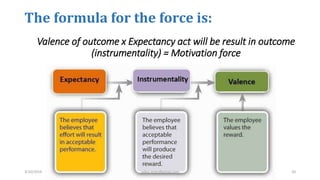
The formula for the force is:
Valence of outcome x Expectancy act will be result in outcome
(instrumentality) = Motivation force
3/10/2019 sabuj.mmc@gmail.com 20
Motivation is a form of learning: The
Law of Effect
• Behaviour that leads toward rewards tends to be
repeated.
• Behaviour that tends to lead towards no reward or to
punishment tends to be avoided.
• The type of reinforcer and the timing (schedule) of
reinforcement are key.
3/10/2019 sabuj.mmc@gmail.com 21
Techniques of motivation:
• Motivation true regarding
• Motivation through job designing
• Motivation through flexibility
3/10/2019 sabuj.mmc@gmail.com 22
Motivation through rewarding:
• Membership and seniority based reward
• Job status based reward
• Competency based reward
• Performance-based reward
• Organisational rewards:
• Profit sharing
• Stock option
3/10/2019 sabuj.mmc@gmail.com 23
Motivation through rewarding: (cont.)
• Team rewards:
• Gain sharing
• Special bonus
• Individual rewards:
• Price rate
• Commission
• Merit pay
• Special bonuses3/10/2019 sabuj.mmc@gmail.com 24
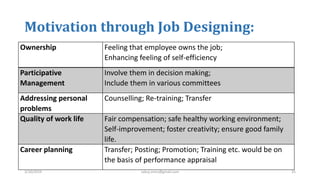
Motivation through Job Designing:
Ownership Feeling that employee owns the job;
Enhancing feeling of self-efficiency
Participative
Management
Involve them in decision making;
Include them in various committees
Addressing personal
problems
Counselling; Re-training; Transfer
Quality of work life Fair compensation; safe healthy working environment;
Self-improvement; foster creativity; ensure good family
life.
Career planning Transfer; Posting; Promotion; Training etc. would be on
the basis of performance appraisal
3/10/2019 sabuj.mmc@gmail.com 25
Motivation through Flexibility:
• MBO (Management by Objective)
• Flexible working hour/flexi-time
• Flexible working place/flexi-place
• Flexible benefits/flexi-pay
• Two-tier pay system
3/10/2019 sabuj.mmc@gmail.com 26
Results of Motivation:
•When an employee is motivated he does the
following:
•Wants to go to work & work willingly
•When at work he gives best performance
•Has a sense of belonging and pride in the
organization
Motivation = high productivity = fulfilment of organization
goal3/10/2019 sabuj.mmc@gmail.com 27
How to Create Motivational Climate:
•Creating environment for interdependent work rather than
dependency
•Creating a competitive climate through recognition of work
•Creating a climate of approach and problem solving rather
than avoidance
•Creating a productive environment through personal
example.
•Motivating staffs individually through guidance and
counselling.3/10/2019 sabuj.mmc@gmail.com 28
Some Feature of a Good Motivation
System:
• A sound motivation system in an organization should have the
following features:
• Superior performance should be reasonably rewarded and should
be duly acknowledged.
• If the performance is not consistently up to the mark, then the
system must make provisions for penalties.
• The employees must be dealt in a fair and just manner.
3/10/2019 sabuj.mmc@gmail.com 29
Some Feature of a Good Motivation
System: (cont.)
• Carrot and stick approach should be implemented very
carefully to motivate both efficient and inefficient employees.
• Performance appraisal system should be very effective.
• Ensure flexibility in working arrangements.
• The motivational system must be modified to the situation
and to the organization.
• The management approach should be participative.
• "Motivate yourself to motivate your employees”
3/10/2019 sabuj.mmc@gmail.com 30
Some Tips for Motivate Staffs:
• Please be polite with everyone;
• Make good relation with subordinate staff.
• Try to know everybody by their first name:
• Avoid staff jobs, seek line jobs.
• Never outshine your master
• Treat all people as special:
3/10/2019 sabuj.mmc@gmail.com 31
Some Tips for Motivate Staffs: (cont.)
• Be a credit maker, not a credit taker
• Boss is always right
• Stay out of office politics.
• Be liberal in granting casual leave.
• Give attention to junior colleagues, guide them, and
help them when necessary.
3/10/2019 sabuj.mmc@gmail.com 32
Some Tips for Motivate Staffs: (cont.)
• Arrange picnic and guest night for families of your
colleagues.
• Congratulate when your colleague/subordinate/ ward
of them achieves any promotion, degree, award and
provide academic counselling to them.
• Make participatory environment in decision making.
• Try to adjust with any situation
3/10/2019 sabuj.mmc@gmail.com 33
Human Relation:
The least most important word: “I”
The one most important word: “WE”
The two most important word: “Thank you”
The three most important word: “If you please”
The four most important word: “What is your opinion?”
The five most important word: “You did a good job”
The six most important word: "I admit I made a mistake”3/10/2019 sabuj.mmc@gmail.com 34
In an office:
A worried person always see a problem
&
A concern person always solve the problem.
3/10/2019 sabuj.mmc@gmail.com 35

Motivation

  • 1.
    Motivation Dr. Ahmedur RahmanSabuj 3/10/2019 sabuj.mmc@gmail.com 1
  • 2.
    Session outline: • Whatis motivation? • Why motivation? • Type of motivation • Motivating factors • Theories of motivation • Rules of motivation • Creating motivational climate • Some tips for motivation 3/10/2019 sabuj.mmc@gmail.com 2
  • 3.
    What is motivation? •Motivation means desire, wants of drives within the individuals. The word motivation is the process of stimulating people to action to accomplish the goal. • To achieve the goal the psychological factors stimulate the people’s behavior. These are: • Desire for money • Success • Job satisfaction • Teamwork, etc. 3/10/2019 sabuj.mmc@gmail.com 3
  • 4.
    What is motivation?(Cont.) • One of the most important functions of management is to create willingness among the employees to perform in the best of their abilities. • The role of a leader is to arouse interest in the performance of employees in the jobs. That can be down in the process of motivation. • Therefore, we can say that motivation is a psychological phenomenon, which means needs, and wants of the individuals have to tackle by framing and incentive plan. 3/10/2019 sabuj.mmc@gmail.com 4
  • 5.
    Motivational Illustration: Misconceptions aboutmotivation: • Current generation has no work ethic • Some people are born “lazy” • Most people are motivated by the same thing 3/10/2019 sabuj.mmc@gmail.com 5
  • 6.
    Why motivation needed? •Motivation is a management tool to increase the behaviour of an individual. • It can compel an employee to act to meet the organizational goal. • It is securing commitment and willingness of the people towards the organization. • It can act as an incentive for workers to achieve defined objectives. • It is an energy directed towards goal. 3/10/2019 sabuj.mmc@gmail.com 6
  • 7.
    Importance of motivation: Motivationis very important for an organization because of the following benefits: • Puts human resources into action. • Improves level of efficiency of employees • Leads to achievement of organizational goals • Builds friendly in relationships • Leads to stability of workforce 3/10/2019 sabuj.mmc@gmail.com 7
  • 8.
    Job performance =f (ability x motivation x organizational support) 3/10/2019 sabuj.mmc@gmail.com 8
  • 9.
    Type of motivation: Primarymotivation: • It is an intrinsic rewards derived from activity itself. (eg. place of posting, any special taskaa) Secondary motivation: • It is an extrinsic rewards influence from outside the activity. (eg. praise and other rewards) 3/10/2019 sabuj.mmc@gmail.com 9
  • 10.
    Type of motivation:(cont.) Positive motivation: • Primary: How well I am doing (intrinsic). • Secondary: Positive comments and encouragement from others (extremes). Negative motivation: • Primary: Feeling bad about what you are attempting. • Secondary: Bad mark for the work. 3/10/2019 sabuj.mmc@gmail.com 10
  • 11.
    Important theories: • Maslow’sHierarchy of needs • McGregor's theory X and Y management styles • Herzberg’s Motivation-Hygiene Theory • Vroom’s Expectancy Theory 3/10/2019 sabuj.mmc@gmail.com 11
  • 12.
    Maslow’s Hierarchy ofneeds: 3/10/2019 sabuj.mmc@gmail.com 12
  • 13.
    Maslow’s Hierarchy ofneeds: Self-Actualization Ego /esteem Need to realise one’s potential for continued self-development, Becoming what one is capable of doing things, Indispensable for the organisation Social Achievement, Adequacy, Freedom, Strength, Status Recognition Appreciation Safety and security Love, friendship Affection Belongings Association Acceptance Physiological Protection from threat/ Deprivation Food, cloth, shelter, sex etc. 3/10/2019 sabuj.mmc@gmail.com 13
  • 14.
    Theory XY: DouglasMcGregor: • Theory X assumes that people are crazy • They hate work to the extent that they avoid it • They have no ambition • Take no initiative and avoid taking any responsibility • All the one job • So, they must be frightened, correct, and punished 3/10/2019 sabuj.mmc@gmail.com 14
  • 15.
    Theory XY: DouglasMcGregor: (Cont.) • Theory ‘Y’ is in sharp contrast to theory ‘X’: McGregor believe that: • People want to learn and work is their natural activity to the extent that that they develop self-discipline and self- development. • They see their reward not so much in cash but in freedom to do difficult and challenging work by themselves. • Work is as natural as play if the conditions are favourable. 3/10/2019 sabuj.mmc@gmail.com 15
  • 16.
    The carrot andstick theory: The character / Reward (participative style) The stick/ Punishment (authoritarian style)  Salary and / Bonus  Fear of loss of job  Increment of salary  Loss of income  Promotion by seniority  Protection of bonus  Fringe Benefits  Other penalty3/10/2019 sabuj.mmc@gmail.com 16
  • 17.
    Herzberg's Motivators andHygiene Factors: • The characteristics associated with job dissatisfaction are called hygiene factors. Factors for satisfaction Factors for dissatisfaction 3/10/2019 sabuj.mmc@gmail.com 17
  • 18.
  • 19.
    Vroom’s expectancy theory: •Expectancytheory is based on an employee benefits. • Valence: refer to emotional orientations which people hold with respect to outcomes (rewards) – leads to first order outcomes. • Expectancy: refer to employee’s different expectations and level of confidence about what they are capable of doing - link between first order and second order outcome. • Instrumentality - refer to the perceptions of employees whether they will actually receiver what the desire. • These three factors interact together to create a motivational factor for an employee to work towards pleasure and avoid pain. 3/10/2019 sabuj.mmc@gmail.com 19
  • 20.
    The formula forthe force is: Valence of outcome x Expectancy act will be result in outcome (instrumentality) = Motivation force 3/10/2019 sabuj.mmc@gmail.com 20
  • 21.
    Motivation is aform of learning: The Law of Effect • Behaviour that leads toward rewards tends to be repeated. • Behaviour that tends to lead towards no reward or to punishment tends to be avoided. • The type of reinforcer and the timing (schedule) of reinforcement are key. 3/10/2019 sabuj.mmc@gmail.com 21
  • 22.
    Techniques of motivation: •Motivation true regarding • Motivation through job designing • Motivation through flexibility 3/10/2019 sabuj.mmc@gmail.com 22
  • 23.
    Motivation through rewarding: •Membership and seniority based reward • Job status based reward • Competency based reward • Performance-based reward • Organisational rewards: • Profit sharing • Stock option 3/10/2019 sabuj.mmc@gmail.com 23
  • 24.
    Motivation through rewarding:(cont.) • Team rewards: • Gain sharing • Special bonus • Individual rewards: • Price rate • Commission • Merit pay • Special bonuses3/10/2019 sabuj.mmc@gmail.com 24
  • 25.
    Motivation through JobDesigning: Ownership Feeling that employee owns the job; Enhancing feeling of self-efficiency Participative Management Involve them in decision making; Include them in various committees Addressing personal problems Counselling; Re-training; Transfer Quality of work life Fair compensation; safe healthy working environment; Self-improvement; foster creativity; ensure good family life. Career planning Transfer; Posting; Promotion; Training etc. would be on the basis of performance appraisal 3/10/2019 sabuj.mmc@gmail.com 25
  • 26.
    Motivation through Flexibility: •MBO (Management by Objective) • Flexible working hour/flexi-time • Flexible working place/flexi-place • Flexible benefits/flexi-pay • Two-tier pay system 3/10/2019 sabuj.mmc@gmail.com 26
  • 27.
    Results of Motivation: •Whenan employee is motivated he does the following: •Wants to go to work & work willingly •When at work he gives best performance •Has a sense of belonging and pride in the organization Motivation = high productivity = fulfilment of organization goal3/10/2019 sabuj.mmc@gmail.com 27
  • 28.
    How to CreateMotivational Climate: •Creating environment for interdependent work rather than dependency •Creating a competitive climate through recognition of work •Creating a climate of approach and problem solving rather than avoidance •Creating a productive environment through personal example. •Motivating staffs individually through guidance and counselling.3/10/2019 sabuj.mmc@gmail.com 28
  • 29.
    Some Feature ofa Good Motivation System: • A sound motivation system in an organization should have the following features: • Superior performance should be reasonably rewarded and should be duly acknowledged. • If the performance is not consistently up to the mark, then the system must make provisions for penalties. • The employees must be dealt in a fair and just manner. 3/10/2019 sabuj.mmc@gmail.com 29
  • 30.
    Some Feature ofa Good Motivation System: (cont.) • Carrot and stick approach should be implemented very carefully to motivate both efficient and inefficient employees. • Performance appraisal system should be very effective. • Ensure flexibility in working arrangements. • The motivational system must be modified to the situation and to the organization. • The management approach should be participative. • "Motivate yourself to motivate your employees” 3/10/2019 sabuj.mmc@gmail.com 30
  • 31.
    Some Tips forMotivate Staffs: • Please be polite with everyone; • Make good relation with subordinate staff. • Try to know everybody by their first name: • Avoid staff jobs, seek line jobs. • Never outshine your master • Treat all people as special: 3/10/2019 sabuj.mmc@gmail.com 31
  • 32.
    Some Tips forMotivate Staffs: (cont.) • Be a credit maker, not a credit taker • Boss is always right • Stay out of office politics. • Be liberal in granting casual leave. • Give attention to junior colleagues, guide them, and help them when necessary. 3/10/2019 sabuj.mmc@gmail.com 32
  • 33.
    Some Tips forMotivate Staffs: (cont.) • Arrange picnic and guest night for families of your colleagues. • Congratulate when your colleague/subordinate/ ward of them achieves any promotion, degree, award and provide academic counselling to them. • Make participatory environment in decision making. • Try to adjust with any situation 3/10/2019 sabuj.mmc@gmail.com 33
  • 34.
    Human Relation: The leastmost important word: “I” The one most important word: “WE” The two most important word: “Thank you” The three most important word: “If you please” The four most important word: “What is your opinion?” The five most important word: “You did a good job” The six most important word: "I admit I made a mistake”3/10/2019 sabuj.mmc@gmail.com 34
  • 35.
    In an office: Aworried person always see a problem & A concern person always solve the problem. 3/10/2019 sabuj.mmc@gmail.com 35