SECTOR THEORY
of urban land development
Homer Hoyt (1895-1984)
I. Brief Introduction
II. Components of Hoyt Model
III. Features, Significance & Limitation
Presented by: TEDRICK EIVANZ F. DANAO
SECTOR THEORY (HOYT MODEL)
• Homer Hoyt – Land Economist
• “The Structure and Growth of Residential
Neighborhoods in American Cities” (1939)
- Commissioned by the Federal Housing
Administration
- Improve housing standard and conditions
- Provide sound housing and home financing
policy
• Improved version of Burgess Model
• Cities developed in the form of sectors
which grow along travel links
THE STRUCTURE AND GROWTH OF
RESIDENTIAL NEIGHBORHOODS IN
AMERICAN CITIES
I. Internal Structure & Relationship of various Neighborhoods
- City Structure (Topography & Transportation)
- Pattern of Land Use
- Types of Residential Areas based on housing
characteristics (Rent, Clustering of Racial Groups, Etc.)
II. Growth of the entire City and its Component Parts
- Settled Area Maps of successive periods
- Commercial, industrial and residential in different periods
THE STRUCTURE AND GROWTH OF
RESIDENTIAL NEIGHBORHOODS IN
AMERICAN CITIES
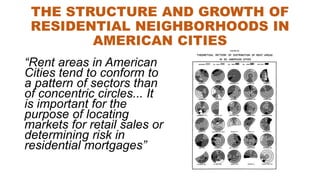
“Rent areas in American
Cities tend to conform to
a pattern of sectors than
of concentric circles... It
is important for the
purpose of locating
markets for retail sales or
determining risk in
residential mortgages”
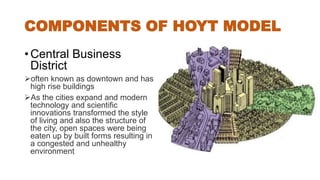
COMPONENTS OF HOYT MODEL
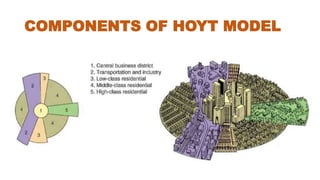
• Central Business
District
often known as downtown and has
high rise buildings
As the cities expand and modern
technology and scientific
innovations transformed the style
of living and also the structure of
the city, open spaces were being
eaten up by built forms resulting in
a congested and unhealthy
environment
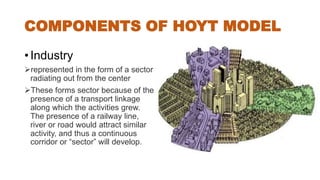
COMPONENTS OF HOYT MODEL
• Industry
represented in the form of a sector
radiating out from the center
These forms sector because of the
presence of a transport linkage
along which the activities grew.
The presence of a railway line,
river or road would attract similar
activity, and thus a continuous
corridor or “sector” will develop.
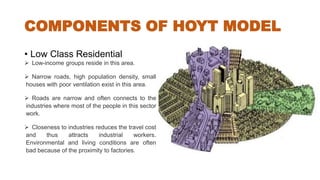
COMPONENTS OF HOYT MODEL
• Low Class Residential
 Low-income groups reside in this area.
 Narrow roads, high population density, small
houses with poor ventilation exist in this area.
 Roads are narrow and often connects to the
industries where most of the people in this sector
work.
 Closeness to industries reduces the travel cost
and thus attracts industrial workers.
Environmental and living conditions are often
bad because of the proximity to factories.
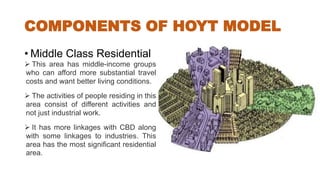
COMPONENTS OF HOYT MODEL
• Middle Class Residential
 This area has middle-income groups
who can afford more substantial travel
costs and want better living conditions.
 The activities of people residing in this
area consist of different activities and
not just industrial work.
 It has more linkages with CBD along
with some linkages to industries. This
area has the most significant residential
area.
COMPONENTS OF HOYT MODEL
• High Class Residential
This is the outermost and farthest
area from downtown.
Wealthy and affluent people live in
this area.
This area is clean, has less traffic,
quiet and has large houses. Corridor
or spine extending from CBD to the
edge has the best housing.
FEATURES OF HOYT MODEL
 Presence of low-income groups near industries
 Transportation and access to resources caused
a disruption of the Burgess model.
 Transport linkages profoundly influence activities
and their locations.
 Low transportation costs and proximity to
roads/railway reduce the cost of production.
 This model applies well to Chicago
 Account for major transportation routes and its
effect on activities
SIGNIFICANCE OF HOYT MODEL
• Ecological factors + economic rent concept
to explain the land use pattern
• Stress on the role of transport routes in
affecting the spatial arrangement of the city
• Both the distance and direction of growth
from the city center are considered
• Brings location of industrial and
environmental amenity values as
determinants in a residential place
LIMITATION OF HOYT MODEL
 Only Railway lines are considered for the
growth of sectors and do not make allowances
for private cars.
 It is a monocentric representation of cities;
multiple business centers are not accounted for
in this model.
 Physical features – physical features may
restrict or direct growth along specific wedges
 No reference to out of town development
References
• https://rashidfaridi.com/2020/03/14/sector-model-of-urban-land-use/
• https://www.albert.io/blog/hoyt-sector-model-ap-human-geography-crash-
course/
• https://www.townandcountryplanninginfo.com/2020/08/sector-theory.html
• https://www.studysmarter.co.uk/explanations/human-geography/urban-
geography/hoyt-sector-model/
• https://planningtank.com/settlement-geography/sector-model-hoyt-model

SECTOR THEORY.pptx

  • 1.
    SECTOR THEORY of urbanland development Homer Hoyt (1895-1984) I. Brief Introduction II. Components of Hoyt Model III. Features, Significance & Limitation Presented by: TEDRICK EIVANZ F. DANAO
  • 2.
    SECTOR THEORY (HOYTMODEL) • Homer Hoyt – Land Economist • “The Structure and Growth of Residential Neighborhoods in American Cities” (1939) - Commissioned by the Federal Housing Administration - Improve housing standard and conditions - Provide sound housing and home financing policy • Improved version of Burgess Model • Cities developed in the form of sectors which grow along travel links
  • 3.
    THE STRUCTURE ANDGROWTH OF RESIDENTIAL NEIGHBORHOODS IN AMERICAN CITIES I. Internal Structure & Relationship of various Neighborhoods - City Structure (Topography & Transportation) - Pattern of Land Use - Types of Residential Areas based on housing characteristics (Rent, Clustering of Racial Groups, Etc.) II. Growth of the entire City and its Component Parts - Settled Area Maps of successive periods - Commercial, industrial and residential in different periods
  • 4.
    THE STRUCTURE ANDGROWTH OF RESIDENTIAL NEIGHBORHOODS IN AMERICAN CITIES “Rent areas in American Cities tend to conform to a pattern of sectors than of concentric circles... It is important for the purpose of locating markets for retail sales or determining risk in residential mortgages”
  • 5.
  • 6.
    COMPONENTS OF HOYTMODEL • Central Business District often known as downtown and has high rise buildings As the cities expand and modern technology and scientific innovations transformed the style of living and also the structure of the city, open spaces were being eaten up by built forms resulting in a congested and unhealthy environment
  • 7.
    COMPONENTS OF HOYTMODEL • Industry represented in the form of a sector radiating out from the center These forms sector because of the presence of a transport linkage along which the activities grew. The presence of a railway line, river or road would attract similar activity, and thus a continuous corridor or “sector” will develop.
  • 8.
    COMPONENTS OF HOYTMODEL • Low Class Residential  Low-income groups reside in this area.  Narrow roads, high population density, small houses with poor ventilation exist in this area.  Roads are narrow and often connects to the industries where most of the people in this sector work.  Closeness to industries reduces the travel cost and thus attracts industrial workers. Environmental and living conditions are often bad because of the proximity to factories.
  • 9.
    COMPONENTS OF HOYTMODEL • Middle Class Residential  This area has middle-income groups who can afford more substantial travel costs and want better living conditions.  The activities of people residing in this area consist of different activities and not just industrial work.  It has more linkages with CBD along with some linkages to industries. This area has the most significant residential area.
  • 10.
    COMPONENTS OF HOYTMODEL • High Class Residential This is the outermost and farthest area from downtown. Wealthy and affluent people live in this area. This area is clean, has less traffic, quiet and has large houses. Corridor or spine extending from CBD to the edge has the best housing.
  • 11.
    FEATURES OF HOYTMODEL  Presence of low-income groups near industries  Transportation and access to resources caused a disruption of the Burgess model.  Transport linkages profoundly influence activities and their locations.  Low transportation costs and proximity to roads/railway reduce the cost of production.  This model applies well to Chicago  Account for major transportation routes and its effect on activities
  • 12.
    SIGNIFICANCE OF HOYTMODEL • Ecological factors + economic rent concept to explain the land use pattern • Stress on the role of transport routes in affecting the spatial arrangement of the city • Both the distance and direction of growth from the city center are considered • Brings location of industrial and environmental amenity values as determinants in a residential place
  • 13.
    LIMITATION OF HOYTMODEL  Only Railway lines are considered for the growth of sectors and do not make allowances for private cars.  It is a monocentric representation of cities; multiple business centers are not accounted for in this model.  Physical features – physical features may restrict or direct growth along specific wedges  No reference to out of town development
  • 14.
    References • https://rashidfaridi.com/2020/03/14/sector-model-of-urban-land-use/ • https://www.albert.io/blog/hoyt-sector-model-ap-human-geography-crash- course/ •https://www.townandcountryplanninginfo.com/2020/08/sector-theory.html • https://www.studysmarter.co.uk/explanations/human-geography/urban- geography/hoyt-sector-model/ • https://planningtank.com/settlement-geography/sector-model-hoyt-model

Editor's Notes

  • #2 Urban areas have always been an area of research by scholars and academicians. Homer Hoyt gave the sector model which is also known as Hoyt model in 1939 explains how cities grew. As we witness the population growth it is becoming more and more essential to understand how cities work. Studies on patterns of urban growth, settlement geography, and land use are of great interest to the concerned people. Various theories and models have been proposed which attempts to explain how the growth took place and how different groups & activities are arranged in an urban area. Different models about the growth of urban regions include rank-size rule, primate city & primacy, central place theory, Multiple Nuclei Model, Burgess Model. (https://rashidfaridi.com/2020/03/14/sector-model-of-urban-land-use/)
  • #3 Homer Hoyt was a Land Economist, a real estate appraisor. He was a major figure in the development of suburban shopping centres in the decade after world war II Hoyt argued that cities do not develop in the form of simple rings, instead, they have “sectors.” For Hoyt, the purpose of the study is to suggest techniques through which generalizations on city structure and growth may be evolved. Another is to develop principles of urban structure and growth that may give insight on the causes of the present arrangement of land uses and residential neighborhoods in American Cities. Fist alteration to concentric zone model