Classification & 
Categorization 
LIS 653 
Starr Hoffman
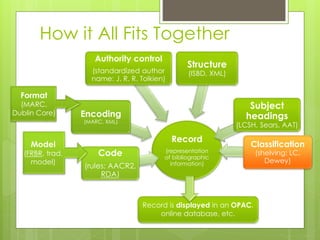
How it All Fits Together 
Record 
Authority control 
(standardized author 
name: J. R. R. Tolkien) 
(representation 
of bibliographic 
information) 
Encoding 
(MARC, XML) 
Code 
(rules: AACR2, 
RDA) 
Structure 
(ISBD, XML) 
Subject 
headings 
(LCSH, Sears, AAT) 
Classification 
(shelving: LC, 
Dewey) 
Model 
(FRBR, trad. 
model) 
Record is displayed in an OPAC, 
online database, etc. 
Format 
(MARC, 
Dublin Core)
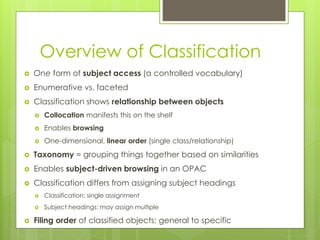
Overview of Classification 
 One form of subject access (a controlled vocabulary) 
 Enumerative vs. faceted 
 Classification shows relationship between objects 
 Collocation manifests this on the shelf 
 Enables browsing 
 One-dimensional, linear order (single class/relationship) 
 Taxonomy = grouping things together based on similarities 
 Enables subject-driven browsing in an OPAC 
 Classification differs from assigning subject headings 
 Classification: single assignment 
 Subject headings: may assign multiple 
 Filing order of classified objects: general to specific
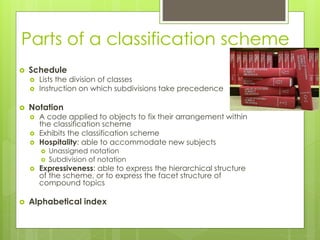
Parts of a classification scheme 
 Schedule 
 Lists the division of classes 
 Instruction on which subdivisions take precedence 
 Notation 
 A code applied to objects to fix their arrangement within 
the classification scheme 
 Exhibits the classification scheme 
 Hospitality: able to accommodate new subjects 
 Unassigned notation 
 Subdivision of notation 
 Expressiveness: able to express the hierarchical structure 
of the scheme, or to express the facet structure of 
compound topics 
 Alphabetical index
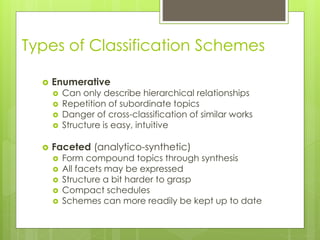
Types of Classification Schemes 
 Enumerative 
 Can only describe hierarchical relationships 
 Repetition of subordinate topics 
 Danger of cross-classification of similar works 
 Structure is easy, intuitive 
 Faceted (analytico-synthetic) 
 Form compound topics through synthesis 
 All facets may be expressed 
 Structure a bit harder to grasp 
 Compact schedules 
 Schemes can more readily be kept up to date
Dewey vs. Library of Congress 
Dewey Decimal Classification 
 DDC 
 Public libraries, school libraries 
 Enumerative 
 Indirect numeric system based on 
subject matter (rather than a shelving 
location, which is direct)—thus able 
to change shelf labels as-needed 
 10 main classes 
 Extensible, scalable (able to add new 
subjects into the system) 
 Dewey consolidated ideas of others 
(including Cutter) into one system 
 consistent subclassifications and 
mnemonics (regardless of category); 
fewer categories & subclasses 
compared to LCC 
Library of Congress 
Classification 
 LC or LCC 
 Academic libraries 
 Enumerative 
 21 main classes 
 Basics taken from Cutter's 
"Expansive Classification” 
 Subdivisions are often by 
country, rather than subject 
 more highly subdivided with 
no mnemonic/structural 
consistency between 
disciplines
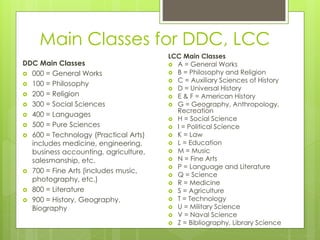
Main Classes for DDC, LCC 
DDC Main Classes 
 000 = General Works 
 100 = Philosophy 
 200 = Religion 
 300 = Social Sciences 
 400 = Languages 
 500 = Pure Sciences 
 600 = Technology (Practical Arts) 
includes medicine, engineering, 
business accounting, agriculture, 
salesmanship, etc. 
 700 = Fine Arts (includes music, 
photography, etc.) 
 800 = Literature 
 900 = History, Geography, 
Biography 
LCC Main Classes 
 A = General Works 
 B = Philosophy and Religion 
 C = Auxiliary Sciences of History 
 D = Universal History 
 E & F = American History 
 G = Geography, Anthropology, 
Recreation 
 H = Social Science 
 I = Political Science 
 K = Law 
 L = Education 
 M = Music 
 N = Fine Arts 
 P = Language and Literature 
 Q = Science 
 R = Medicine 
 S = Agriculture 
 T = Technology 
 U = Military Science 
 V = Naval Science 
 Z = Bibliography, Library Science
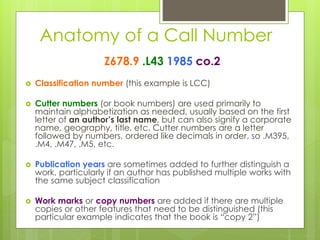
Anatomy of a Call Number 
Z678.9 .L43 1985 co.2 
 Classification number (this example is LCC) 
 Cutter numbers (or book numbers) are used primarily to 
maintain alphabetization as needed, usually based on the first 
letter of an author’s last name, but can also signify a corporate 
name, geography, title, etc. Cutter numbers are a letter 
followed by numbers, ordered like decimals in order, so .M395, 
.M4, .M47, .M5, etc. 
 Publication years are sometimes added to further distinguish a 
work, particularly if an author has published multiple works with 
the same subject classification 
 Work marks or copy numbers are added if there are multiple 
copies or other features that need to be distinguished (this 
particular example indicates that the book is “copy 2”)

LIS 653, Session 7: Classification and Categorization

  • 1.
    Classification & Categorization LIS 653 Starr Hoffman
  • 2.
    How it AllFits Together Record Authority control (standardized author name: J. R. R. Tolkien) (representation of bibliographic information) Encoding (MARC, XML) Code (rules: AACR2, RDA) Structure (ISBD, XML) Subject headings (LCSH, Sears, AAT) Classification (shelving: LC, Dewey) Model (FRBR, trad. model) Record is displayed in an OPAC, online database, etc. Format (MARC, Dublin Core)
  • 3.
    Overview of Classification  One form of subject access (a controlled vocabulary)  Enumerative vs. faceted  Classification shows relationship between objects  Collocation manifests this on the shelf  Enables browsing  One-dimensional, linear order (single class/relationship)  Taxonomy = grouping things together based on similarities  Enables subject-driven browsing in an OPAC  Classification differs from assigning subject headings  Classification: single assignment  Subject headings: may assign multiple  Filing order of classified objects: general to specific
  • 4.
    Parts of aclassification scheme  Schedule  Lists the division of classes  Instruction on which subdivisions take precedence  Notation  A code applied to objects to fix their arrangement within the classification scheme  Exhibits the classification scheme  Hospitality: able to accommodate new subjects  Unassigned notation  Subdivision of notation  Expressiveness: able to express the hierarchical structure of the scheme, or to express the facet structure of compound topics  Alphabetical index
  • 5.
    Types of ClassificationSchemes  Enumerative  Can only describe hierarchical relationships  Repetition of subordinate topics  Danger of cross-classification of similar works  Structure is easy, intuitive  Faceted (analytico-synthetic)  Form compound topics through synthesis  All facets may be expressed  Structure a bit harder to grasp  Compact schedules  Schemes can more readily be kept up to date
  • 6.
    Dewey vs. Libraryof Congress Dewey Decimal Classification  DDC  Public libraries, school libraries  Enumerative  Indirect numeric system based on subject matter (rather than a shelving location, which is direct)—thus able to change shelf labels as-needed  10 main classes  Extensible, scalable (able to add new subjects into the system)  Dewey consolidated ideas of others (including Cutter) into one system  consistent subclassifications and mnemonics (regardless of category); fewer categories & subclasses compared to LCC Library of Congress Classification  LC or LCC  Academic libraries  Enumerative  21 main classes  Basics taken from Cutter's "Expansive Classification”  Subdivisions are often by country, rather than subject  more highly subdivided with no mnemonic/structural consistency between disciplines
  • 7.
    Main Classes forDDC, LCC DDC Main Classes  000 = General Works  100 = Philosophy  200 = Religion  300 = Social Sciences  400 = Languages  500 = Pure Sciences  600 = Technology (Practical Arts) includes medicine, engineering, business accounting, agriculture, salesmanship, etc.  700 = Fine Arts (includes music, photography, etc.)  800 = Literature  900 = History, Geography, Biography LCC Main Classes  A = General Works  B = Philosophy and Religion  C = Auxiliary Sciences of History  D = Universal History  E & F = American History  G = Geography, Anthropology, Recreation  H = Social Science  I = Political Science  K = Law  L = Education  M = Music  N = Fine Arts  P = Language and Literature  Q = Science  R = Medicine  S = Agriculture  T = Technology  U = Military Science  V = Naval Science  Z = Bibliography, Library Science
  • 8.
    Anatomy of aCall Number Z678.9 .L43 1985 co.2  Classification number (this example is LCC)  Cutter numbers (or book numbers) are used primarily to maintain alphabetization as needed, usually based on the first letter of an author’s last name, but can also signify a corporate name, geography, title, etc. Cutter numbers are a letter followed by numbers, ordered like decimals in order, so .M395, .M4, .M47, .M5, etc.  Publication years are sometimes added to further distinguish a work, particularly if an author has published multiple works with the same subject classification  Work marks or copy numbers are added if there are multiple copies or other features that need to be distinguished (this particular example indicates that the book is “copy 2”)

Editor's Notes

  • #3 Bibliographic record = record with descriptive information about a work (information object) that it represents Catalog = a group of records, a list of objects in a collection Model = determines how records are organized and created in a catalog (FRBR) Cataloging codes = rules for creating catalog records (AACR2, RDA) Structure = rules that help determine the order of elements & punctuation/spacing in a record (ISBD, XML) Format = format in which a record is created and/or encoded (MARC, Dublin Core) Subject heading = terms from a topical controlled vocabulary that describe the content of a work (LCSH, Sears, AAT) Authority control = term from a controlled vocabulary chosen to uniquely identify an author, corporation, book title, or series (so that all records for one author can be accessed easily) Classification scheme = assigns a unique descriptor to a work (usually based on subject), often used to indicate a work’s physical location (LC, Dewey)
  • #4 In Dewey’s day, books fixed on shelves—he allowed for easier collection growth and patron browsing. It’s just one form of subject access Uses controlled vocabulary Natural vs. bibliographic classification Enumerative vs. faceted Classification shows relationship between objects (for the library world, this is done in terms of subject matter—combinations of topics) Collocation– aids in patron browsing One-dimensional, linear order—shelf arrangement may display only one classification/relationship at a time Taxonomy = grouping things together based on similarities Enables subject-driven browsing in an OPAC (catalog) Classification is different than subject cataloging (assigning subject headings) Filing order of classified objects: general to specific
  • #5 Schedule Lists the division of classes (main classes or primary facet, plus subdivisions or subfacets) Instruction on which subdivisions take precedence Notation A code applied to objects to fix their arrangement within the classification scheme Exhibits the classification scheme Hospitality: able to accommodate new subjects Unassigned notation Subdivision of notation Expressiveness: able to express the hierarchical structure of the scheme, or to express the facet structure of compound topics Alphabetical index
  • #7 Find (a specific work, works by a certain author, or on a certain topic) Identify (find a specific edition of a work) Select (evaluate work to determine if it meets the user need) Obtain/Access (find the object on the shelf) List (inventory all objects in the library)