Classification The Librarians’ Numbers Game or  Doing the Dewey Thing
What is Classification? Classification The process of dividing objects or  concepts into logically hierarchical  class es,  subclass es, and sub-subclasses based on the  characteristic s they have in common and those that distinguish them. Also used as a shortened form of the term  classification system  or classification scheme.  See also :  cross-classification . Online Dictionary of Library and Information Science
Classification system?  classification system  A list of  class es  arranged  according to a set of pre-established principles for the purpose of organizing  item s in a  collection , or  entries  in an  index ,  bibliography , or  catalog , into groups based on their similarities and differences, to facilitate  access  and  retrieval . In the United States, most  library collection s are classified by  subject . Classification systems can be  enumerative  or  hierarchical ,  broad  or  close . In the United States, most  public libraries  use  Dewey Decimal Classification , but  academic  and  research libraries  prefer  Library of Congress Classification .  See also :  Classification   Society of North America ,  Colon Classification , and  notation .
The  Wikipedia  version Library classification A library classification is a  system  of coding and organizing  library materials  ( books , serials, audiovisual materials, computer files,  maps ,  manuscripts ,  realia ) according to their subject. A classification consists of tables of subject headings and  classification  schedules used to assign a class number to each item being classified, based on that item's subject. Until the  19th century , most libraries had closed stacks, so the library classification only served to organize the subject  catalog . In the  20th century , libraries opened their stacks to the public and started to shelve the library material itself according to some library classification to simplify subject browsing.
More of the Wikipedia definition Library classification  (cont.) There are three main types of classification systems: enumerative : produce an alphabetical list of subject headings, assign numbers to each heading in alphabetical order  hierarchical : divides subjects hierarchically, from most general to most specific  faceted  or analytico-synthetic : divides subjects into mutually exclusive orthogonal facets
Dewey Decimal and Library of Congress Where do these systems fit? The most common classification systems, LC and DDC, are essentially enumerative, though with some hierarchical and faceted elements, especially at the broadest and most general level. The first true faceted system was the  Colon classification  of  S. R.  Ranganathan .
Library of Congress classification Library of Congress classification The Library of Congress Classification (LCC) is a system of  library classification  developed by the  Library of Congress .  The classification was originally developed by  Herbert Putnam  with the advice of  Charles  Ammi  Cutter  in  1897  before he assumed the librarianship of Congress. It was influenced by  Cutter Expansive Classification , DDC [i.e. Dewey], and was designed for the use by the Library of Congress.
More about LCC Library of Congress Classification (LCC)  A  system  of  classify ing  book s and other  library materials  developed and maintained over the last 200 years by the  Library of Congress  in Washington, D.C. In LCC, human  knowledge  is divided into 20 broad categories indicated by single  letter s of the roman  alphabet , with major  subdivision s indicated by a second letter, and narrower subdivisions by  decimal   number s  and further alphabetic  notation .   Example :  LC call number:  PE 3727.N4 M34 1994
LCC example explained LC call number:  PE 3727.N4 M34 1994 In the example given above (assigned to the book  Juba to Jive: A Dictionary of African-American Slang ,  edited  by Clarence Major), P represents the  main class  "Language and literature," PE the  class  "English language," 3727 the  subclass  "English slang," and N4 African Americans as a special group. M34 is the  Cutter number  for the  editor 's  surname  and 1994 the  year of publication .
More about LCC How to understand  LCC  call numbers The Library of Congress Classification System organizes material in libraries according to twenty-one branches of knowledge (see  here  or  here ).  The 21 categories (labeled A to Z, but missing I, O, W, X and Y) are further divided by adding one or two additional letters and a set of numbers.   (modified from the  original version  and used by  York University Libraries  with the permission of Matt Rosenberg,  Geography Guide at The Mining Co. ) [The Mining Co. is now  About.com ]
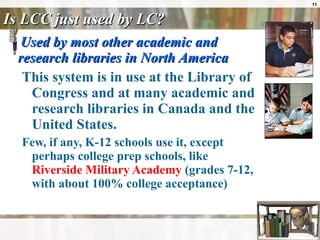
Is LCC just used by LC? Used by most other academic and research libraries in North America This system is in use at the Library of Congress and at many academic and research libraries in Canada and the United States.  Few, if any, K-12 schools use it, except perhaps college prep schools, like  Riverside Military Academy  (grades 7-12, with about 100% college acceptance)
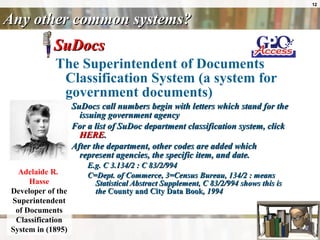
Any other common systems? SuDocs The Superintendent of Documents Classification System (a system for government documents) SuDocs call numbers begin with letters which stand for the issuing government agency  For a list of SuDoc department classification system, click  HERE .  After the department, other codes are added which represent agencies, the specific item, and date.  E.g. C 3.134/2 : C 83/2/994  C=Dept. of Commerce, 3=Census Bureau, 134/2 : means Statistical Abstract Supplement, C 83/2/994 shows this is the  County and City Data Book , 1994 Adelaide   R .  Hasse Developer of the Superintendent of Documents Classification System in (1895)
Another commonly used system Universal Decimal Classification The Universal Decimal Classification (UDC) is the world's foremost multilingual classification scheme for all fields of knowledge, a sophisticated indexing and retrieval tool. It was adapted by Paul Otlet  (1) ,  (2) ,  (3)  and Nobel Prizewinner  Henri La Fontaine  from the Decimal Classification of Melvil Dewey, and first published (in French) from 1904 to 1907. Since then, it has been extensively revised and developed, and has become a highly flexible and effective system for organizing bibliographic records for all kinds of information in any medium (it is well suited to multi-media information collections).  [ Used mostly in Europe or anglophone  countries outside North America ] What is the UDC?   See also  UDC Flyer 2001(Word document)
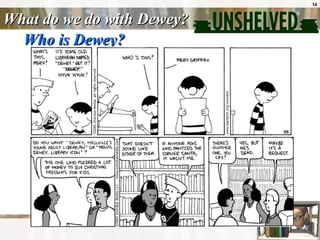
What do we do with Dewey? Who is Dewey?
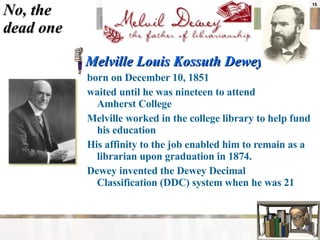
No, the  dead one Melville Louis Kossuth Dewey  born on December 10, 1851  waited until he was nineteen to attend  Amherst College  Melville worked in the college library to help fund his education  His affinity to the job enabled him to remain as a librarian upon graduation in 1874.  Dewey invented the Dewey Decimal  Classification (DDC) system when he was 21
Other accomplishments of Dewey Spelling reformer In 1876 Dewey was involved in the foundation of the Spelling Reform Association of which he was Secretary for almost all his life.  About the English language Dewey writes: “ Speling Skolars agree that we hav the most unsyentifik, unskolarli, illojikal & wasteful speling ani languaj ever ataind.”   http://www.childrenofthecode.org/code-history/dewey.htm For more information about Dewey, see  Dewey the Right Thing   Dishing the Dirt on  Melvil  Dewey, the Father of Modern Library Science
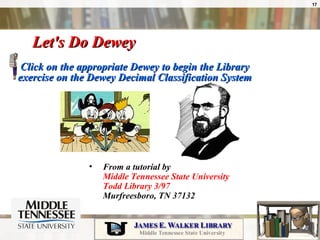
Let's Do Dewey  Click on the appropriate Dewey to begin the Library exercise on the Dewey Decimal Classification System From a tutorial by  Middle Tennessee State University  Todd Library 3/97  Murfreesboro, TN 37132
Dewey Call numbers vs. LCC What Is a Call Number?  A unique  identification  number Each book (or other item) has its own unique call number which is taped to the lower outside edge of the book's spine. The call number is also written or taped inside the book, usually on the reverse side (verso) of the title page.  A miniature  subject  formula Books written about the same subject have similar call numbers, which groups them together on the shelf, making it easier for you to browse the library's holdings on a specific topic.  A  location  code    The J. Conrad  Dunagan  Library Online
There are 2 basic parts to a call number The SUBJECT part and the AUTHOR part. In the Library of Congress Classification... Subject  - This part is made up of 2 letters plus 1 to 4 (or more) digits. Author  - This part begins with a letter that corresponds to the first letter of the author's last name, followed by a series of numbers. For example, if you had a book by Jeffrey Pfeffer entitled  The Human Equation:  Building Profits by Putting People First ,  The Library of Congress call number might be HF 5386 .P5468
In the Dewey Decimal Classification... Subject –   This part is made up of all numbers, ranging from 3 to 10 or more digits (depending on how narrowly focused the topic of the book).   Author –   This part begins with a letter that matches the first letter of the author's last name, followed by 2 or 3 numbers, and then usually another letter that matches the first letter of the first word of the title.   For the book by Jeffrey Pfeffer entitled  The Human Equation: Building Profits by Putting People First : The Dewey call number might be 658.314 P524h     http://www.emu.edu/library/tutorials/Tutorial_dist/Mod1Bdewey.htm
How do these numbers work? Library of Congress:  HF = The section for books about commerce  5386 = Books about success in business .P5468 = Represents the author's last name  Dewey:  658.314 = The number for books about motivating employees P524h = P524 stands for the author's last name (Pfeffer); "h" for the first word of the title (Human)   Adapted from  Making Call Numbers Work For You
How DDC works Organization of knowledge The DDC attempts to organize all knowledge into ten main classes that, excluding the first class (000 Computers, information and general reference), proceed from the divine (philosophy & religion) to the mundane (history & geography). DDC's cleverness is in choosing  decimals  for its categories; this allows it to be both purely numerical and infinitely hierarchical.
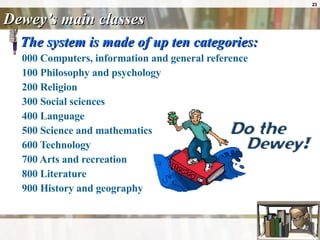
Dewey’s main classes The system is made of up ten categories: 000 Computers, information and general reference  100 Philosophy and psychology  200 Religion  300 Social sciences  400 Language  500 Science and mathematics  600 Technology  700 Arts and recreation  800 Literature  900 History and geography
Subdividing from the main classes From the general to the specific: Each of the above classes each have  ten divisions .  These divisions are further divided--and then further divided. Each division becomes more specific. The more numbers, the more specific the subject. In this way, the Dewey classification system progresses from the general to the specific. For a detailed summary for each number see the  Dewey Decimal Classification System .  The decimal place is used to make the number even more specific.   Let’s do Dewey
Try catching a butterfly with Dewey! Start with the class for natural sciences, the 500’s   This means that the first number of the call number will be a 5  The 10 divisions of the 500 class are: 510 Mathematics  520 Astronomy  530 Physics  540 Chemistry  550 Earth Sciences  560 Paleontology  570 Life Sciences  580 Botanical Sciences  590 Zoological Sciences   From Let's Do Dewey ,   What is a call number?
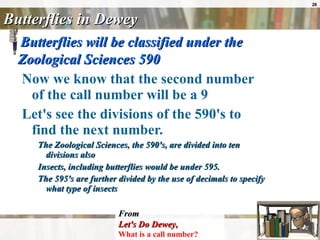
Butterflies in Dewey Butterflies will be classified under the Zoological Sciences 590   Now we know that the second number of the call number will be a 9  Let's see the divisions of the 590's to find the next number.   The Zoological Sciences, the 590's, are divided into ten divisions also  Insects, including butterflies would be under 595.  The 595's are further divided by the use of decimals to specify what type of insects   From Let's Do Dewey ,   What is a call number?
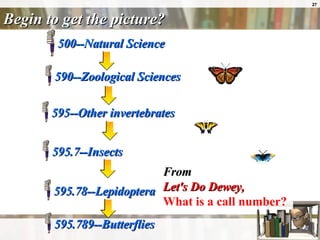
Begin to get the picture? 500--Natural Science   590--Zoological Sciences  595--Other invertebrates  595.7--Insects  595.78--Lepidoptera  595.789--Butterflies  From Let's Do Dewey ,   What is a call number?
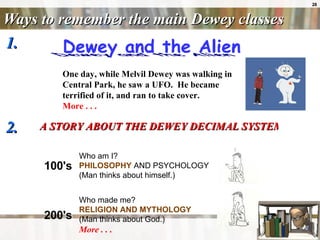
Ways to remember the main Dewey classes 1.  2.  A STORY ABOUT THE DEWEY DECIMAL SYSTEM OF CLASSIFICATION  One day, while Melvil Dewey was walking in Central Park, he saw a UFO.  He became terrified of it, and ran to take cover. More . . .                      Who made me?  RELIGION AND MYTHOLOGY  (Man thinks about God.) More . . .   200's                     Who am I?  PHILOSOPHY  AND PSYCHOLOGY  (Man thinks about himself.) 100's
Anatomy of a Dewey call number The  Size Designation  relates to the physical size of the book  [ not all libraries use this; the letter here might also indicate a special location, e.g. R=reference ] Q=quarto The  Dewey Decimal Number  indicates the subject matter of the book,  The  Cutter Number  identifies who wrote the book, and  The  Work Mark  distinguishes multiple works by the same author. [ Again, not all libraries will use this, and they may do  it differently ]  Adapted from  Dewey Decimal in the UIUC  Bookstacks
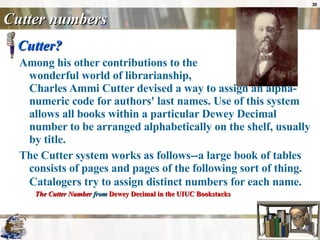
Cutter numbers Cutter?  Among his other contributions to the  wonderful world of librarianship,  Charles Ammi Cutter devised a way to assign an alpha-numeric code for authors' last names. Use of this system allows all books within a particular Dewey Decimal number to be arranged alphabetically on the shelf, usually by title.  The Cutter system works as follows--a large book of tables consists of pages and pages of the following sort of thing. Catalogers try to assign distinct numbers for each name.   The Cutter Number  from  Dewey Decimal in the UIUC  Bookstacks
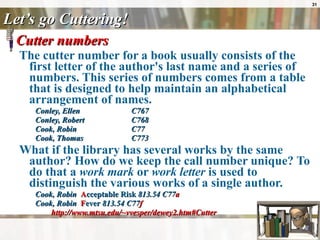
Let’s go Cuttering! Cutter numbers  The cutter number for a book usually consists of the first letter of the author's last name and a series of numbers. This series of numbers comes from a table that is designed to help maintain an alphabetical arrangement of names. Conley, Ellen C767  Conley, Robert  C768  Cook, Robin  C77  Cook, Thomas  C773 What if the library has several works by the same author? How do we keep the call number unique? To do that a  work mark  or  work letter  is used to distinguish the various works of a single author.  Cook, Robin  A cceptable Risk  813.54 C77 a   Cook, Robin  F ever  813.54 C77 f   http://www.mtsu.edu/~vvesper/dewey2.htm#Cutter
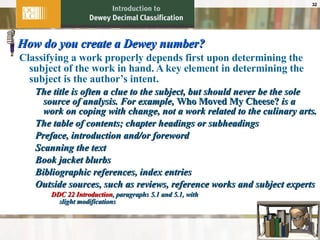
How do you create a Dewey number? Classifying a work properly depends first upon determining the subject of the work in hand. A key element in determining the subject is the author’s intent. The title is often a clue to the subject, but should never be the sole source of analysis. For example,  Who Moved My Cheese?  is a work on coping with change, not a work related to the culinary arts. The table of contents; chapter headings or subheadings Preface, introduction and/or foreword Scanning the text Book jacket blurbs Bibliographic references, index entries Outside sources, such as reviews, reference works and subject experts DDC 22 Introduction , paragraphs 5.1 and 5.1, with  slight modifications
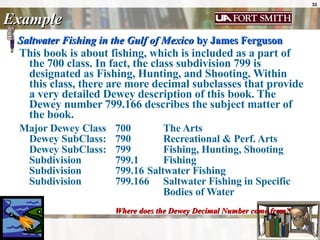
Example Saltwater Fishing in the Gulf of Mexico  by James Ferguson   This book is about fishing, which is included as a part of the 700 class. In fact, the class subdivision 799 is designated as Fishing, Hunting, and Shooting. Within this class, there are more decimal subclasses that provide a very detailed Dewey description of this book. The Dewey number 799.166 describes the subject matter of the book.   Major Dewey Class 700  The Arts  Dewey SubClass:  790 Recreational & Perf. Arts  Dewey SubClass:  799  Fishing, Hunting, Shooting  Subdivision  799.1  Fishing  Subdivision  799.16  Saltwater Fishing  Subdivision  799.166  Saltwater Fishing in Specific  Bodies of Water  Where does the Dewey Decimal Number come from?
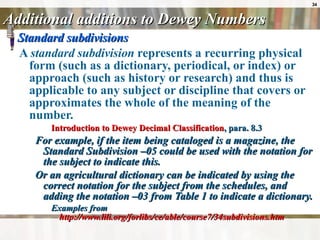
Additional additions to Dewey Numbers Standard subdivisions A  standard subdivision  represents a recurring physical form (such as a dictionary, periodical, or index) or approach (such as history or research) and thus is applicable to any subject or discipline that covers or approximates the whole of the meaning of the number. Introduction to Dewey Decimal Classification , para. 8.3 For example, if the item being cataloged is a magazine, the Standard Subdivision –05 could be used with the notation for the subject to indicate this.  Or an agricultural dictionary can be indicated by using the correct notation for the subject from the schedules, and adding the notation –03 from Table 1 to indicate a dictionary.  Examples from  http://www.lili.org/forlibs/ce/able/course7/34subdivisions.htm
Other examples of Standard Subdivisions 150.5  Periodical  on psychology 230.003  Dictionary  of Christianity 340.02573  Directory  of lawyers in the U.S. 401  Philosophy  of language 507.8  Use of apparatus and equipment in  the   study and teaching  of science, e.g.,  science fair projects 624.0285  Computer applications  in civil  engineering 796.912092  Biography  of a figure skater 808.0071  Teaching  of rhetoric Some examples have added 0, because of instructions in schedules Introduction to DDC , para. 8.3
Where do you find these subdivisions? In schedules or Table 1 Standard subdivisions may be listed in the schedules when the subdivisions have special meanings, when extended notation is required for the topic in question, or when notes are required. The rest of standard subdivisions from Table 1 may be used with their regular meanings. DDC Introduction , para. 8.4
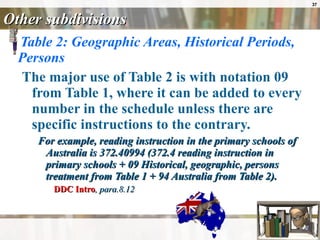
Other subdivisions Table 2: Geographic Areas, Historical Periods, Persons The major use of Table 2 is with notation 09 from Table 1, where it can be added to every number in the schedule unless there are specific instructions to the contrary. For example, reading instruction in the primary schools of Australia is 372.40994 (372.4 reading instruction in primary schools + 09 Historical, geographic, persons treatment from Table 1 + 94 Australia from Table 2). DDC Intro , para.8.12
Tables 3-6 Table 3 Subdivisions for the Arts, for Individual Literatures, for Specific Literary Forms These subdivisions are used in class 800 as instructed Table 4  Subdivisions of Individual Languages and Language Families These subdivisions are used as instructed in class 400, following numbers for designated specific languages or language families in 420 – 490 Table 5 Ethnic and National Groups May only be added when specified in a note Table 6 Languages The major uses of Table 6 notation are to provide the basis for building a specific language number in 490 . . . and to provide the basis for building a specific literature number in 890. DDC Intro , paras 8.14-8.18
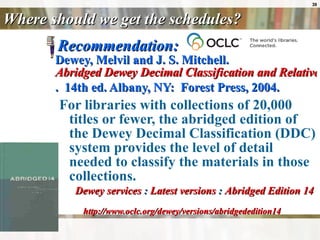
Where should we get the schedules? Recommendation: Dewey, Melvil and J. S. Mitchell.    Abridged Dewey Decimal Classification and Relative Index .  14th ed. Albany, NY:  Forest Press, 2004.   For libraries with collections of 20,000 titles or fewer, the abridged edition of the Dewey Decimal Classification (DDC) system provides the level of detail needed to classify the materials in those collections.  Dewey services  :  Latest versions  :  Abridged Edition 14  http://www.oclc.org/dewey/versions/abridgededition14
Is it available online? Abridged WebDewey Abridged WebDewey gives you access to  an enhanced version of the Abridged 14 database.  Abridged   WebDewey is available on an annual subscription basis, according to [ this table ]. You may start your subscription at any time of year. If your library has more than 20,000 items in its collection, you may want to consider  WebDewey . Let our tutorial show you how WebDewey works!  Using  WebDewey : An OCLC Tutorial
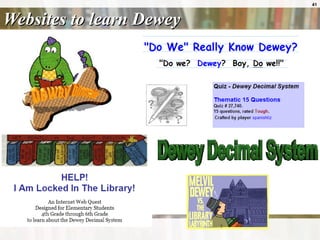
Websites to learn Dewey

Classification 1207530467697071 9

  • 1.
    Classification The Librarians’Numbers Game or Doing the Dewey Thing
  • 2.
    What is Classification?Classification The process of dividing objects or concepts into logically hierarchical class es, subclass es, and sub-subclasses based on the characteristic s they have in common and those that distinguish them. Also used as a shortened form of the term classification system or classification scheme. See also : cross-classification . Online Dictionary of Library and Information Science
  • 3.
    Classification system? classification system A list of class es arranged according to a set of pre-established principles for the purpose of organizing item s in a collection , or entries in an index , bibliography , or catalog , into groups based on their similarities and differences, to facilitate access and retrieval . In the United States, most library collection s are classified by subject . Classification systems can be enumerative or hierarchical , broad or close . In the United States, most public libraries use Dewey Decimal Classification , but academic and research libraries prefer Library of Congress Classification . See also : Classification Society of North America , Colon Classification , and notation .
  • 4.
    The Wikipedia version Library classification A library classification is a system of coding and organizing library materials ( books , serials, audiovisual materials, computer files, maps , manuscripts , realia ) according to their subject. A classification consists of tables of subject headings and classification schedules used to assign a class number to each item being classified, based on that item's subject. Until the 19th century , most libraries had closed stacks, so the library classification only served to organize the subject catalog . In the 20th century , libraries opened their stacks to the public and started to shelve the library material itself according to some library classification to simplify subject browsing.
  • 5.
    More of theWikipedia definition Library classification (cont.) There are three main types of classification systems: enumerative : produce an alphabetical list of subject headings, assign numbers to each heading in alphabetical order hierarchical : divides subjects hierarchically, from most general to most specific faceted or analytico-synthetic : divides subjects into mutually exclusive orthogonal facets
  • 6.
    Dewey Decimal andLibrary of Congress Where do these systems fit? The most common classification systems, LC and DDC, are essentially enumerative, though with some hierarchical and faceted elements, especially at the broadest and most general level. The first true faceted system was the Colon classification of S. R. Ranganathan .
  • 7.
    Library of Congressclassification Library of Congress classification The Library of Congress Classification (LCC) is a system of library classification developed by the Library of Congress . The classification was originally developed by Herbert Putnam with the advice of Charles Ammi Cutter in 1897 before he assumed the librarianship of Congress. It was influenced by Cutter Expansive Classification , DDC [i.e. Dewey], and was designed for the use by the Library of Congress.
  • 8.
    More about LCCLibrary of Congress Classification (LCC) A system of classify ing book s and other library materials developed and maintained over the last 200 years by the Library of Congress in Washington, D.C. In LCC, human knowledge is divided into 20 broad categories indicated by single letter s of the roman alphabet , with major subdivision s indicated by a second letter, and narrower subdivisions by decimal number s and further alphabetic notation . Example : LC call number: PE 3727.N4 M34 1994
  • 9.
    LCC example explainedLC call number: PE 3727.N4 M34 1994 In the example given above (assigned to the book Juba to Jive: A Dictionary of African-American Slang , edited by Clarence Major), P represents the main class "Language and literature," PE the class "English language," 3727 the subclass "English slang," and N4 African Americans as a special group. M34 is the Cutter number for the editor 's surname and 1994 the year of publication .
  • 10.
    More about LCCHow to understand LCC call numbers The Library of Congress Classification System organizes material in libraries according to twenty-one branches of knowledge (see here or here ). The 21 categories (labeled A to Z, but missing I, O, W, X and Y) are further divided by adding one or two additional letters and a set of numbers. (modified from the original version and used by York University Libraries with the permission of Matt Rosenberg, Geography Guide at The Mining Co. ) [The Mining Co. is now About.com ]
  • 11.
    Is LCC justused by LC? Used by most other academic and research libraries in North America This system is in use at the Library of Congress and at many academic and research libraries in Canada and the United States. Few, if any, K-12 schools use it, except perhaps college prep schools, like Riverside Military Academy (grades 7-12, with about 100% college acceptance)
  • 12.
    Any other commonsystems? SuDocs The Superintendent of Documents Classification System (a system for government documents) SuDocs call numbers begin with letters which stand for the issuing government agency For a list of SuDoc department classification system, click HERE . After the department, other codes are added which represent agencies, the specific item, and date. E.g. C 3.134/2 : C 83/2/994 C=Dept. of Commerce, 3=Census Bureau, 134/2 : means Statistical Abstract Supplement, C 83/2/994 shows this is the County and City Data Book , 1994 Adelaide R . Hasse Developer of the Superintendent of Documents Classification System in (1895)
  • 13.
    Another commonly usedsystem Universal Decimal Classification The Universal Decimal Classification (UDC) is the world's foremost multilingual classification scheme for all fields of knowledge, a sophisticated indexing and retrieval tool. It was adapted by Paul Otlet (1) , (2) , (3) and Nobel Prizewinner Henri La Fontaine from the Decimal Classification of Melvil Dewey, and first published (in French) from 1904 to 1907. Since then, it has been extensively revised and developed, and has become a highly flexible and effective system for organizing bibliographic records for all kinds of information in any medium (it is well suited to multi-media information collections). [ Used mostly in Europe or anglophone countries outside North America ] What is the UDC? See also UDC Flyer 2001(Word document)
  • 14.
    What do wedo with Dewey? Who is Dewey?
  • 15.
    No, the dead one Melville Louis Kossuth Dewey born on December 10, 1851 waited until he was nineteen to attend Amherst College Melville worked in the college library to help fund his education His affinity to the job enabled him to remain as a librarian upon graduation in 1874. Dewey invented the Dewey Decimal Classification (DDC) system when he was 21
  • 16.
    Other accomplishments ofDewey Spelling reformer In 1876 Dewey was involved in the foundation of the Spelling Reform Association of which he was Secretary for almost all his life. About the English language Dewey writes: “ Speling Skolars agree that we hav the most unsyentifik, unskolarli, illojikal & wasteful speling ani languaj ever ataind.” http://www.childrenofthecode.org/code-history/dewey.htm For more information about Dewey, see Dewey the Right Thing Dishing the Dirt on Melvil Dewey, the Father of Modern Library Science
  • 17.
    Let's Do Dewey Click on the appropriate Dewey to begin the Library exercise on the Dewey Decimal Classification System From a tutorial by Middle Tennessee State University Todd Library 3/97 Murfreesboro, TN 37132
  • 18.
    Dewey Call numbersvs. LCC What Is a Call Number? A unique identification number Each book (or other item) has its own unique call number which is taped to the lower outside edge of the book's spine. The call number is also written or taped inside the book, usually on the reverse side (verso) of the title page. A miniature subject formula Books written about the same subject have similar call numbers, which groups them together on the shelf, making it easier for you to browse the library's holdings on a specific topic. A location code The J. Conrad Dunagan Library Online
  • 19.
    There are 2basic parts to a call number The SUBJECT part and the AUTHOR part. In the Library of Congress Classification... Subject - This part is made up of 2 letters plus 1 to 4 (or more) digits. Author - This part begins with a letter that corresponds to the first letter of the author's last name, followed by a series of numbers. For example, if you had a book by Jeffrey Pfeffer entitled The Human Equation: Building Profits by Putting People First , The Library of Congress call number might be HF 5386 .P5468
  • 20.
    In the DeweyDecimal Classification... Subject – This part is made up of all numbers, ranging from 3 to 10 or more digits (depending on how narrowly focused the topic of the book). Author – This part begins with a letter that matches the first letter of the author's last name, followed by 2 or 3 numbers, and then usually another letter that matches the first letter of the first word of the title. For the book by Jeffrey Pfeffer entitled The Human Equation: Building Profits by Putting People First : The Dewey call number might be 658.314 P524h http://www.emu.edu/library/tutorials/Tutorial_dist/Mod1Bdewey.htm
  • 21.
    How do thesenumbers work? Library of Congress: HF = The section for books about commerce 5386 = Books about success in business .P5468 = Represents the author's last name Dewey: 658.314 = The number for books about motivating employees P524h = P524 stands for the author's last name (Pfeffer); "h" for the first word of the title (Human) Adapted from Making Call Numbers Work For You
  • 22.
    How DDC worksOrganization of knowledge The DDC attempts to organize all knowledge into ten main classes that, excluding the first class (000 Computers, information and general reference), proceed from the divine (philosophy & religion) to the mundane (history & geography). DDC's cleverness is in choosing decimals for its categories; this allows it to be both purely numerical and infinitely hierarchical.
  • 23.
    Dewey’s main classesThe system is made of up ten categories: 000 Computers, information and general reference 100 Philosophy and psychology 200 Religion 300 Social sciences 400 Language 500 Science and mathematics 600 Technology 700 Arts and recreation 800 Literature 900 History and geography
  • 24.
    Subdividing from themain classes From the general to the specific: Each of the above classes each have ten divisions . These divisions are further divided--and then further divided. Each division becomes more specific. The more numbers, the more specific the subject. In this way, the Dewey classification system progresses from the general to the specific. For a detailed summary for each number see the Dewey Decimal Classification System . The decimal place is used to make the number even more specific. Let’s do Dewey
  • 25.
    Try catching abutterfly with Dewey! Start with the class for natural sciences, the 500’s This means that the first number of the call number will be a 5 The 10 divisions of the 500 class are: 510 Mathematics 520 Astronomy 530 Physics 540 Chemistry 550 Earth Sciences 560 Paleontology 570 Life Sciences 580 Botanical Sciences 590 Zoological Sciences From Let's Do Dewey , What is a call number?
  • 26.
    Butterflies in DeweyButterflies will be classified under the Zoological Sciences 590 Now we know that the second number of the call number will be a 9 Let's see the divisions of the 590's to find the next number.  The Zoological Sciences, the 590's, are divided into ten divisions also Insects, including butterflies would be under 595. The 595's are further divided by the use of decimals to specify what type of insects From Let's Do Dewey , What is a call number?
  • 27.
    Begin to getthe picture? 500--Natural Science 590--Zoological Sciences 595--Other invertebrates 595.7--Insects 595.78--Lepidoptera 595.789--Butterflies From Let's Do Dewey , What is a call number?
  • 28.
    Ways to rememberthe main Dewey classes 1. 2. A STORY ABOUT THE DEWEY DECIMAL SYSTEM OF CLASSIFICATION One day, while Melvil Dewey was walking in Central Park, he saw a UFO.  He became terrified of it, and ran to take cover. More . . .                     Who made me? RELIGION AND MYTHOLOGY (Man thinks about God.) More . . . 200's                     Who am I? PHILOSOPHY AND PSYCHOLOGY (Man thinks about himself.) 100's
  • 29.
    Anatomy of aDewey call number The Size Designation relates to the physical size of the book [ not all libraries use this; the letter here might also indicate a special location, e.g. R=reference ] Q=quarto The Dewey Decimal Number indicates the subject matter of the book, The Cutter Number identifies who wrote the book, and The Work Mark distinguishes multiple works by the same author. [ Again, not all libraries will use this, and they may do it differently ] Adapted from Dewey Decimal in the UIUC Bookstacks
  • 30.
    Cutter numbers Cutter? Among his other contributions to the wonderful world of librarianship, Charles Ammi Cutter devised a way to assign an alpha-numeric code for authors' last names. Use of this system allows all books within a particular Dewey Decimal number to be arranged alphabetically on the shelf, usually by title. The Cutter system works as follows--a large book of tables consists of pages and pages of the following sort of thing. Catalogers try to assign distinct numbers for each name. The Cutter Number from Dewey Decimal in the UIUC Bookstacks
  • 31.
    Let’s go Cuttering!Cutter numbers The cutter number for a book usually consists of the first letter of the author's last name and a series of numbers. This series of numbers comes from a table that is designed to help maintain an alphabetical arrangement of names. Conley, Ellen C767 Conley, Robert C768 Cook, Robin C77 Cook, Thomas C773 What if the library has several works by the same author? How do we keep the call number unique? To do that a work mark or work letter is used to distinguish the various works of a single author. Cook, Robin A cceptable Risk 813.54 C77 a Cook, Robin F ever 813.54 C77 f http://www.mtsu.edu/~vvesper/dewey2.htm#Cutter
  • 32.
    How do youcreate a Dewey number? Classifying a work properly depends first upon determining the subject of the work in hand. A key element in determining the subject is the author’s intent. The title is often a clue to the subject, but should never be the sole source of analysis. For example, Who Moved My Cheese? is a work on coping with change, not a work related to the culinary arts. The table of contents; chapter headings or subheadings Preface, introduction and/or foreword Scanning the text Book jacket blurbs Bibliographic references, index entries Outside sources, such as reviews, reference works and subject experts DDC 22 Introduction , paragraphs 5.1 and 5.1, with slight modifications
  • 33.
    Example Saltwater Fishingin the Gulf of Mexico by James Ferguson This book is about fishing, which is included as a part of the 700 class. In fact, the class subdivision 799 is designated as Fishing, Hunting, and Shooting. Within this class, there are more decimal subclasses that provide a very detailed Dewey description of this book. The Dewey number 799.166 describes the subject matter of the book. Major Dewey Class 700 The Arts Dewey SubClass: 790 Recreational & Perf. Arts Dewey SubClass: 799 Fishing, Hunting, Shooting Subdivision 799.1 Fishing Subdivision 799.16 Saltwater Fishing Subdivision 799.166 Saltwater Fishing in Specific Bodies of Water Where does the Dewey Decimal Number come from?
  • 34.
    Additional additions toDewey Numbers Standard subdivisions A standard subdivision represents a recurring physical form (such as a dictionary, periodical, or index) or approach (such as history or research) and thus is applicable to any subject or discipline that covers or approximates the whole of the meaning of the number. Introduction to Dewey Decimal Classification , para. 8.3 For example, if the item being cataloged is a magazine, the Standard Subdivision –05 could be used with the notation for the subject to indicate this. Or an agricultural dictionary can be indicated by using the correct notation for the subject from the schedules, and adding the notation –03 from Table 1 to indicate a dictionary. Examples from http://www.lili.org/forlibs/ce/able/course7/34subdivisions.htm
  • 35.
    Other examples ofStandard Subdivisions 150.5 Periodical on psychology 230.003 Dictionary of Christianity 340.02573 Directory of lawyers in the U.S. 401 Philosophy of language 507.8 Use of apparatus and equipment in the study and teaching of science, e.g., science fair projects 624.0285 Computer applications in civil engineering 796.912092 Biography of a figure skater 808.0071 Teaching of rhetoric Some examples have added 0, because of instructions in schedules Introduction to DDC , para. 8.3
  • 36.
    Where do youfind these subdivisions? In schedules or Table 1 Standard subdivisions may be listed in the schedules when the subdivisions have special meanings, when extended notation is required for the topic in question, or when notes are required. The rest of standard subdivisions from Table 1 may be used with their regular meanings. DDC Introduction , para. 8.4
  • 37.
    Other subdivisions Table2: Geographic Areas, Historical Periods, Persons The major use of Table 2 is with notation 09 from Table 1, where it can be added to every number in the schedule unless there are specific instructions to the contrary. For example, reading instruction in the primary schools of Australia is 372.40994 (372.4 reading instruction in primary schools + 09 Historical, geographic, persons treatment from Table 1 + 94 Australia from Table 2). DDC Intro , para.8.12
  • 38.
    Tables 3-6 Table3 Subdivisions for the Arts, for Individual Literatures, for Specific Literary Forms These subdivisions are used in class 800 as instructed Table 4 Subdivisions of Individual Languages and Language Families These subdivisions are used as instructed in class 400, following numbers for designated specific languages or language families in 420 – 490 Table 5 Ethnic and National Groups May only be added when specified in a note Table 6 Languages The major uses of Table 6 notation are to provide the basis for building a specific language number in 490 . . . and to provide the basis for building a specific literature number in 890. DDC Intro , paras 8.14-8.18
  • 39.
    Where should weget the schedules? Recommendation: Dewey, Melvil and J. S. Mitchell.  Abridged Dewey Decimal Classification and Relative Index .  14th ed. Albany, NY:  Forest Press, 2004. For libraries with collections of 20,000 titles or fewer, the abridged edition of the Dewey Decimal Classification (DDC) system provides the level of detail needed to classify the materials in those collections. Dewey services : Latest versions : Abridged Edition 14 http://www.oclc.org/dewey/versions/abridgededition14
  • 40.
    Is it availableonline? Abridged WebDewey Abridged WebDewey gives you access to an enhanced version of the Abridged 14 database. Abridged WebDewey is available on an annual subscription basis, according to [ this table ]. You may start your subscription at any time of year. If your library has more than 20,000 items in its collection, you may want to consider WebDewey . Let our tutorial show you how WebDewey works! Using WebDewey : An OCLC Tutorial
  • 41.