Classification Challenge
C L A S S I F I C AT I O N P R A C T I C E : U N I V E R S I T Y O F
SUSSEX
T I M H A I L L AY A N D A N N E T T E M O O R E
NOVEMBER 2013
Overview of the Workshop
 Classification systems: comparison of Dewey

Decimal Classification (DDC), Universal Decimal
Classification (UDC) and Library of Congress
(LCC)
 Library of Congress Classification at the University
of Sussex
 Practical experience of creating Library of
Congress / Sussex call numbers
 Use of classification schemes in organizing the
Web
Classification Systems: DDC, UDC and LCC

Library classification:
“System of arrangement adopted by a library to enable patrons to find its
materials quickly and easily. While cataloguing provides information on the
physical and topical nature of the book (or other item), classification, through
assignment of a call number (consisting of class designation and author
representation), locates the item in its library setting and, ideally, in the
realm of knowledge. Arranging similar things in some order according to
some principle unites and controls information from various sources.”
Encyclopaedia Britannica , 2013. Encyclopaedia Britannica Online. [online] Available through:
http://www.britannica.com/EBchecked/topic/339461/library-classification [Accessed 22 October
2013]
Classification Systems: DDC, UDC and LCC
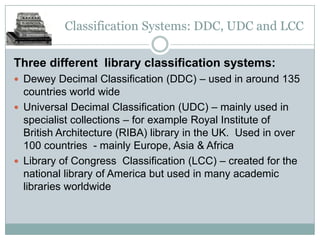
Types of classification:
 Hierarchical classification is based on the division of subjects from

the most general to the most specific
 Enumerative classification attempts to spell out all the single and
composite subject concepts required.
 Faceted classification lists numbers for single concepts and allows
the classifier to construct numbers for composite subjects.
Faceted classification schemes are sometimes referred to as
„analytico-synthetic‟ systems in technical terms. The tem refers to
the two main activities involved in Faceted classification: analysis
of subject into facets and synthesis of the facets to create a
notation.
Classification Systems: DDC, UDC and LCC
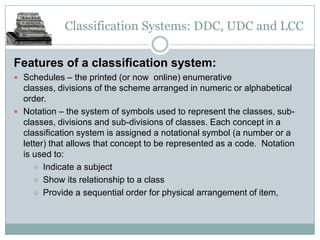
Three different library classification systems:
 Dewey Decimal Classification (DDC) – used in around 135

countries world wide
 Universal Decimal Classification (UDC) – mainly used in
specialist collections – for example Royal Institute of
British Architecture (RIBA) library in the UK. Used in over
100 countries - mainly Europe, Asia & Africa
 Library of Congress Classification (LCC) – created for the
national library of America but used in many academic
libraries worldwide
Classification Systems: DDC, UDC and LCC
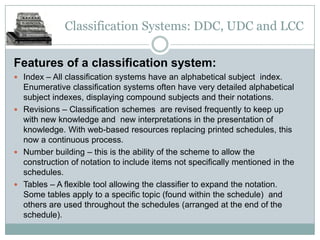
Features of a classification system:
 Schedules – the printed (or now online) enumerative

classes, divisions of the scheme arranged in numeric or alphabetical
order.
 Notation – the system of symbols used to represent the classes, subclasses, divisions and sub-divisions of classes. Each concept in a
classification system is assigned a notational symbol (a number or a
letter) that allows that concept to be represented as a code. Notation
is used to:
 Indicate a subject
 Show its relationship to a class
 Provide a sequential order for physical arrangement of item,
Classification Systems: DDC, UDC and LCC
Features of a classification system:
 Index – All classification systems have an alphabetical subject index.

Enumerative classification systems often have very detailed alphabetical
subject indexes, displaying compound subjects and their notations.
 Revisions – Classification schemes are revised frequently to keep up
with new knowledge and new interpretations in the presentation of
knowledge. With web-based resources replacing printed schedules, this
now a continuous process.
 Number building – this is the ability of the scheme to allow the
construction of notation to include items not specifically mentioned in the
schedules.
 Tables – A flexible tool allowing the classifier to expand the notation.
Some tables apply to a specific topic (found within the schedule) and
others are used throughout the schedules (arranged at the end of the
schedule).
Classification Systems: DDC, UDC and LCC
Features of a classification system:
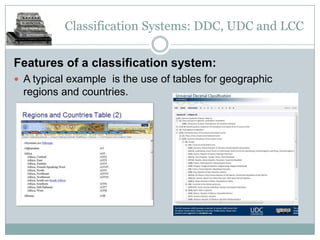
 A typical example is the use of tables for geographic

regions and countries.
Classification Systems: DDC, UDC and LCC
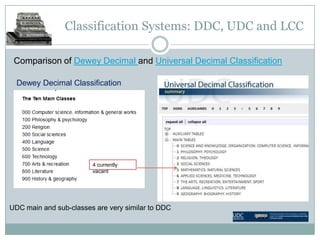
Comparison of Dewey Decimal and Universal Decimal Classification
Dewey Decimal Classification

4 currently
vacant

UDC main and sub-classes are very similar to DDC
Classification Systems: DDC, UDC and LCC
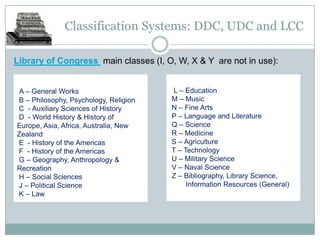
Library of Congress main classes (I, O, W, X & Y are not in use):
A – General Works
B – Philosophy, Psychology, Religion
C - Auxiliary Sciences of History
D - World History & History of
Europe, Asia, Africa, Australia, New
Zealand
E - History of the Americas
F - History of the Americas
G – Geography, Anthropology &
Recreation
H – Social Sciences
J – Political Science
K – Law

L – Education
M – Music
N – Fine Arts
P – Language and Literature
Q – Science
R – Medicine
S – Agriculture
T – Technology
U – Military Science
V – Naval Science
Z – Bibliography, Library Science,
Information Resources (General)
Classification Systems: DDC, UDC and LCC
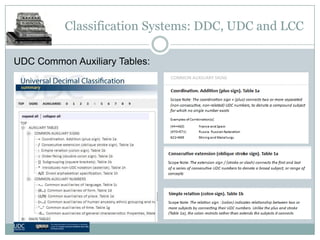
UDC Common Auxiliary Tables:
Classification Systems: DDC, UDC and LCC
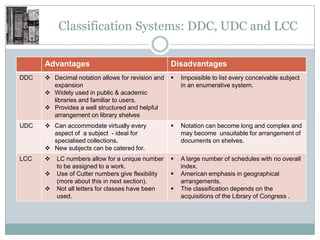
Advantages

Disadvantages

DDC

 Decimal notation allows for revision and
expansion
 Widely used in public & academic
libraries and familiar to users.
 Provides a well structured and helpful
arrangement on library shelves



Impossible to list every conceivable subject
in an enumerative system.

UDC

 Can accommodate virtually every
aspect of a subject - ideal for
specialised collections.
 New subjects can be catered for.



Notation can become long and complex and
may become unsuitable for arrangement of
documents on shelves.

LCC





A large number of schedules with no overall
index.
American emphasis in geographical
arrangements.
The classification depends on the
acquisitions of the Library of Congress .




LC numbers allow for a unique number
to be assigned to a work.
Use of Cutter numbers give flexibility
(more about this in next section).
Not all letters for classes have been
used.



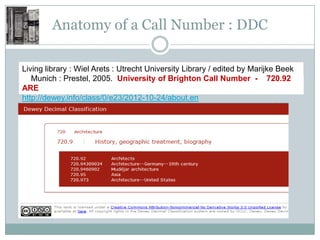
Anatomy of a Call Number : DDC
Living library : Wiel Arets : Utrecht University Library / order by Marijke Beek
of publication, numerical edited
Munich : Prestel, 2005. University of Brighton Call Number - 720.92
ARE
http://dewey.info/class/0/e23/2012-10-24/about.en
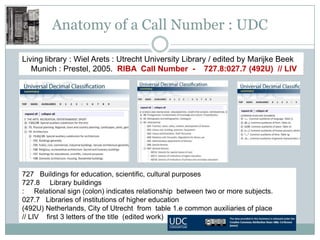
Anatomy of a Call Number : UDC
Living library : Wiel Arets : Utrecht University Library / edited by Marijke Beek
Munich : Prestel, 2005. RIBA Call Number - 727.8:027.7 (492U) // LIV
of publication, numerical order

727 Buildings for education, scientific, cultural purposes
727.8 Library buildings
: Relational sign (colon) indicates relationship between two or more subjects.
027.7 Libraries of institutions of higher education
(492U) Netherlands, City of Utrecht from table 1.e common auxiliaries of place
// LIV first 3 letters of the title (edited work)
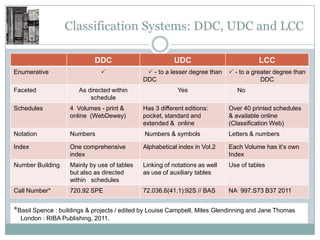
Classification Systems: DDC, UDC and LCC
DDC

UDC

LCC



 - to a lesser degree than
DDC

 - to a greater degree than
DDC

As directed within
schedule

Yes

Enumerative
Faceted

No

Schedules

4 Volumes - print &
online (WebDewey)

Has 3 different editions:
pocket, standard and
extended & online

Over 40 printed schedules
& available online
(Classification Web)

Notation

Numbers

Numbers & symbols

Letters & numbers

Index

One comprehensive
index

Alphabetical index in Vol.2

Each Volume has it‟s own
Index

Number Building

Mainly by use of tables
but also as directed
within schedules

Linking of notations as well
as use of auxiliary tables

Use of tables

Call Number*

720.92 SPE

72.036.6(41.1):92S // BAS

NA 997.S73 B37 2011

*Basil Spence : buildings & projects / edited by Louise Campbell, Miles Glendinning and Jane Thomas
London : RIBA Publishing, 2011.

Classification challenge part I

  • 1.
    Classification Challenge C LA S S I F I C AT I O N P R A C T I C E : U N I V E R S I T Y O F SUSSEX T I M H A I L L AY A N D A N N E T T E M O O R E NOVEMBER 2013
  • 2.
    Overview of theWorkshop  Classification systems: comparison of Dewey Decimal Classification (DDC), Universal Decimal Classification (UDC) and Library of Congress (LCC)  Library of Congress Classification at the University of Sussex  Practical experience of creating Library of Congress / Sussex call numbers  Use of classification schemes in organizing the Web
  • 3.
    Classification Systems: DDC,UDC and LCC Library classification: “System of arrangement adopted by a library to enable patrons to find its materials quickly and easily. While cataloguing provides information on the physical and topical nature of the book (or other item), classification, through assignment of a call number (consisting of class designation and author representation), locates the item in its library setting and, ideally, in the realm of knowledge. Arranging similar things in some order according to some principle unites and controls information from various sources.” Encyclopaedia Britannica , 2013. Encyclopaedia Britannica Online. [online] Available through: http://www.britannica.com/EBchecked/topic/339461/library-classification [Accessed 22 October 2013]
  • 4.
    Classification Systems: DDC,UDC and LCC Types of classification:  Hierarchical classification is based on the division of subjects from the most general to the most specific  Enumerative classification attempts to spell out all the single and composite subject concepts required.  Faceted classification lists numbers for single concepts and allows the classifier to construct numbers for composite subjects. Faceted classification schemes are sometimes referred to as „analytico-synthetic‟ systems in technical terms. The tem refers to the two main activities involved in Faceted classification: analysis of subject into facets and synthesis of the facets to create a notation.
  • 5.
    Classification Systems: DDC,UDC and LCC Three different library classification systems:  Dewey Decimal Classification (DDC) – used in around 135 countries world wide  Universal Decimal Classification (UDC) – mainly used in specialist collections – for example Royal Institute of British Architecture (RIBA) library in the UK. Used in over 100 countries - mainly Europe, Asia & Africa  Library of Congress Classification (LCC) – created for the national library of America but used in many academic libraries worldwide
  • 6.
    Classification Systems: DDC,UDC and LCC Features of a classification system:  Schedules – the printed (or now online) enumerative classes, divisions of the scheme arranged in numeric or alphabetical order.  Notation – the system of symbols used to represent the classes, subclasses, divisions and sub-divisions of classes. Each concept in a classification system is assigned a notational symbol (a number or a letter) that allows that concept to be represented as a code. Notation is used to:  Indicate a subject  Show its relationship to a class  Provide a sequential order for physical arrangement of item,
  • 7.
    Classification Systems: DDC,UDC and LCC Features of a classification system:  Index – All classification systems have an alphabetical subject index. Enumerative classification systems often have very detailed alphabetical subject indexes, displaying compound subjects and their notations.  Revisions – Classification schemes are revised frequently to keep up with new knowledge and new interpretations in the presentation of knowledge. With web-based resources replacing printed schedules, this now a continuous process.  Number building – this is the ability of the scheme to allow the construction of notation to include items not specifically mentioned in the schedules.  Tables – A flexible tool allowing the classifier to expand the notation. Some tables apply to a specific topic (found within the schedule) and others are used throughout the schedules (arranged at the end of the schedule).
  • 8.
    Classification Systems: DDC,UDC and LCC Features of a classification system:  A typical example is the use of tables for geographic regions and countries.
  • 9.
    Classification Systems: DDC,UDC and LCC Comparison of Dewey Decimal and Universal Decimal Classification Dewey Decimal Classification 4 currently vacant UDC main and sub-classes are very similar to DDC
  • 10.
    Classification Systems: DDC,UDC and LCC Library of Congress main classes (I, O, W, X & Y are not in use): A – General Works B – Philosophy, Psychology, Religion C - Auxiliary Sciences of History D - World History & History of Europe, Asia, Africa, Australia, New Zealand E - History of the Americas F - History of the Americas G – Geography, Anthropology & Recreation H – Social Sciences J – Political Science K – Law L – Education M – Music N – Fine Arts P – Language and Literature Q – Science R – Medicine S – Agriculture T – Technology U – Military Science V – Naval Science Z – Bibliography, Library Science, Information Resources (General)
  • 11.
    Classification Systems: DDC,UDC and LCC UDC Common Auxiliary Tables:
  • 12.
    Classification Systems: DDC,UDC and LCC Advantages Disadvantages DDC  Decimal notation allows for revision and expansion  Widely used in public & academic libraries and familiar to users.  Provides a well structured and helpful arrangement on library shelves  Impossible to list every conceivable subject in an enumerative system. UDC  Can accommodate virtually every aspect of a subject - ideal for specialised collections.  New subjects can be catered for.  Notation can become long and complex and may become unsuitable for arrangement of documents on shelves. LCC   A large number of schedules with no overall index. American emphasis in geographical arrangements. The classification depends on the acquisitions of the Library of Congress .   LC numbers allow for a unique number to be assigned to a work. Use of Cutter numbers give flexibility (more about this in next section). Not all letters for classes have been used.  
  • 13.
    Anatomy of aCall Number : DDC Living library : Wiel Arets : Utrecht University Library / order by Marijke Beek of publication, numerical edited Munich : Prestel, 2005. University of Brighton Call Number - 720.92 ARE http://dewey.info/class/0/e23/2012-10-24/about.en
  • 14.
    Anatomy of aCall Number : UDC Living library : Wiel Arets : Utrecht University Library / edited by Marijke Beek Munich : Prestel, 2005. RIBA Call Number - 727.8:027.7 (492U) // LIV of publication, numerical order 727 Buildings for education, scientific, cultural purposes 727.8 Library buildings : Relational sign (colon) indicates relationship between two or more subjects. 027.7 Libraries of institutions of higher education (492U) Netherlands, City of Utrecht from table 1.e common auxiliaries of place // LIV first 3 letters of the title (edited work)
  • 15.
    Classification Systems: DDC,UDC and LCC DDC UDC LCC   - to a lesser degree than DDC  - to a greater degree than DDC As directed within schedule Yes Enumerative Faceted No Schedules 4 Volumes - print & online (WebDewey) Has 3 different editions: pocket, standard and extended & online Over 40 printed schedules & available online (Classification Web) Notation Numbers Numbers & symbols Letters & numbers Index One comprehensive index Alphabetical index in Vol.2 Each Volume has it‟s own Index Number Building Mainly by use of tables but also as directed within schedules Linking of notations as well as use of auxiliary tables Use of tables Call Number* 720.92 SPE 72.036.6(41.1):92S // BAS NA 997.S73 B37 2011 *Basil Spence : buildings & projects / edited by Louise Campbell, Miles Glendinning and Jane Thomas London : RIBA Publishing, 2011.