Bibliographic control systems (LC classification) IST 603   November 29, 2006 Denise A. Garofalo
LC classification—history The Library of Congress was founded in 1780 The earliest classification system was by size (folios, quartos, octavos), subdivided by accession numbers In 1812 there were 3000 volumes and the size-based system was failing A system with 18 categories was devised
LC classification—history In 1814 the Capitol was burned (LC’s collection was housed there) Thomas Jefferson offered to sell Congress his library to re-establish LC He had cataloged and classified the works His scheme had 44 classes Jefferson’s scheme (modified somewhat over the years) was used in the LC until the end of the 19 th  century
LC classification—history In 1899 LC had a new Librarian and a new building—a reorganization and reclassification seemed appropriate The reclassification resulted in what is known today as the LCC The LCC built upon DDC, Cutter’s  Expansive Classification  and the German  Halle Schema
LC classification The outline and notation are similar to Cutter’s  Expansive Classification No main classes  I ,  O ,  W ,  X  or  Y These letters do appear as second or third symbols in various LCC subclasses The structure of class Z (Bibliography and Library Science) follows Cutter’s with minor variations (Z was the first class devised under LCC)
LC classification Different subject specialists developed each individual LC schedule following a broad general framework which was established to ensure coordination Each schedule of a class or parts of classes was published as completed Schedules are revised through committee review and then reissued
LC classification Because LCC involves letters and letter combination as well as numbers, it will continue to accommodate new subjects and aspects of subjects for a long time LCC is favored by large university and research collections Hospitality and inherent flexibility Also used in smaller academic and public libraries and some special libraries Doesn’t handle broad classifications well
LCC schedules LCC schedules comprise 43 volumes Basic schedules A short general outline which contains secondary and tertiary subclass spans for most classes For complete list see  http://www.loc.gov/cds/classif.html#lccs
Updating LCC Revised editions of individual schedules are published as needed Later editions do not always contain all the information from previous editions (prefaces, index entries, author cutters) May need to keep earlier editions in order to have access to needed information even though later editions are used for actual classifying
Updating LCC A quarterly publication,  Library of Congress Classification—Additions and Changes , stopped in print in 2002.  The latest adjustments in all schedules and schedule indexes for LCC is available online
Tools for LCC work For fine-tuning class numbers and shelflist assignments the LC catalog, Thomas, can be consulted (search online LC catalog via classification number) Vendors publish other tools for use with LCC Many folks have penned articles on using LCC
LCC--overview It is an  enumerative  rather than a  deductive  system Uses capital letters for main and subclass notations Uses Arabic numbers for further subdivisions Modified Cutter’s author-mark scheme to achieve alphabetic arrangements
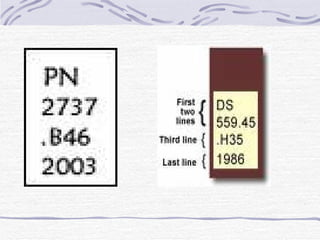
LCC--overview Most LC call numbers follow a simple pattern Letter/number/letter/number Some LCC combinations reflect special situations and do not follow this pattern All LC schedules have similar but not identical sequencing arrangements and physical appearance
 
LCC--overview All LC schedules have similar but not identical sequencing arrangements and physical appearance The order proceeds as a rule from general aspects of the topic to particular subdivisions and subtopics Chronological sequence may trace useful time frames Geographical arrangements are generally alphabetical but may have a different, “preferred” order
LCC--overview Does not group literature by form (like DDC) but rather by national literature then chronology and then individual author (German lit, then 19 th  century, then alpha by author) LCC has two places for “generalia” as found in DDC A , General Works (encyclopedias) X , Bibliographies and library science
Questions?
Break time
LCC live http://summit.orbiscascade.org/ http://libraries.mit.edu/
LCC schedule format External format (most schedules follow a pattern which includes): Preface Brief synopsis of the primary subdivisions in this class/schedule An outline of alphabetic subclasses and alphanumeric subspans The schedule proper Auxiliary tables Detailed index Supplementary pages of additions and changes
LCC schedule format Internal format, or “Martel’s Seven Points of Internal Format” (basic orientation features found in each schedule): General form divisions Then theory and philosophy Then history and biography Then treatises and general works Then law, regulation and state relations Then study and teaching, research and textbooks And finally, subjects and subdivisions of subjects
LCC notation Mixed notation One to three letters Followed by one to four integers And possibly a short decimal Decimals were not used much until certain sections needed to be expanded and no more integers were available Decimals do not generally indicate subordination but allow a new topic to be inserted
LCC notation LCC notations can be expanded through mnemonic letter-number combinations Can represent geographic, personal, corporate or topical names Subordinated to schedule notations where an instruction to subdivide “A-Z” appears LCC interpretation of “cutter numbers” is always a decimal (HG 509 follows HG 51 but precedes HG 5018)
LCC Catalogers should be able to break down an LC call number into its components Catalogers should be able to create reasonably consistent notations which fit into LCC and their unique holdings LCC is loosely coordinated and pragmatic Aims to class closely and then identify uniquely Perfectionists used to DDC’s rigidity will have trouble using LCC
Questions?
Assignment Complete homework handout Search an OPAC for a title View the MARC record Look for the DDC and the LCC numbers Note those and any locally-used call # In your opinion, for that particular title, which scheme suits the title better for the type of library to which the OPAC belongs, DDC or LCC?

Library of Congress Classification

  • 1.
    Bibliographic control systems(LC classification) IST 603 November 29, 2006 Denise A. Garofalo
  • 2.
    LC classification—history TheLibrary of Congress was founded in 1780 The earliest classification system was by size (folios, quartos, octavos), subdivided by accession numbers In 1812 there were 3000 volumes and the size-based system was failing A system with 18 categories was devised
  • 3.
    LC classification—history In1814 the Capitol was burned (LC’s collection was housed there) Thomas Jefferson offered to sell Congress his library to re-establish LC He had cataloged and classified the works His scheme had 44 classes Jefferson’s scheme (modified somewhat over the years) was used in the LC until the end of the 19 th century
  • 4.
    LC classification—history In1899 LC had a new Librarian and a new building—a reorganization and reclassification seemed appropriate The reclassification resulted in what is known today as the LCC The LCC built upon DDC, Cutter’s Expansive Classification and the German Halle Schema
  • 5.
    LC classification Theoutline and notation are similar to Cutter’s Expansive Classification No main classes I , O , W , X or Y These letters do appear as second or third symbols in various LCC subclasses The structure of class Z (Bibliography and Library Science) follows Cutter’s with minor variations (Z was the first class devised under LCC)
  • 6.
    LC classification Differentsubject specialists developed each individual LC schedule following a broad general framework which was established to ensure coordination Each schedule of a class or parts of classes was published as completed Schedules are revised through committee review and then reissued
  • 7.
    LC classification BecauseLCC involves letters and letter combination as well as numbers, it will continue to accommodate new subjects and aspects of subjects for a long time LCC is favored by large university and research collections Hospitality and inherent flexibility Also used in smaller academic and public libraries and some special libraries Doesn’t handle broad classifications well
  • 8.
    LCC schedules LCCschedules comprise 43 volumes Basic schedules A short general outline which contains secondary and tertiary subclass spans for most classes For complete list see http://www.loc.gov/cds/classif.html#lccs
  • 9.
    Updating LCC Revisededitions of individual schedules are published as needed Later editions do not always contain all the information from previous editions (prefaces, index entries, author cutters) May need to keep earlier editions in order to have access to needed information even though later editions are used for actual classifying
  • 10.
    Updating LCC Aquarterly publication, Library of Congress Classification—Additions and Changes , stopped in print in 2002. The latest adjustments in all schedules and schedule indexes for LCC is available online
  • 11.
    Tools for LCCwork For fine-tuning class numbers and shelflist assignments the LC catalog, Thomas, can be consulted (search online LC catalog via classification number) Vendors publish other tools for use with LCC Many folks have penned articles on using LCC
  • 12.
    LCC--overview It isan enumerative rather than a deductive system Uses capital letters for main and subclass notations Uses Arabic numbers for further subdivisions Modified Cutter’s author-mark scheme to achieve alphabetic arrangements
  • 13.
    LCC--overview Most LCcall numbers follow a simple pattern Letter/number/letter/number Some LCC combinations reflect special situations and do not follow this pattern All LC schedules have similar but not identical sequencing arrangements and physical appearance
  • 14.
  • 15.
    LCC--overview All LCschedules have similar but not identical sequencing arrangements and physical appearance The order proceeds as a rule from general aspects of the topic to particular subdivisions and subtopics Chronological sequence may trace useful time frames Geographical arrangements are generally alphabetical but may have a different, “preferred” order
  • 16.
    LCC--overview Does notgroup literature by form (like DDC) but rather by national literature then chronology and then individual author (German lit, then 19 th century, then alpha by author) LCC has two places for “generalia” as found in DDC A , General Works (encyclopedias) X , Bibliographies and library science
  • 17.
  • 18.
  • 19.
  • 20.
    LCC schedule formatExternal format (most schedules follow a pattern which includes): Preface Brief synopsis of the primary subdivisions in this class/schedule An outline of alphabetic subclasses and alphanumeric subspans The schedule proper Auxiliary tables Detailed index Supplementary pages of additions and changes
  • 21.
    LCC schedule formatInternal format, or “Martel’s Seven Points of Internal Format” (basic orientation features found in each schedule): General form divisions Then theory and philosophy Then history and biography Then treatises and general works Then law, regulation and state relations Then study and teaching, research and textbooks And finally, subjects and subdivisions of subjects
  • 22.
    LCC notation Mixednotation One to three letters Followed by one to four integers And possibly a short decimal Decimals were not used much until certain sections needed to be expanded and no more integers were available Decimals do not generally indicate subordination but allow a new topic to be inserted
  • 23.
    LCC notation LCCnotations can be expanded through mnemonic letter-number combinations Can represent geographic, personal, corporate or topical names Subordinated to schedule notations where an instruction to subdivide “A-Z” appears LCC interpretation of “cutter numbers” is always a decimal (HG 509 follows HG 51 but precedes HG 5018)
  • 24.
    LCC Catalogers shouldbe able to break down an LC call number into its components Catalogers should be able to create reasonably consistent notations which fit into LCC and their unique holdings LCC is loosely coordinated and pragmatic Aims to class closely and then identify uniquely Perfectionists used to DDC’s rigidity will have trouble using LCC
  • 25.
  • 26.
    Assignment Complete homeworkhandout Search an OPAC for a title View the MARC record Look for the DDC and the LCC numbers Note those and any locally-used call # In your opinion, for that particular title, which scheme suits the title better for the type of library to which the OPAC belongs, DDC or LCC?