FRBR & RDA: 
Relationships in 
Cataloging 
LIS 653 
Spring 2014 
Starr Hoffman
Goals… 
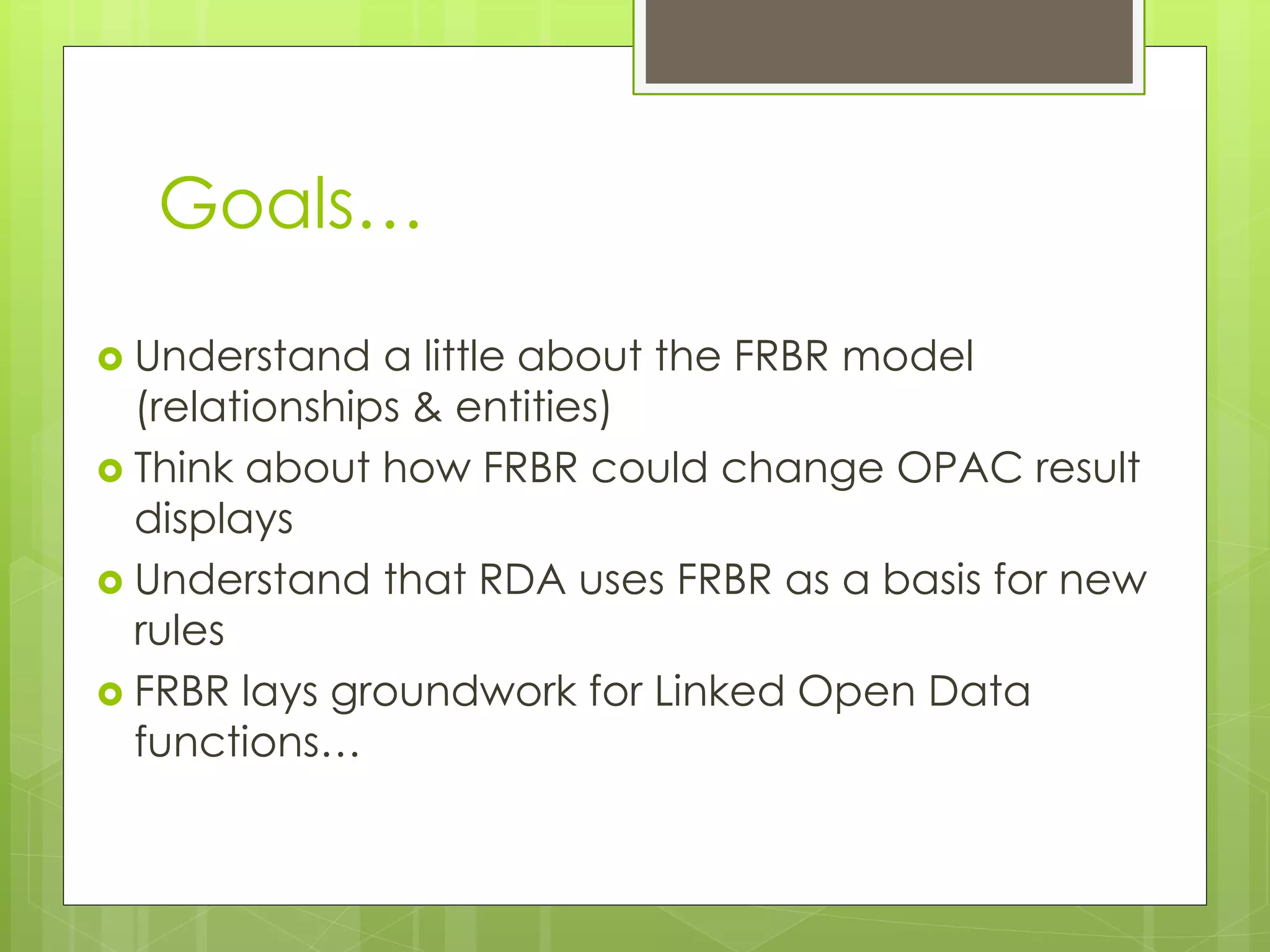
 Understand a little about the FRBR model 
(relationships & entities) 
 Think about how FRBR could change OPAC result 
displays 
 Understand that RDA uses FRBR as a basis for new 
rules 
 FRBR lays groundwork for Linked Open Data 
functions…
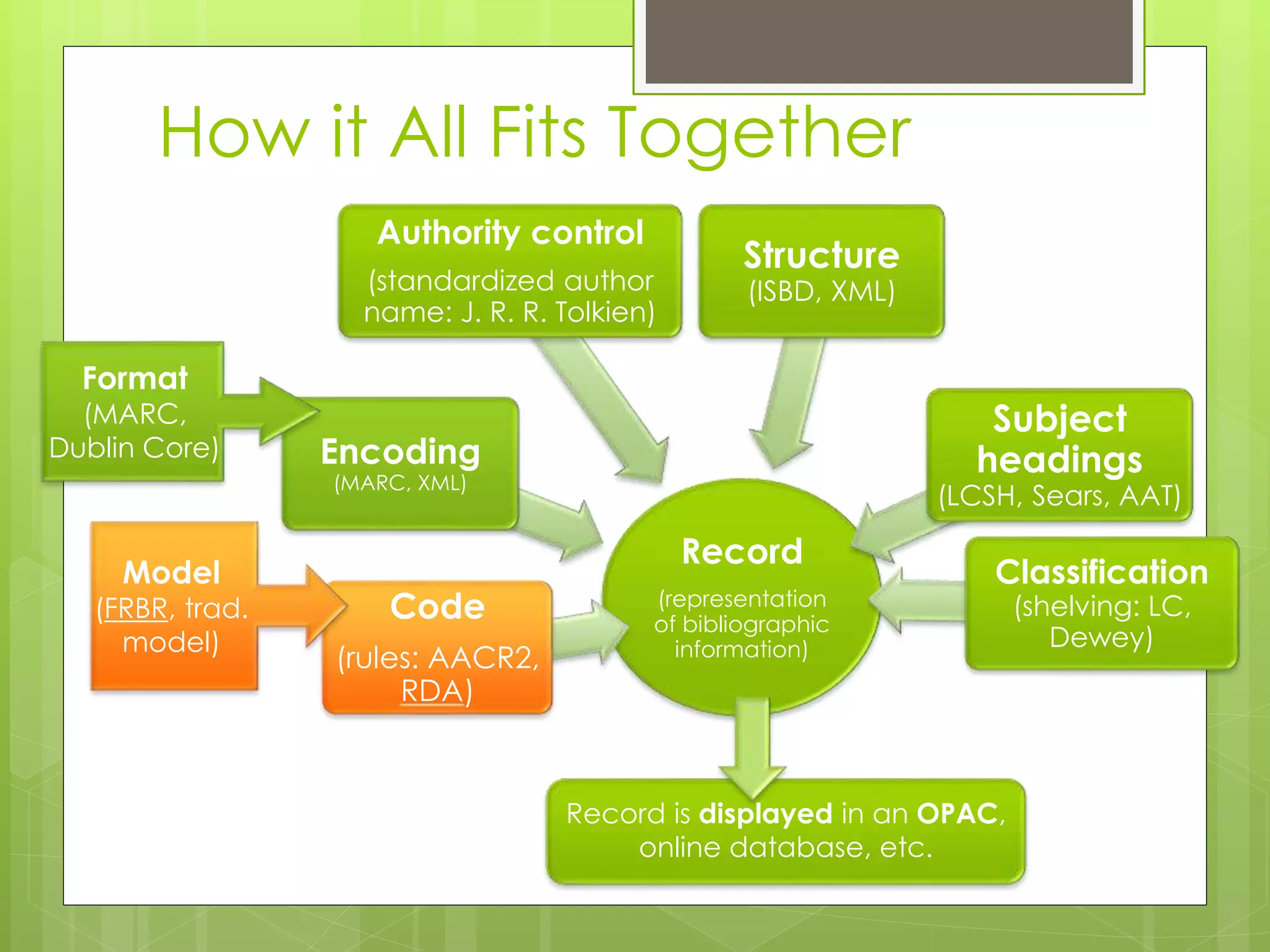
How it All Fits Together 
Record 
Authority control 
(standardized author 
name: J. R. R. Tolkien) 
(representation 
of bibliographic 
information) 
Encoding 
(MARC, XML) 
Code 
(rules: AACR2, 
RDA) 
Structure 
(ISBD, XML) 
Subject 
headings 
(LCSH, Sears, AAT) 
Classification 
(shelving: LC, 
Dewey) 
Model 
(FRBR, trad. 
model) 
Record is displayed in an OPAC, 
online database, etc. 
Format 
(MARC, 
Dublin Core)
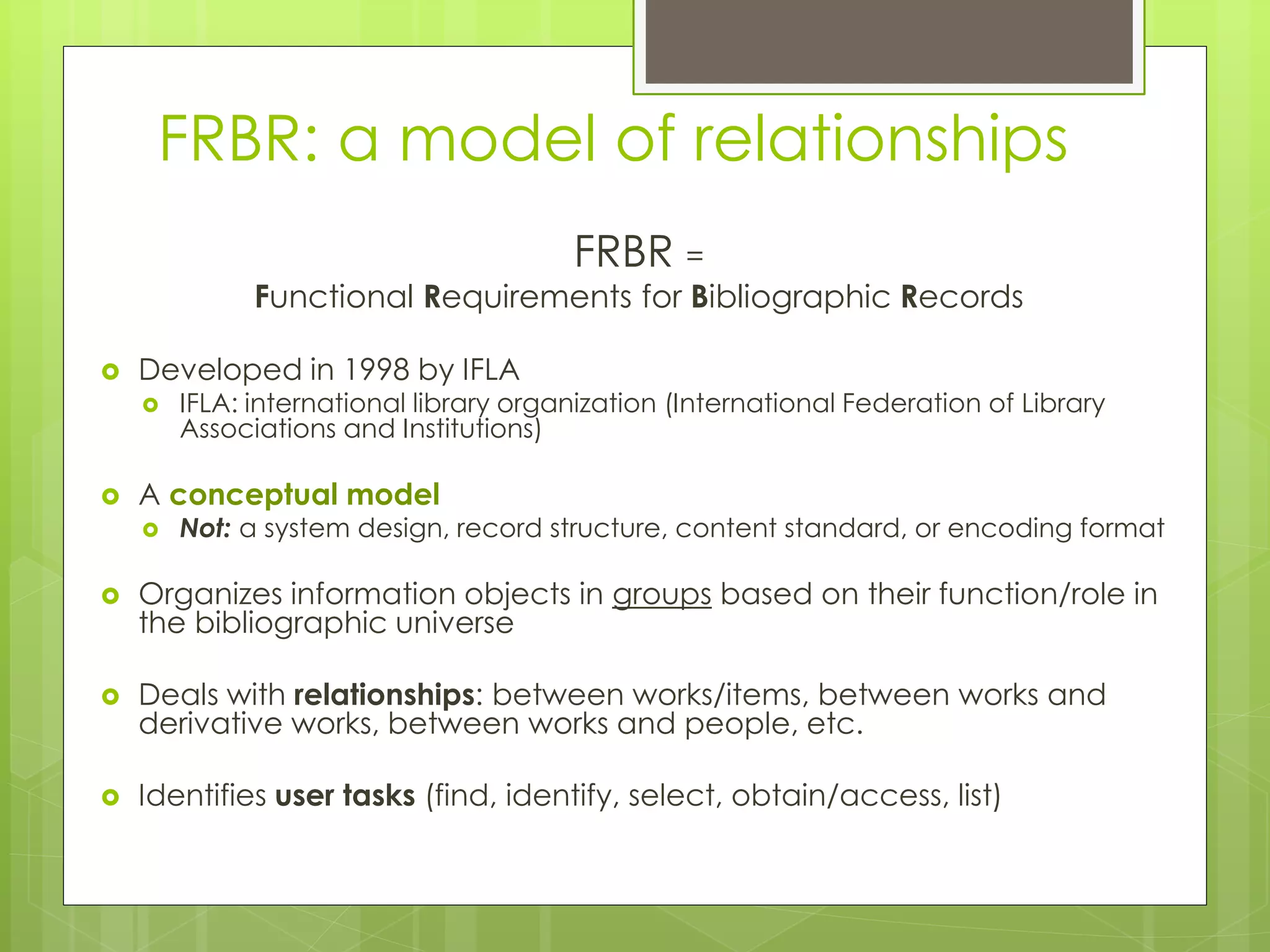
FRBR: a model of relationships 
FRBR = 
Functional Requirements for Bibliographic Records 
 Developed in 1998 by IFLA 
 IFLA: international library organization (International Federation of Library 
Associations and Institutions) 
 A conceptual model 
 Not: a system design, record structure, content standard, or encoding format 
 Organizes information objects in groups based on their function/role in 
the bibliographic universe 
 Deals with relationships: between works/items, between works and 
derivative works, between works and people, etc. 
 Identifies user tasks (find, identify, select, obtain/access, list)
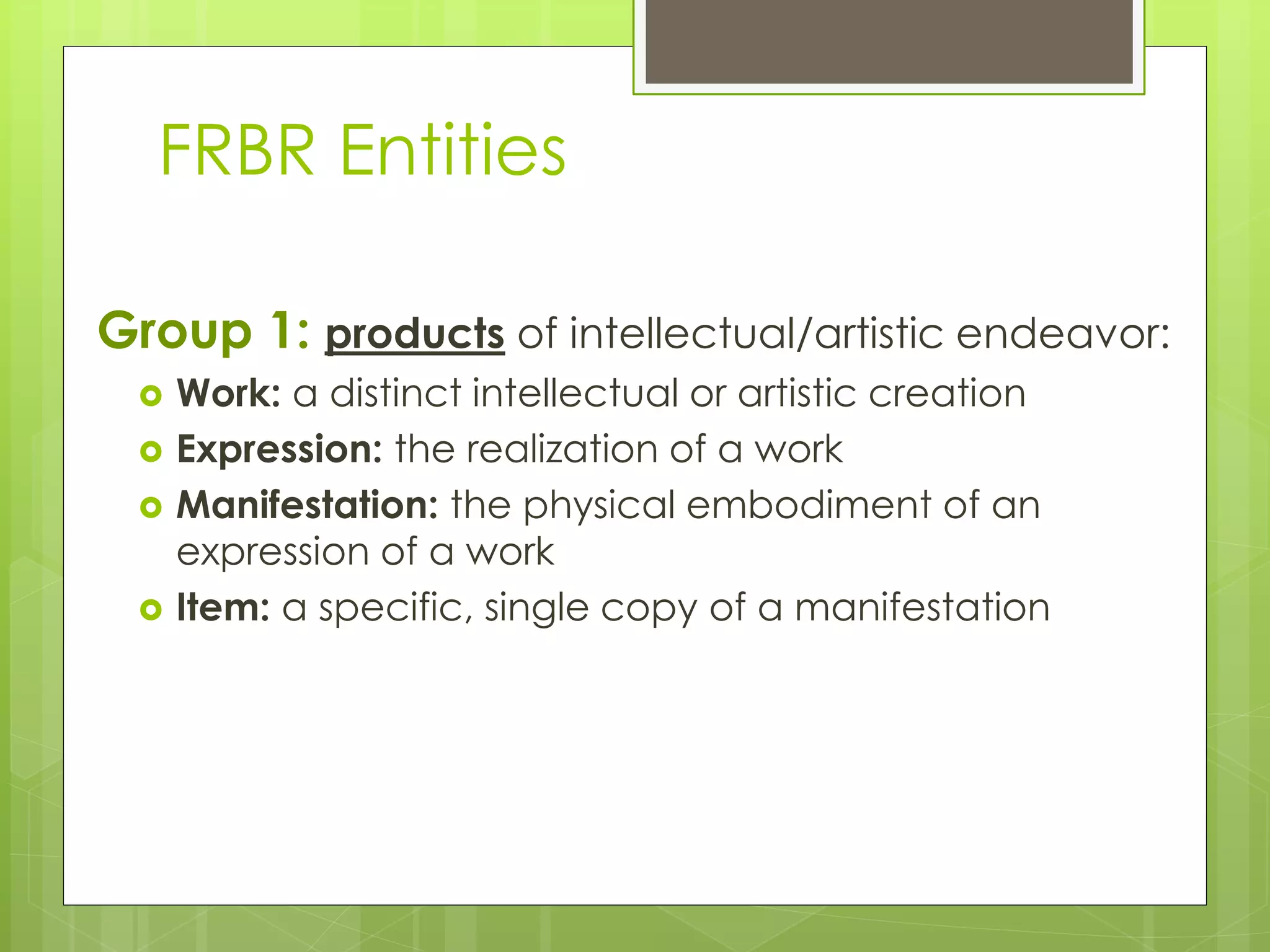
FRBR Entities 
Group 1: products of intellectual/artistic endeavor: 
 Work: a distinct intellectual or artistic creation 
 Expression: the realization of a work 
 Manifestation: the physical embodiment of an 
expression of a work 
 Item: a specific, single copy of a manifestation
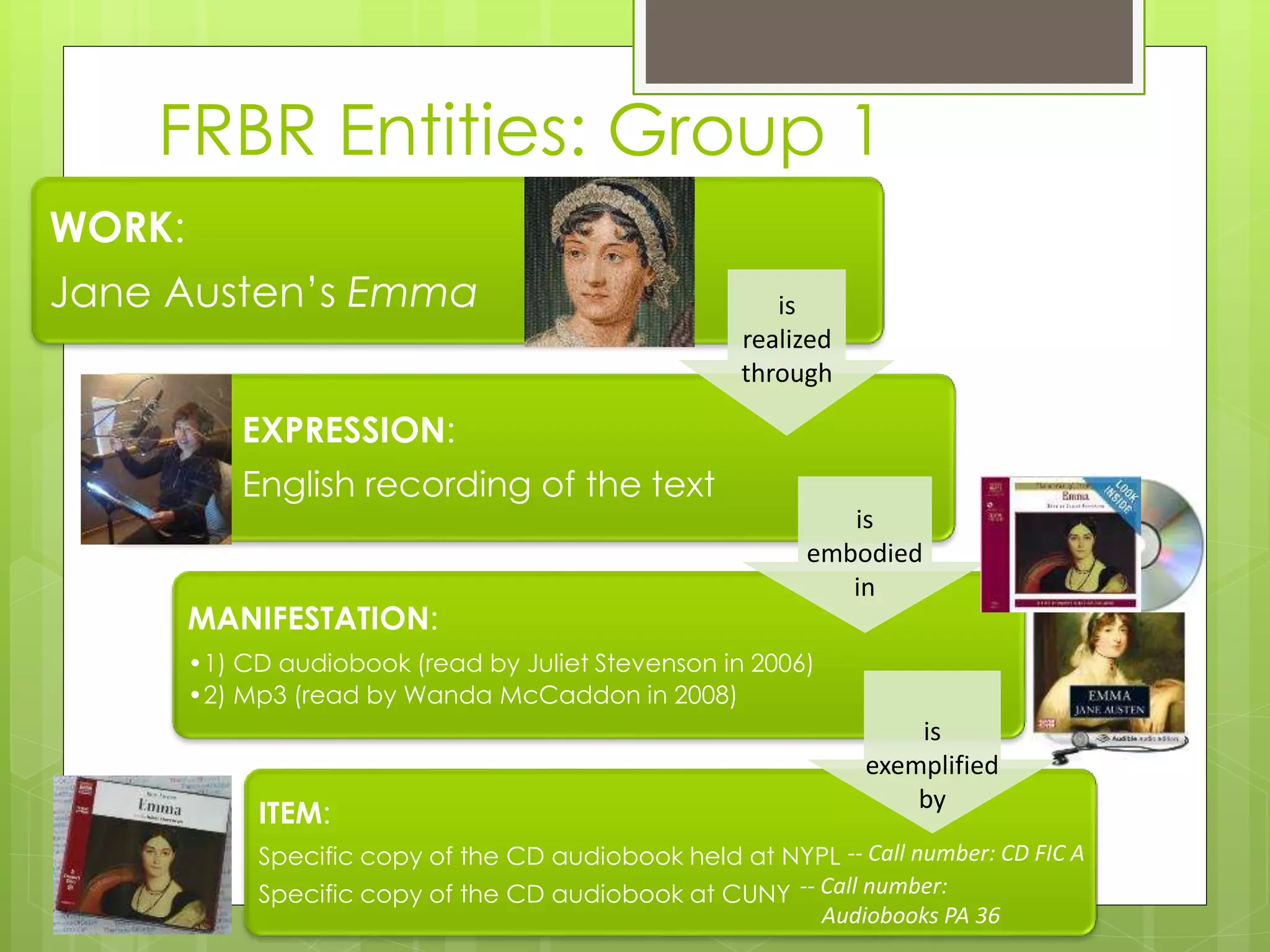
FRBR Entities: Group 1 
WORK: 
Jane Austen’s Emma 
EXPRESSION: 
English recording of the text 
is 
realized 
through 
MANIFESTATION: 
•1) CD audiobook (read by Juliet Stevenson in 2006) 
•2) Mp3 (read by Wanda McCaddon in 2008) 
ITEM: 
Specific copy of the CD audiobook held at NYPL 
Specific copy of the CD audiobook at CUNY 
is 
embodied 
in 
is 
exemplified 
by 
-- Call number: CD FIC A 
-- Call number: 
Audiobooks PA 36
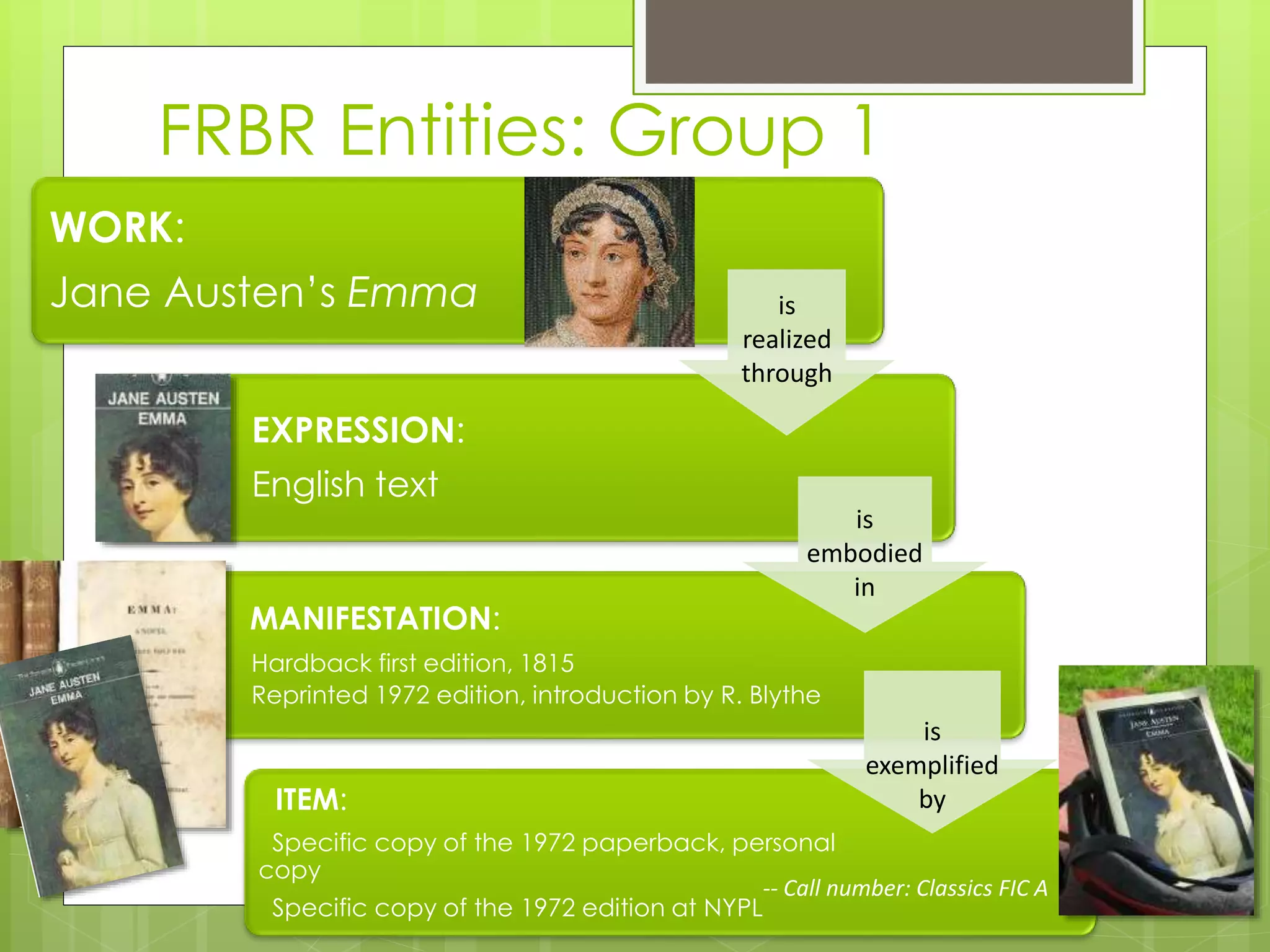
FRBR Entities: Group 1 
WORK: 
Jane Austen’s Emma 
EXPRESSION: 
English text 
MANIFESTATION: 
is 
realized 
through 
• Hardback first edition, 1815 
• Reprinted 1972 edition, introduction by R. Blythe 
ITEM: 
Specific copy of the 1972 paperback, personal 
copy 
Specific copy of the 1972 edition at NYPL 
is 
embodied 
in 
is 
exemplified 
by 
-- Call number: Classics FIC A
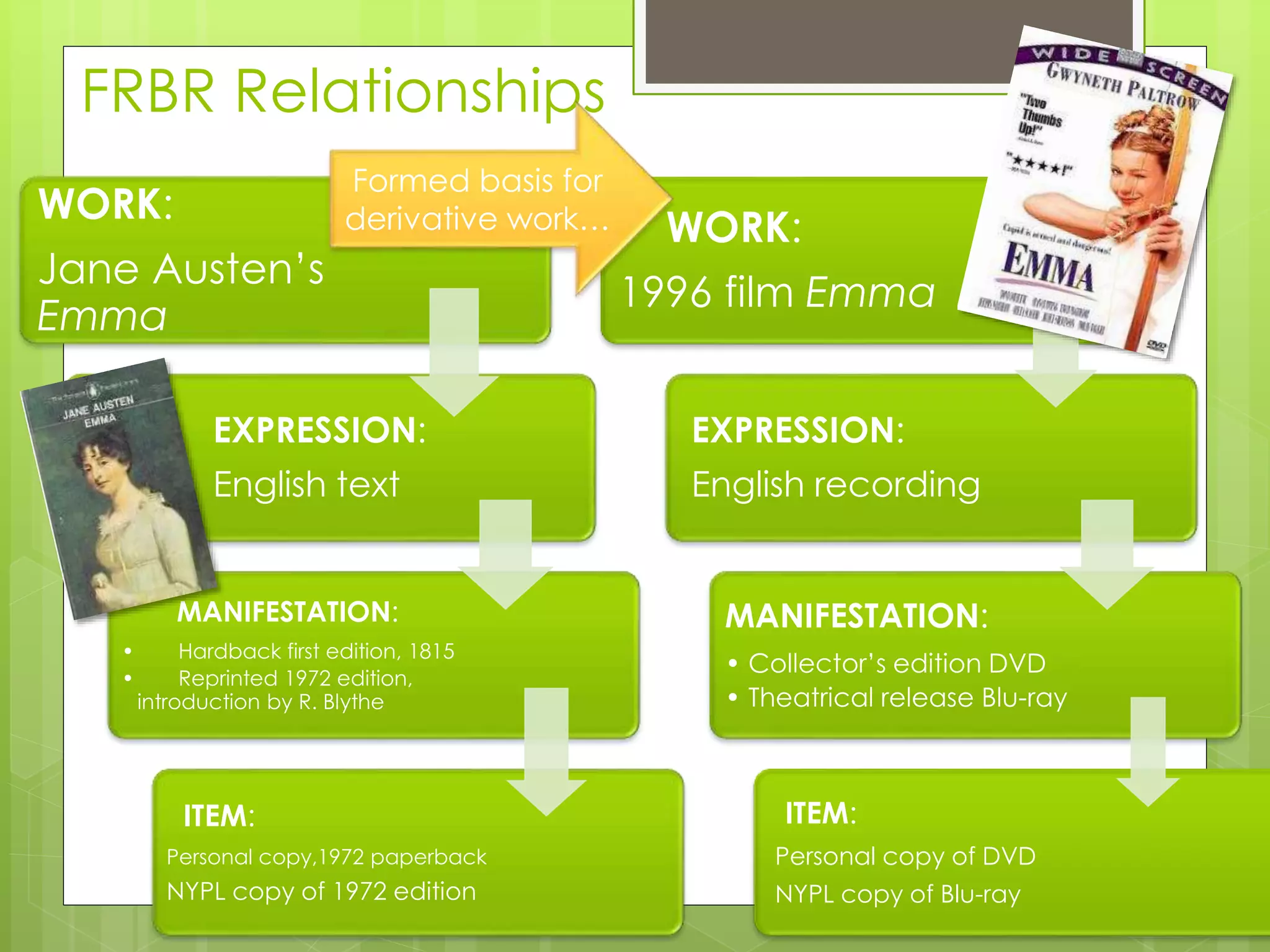
FRBR Relationships 
WORK: 
Jane Austen’s 
Emma 
EXPRESSION: 
English text 
MANIFESTATION: 
• Hardback first edition, 1815 
• Reprinted 1972 edition, 
introduction by R. Blythe 
ITEM: 
Personal copy,1972 paperback 
NYPL copy of 1972 edition 
WORK: 
1996 film Emma 
EXPRESSION: 
English recording 
MANIFESTATION: 
• Collector’s edition DVD 
• Theatrical release Blu-ray 
ITEM: 
Personal copy of DVD 
NYPL copy of Blu-ray 
-- Call number: Classics FIC A 
Formed basis for 
derivative work…
FRBR Entities 
Group 2: persons (or corporate bodies) responsible 
for the intellectual/artistic content, physical 
production and dissemination, or custodianship of a 
work. 
Examples: 
 Harper Collins, the publisher of a work 
 Jane Austen, the author of a work
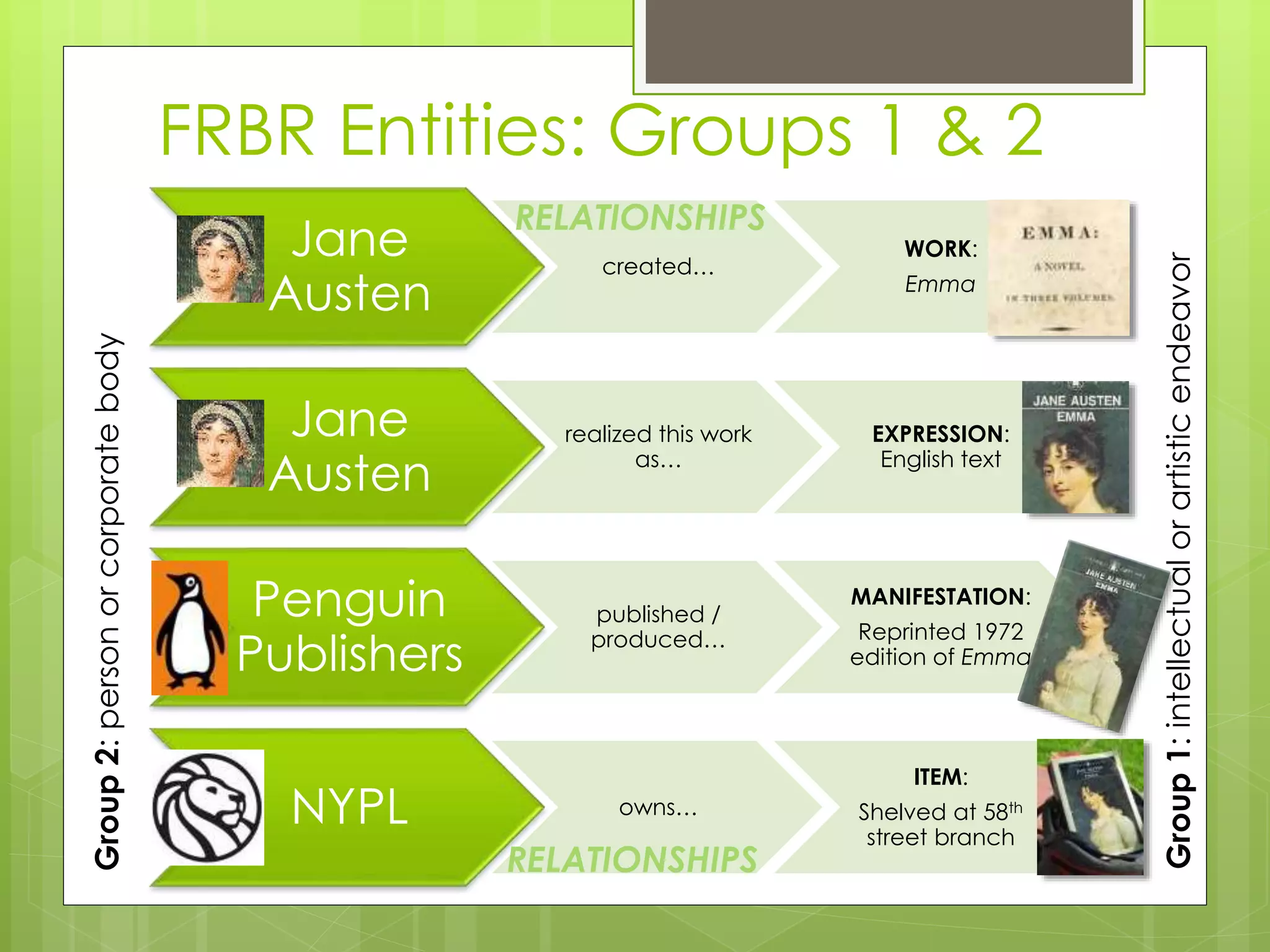
FRBR Entities: Groups 1 & 2 
Jane 
Austen 
RELATIONSHIPS 
created… 
WORK: 
Emma 
Jane 
Austen 
realized this work 
as… 
EXPRESSION: 
English text 
Penguin 
Publishers 
published / 
produced… 
MANIFESTATION: 
Reprinted 1972 
edition of Emma 
NYPL owns… 
ITEM: 
Shelved at 58th 
street branch 
Group 2: person or corporate body 
RELATIONSHIPS 
Group 1: intellectual or artistic endeavor
FRBR Entities 
Group 3: subjects of an intellectual/artistic 
endeavor—may be a concept, object, event, 
place, and/or any Group 1 or Group 2 entity, 
Examples: 
 The French Revolution 
 the event that is the subject of the musical Les Miz 
 Jane Austen 
 an author of books (Group 2) who is the subject of the 
movie Becoming Jane
FRBR Compared to Other Models 
 One-entity model (an inventory) 
 Each individual copy (or item) has its own record 
 Two-entity model (currently common) 
 Catalog records represent editions (FRBR manifestations) that may have multiple 
copies (items) 
 Current catalog records are often at this level, with holdings information for each 
item (number of copies, call numbers) 
 Three-entity model 
 Catalog that uses consistent uniform titles 
 Multiple expressions are not collocated 
 Four-entity model (FRBR) 
 Works/expressions are collocated 
 Long results lists are compacted 
 Easier for user who only cares about the work (i.e., “I want to read Jane Austen’s 
Emma, I don’t care what edition”) to quickly find all available items of that work 
 Easier for user to find related works (i.e., movies adapted from books) 
 V/FRBR test catalog: Scherzo: http://www.dlib.indiana.edu/projects/vfrbr/ 
 Example: search for work “Moonlight Sonata” 
 Previous Indiana catalog: list of over 100 results, displayed in reverse chronological 
order, included unrelated books
So… What about RDA? 
 RDA started as AACR3 (new cataloging rules) in 
2004/2005 
 Renamed to indicate a break from the AACR 
tradition 
 Based on FRBR model of bibliographic relationships
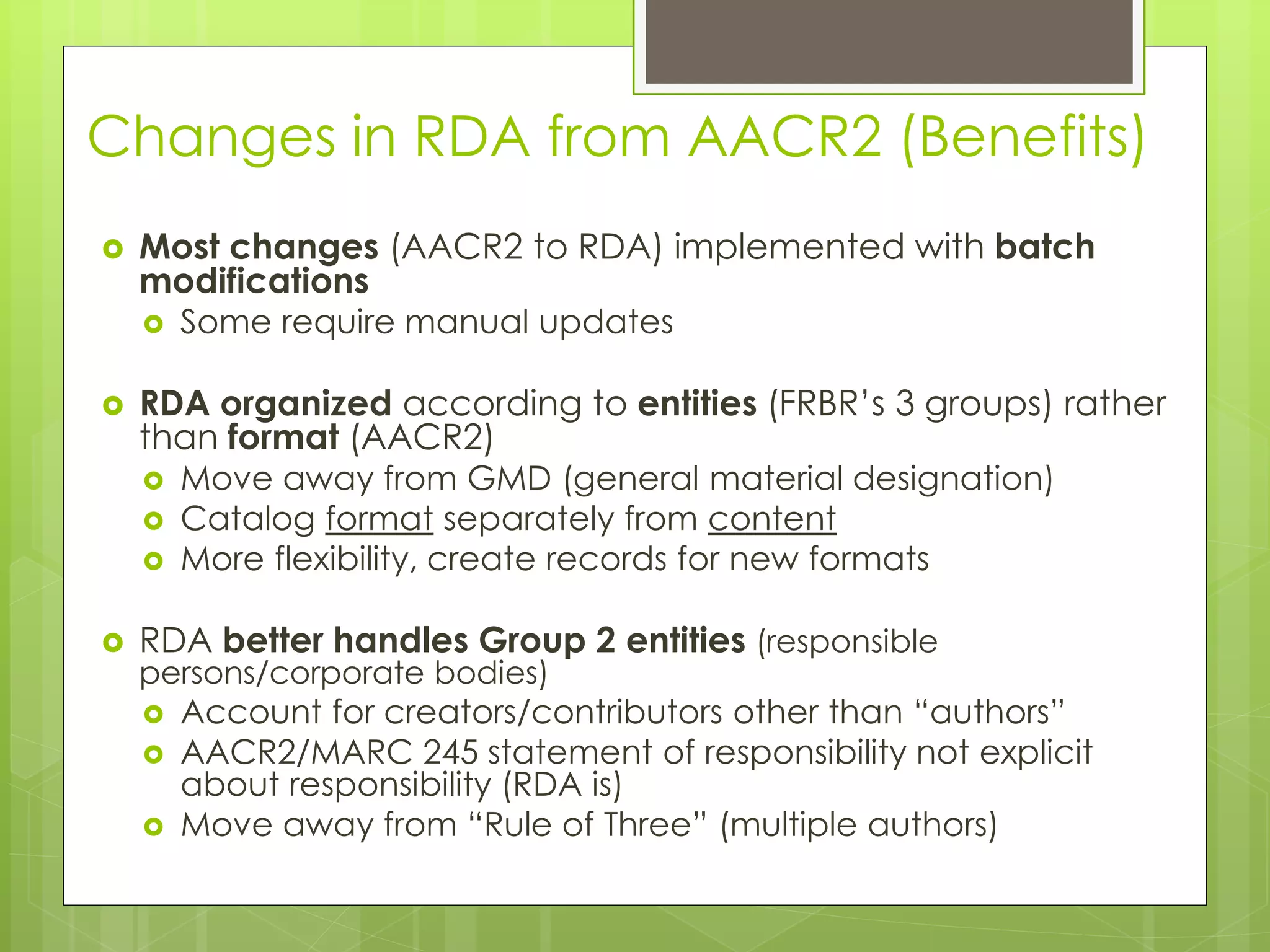
Changes in RDA from AACR2 (Benefits) 
 Most changes (AACR2 to RDA) implemented with batch 
modifications 
 Some require manual updates 
 RDA organized according to entities (FRBR’s 3 groups) rather 
than format (AACR2) 
 Move away from GMD (general material designation) 
 Catalog format separately from content 
 More flexibility, create records for new formats 
 RDA better handles Group 2 entities (responsible 
persons/corporate bodies) 
 Account for creators/contributors other than “authors” 
 AACR2/MARC 245 statement of responsibility not explicit 
about responsibility (RDA is) 
 Move away from “Rule of Three” (multiple authors)
AACR2 to RDA Example 
Example: book titled, Managing Bird Damage to Fruit and Other Horticultural Crops, coauthored by John 
Tracy, Mary Bomford, Quentin Hart, Glen Saunders, and Ron Sinclair. (Example created by Adam Schiff at the 
University of Washington Libraries: http://rdabasics.com/2012/09/10/specific-changes-from-aacr2-to-rda/) 
AACR2 would code the book thusly in MARC: 
 245 00 $a Managing bird damage to fruit and other 
horticultural crops / John Tracey … [et al.]. 
 700 1_ $a Tracey, John Paul. 
RDA codes the book in MARC this way: 
 100 1_ $a Tracey, John Paul, $e author. 
 245 10 $a Managing bird damage to fruit and other 
horticultural crops / John Tracey, Mary Bomford, Quentin 
Hart, Glen Saunders, Ron Sinclair. 
 700 1_ $a Bomford, Mary, $e author. 
 700 1_ $a Hart, Quentin, $e author. 
 700 1_ $a Saunders, Glen, $e author. 
 700 1_ $a Sinclair, Ron, $e author.
Takeaways for FRBR & RDA 
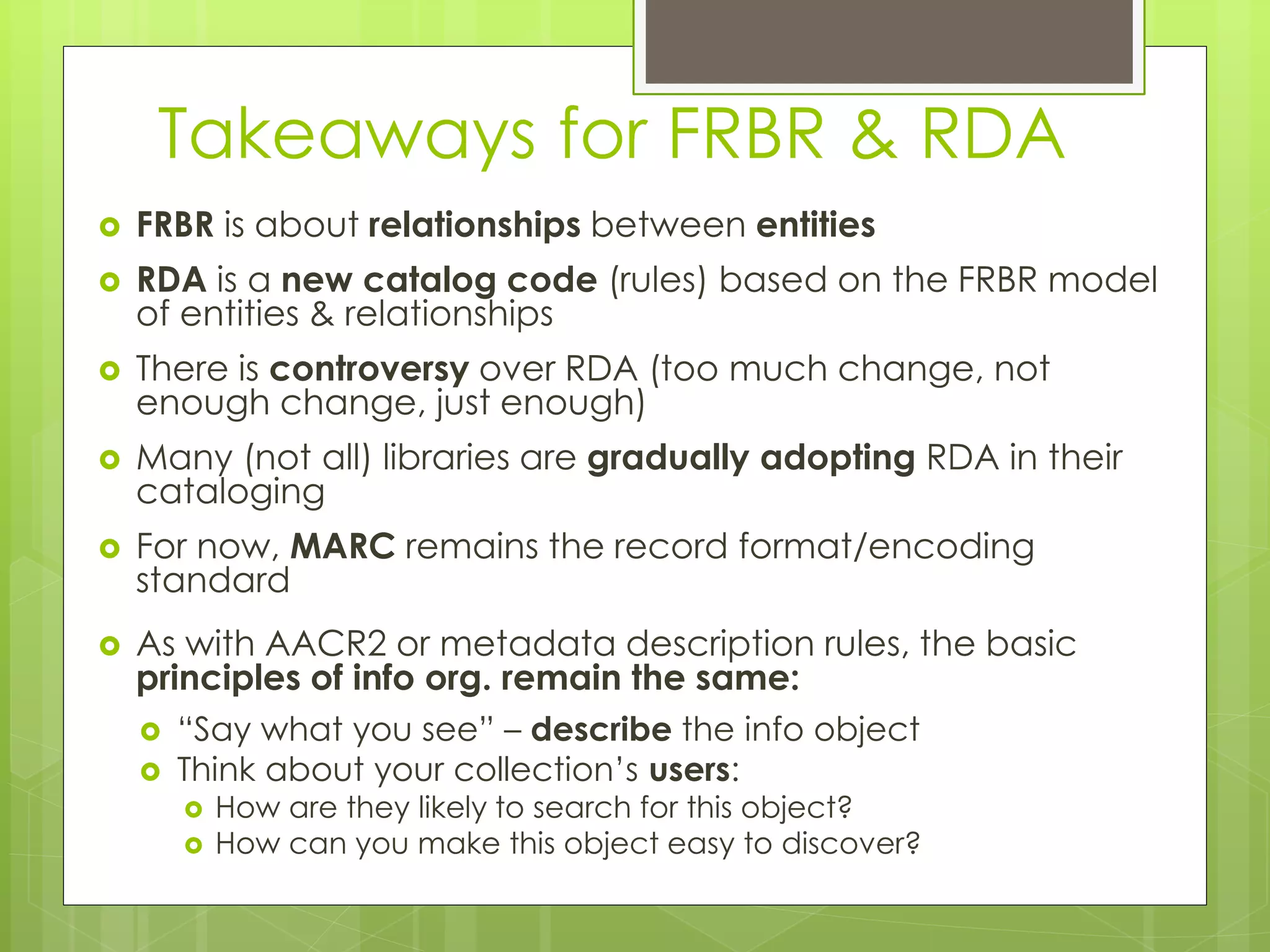
 FRBR is about relationships between entities 
 RDA is a new catalog code (rules) based on the FRBR model 
of entities & relationships 
 There is controversy over RDA (too much change, not 
enough change, just enough) 
 Many (not all) libraries are gradually adopting RDA in their 
cataloging 
 For now, MARC remains the record format/encoding 
standard 
 As with AACR2 or metadata description rules, the basic 
principles of info org. remain the same: 
 “Say what you see” – describe the info object 
 Think about your collection’s users: 
 How are they likely to search for this object? 
 How can you make this object easy to discover?

LIS 653, Session 6: FRBR & Relationships

  • 1.
    FRBR & RDA: Relationships in Cataloging LIS 653 Spring 2014 Starr Hoffman
  • 2.
    Goals…  Understanda little about the FRBR model (relationships & entities)  Think about how FRBR could change OPAC result displays  Understand that RDA uses FRBR as a basis for new rules  FRBR lays groundwork for Linked Open Data functions…
  • 3.
    How it AllFits Together Record Authority control (standardized author name: J. R. R. Tolkien) (representation of bibliographic information) Encoding (MARC, XML) Code (rules: AACR2, RDA) Structure (ISBD, XML) Subject headings (LCSH, Sears, AAT) Classification (shelving: LC, Dewey) Model (FRBR, trad. model) Record is displayed in an OPAC, online database, etc. Format (MARC, Dublin Core)
  • 4.
    FRBR: a modelof relationships FRBR = Functional Requirements for Bibliographic Records  Developed in 1998 by IFLA  IFLA: international library organization (International Federation of Library Associations and Institutions)  A conceptual model  Not: a system design, record structure, content standard, or encoding format  Organizes information objects in groups based on their function/role in the bibliographic universe  Deals with relationships: between works/items, between works and derivative works, between works and people, etc.  Identifies user tasks (find, identify, select, obtain/access, list)
  • 5.
    FRBR Entities Group1: products of intellectual/artistic endeavor:  Work: a distinct intellectual or artistic creation  Expression: the realization of a work  Manifestation: the physical embodiment of an expression of a work  Item: a specific, single copy of a manifestation
  • 6.
    FRBR Entities: Group1 WORK: Jane Austen’s Emma EXPRESSION: English recording of the text is realized through MANIFESTATION: •1) CD audiobook (read by Juliet Stevenson in 2006) •2) Mp3 (read by Wanda McCaddon in 2008) ITEM: Specific copy of the CD audiobook held at NYPL Specific copy of the CD audiobook at CUNY is embodied in is exemplified by -- Call number: CD FIC A -- Call number: Audiobooks PA 36
  • 7.
    FRBR Entities: Group1 WORK: Jane Austen’s Emma EXPRESSION: English text MANIFESTATION: is realized through • Hardback first edition, 1815 • Reprinted 1972 edition, introduction by R. Blythe ITEM: Specific copy of the 1972 paperback, personal copy Specific copy of the 1972 edition at NYPL is embodied in is exemplified by -- Call number: Classics FIC A
  • 8.
    FRBR Relationships WORK: Jane Austen’s Emma EXPRESSION: English text MANIFESTATION: • Hardback first edition, 1815 • Reprinted 1972 edition, introduction by R. Blythe ITEM: Personal copy,1972 paperback NYPL copy of 1972 edition WORK: 1996 film Emma EXPRESSION: English recording MANIFESTATION: • Collector’s edition DVD • Theatrical release Blu-ray ITEM: Personal copy of DVD NYPL copy of Blu-ray -- Call number: Classics FIC A Formed basis for derivative work…
  • 9.
    FRBR Entities Group2: persons (or corporate bodies) responsible for the intellectual/artistic content, physical production and dissemination, or custodianship of a work. Examples:  Harper Collins, the publisher of a work  Jane Austen, the author of a work
  • 10.
    FRBR Entities: Groups1 & 2 Jane Austen RELATIONSHIPS created… WORK: Emma Jane Austen realized this work as… EXPRESSION: English text Penguin Publishers published / produced… MANIFESTATION: Reprinted 1972 edition of Emma NYPL owns… ITEM: Shelved at 58th street branch Group 2: person or corporate body RELATIONSHIPS Group 1: intellectual or artistic endeavor
  • 11.
    FRBR Entities Group3: subjects of an intellectual/artistic endeavor—may be a concept, object, event, place, and/or any Group 1 or Group 2 entity, Examples:  The French Revolution  the event that is the subject of the musical Les Miz  Jane Austen  an author of books (Group 2) who is the subject of the movie Becoming Jane
  • 12.
    FRBR Compared toOther Models  One-entity model (an inventory)  Each individual copy (or item) has its own record  Two-entity model (currently common)  Catalog records represent editions (FRBR manifestations) that may have multiple copies (items)  Current catalog records are often at this level, with holdings information for each item (number of copies, call numbers)  Three-entity model  Catalog that uses consistent uniform titles  Multiple expressions are not collocated  Four-entity model (FRBR)  Works/expressions are collocated  Long results lists are compacted  Easier for user who only cares about the work (i.e., “I want to read Jane Austen’s Emma, I don’t care what edition”) to quickly find all available items of that work  Easier for user to find related works (i.e., movies adapted from books)  V/FRBR test catalog: Scherzo: http://www.dlib.indiana.edu/projects/vfrbr/  Example: search for work “Moonlight Sonata”  Previous Indiana catalog: list of over 100 results, displayed in reverse chronological order, included unrelated books
  • 13.
    So… What aboutRDA?  RDA started as AACR3 (new cataloging rules) in 2004/2005  Renamed to indicate a break from the AACR tradition  Based on FRBR model of bibliographic relationships
  • 14.
    Changes in RDAfrom AACR2 (Benefits)  Most changes (AACR2 to RDA) implemented with batch modifications  Some require manual updates  RDA organized according to entities (FRBR’s 3 groups) rather than format (AACR2)  Move away from GMD (general material designation)  Catalog format separately from content  More flexibility, create records for new formats  RDA better handles Group 2 entities (responsible persons/corporate bodies)  Account for creators/contributors other than “authors”  AACR2/MARC 245 statement of responsibility not explicit about responsibility (RDA is)  Move away from “Rule of Three” (multiple authors)
  • 15.
    AACR2 to RDAExample Example: book titled, Managing Bird Damage to Fruit and Other Horticultural Crops, coauthored by John Tracy, Mary Bomford, Quentin Hart, Glen Saunders, and Ron Sinclair. (Example created by Adam Schiff at the University of Washington Libraries: http://rdabasics.com/2012/09/10/specific-changes-from-aacr2-to-rda/) AACR2 would code the book thusly in MARC:  245 00 $a Managing bird damage to fruit and other horticultural crops / John Tracey … [et al.].  700 1_ $a Tracey, John Paul. RDA codes the book in MARC this way:  100 1_ $a Tracey, John Paul, $e author.  245 10 $a Managing bird damage to fruit and other horticultural crops / John Tracey, Mary Bomford, Quentin Hart, Glen Saunders, Ron Sinclair.  700 1_ $a Bomford, Mary, $e author.  700 1_ $a Hart, Quentin, $e author.  700 1_ $a Saunders, Glen, $e author.  700 1_ $a Sinclair, Ron, $e author.
  • 16.
    Takeaways for FRBR& RDA  FRBR is about relationships between entities  RDA is a new catalog code (rules) based on the FRBR model of entities & relationships  There is controversy over RDA (too much change, not enough change, just enough)  Many (not all) libraries are gradually adopting RDA in their cataloging  For now, MARC remains the record format/encoding standard  As with AACR2 or metadata description rules, the basic principles of info org. remain the same:  “Say what you see” – describe the info object  Think about your collection’s users:  How are they likely to search for this object?  How can you make this object easy to discover?

Editor's Notes

  • #4 Bibliographic record = record with descriptive information about a work (information object) that it represents Catalog = a group of records, a list of objects in a collection Model = determines how records are organized and created in a catalog (FRBR) Cataloging codes = rules for creating catalog records (AACR2, RDA) Structure = rules that help determine the order of elements & punctuation/spacing in a record (ISBD, XML) Format = format in which a record is created and/or encoded (MARC, Dublin Core) Subject heading = terms from a topical controlled vocabulary that describe the content of a work (LCSH, Sears, AAT) Authority control = term from a controlled vocabulary chosen to uniquely identify an author, corporation, book title, or series (so that all records for one author can be accessed easily) Classification scheme = assigns a unique descriptor to a work (usually based on subject), often used to indicate a work’s physical location (LC, Dewey)
  • #5 Find (a specific work, works by a certain author, or on a certain topic) Identify (find a specific edition of a work) Select (evaluate work to determine if it meets the user need) Obtain/Access (find the object on the shelf) List (inventory all objects in the library)
  • #6 Group 1: products of intellectual/artistic endeavor: Work: a distinct intellectual or artistic creation Expression: the realization of a work Manifestation: the physical embodiment of an expression of a work Item: a specific, single copy of a manifestation
  • #7 Group 1: products of intellectual/artistic endeavor. Work: One work: Jane Austen’s Emma A distinct, new work (derivative work): Emma, the 1997 movie adaptation starring Gwyneth Paltrow Expression: (of Jane Austen’s Emma) The book’s first edition, printed in 1815 A reprinted edition from 1972 with an introduction by Ronald Blythe A 2007 audiobook read by Belinda Lang Manifestation: The 2007 audiobook as a mp3 file The 2007 audiobook as a CD Item: a specific copy of the 2007 audiobook CD of Emma at the 58th Street NYPL branch, call number: CD FIC A a specific copy of the 2007 CD audiobook that I own
  • #10  Group 2: persons (or corporate bodies) responsible for the intellectual/artistic content, physical production and dissemination, or custodianship of a work. Examples: Harper Collins, the publisher of a work Jane Austen, the author of a work
  • #11 Left: Group 2 entities (persons, corporate bodies) Middle: relationships between entities Right: Group 1 entities
  • #12  Group 3: subjects of an intellectual/artistic endeavor—may be a concept, object, event, place, and/or any Group 1 or Group 2 entity, Examples: The French Revolution: the event that is the subject of the musical Les Miz Jane Austen: an author of books (Group 2) who is also the subject of the movie Becoming Jane
  • #15 Rule of Three from AACR2: 21.6C2 If responsibility is shared among more than three persons or corporate bodies and principal responsibility is not attributed to any one, two, or three, enter under title. Make an added entry under the heading for the first person or corporate body named. Attempt for most changes from AACR2 to RDA to be implemented on existing records with batch modifications Some require manual updates AACR2 was organized according to format; RDA organized according to entities (FRBR’s 3 groups) Move away from GMD (general material designation): instead, catalog format separately from content Provides more flexibility than AACR2, better able to create records for new formats RDA better handles Group 2 entities (responsible persons/corporate bodies) Can better account for creators/contributors other than traditional “authors” AACR2/MARC old statement of responsibility in 245 tag not explicit about what that “responsibility” was—RDA makes this explicit Move away from “Rule of Three”
  • #16 Note that not only does this make more authors searchable for this book, it also explicitly states what their responsibility is