Lu Bai
Andrew Jeffcoat
 Laura Loveday
 Cyndy Moore
What is a Facet?
Chan (1994) defines the term facet
  as, “A component (based on a
  particular characteristic) of a
    complex subject” (p. 484).
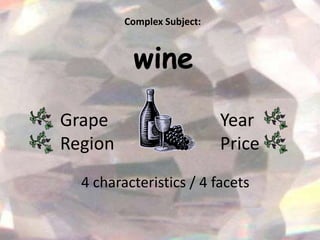
Complex Subject:


          wine
Grape                       Year
Region                      Price
  4 characteristics / 4 facets
These
characteristics/facets/categories
               are:
   “MUTUALLY EXCLUSIVE”
         have their own meaning
                   and
    “JOINTLY EXHAUSTIVE”
as many facets created as necessary to fully
           describe the subject

                           (Denton, 2009)
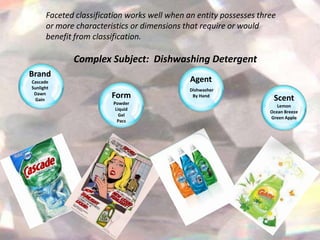
Faceted classification works well when an entity possesses three
      or more characteristics or dimensions that require or would
      benefit from classification.

             Complex Subject: Dishwashing Detergent
Brand
Cascade                                       Agent
Sunlight                                      Dishwasher
 Dawn
  Gain
                        Form                   By Hand
                                                                     Scent
                        Powder
                                                                       Lemon
                         Liquid
                                                                    Ocean Breeze
                           Gel
                                                                    Green Apple
                          Pacs
When classifying an entity using a faceted approach, Kwasnick puts forth the following
guidelines:

•Choose facets. Decide, in advance, on important criteria for description. These form
the facets or fundamental categories.
•Develop facets. Each facet can be developed/expanded using its own logic and
warrant and its own classificatory structure.
•Analyze entities using the facets.
•Develop citation order. In organizing the classified objects, choose a primary facet
that will determine the main attribute and a citation order for the other facets (p.40).
Next-Generation Library Catalogs
               /
        Discovery Tools
wine
“Research has not yet been
determined if technology changes
are driving us to drink wine, or we
 drink wine to help us create and
  implement new technologies.”
Faceted Classification Systems

   Advantages and Disadvantages
Advantages

   Flexibility of Classification
   Post-Coordination
   Support for Rapidly Changing Fields
   Minimal Theory Requirement
   Clarification of Terms
Disadvantages

   Difficulty in Expanding Facets
   Lack of Relationship Amongst Facets
   Resistance to Visual Analysis
Clarification of Terms

   Faceted classification systems can help to
    eliminate confusion regarding the most
    appropriate search terms.
Flexibility of Classification

   Faceted classification systems offer excellent
    flexibility. Developers need not possess as
    complete a picture as with more traditional
    hierarchical systems. Facets can be added
    over time as need dictates.
Post-Coordination

• Faceted schemes describes objects of all sorts
  using independent attributes. Making use of
  these attributes allows for items to be mixed
  and matched at the time of retrieval.
Minimal Theory Requirement

   Faceted schemes require little theory and can
    be constructed ad hoc.
Support for Rapidly Changing Fields

   Fields that experience rapid change can be
    easily accommodated by changing facets.
Difficulty in Expanding Facets

   Choosing appropriate facets later may be
    complicated.
Lack of Relationship Among Facets

   Facets may be come isolated, their own
    “hermit kingdom.”
Resistance to Visual Analysis

   Faceted classification systems might not easily
    allow for visual representations.
Ranganathan's Colon
   Classification
Origin of Colon Classification
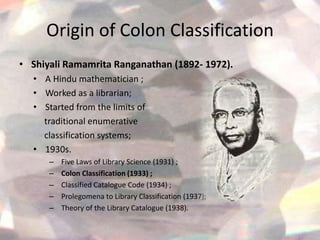
• Shiyali Ramamrita Ranganathan (1892- 1972).
  • A Hindu mathematician ;
  • Worked as a librarian;
  • Started from the limits of
    traditional enumerative
    classification systems;
  • 1930s.
      –   Five Laws of Library Science (1931) ;
      –   Colon Classification (1933) ;
      –   Classified Catalogue Code (1934) ;
      –   Prolegomena to Library Classification (1937);
      –   Theory of the Library Catalogue (1938).
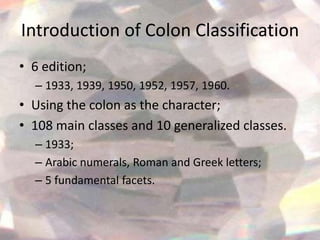
Introduction of Colon Classification
• 6 edition;
  – 1933, 1939, 1950, 1952, 1957, 1960.
• Using the colon as the character;
• 108 main classes and 10 generalized classes.
  – 1933;
  – Arabic numerals, Roman and Greek letters;
  – 5 fundamental facets.
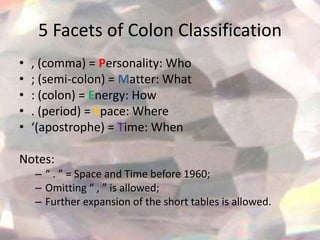
5 Facets of Colon Classification
•   , (comma) = Personality: Who
•   ; (semi-colon) = Matter: What
•   : (colon) = Energy: How
•   . (period) = Space: Where
•   ‘(apostrophe) = Time: When

Notes:
    – “ . ” = Space and Time before 1960;
    – Omitting “ , ” is allowed;
    – Further expansion of the short tables is allowed.
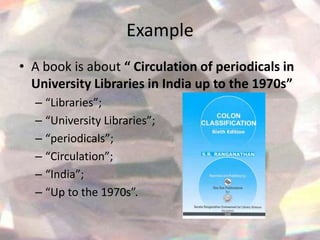
Example
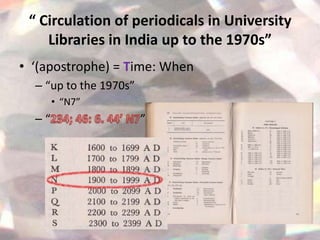
• A book is about “ Circulation of periodicals in
  University Libraries in India up to the 1970s”
  – “Libraries”;
  – “University Libraries”;
  – “periodicals”;
  – “Circulation”;
  – “India”;
  – “Up to the 1970s”.
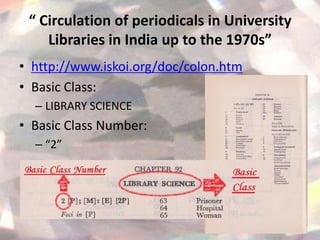
“ Circulation of periodicals in University
    Libraries in India up to the 1970s”
• http://www.iskoi.org/doc/colon.htm
• Basic Class:
  – LIBRARY SCIENCE
• Basic Class Number:
  – “2”
“ Circulation of periodicals in University
    Libraries in India up to the 1970s”
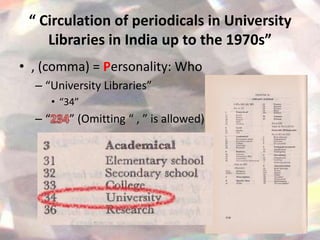
• , (comma) = Personality: Who
  – “University Libraries”
       • “34”
  –“      ” (Omitting “ , ” is allowed)
“ Circulation of periodicals in University
    Libraries in India up to the 1970s”
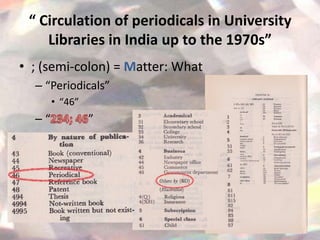
• ; (semi-colon) = Matter: What
  – “Periodicals”
       • “46”
  –“            ”
“ Circulation of periodicals in University
    Libraries in India up to the 1970s”
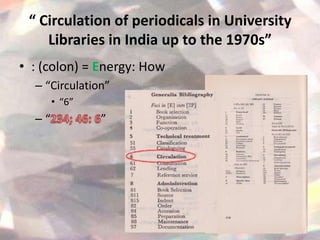
• : (colon) = Energy: How
  – “Circulation”
       • “6”
  –“           ”
“ Circulation of periodicals in University
    Libraries in India up to the 1970s”
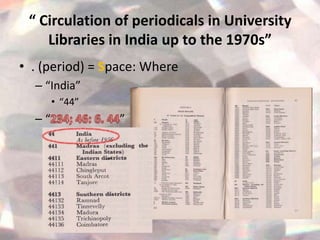
• . (period) = Space: Where
  – “India”
       • “44”
  –“             ”
“ Circulation of periodicals in University
    Libraries in India up to the 1970s”
• ‘(apostrophe) = Time: When
  – “up to the 1970s”
       • “N7”
  –“                    ”
• Is not widely used in libraries;
  – Academic libraries > public libraries;
  – Too complex for the patrons.
• Kashyap, M. M. (2001).
  – “Classified catalogue code of ranganathan: a
    proposal to make it compatible for developing
    computer-based library information systems.”
Faceted Application of Subject
               Terminology
•   Maintains compatibility with LCSH
•   Suitable for metadata
•   Ease of input and retrieval
•   Affordable maintenance
Facet Categories
•   Personal names
•   Corporate names
•   Geographic names
•   Events
•   Titles
•   Time periods
•   Topics
•   Form/Genre
Features
• Subdivisions must belong to the same facet as the subject
  heading
• First level geographic names are restricted to the Geographic
  Area Code table, then subdivided
• Personal names are derived from the LC Name Authority file
  and the name must be a subject in at least one WorldCat
  record, in the Name Authority File, and for subject use
• Chronological facet is either a single numeric date or a date
  range
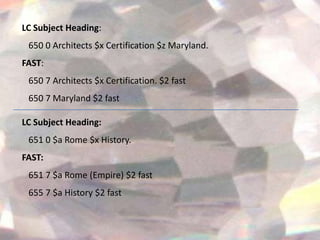
LC Subject Heading:
 650 0 Architects $x Certification $z Maryland.
FAST:
 650 7 Architects $x Certification. $2 fast
 650 7 Maryland $2 fast

LC Subject Heading:
 651 0 $a Rome $x History.
FAST:
 651 7 $a Rome (Empire) $2 fast
 655 7 $a History $2 fast
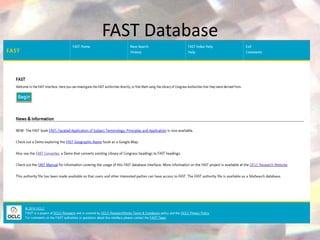
FAST Database
Faceted Classification System in Libraries

Faceted Classification System in Libraries

  • 1.
    Lu Bai Andrew Jeffcoat Laura Loveday Cyndy Moore
  • 2.
    What is aFacet? Chan (1994) defines the term facet as, “A component (based on a particular characteristic) of a complex subject” (p. 484).
  • 3.
    Complex Subject: wine Grape Year Region Price 4 characteristics / 4 facets
  • 4.
    These characteristics/facets/categories are: “MUTUALLY EXCLUSIVE” have their own meaning and “JOINTLY EXHAUSTIVE” as many facets created as necessary to fully describe the subject (Denton, 2009)
  • 5.
    Faceted classification workswell when an entity possesses three or more characteristics or dimensions that require or would benefit from classification. Complex Subject: Dishwashing Detergent Brand Cascade Agent Sunlight Dishwasher Dawn Gain Form By Hand Scent Powder Lemon Liquid Ocean Breeze Gel Green Apple Pacs
  • 6.
    When classifying anentity using a faceted approach, Kwasnick puts forth the following guidelines: •Choose facets. Decide, in advance, on important criteria for description. These form the facets or fundamental categories. •Develop facets. Each facet can be developed/expanded using its own logic and warrant and its own classificatory structure. •Analyze entities using the facets. •Develop citation order. In organizing the classified objects, choose a primary facet that will determine the main attribute and a citation order for the other facets (p.40).
  • 8.
  • 9.
  • 11.
    “Research has notyet been determined if technology changes are driving us to drink wine, or we drink wine to help us create and implement new technologies.”
  • 12.
    Faceted Classification Systems  Advantages and Disadvantages
  • 13.
    Advantages  Flexibility of Classification  Post-Coordination  Support for Rapidly Changing Fields  Minimal Theory Requirement  Clarification of Terms
  • 14.
    Disadvantages  Difficulty in Expanding Facets  Lack of Relationship Amongst Facets  Resistance to Visual Analysis
  • 15.
    Clarification of Terms  Faceted classification systems can help to eliminate confusion regarding the most appropriate search terms.
  • 16.
    Flexibility of Classification  Faceted classification systems offer excellent flexibility. Developers need not possess as complete a picture as with more traditional hierarchical systems. Facets can be added over time as need dictates.
  • 17.
    Post-Coordination • Faceted schemesdescribes objects of all sorts using independent attributes. Making use of these attributes allows for items to be mixed and matched at the time of retrieval.
  • 18.
    Minimal Theory Requirement  Faceted schemes require little theory and can be constructed ad hoc.
  • 19.
    Support for RapidlyChanging Fields  Fields that experience rapid change can be easily accommodated by changing facets.
  • 20.
    Difficulty in ExpandingFacets  Choosing appropriate facets later may be complicated.
  • 21.
    Lack of RelationshipAmong Facets  Facets may be come isolated, their own “hermit kingdom.”
  • 22.
    Resistance to VisualAnalysis  Faceted classification systems might not easily allow for visual representations.
  • 23.
    Ranganathan's Colon Classification
  • 24.
    Origin of ColonClassification • Shiyali Ramamrita Ranganathan (1892- 1972). • A Hindu mathematician ; • Worked as a librarian; • Started from the limits of traditional enumerative classification systems; • 1930s. – Five Laws of Library Science (1931) ; – Colon Classification (1933) ; – Classified Catalogue Code (1934) ; – Prolegomena to Library Classification (1937); – Theory of the Library Catalogue (1938).
  • 25.
    Introduction of ColonClassification • 6 edition; – 1933, 1939, 1950, 1952, 1957, 1960. • Using the colon as the character; • 108 main classes and 10 generalized classes. – 1933; – Arabic numerals, Roman and Greek letters; – 5 fundamental facets.
  • 26.
    5 Facets ofColon Classification • , (comma) = Personality: Who • ; (semi-colon) = Matter: What • : (colon) = Energy: How • . (period) = Space: Where • ‘(apostrophe) = Time: When Notes: – “ . ” = Space and Time before 1960; – Omitting “ , ” is allowed; – Further expansion of the short tables is allowed.
  • 27.
    Example • A bookis about “ Circulation of periodicals in University Libraries in India up to the 1970s” – “Libraries”; – “University Libraries”; – “periodicals”; – “Circulation”; – “India”; – “Up to the 1970s”.
  • 28.
    “ Circulation ofperiodicals in University Libraries in India up to the 1970s” • http://www.iskoi.org/doc/colon.htm • Basic Class: – LIBRARY SCIENCE • Basic Class Number: – “2”
  • 29.
    “ Circulation ofperiodicals in University Libraries in India up to the 1970s” • , (comma) = Personality: Who – “University Libraries” • “34” –“ ” (Omitting “ , ” is allowed)
  • 30.
    “ Circulation ofperiodicals in University Libraries in India up to the 1970s” • ; (semi-colon) = Matter: What – “Periodicals” • “46” –“ ”
  • 31.
    “ Circulation ofperiodicals in University Libraries in India up to the 1970s” • : (colon) = Energy: How – “Circulation” • “6” –“ ”
  • 32.
    “ Circulation ofperiodicals in University Libraries in India up to the 1970s” • . (period) = Space: Where – “India” • “44” –“ ”
  • 33.
    “ Circulation ofperiodicals in University Libraries in India up to the 1970s” • ‘(apostrophe) = Time: When – “up to the 1970s” • “N7” –“ ”
  • 34.
    • Is notwidely used in libraries; – Academic libraries > public libraries; – Too complex for the patrons. • Kashyap, M. M. (2001). – “Classified catalogue code of ranganathan: a proposal to make it compatible for developing computer-based library information systems.”
  • 35.
    Faceted Application ofSubject Terminology • Maintains compatibility with LCSH • Suitable for metadata • Ease of input and retrieval • Affordable maintenance
  • 36.
    Facet Categories • Personal names • Corporate names • Geographic names • Events • Titles • Time periods • Topics • Form/Genre
  • 37.
    Features • Subdivisions mustbelong to the same facet as the subject heading • First level geographic names are restricted to the Geographic Area Code table, then subdivided • Personal names are derived from the LC Name Authority file and the name must be a subject in at least one WorldCat record, in the Name Authority File, and for subject use • Chronological facet is either a single numeric date or a date range
  • 38.
    LC Subject Heading: 650 0 Architects $x Certification $z Maryland. FAST: 650 7 Architects $x Certification. $2 fast 650 7 Maryland $2 fast LC Subject Heading: 651 0 $a Rome $x History. FAST: 651 7 $a Rome (Empire) $2 fast 655 7 $a History $2 fast
  • 39.

Editor's Notes

  • #3 To define Faceted Classification, one might begin by providing the definition of the word facet.
  • #4 WHILE RESEARCHING FACETED CLASSIFICATION, IT SEEMED AS IF EVERYONE USED ‘WINE’ AS AN ILLUSTRATIVE EXAMPLE OF HOW THE SCHEME WORKS.
  • #5 For example, red wine drinkers may not care about region or year, but care very much about the price. They should be able to find a good bottle of Merlot for under $20, without knowing anything about the region from which it came, or the vintage year. The fact that the wine is red has nothing to do with the year it was produced. The region in which the wine was produced may have relatively little to do with its price. What is true of one category, is not true of another category. The categories are exclusive. This is how a faceted classification system differs from a hierarchy classification system, where entities are divided and subdivided down to the nth degree, and where what is true of the parent group is also true of the sub-groups (Kwasnick, 1999).
  • #6 Unlike a simple hierarchical scheme, faceted classification gives the users the ability to find items based on more than one dimension. Users shopping for Dish Detergent may be concerned primarily by agent, while others by brand. Brand, Form, Agent, and Scent are examples of Facets, while Cascade, Powder, Dishwasher, Lemon are examples of Facet Value or facet development.
  • #7 READ SLIDE FIRST AND CLICK FOR OUTLINE OF CITATION ORDERIn a faceted classification system, each topic within a facet is assigned an individual notation (Taylor & Joudrey, 2009, p.387). Notations can be numeric digits, symbols, letters of the alphabet, or any combination of the three determined to be most appropriate for the classification system being designed. The notations from each facet of a subject or topic are then strung together, in a predetermined order, “to create a multi-dimensional classification” (Taylor & Joudrey, 2009, p.387). This multi-dimensional, ordered, and notational model of classifying information was first conceptualized by Ranganathan when he developed his Colon Classification Scheme, which will be discussed later.
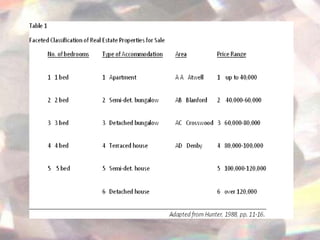
  • #8 In this example, the entity to be classified is a real estate agent’s records of his advertised properties for sale. As shown in Table 1, the facets used to classify these properties are number of bedrooms, types of accommodation, location/area, and price range. WHAT WOULD THE CLASSIFICATION NUMBER BE FOR A 4 BEDROOM DETACHED HOUSE IN THE CROSSWOOD AREA LISTED AT $115,000? 46AC5. If the classification scheme assigned the notation of “4” to a four bedroom dwelling, the notation of “6” to a detached house, the notation of “AC” to the Crosswood area, and the notation of “5” to the price range of $100,000-$120,000, then the classification number for a four bedroom detached house in Crosswood priced at $115,000 would be 46AC5. However, what if the real estate agent decides that his clients prioritize by area, then type of dwelling, then by number of bedrooms, and lastly by price?Then the order of citation would change and the classification number would be AC645.
  • #9 Over the last decade, libraries have been rapidly implementing what has become known as “next-generation” catalogs or “discovery tools” that utilize faceted searching (Fagan, 2010). AquaBrowser is a popular faceted catalog interface software product used by libraries including the University of Chicago Library and the Washington Research Libraries Consortium, referred to as Lens and Aladin Discovery, respectively. Users appreciate the speed and ease at which they can quickly whittle down to the exact information they seek when using a faceted search. Fagan explains,“Faceted browsing offers the user relevant subcategories by which they can see an overview of results, then narrow their list. In library catalog interfaces, facets usually include authors, subjects, and formats, but may include any field that can be logically created from the MARC record” (2010).
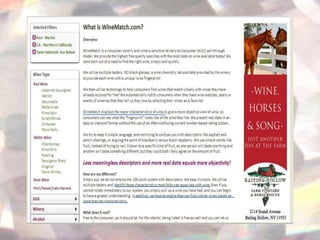
  • #10 As we saw in the real estate example, database designers, catalogers, and programmers usually have decided the order in which information will be retrieved in a classification system and website, a faceted system still allows for a great amount of flexibility and users can often change at will the order in which they search facets.Let’s take a look at how we can search for wine at a website designed to allow users to search by category or facet:CLICK ON HYPERLINK AND SEARCH THE SITE . GO TO ABOUT US AT THE BOTTOM OF THE PAGE AND GO OVER THE HOW THEY DESCRIBE THEIR SEARCH CAPABILITIES.
  • #11 CompanyOriginally conceived in 2001, and refined over the last five plus years, WineMatch.com is a Southern California company, a wholly-owned subsidiary of the IT firm, Roundbrix.
  • #12 Though the ease of use these databases bring us is remarkable, users must remember that as of yet there are no perfect search tools, and not every document or product will be retrieved by them. Further, while the faceted classification scheme does have many advantages over traditional hierarchal systems, there are disadvantages and limitations, as well, which Andrew will address next.BRIEF EXPLANATION ON HOW ROUNDBRIX GOT THEIR NAME.