   Libraries store and manage thousands materials.
   These materials need to be organized in a manner
    that allows the easiest possible access for the end
    user.
   Classification Systems are the tools Libraries use to
    organize books and other library materials.
    Classification Systems consists of subjects that can
    be located by call number.
   There are several different kinds of classification
    systems
   LC ( Library of Congress Classification System) used
    mostly in Academic and research libraries. Meant for
    large libraries.
   DDC (Dewey Decimal System) most widely used
    classification system. Used in small, medium public
    and school libraries.
   SuDocs ( Superintendent Documents Classification) a
    specialized system of classification for Government
    Documents.
   ANSCR( Alpha-Numeric System for Classification
    Recordings) Specialized system for classifying sound
    recordings.
   NLM ( National Library of Medicine Classification) A
    Specialized classification system used in medical
    libraries.
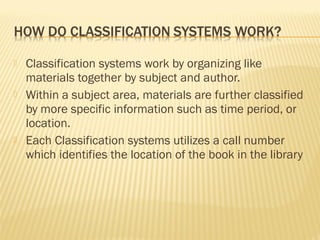
   Classification systems work by organizing like
    materials together by subject and author.
   Within a subject area, materials are further classified
    by more specific information such as time period, or
    location.
   Each Classification systems utilizes a call number
    which identifies the location of the book in the library
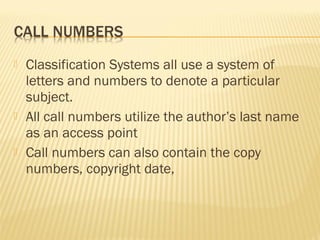
   Classification Systems all use a system of
    letters and numbers to denote a particular
    subject.
   All call numbers utilize the author’s last name
    as an access point
   Call numbers can also contain the copy
    numbers, copyright date,
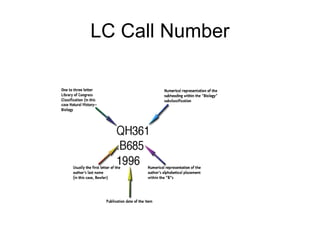
LC Call Number
   The Library of Congress Classification (LCC) is a
    classification system that was first developed in the
    late nineteenth and early twentieth centuries to
    organize and arrange the book collections of the
    Library of Congress. Over the course of the twentieth
    century, the system was adopted for use by other
    libraries as well, especially large academic libraries in
    the United States. It is currently one of the most widely
    used library classification systems in the world.
   LCC call number is made up of three elements
   1. Subject ( based on 21wide subject classes).
   2. These classes are then further broken down by subject.
   3. author initial and numeric determination based on
    alphabetic placement
   Although all classification systems provide access to
    information. Some systems work better with specific types of
    information or in specific types of Libraries.

   Libraries choose a classification system based on three factors
         1. Collection Size
         2. Subjects/ Materials in the Collection
         3. End User
   For example, The DDC is a broad with
    classification system.
   DDC categories encompass many subjects that
    are loosely related, but easy to search.
   This system works well in library that have
    general subjects, or specific Academic
    subjects.
   Libraries with Small to Medium collections,
    generally Public Libraries or School libraries
    favor this system for its ease of use of their
    patron base.
   The Library of Congress Cataloging system is a
    much narrower system meant for use in
    libraries that have multiple subcategories.
   Not all classification systems classify books.
   Many Libraries use classification systems to
    classify:
   Music
   Art
   Government Documents
   Stands for Alpha-Numeric System for
    Classification of Recordings (ANSCR)
   This system is used for sound recordings in
    Music Libraries and some academic and public
    libraries.
   Like LCC and Dewey ANSCR is a Hierarchical
    system that uses 46 different subjects that
    encompass all sound recordings.
   ANSCR call number composition
   ANSCR call number composition consists of four lines of information. Each item of
    information is explained below. Term One Term Two Term Three Term Four
   Term One
        Letter or letters representing one of the ANSCR categories

   Term Two
        Based on the ANSCR category specified in Term One, Term Two will be the first four
         consecutive letters of the composer's surname, performer's surname, author's surname, title,
         or topic

   Term Three
        Initial letters of the first three significant words of the title, or the first three consecutive letters
         of a one-word title

   Term Four
        First letter of the performer's surname (or production company if a children's recording)
         followed by the last two digits of the recording company's production number
   Sample ANSCR call number:
   B
   PUCC
   BOH
   S82
   Term One:
   Opera (B)
   Term Two:
   Puccini (PUCC)
   Term Three:
   La Boheme (BOH)
   Term Four:
   Tullio Serafin, Decca 0082 (S82)
   The Superintendent of Documents
    classification system was developed in the
    Library of the Government Printing Office
    between 1895 and 1903.
   SuDocs is a classification system created for
    the many articles that are published by the US
    Government.
   The Superintendent of Documents (SuDocs)
    classification system is designed to group together
    publications by the same government author. Within
    an agency or department, publications are grouped
    according to the subordinate organization. The
    purpose of this system is to uniquely identify, logically
    relate, and physically arrange each publication so that
    all publications of a single agency or department may
    be found together.
   Each executive department and agency, the Judiciary,
    Congress, and other major independent
    establishments are assigned a unique alphabetical
    identifier, based on the name of the organization, e.g.,
    "A" for Agriculture Department, "JU" for Judiciary, and
    "NS" for National Science Foundation. However, the
    letters "X" and "Y" are reserved for Congress. The
    designation "Z" is not used.
   Unlike other classification systems, SuDocs
    does not use the author’s name as a
    classification tool. Further since government
    documents are rarely in book form, each
    individual document has its own call number.
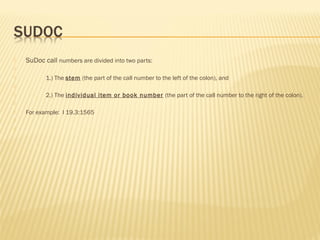
   SuDoc call numbers are divided into two parts:
    
          1.) The stem (the part of the call number to the left of the colon), and
    
          2.) The individual item or book number (the part of the call number to the right of the colon).
    
   For example: I 19.3:1565
    

   I 19.3:        is the stem
   1565         is the book number for this item

   I   Interior Department          [Department]
   19. U.S. Geological Survey       [Sub-agency]
   3:  Bulletins                    [Series Designation]
   1565 1565                        [Book number]
   Call Numbers are the primary access point for
    finding library materials.
   Call numbers provide a lot of information to
    patrons and Library staff members that help
    each successfully locate books and other
    library materials.
   No matter what type of classification system
    your library uses, if materials are not put back
    in the proper order materials can be lost
    forever!
   For example:
   What will happen if the catalog says a books
    call number is 398.2 CAY, but the label reads
    389.2 CAY?
   Example:

   A thin book, who’s spine is too small for the
    label is incorrectly shelved. The book is now
    missing. How will the library staff members
    find this book?

Library classification systems.ppt 2011

  • 2.
    Libraries store and manage thousands materials.  These materials need to be organized in a manner that allows the easiest possible access for the end user.  Classification Systems are the tools Libraries use to organize books and other library materials.  Classification Systems consists of subjects that can be located by call number.
  • 3.
    There are several different kinds of classification systems  LC ( Library of Congress Classification System) used mostly in Academic and research libraries. Meant for large libraries.  DDC (Dewey Decimal System) most widely used classification system. Used in small, medium public and school libraries.
  • 4.
    SuDocs ( Superintendent Documents Classification) a specialized system of classification for Government Documents.  ANSCR( Alpha-Numeric System for Classification Recordings) Specialized system for classifying sound recordings.  NLM ( National Library of Medicine Classification) A Specialized classification system used in medical libraries.
  • 5.
    Classification systems work by organizing like materials together by subject and author.  Within a subject area, materials are further classified by more specific information such as time period, or location.  Each Classification systems utilizes a call number which identifies the location of the book in the library
  • 6.
    Classification Systems all use a system of letters and numbers to denote a particular subject.  All call numbers utilize the author’s last name as an access point  Call numbers can also contain the copy numbers, copyright date,
  • 7.
  • 8.
    The Library of Congress Classification (LCC) is a classification system that was first developed in the late nineteenth and early twentieth centuries to organize and arrange the book collections of the Library of Congress. Over the course of the twentieth century, the system was adopted for use by other libraries as well, especially large academic libraries in the United States. It is currently one of the most widely used library classification systems in the world.
  • 9.
    LCC call number is made up of three elements  1. Subject ( based on 21wide subject classes).  2. These classes are then further broken down by subject.  3. author initial and numeric determination based on alphabetic placement
  • 10.
    Although all classification systems provide access to information. Some systems work better with specific types of information or in specific types of Libraries.  Libraries choose a classification system based on three factors 1. Collection Size 2. Subjects/ Materials in the Collection 3. End User
  • 11.
    For example, The DDC is a broad with classification system.  DDC categories encompass many subjects that are loosely related, but easy to search.  This system works well in library that have general subjects, or specific Academic subjects.
  • 12.
    Libraries with Small to Medium collections, generally Public Libraries or School libraries favor this system for its ease of use of their patron base.  The Library of Congress Cataloging system is a much narrower system meant for use in libraries that have multiple subcategories.
  • 13.
    Not all classification systems classify books.  Many Libraries use classification systems to classify:  Music  Art  Government Documents
  • 14.
    Stands for Alpha-Numeric System for Classification of Recordings (ANSCR)  This system is used for sound recordings in Music Libraries and some academic and public libraries.  Like LCC and Dewey ANSCR is a Hierarchical system that uses 46 different subjects that encompass all sound recordings.
  • 15.
    ANSCR call number composition  ANSCR call number composition consists of four lines of information. Each item of information is explained below. Term One Term Two Term Three Term Four  Term One  Letter or letters representing one of the ANSCR categories  Term Two  Based on the ANSCR category specified in Term One, Term Two will be the first four consecutive letters of the composer's surname, performer's surname, author's surname, title, or topic  Term Three  Initial letters of the first three significant words of the title, or the first three consecutive letters of a one-word title  Term Four  First letter of the performer's surname (or production company if a children's recording) followed by the last two digits of the recording company's production number
  • 16.
    Sample ANSCR call number:  B  PUCC  BOH  S82
  • 17.
    Term One:  Opera (B)  Term Two:  Puccini (PUCC)  Term Three:  La Boheme (BOH)  Term Four:  Tullio Serafin, Decca 0082 (S82)
  • 18.
    The Superintendent of Documents classification system was developed in the Library of the Government Printing Office between 1895 and 1903.  SuDocs is a classification system created for the many articles that are published by the US Government.
  • 19.
    The Superintendent of Documents (SuDocs) classification system is designed to group together publications by the same government author. Within an agency or department, publications are grouped according to the subordinate organization. The purpose of this system is to uniquely identify, logically relate, and physically arrange each publication so that all publications of a single agency or department may be found together.
  • 20.
    Each executive department and agency, the Judiciary, Congress, and other major independent establishments are assigned a unique alphabetical identifier, based on the name of the organization, e.g., "A" for Agriculture Department, "JU" for Judiciary, and "NS" for National Science Foundation. However, the letters "X" and "Y" are reserved for Congress. The designation "Z" is not used.
  • 21.
    Unlike other classification systems, SuDocs does not use the author’s name as a classification tool. Further since government documents are rarely in book form, each individual document has its own call number.
  • 22.
    SuDoc call numbers are divided into two parts:     1.) The stem (the part of the call number to the left of the colon), and     2.) The individual item or book number (the part of the call number to the right of the colon).     For example: I 19.3:1565    
  • 23.
    I 19.3: is the stem  1565 is the book number for this item  I Interior Department [Department]  19. U.S. Geological Survey [Sub-agency]  3: Bulletins [Series Designation]  1565 1565 [Book number]
  • 24.
    Call Numbers are the primary access point for finding library materials.  Call numbers provide a lot of information to patrons and Library staff members that help each successfully locate books and other library materials.
  • 25.
    No matter what type of classification system your library uses, if materials are not put back in the proper order materials can be lost forever!
  • 26.
    For example:  What will happen if the catalog says a books call number is 398.2 CAY, but the label reads 389.2 CAY?
  • 27.
    Example:  A thin book, who’s spine is too small for the label is incorrectly shelved. The book is now missing. How will the library staff members find this book?