Presents
6th Knowledge Master Class
On
Understanding Service Tax Law Nuances
Conducted by
Dr. Sanjiv Agarwal
FCA, FCS
Wednesday,
17th April, 2013
Mumbai © Dr. Sanjiv Agarwal
1
SESSION – I
SERVICE TAX
Overview
and
Recent Changes
2
This Presentation Covers
• Economic Overview
• Taxation of Services – Past and Present
• Major Changes in 2012 -2013
• Macro View of Budget – 2013 Proposals
• GST – An update
3
4
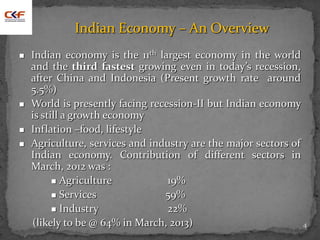
Indian Economy – An Overview
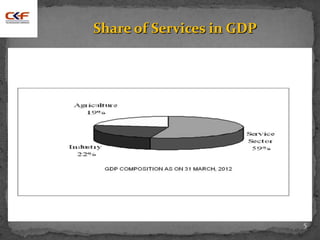
 Indian economy is the 11th largest economy in the world
and the third fastest growing even in today’s recession,
after China and Indonesia (Present growth rate around
5.5%)
 World is presently facing recession-II but Indian economy
is still a growth economy
 Inflation –food, lifestyle
 Agriculture, services and industry are the major sectors of
Indian economy. Contribution of different sectors in
March, 2012 was :
 Agriculture 19%
 Services 59%
 Industry 22%
(likely to be @ 64% in March, 2013)
5
Share of Services in GDP
6
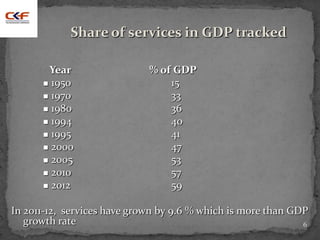
Share of services in GDP tracked
Year % of GDP
 1950 15
 1970 33
 1980 36
 1994 40
 1995 41
 2000 47
 2005 53
 2010 57
 2012 59
In 2011-12, services have grown by 9.6 % which is more than GDP
growth rate
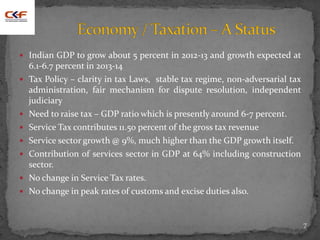
 Indian GDP to grow about 5 percent in 2012-13 and growth expected at
6.1-6.7 percent in 2013-14
 Tax Policy – clarity in tax Laws, stable tax regime, non-adversarial tax
administration, fair mechanism for dispute resolution, independent
judiciary
 Need to raise tax – GDP ratio which is presently around 6-7 percent.
 Service Tax contributes 11.50 percent of the gross tax revenue
 Service sector growth @ 9%, much higher than the GDP growth itself.
 Contribution of services sector in GDP at 64% including construction
sector.
 No change in Service Tax rates.
 No change in peak rates of customs and excise duties also.
7
8
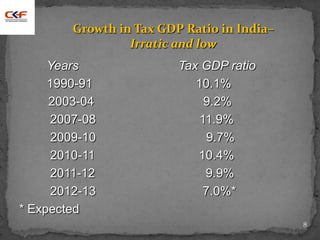
Growth in Tax GDP Ratio in India–
Irratic and low
Years Tax GDP ratio
1990-91 10.1%
2003-04 9.2%
2007-08 11.9%
2009-10 9.7%
2010-11 10.4%
2011-12 9.9%
2012-13 7.0%*
* Expected
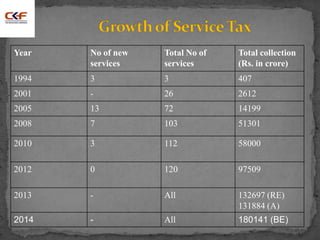
Year No of new
services
Total No of
services
Total collection
(Rs. in crore)
1994 3 3 407
2001 - 26 2612
2005 13 72 14199
2008 7 103 51301
2010 3 112 58000
2012 0 120 97509
2013 - All 132697 (RE)
131884 (A)
2014 - All 180141 (BE)
10
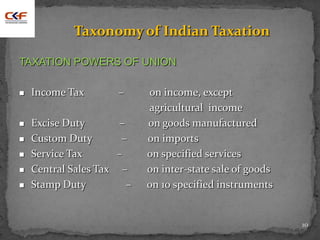
Taxonomy of Indian Taxation
TAXATION POWERS OF UNION
 Income Tax – on income, except
agricultural income
 Excise Duty – on goods manufactured
 Custom Duty – on imports
 Service Tax – on specified services
 Central Sales Tax – on inter-state sale of goods
 Stamp Duty – on 10 specified instruments
11
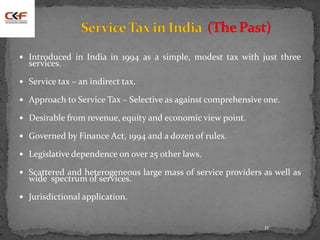
 Introduced in India in 1994 as a simple, modest tax with just three
services.
 Service tax – an indirect tax.
 Approach to Service Tax – Selective as against comprehensive one.
 Desirable from revenue, equity and economic view point.
 Governed by Finance Act, 1994 and a dozen of rules.
 Legislative dependence on over 25 other laws.
 Scattered and heterogeneous large mass of service providers as well as
wide spectrum of services.
 Jurisdictional application.
12
Selective Approach to Service Tax
 Taxation by choice
 Service not defined but taxable service defined.
 > 120 taxable services [section 65(105)]
 Resulted in distortions / prejudice
 Untapped tax potential
 Economically unjustified
 Issues – Classification, Illogical definitions,
Constitutional challenges, deemed services etc.
13
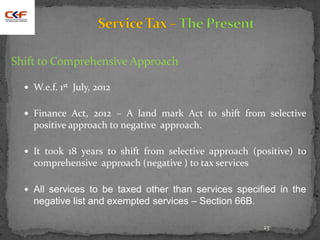
Shift to Comprehensive Approach
 W.e.f. 1st July, 2012
 Finance Act, 2012 – A land mark Act to shift from selective
positive approach to negative approach.
 It took 18 years to shift from selective approach (positive) to
comprehensive approach (negative ) to tax services
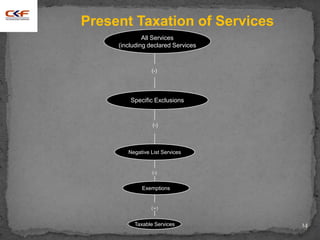
 All services to be taxed other than services specified in the
negative list and exempted services – Section 66B.
14
All Services
(including declared Services
(-)
Specific Exclusions
(-)
Negative List Services
Exemptions
Taxable Services
(-)
Present Taxation of Services
(=)
15
New Law of Taxation of Services
 Negative list (17 in number) specified through
statutory provisions – Section 66D.
 ‘Service’ defined for the first time.
 ‘Negative List’ and ‘declared services’ also
defined.
16
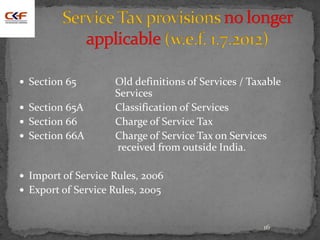
 Section 65 Old definitions of Services / Taxable
Services
 Section 65A Classification of Services
 Section 66 Charge of Service Tax
 Section 66A Charge of Service Tax on Services
received from outside India.
 Import of Service Rules, 2006
 Export of Service Rules, 2005
17
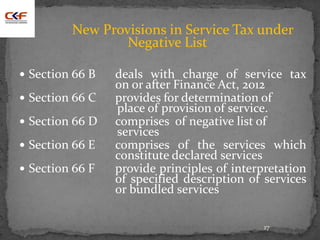
New Provisions in Service Tax under
Negative List
 Section 66 B deals with charge of service tax
on or after Finance Act, 2012
 Section 66 C provides for determination of
place of provision of service.
 Section 66 D comprises of negative list of
services
 Section 66 E comprises of the services which
constitute declared services
 Section 66 F provide principles of interpretation
of specified description of services
or bundled services
18
 All services Taxable
[section 65B (44)]
 Declared services Taxable
(section 66E)
 Services covered under Not Taxable
negative list of services
(section 66D)
 Services exempt under Mega Exempted
Notification No. 25/2012-ST
dated 20.6.2012
 Other specified Exemptions Exempted
 Service Tax Law made shorter by about 40 percent
 Effective rate of Service Tax @ 12.36 percent w.e.f. 01.04.2012
including education cess.
 Definition of ‘service’ finds place in statutory provisions
 All services taxed including a set of services called ‘declared
services’
 Negative list of services containing 17 broad service categories out
of Service Tax ambit.
 Withdrawal of many existing exemptions / abetments or their
rationalization
19
 Place of provision of service rules determine the location of service
and become be basis of taxation.
 Withdrawal of export of service rules and import of service rules in
view of place of provision of service rules coming into operation.
 Concept of taxable territory and non- taxable territory introduced
 Taxation of Service to be determined by provision of service in
taxable territory and non taxable territory.
 Basis of charge of Service Tax shifted under new section 66B.
 Classification of service criteria replaced by new section 66F on
interpretation principles of specified description of services or
bundled services.
20
 Under new reverse charge mechanism, onus of paying Service Tax
will be shared by service provider and service receiver in case of
specified services.
 Service Tax on taxable services provided by service provider located in
Jammu & Kashmir state liable under reverse charge.
 Change in valuation rules in relation to works contracts and outdoor
catering / supply of food.
 Payment of Service Tax on receipt basis for all service providers being
individuals / firms / LLPs, if aggregate value of taxable services in
previous year does not exceed Rs. 50 lakh.
21
 Criteria for Rs 10 lakh threshold exemption changed to invoices
 Time limit for appeal by assessees to Commissioner (Appeals)
reduced from 3 months to 2 months
 Revision Application Authority and Settlement Commission
provisions made applicable to service tax.
 Special Audit of Service tax assesses by CAs /CWAs
 Recovery of tax dues – legal smartness (Circular dated
1.1.2013)
22
New Accounting Codes under new regime ( July – November 2012)
Tax Collection 00441089
Other Receipts 00441090
Penalties 00441093
Deduct Refunds 00441094
Restoration of Service Specific Accounting Codes
 C. No. 165 dated 20.11.2012 / N. No. 48/2012-ST dated 3.12.2012
 No change in law ; only for statistical analysis
 New code created for penalty
 Registration obtained under the positive list approach continue to be
valid
 Registration under all taxable services to be amended online under
specific head of services
 For reverse charge, registration should be obtained as service
receiver under respective category.
 Accounting codes for residual entry
Service Tax 00441480
Interest 00441481
Penalty 00441485
23
Quarterly Service Tax Returns
April to June, 2012
 N. No. 47/2012-ST dated 28.09.2012 – for April to June 2012, quarterly return
prescribed.
 Order No. 3/2012 - last date of return was extended upto 25.11.2012
July to October, 2012
N. No. 1/2013-ST, dated 22.02.2013
Circular No. 137 dated 22.02.2013 / Order No. 1
 New ST-3 Form is available in offline mode
 Last date 25th March, 2013; extended to 15th April, 2013; further extended
upto 30th April 2013 vide Order No. 2/2013-ST, dated 12.4.2013
 To indicate capacity – as provider / under RCM / under partial RCM
 Filing of return for second half of 2012-13 yet to be notified
24
 Stability in negative list maintained with only a few changes.
 Vocational courses offered by institutes affiliated to the State
Council of Vocational Training and testing activities in relation
to agriculture and agriculture produce to be in the negative list.
 Service Tax to be levied on all restaurants which are air
conditioned. The condition of liquor license done away with.
 Certain exemptions curtailed / withdrawn in relation to auxiliary
education service and renting by educational institutes,
transportation of goods by railway / vessel, vehicle parking to
general public, repair or maintenance of government aircrafts,
charitable activities etc. (w.e.f. 1.4.2013)
25
Macro View of Budget – 2013 Proposals
 Penalty u/s 77(a) (in case of non-registration) shall be restricted
to a maximum of Rs. 10,000.
 Abatement reduced w.e.f. 1.3.2013 from 75% to 70% in case of
luxury apartments / residential complexes and others (with
carpet area of 2000 sq. ft. or more or value of Rs. 1 crore or more).
 New provisions for revised punishments for offences u/s 89,
making certain offences cognizable and others non cognizable
and bailable.
 New Section 78A inserted to impose penalty on directors and
officials of company for specified willful actions / offences.
26
Macro View of Budget – 2013 Proposals
 Power to arrest provided u/s 91 where Service Tax default is more than
Rs. 50 lakhs.
 Resident public limited companies also allowed to seek advance ruling
from Advance Ruling Authority (w.e.f 1.3.2013)
 Stay orders of CESTAT to have a maximum period of 365 days (180+185)
upto which stay granted will be operational even when assessee is not
at fault.; Stay to get vacated after 365 days.
 Voluntary Compliance Encouragement Scheme, 2013 (VCES)
introduced as a one time amnesty measure to effect compliance and
recovery and provide amnesty from interest and penalties (last date
31.12.2013).
27
Macro View of Budget – 2013 Proposals
28
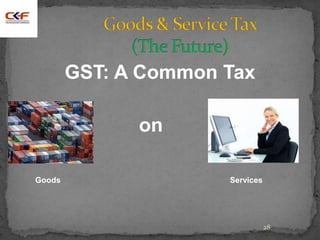
GST: A Common Tax
on
Goods Services
 Need for Centre to compensate states for loss due to
reduction in CST rate
 Agreement on CST compensation - Rs 9000 crore provided
in Budget
 Petroleum products to be under GST; Alcoholic products to
be outside GST
 Constitutional Amendment Bill, 2011- Report of Standing
Committee in this Budget session; further amendments to
be made.
 Not likely before 2014 LS elections
 No clear road map and commitment on time lines on GST
implementation
 Hope for consensus in next few months.
29
 Time to wrap up loose ends
 GST rate – band may be introduced
 Consensus required at Empowered Committee on GST to abolish small
taxes
 Agreement on dropping Dispute Settlement Body
 GST may be introduced in phases. States to decide / opt out
 States may be empowered to raise GST rates in case of distress
 Revenue sharing mechanism to be rationalized
 What could be a suitable GST rate?
 Need for drafting a GST Law by States and Centre
 Next meeting of Empowered Committee on 11-12 May at Mussoorie
 Dual control not likely - to be controlled by Central / States based on
turnover
 Composition scheme likely, besides threshold exemption
30
31

Mumbai Presentation 17.4.2013 (Session i)

  • 1.
    Presents 6th Knowledge MasterClass On Understanding Service Tax Law Nuances Conducted by Dr. Sanjiv Agarwal FCA, FCS Wednesday, 17th April, 2013 Mumbai © Dr. Sanjiv Agarwal 1
  • 2.
    SESSION – I SERVICETAX Overview and Recent Changes 2
  • 3.
    This Presentation Covers •Economic Overview • Taxation of Services – Past and Present • Major Changes in 2012 -2013 • Macro View of Budget – 2013 Proposals • GST – An update 3
  • 4.
    4 Indian Economy –An Overview  Indian economy is the 11th largest economy in the world and the third fastest growing even in today’s recession, after China and Indonesia (Present growth rate around 5.5%)  World is presently facing recession-II but Indian economy is still a growth economy  Inflation –food, lifestyle  Agriculture, services and industry are the major sectors of Indian economy. Contribution of different sectors in March, 2012 was :  Agriculture 19%  Services 59%  Industry 22% (likely to be @ 64% in March, 2013)
  • 5.
  • 6.
    6 Share of servicesin GDP tracked Year % of GDP  1950 15  1970 33  1980 36  1994 40  1995 41  2000 47  2005 53  2010 57  2012 59 In 2011-12, services have grown by 9.6 % which is more than GDP growth rate
  • 7.
     Indian GDPto grow about 5 percent in 2012-13 and growth expected at 6.1-6.7 percent in 2013-14  Tax Policy – clarity in tax Laws, stable tax regime, non-adversarial tax administration, fair mechanism for dispute resolution, independent judiciary  Need to raise tax – GDP ratio which is presently around 6-7 percent.  Service Tax contributes 11.50 percent of the gross tax revenue  Service sector growth @ 9%, much higher than the GDP growth itself.  Contribution of services sector in GDP at 64% including construction sector.  No change in Service Tax rates.  No change in peak rates of customs and excise duties also. 7
  • 8.
    8 Growth in TaxGDP Ratio in India– Irratic and low Years Tax GDP ratio 1990-91 10.1% 2003-04 9.2% 2007-08 11.9% 2009-10 9.7% 2010-11 10.4% 2011-12 9.9% 2012-13 7.0%* * Expected
  • 9.
    Year No ofnew services Total No of services Total collection (Rs. in crore) 1994 3 3 407 2001 - 26 2612 2005 13 72 14199 2008 7 103 51301 2010 3 112 58000 2012 0 120 97509 2013 - All 132697 (RE) 131884 (A) 2014 - All 180141 (BE)
  • 10.
    10 Taxonomy of IndianTaxation TAXATION POWERS OF UNION  Income Tax – on income, except agricultural income  Excise Duty – on goods manufactured  Custom Duty – on imports  Service Tax – on specified services  Central Sales Tax – on inter-state sale of goods  Stamp Duty – on 10 specified instruments
  • 11.
    11  Introduced inIndia in 1994 as a simple, modest tax with just three services.  Service tax – an indirect tax.  Approach to Service Tax – Selective as against comprehensive one.  Desirable from revenue, equity and economic view point.  Governed by Finance Act, 1994 and a dozen of rules.  Legislative dependence on over 25 other laws.  Scattered and heterogeneous large mass of service providers as well as wide spectrum of services.  Jurisdictional application.
  • 12.
    12 Selective Approach toService Tax  Taxation by choice  Service not defined but taxable service defined.  > 120 taxable services [section 65(105)]  Resulted in distortions / prejudice  Untapped tax potential  Economically unjustified  Issues – Classification, Illogical definitions, Constitutional challenges, deemed services etc.
  • 13.
    13 Shift to ComprehensiveApproach  W.e.f. 1st July, 2012  Finance Act, 2012 – A land mark Act to shift from selective positive approach to negative approach.  It took 18 years to shift from selective approach (positive) to comprehensive approach (negative ) to tax services  All services to be taxed other than services specified in the negative list and exempted services – Section 66B.
  • 14.
    14 All Services (including declaredServices (-) Specific Exclusions (-) Negative List Services Exemptions Taxable Services (-) Present Taxation of Services (=)
  • 15.
    15 New Law ofTaxation of Services  Negative list (17 in number) specified through statutory provisions – Section 66D.  ‘Service’ defined for the first time.  ‘Negative List’ and ‘declared services’ also defined.
  • 16.
    16  Section 65Old definitions of Services / Taxable Services  Section 65A Classification of Services  Section 66 Charge of Service Tax  Section 66A Charge of Service Tax on Services received from outside India.  Import of Service Rules, 2006  Export of Service Rules, 2005
  • 17.
    17 New Provisions inService Tax under Negative List  Section 66 B deals with charge of service tax on or after Finance Act, 2012  Section 66 C provides for determination of place of provision of service.  Section 66 D comprises of negative list of services  Section 66 E comprises of the services which constitute declared services  Section 66 F provide principles of interpretation of specified description of services or bundled services
  • 18.
    18  All servicesTaxable [section 65B (44)]  Declared services Taxable (section 66E)  Services covered under Not Taxable negative list of services (section 66D)  Services exempt under Mega Exempted Notification No. 25/2012-ST dated 20.6.2012  Other specified Exemptions Exempted
  • 19.
     Service TaxLaw made shorter by about 40 percent  Effective rate of Service Tax @ 12.36 percent w.e.f. 01.04.2012 including education cess.  Definition of ‘service’ finds place in statutory provisions  All services taxed including a set of services called ‘declared services’  Negative list of services containing 17 broad service categories out of Service Tax ambit.  Withdrawal of many existing exemptions / abetments or their rationalization 19
  • 20.
     Place ofprovision of service rules determine the location of service and become be basis of taxation.  Withdrawal of export of service rules and import of service rules in view of place of provision of service rules coming into operation.  Concept of taxable territory and non- taxable territory introduced  Taxation of Service to be determined by provision of service in taxable territory and non taxable territory.  Basis of charge of Service Tax shifted under new section 66B.  Classification of service criteria replaced by new section 66F on interpretation principles of specified description of services or bundled services. 20
  • 21.
     Under newreverse charge mechanism, onus of paying Service Tax will be shared by service provider and service receiver in case of specified services.  Service Tax on taxable services provided by service provider located in Jammu & Kashmir state liable under reverse charge.  Change in valuation rules in relation to works contracts and outdoor catering / supply of food.  Payment of Service Tax on receipt basis for all service providers being individuals / firms / LLPs, if aggregate value of taxable services in previous year does not exceed Rs. 50 lakh. 21
  • 22.
     Criteria forRs 10 lakh threshold exemption changed to invoices  Time limit for appeal by assessees to Commissioner (Appeals) reduced from 3 months to 2 months  Revision Application Authority and Settlement Commission provisions made applicable to service tax.  Special Audit of Service tax assesses by CAs /CWAs  Recovery of tax dues – legal smartness (Circular dated 1.1.2013) 22
  • 23.
    New Accounting Codesunder new regime ( July – November 2012) Tax Collection 00441089 Other Receipts 00441090 Penalties 00441093 Deduct Refunds 00441094 Restoration of Service Specific Accounting Codes  C. No. 165 dated 20.11.2012 / N. No. 48/2012-ST dated 3.12.2012  No change in law ; only for statistical analysis  New code created for penalty  Registration obtained under the positive list approach continue to be valid  Registration under all taxable services to be amended online under specific head of services  For reverse charge, registration should be obtained as service receiver under respective category.  Accounting codes for residual entry Service Tax 00441480 Interest 00441481 Penalty 00441485 23
  • 24.
    Quarterly Service TaxReturns April to June, 2012  N. No. 47/2012-ST dated 28.09.2012 – for April to June 2012, quarterly return prescribed.  Order No. 3/2012 - last date of return was extended upto 25.11.2012 July to October, 2012 N. No. 1/2013-ST, dated 22.02.2013 Circular No. 137 dated 22.02.2013 / Order No. 1  New ST-3 Form is available in offline mode  Last date 25th March, 2013; extended to 15th April, 2013; further extended upto 30th April 2013 vide Order No. 2/2013-ST, dated 12.4.2013  To indicate capacity – as provider / under RCM / under partial RCM  Filing of return for second half of 2012-13 yet to be notified 24
  • 25.
     Stability innegative list maintained with only a few changes.  Vocational courses offered by institutes affiliated to the State Council of Vocational Training and testing activities in relation to agriculture and agriculture produce to be in the negative list.  Service Tax to be levied on all restaurants which are air conditioned. The condition of liquor license done away with.  Certain exemptions curtailed / withdrawn in relation to auxiliary education service and renting by educational institutes, transportation of goods by railway / vessel, vehicle parking to general public, repair or maintenance of government aircrafts, charitable activities etc. (w.e.f. 1.4.2013) 25 Macro View of Budget – 2013 Proposals
  • 26.
     Penalty u/s77(a) (in case of non-registration) shall be restricted to a maximum of Rs. 10,000.  Abatement reduced w.e.f. 1.3.2013 from 75% to 70% in case of luxury apartments / residential complexes and others (with carpet area of 2000 sq. ft. or more or value of Rs. 1 crore or more).  New provisions for revised punishments for offences u/s 89, making certain offences cognizable and others non cognizable and bailable.  New Section 78A inserted to impose penalty on directors and officials of company for specified willful actions / offences. 26 Macro View of Budget – 2013 Proposals
  • 27.
     Power toarrest provided u/s 91 where Service Tax default is more than Rs. 50 lakhs.  Resident public limited companies also allowed to seek advance ruling from Advance Ruling Authority (w.e.f 1.3.2013)  Stay orders of CESTAT to have a maximum period of 365 days (180+185) upto which stay granted will be operational even when assessee is not at fault.; Stay to get vacated after 365 days.  Voluntary Compliance Encouragement Scheme, 2013 (VCES) introduced as a one time amnesty measure to effect compliance and recovery and provide amnesty from interest and penalties (last date 31.12.2013). 27 Macro View of Budget – 2013 Proposals
  • 28.
    28 GST: A CommonTax on Goods Services
  • 29.
     Need forCentre to compensate states for loss due to reduction in CST rate  Agreement on CST compensation - Rs 9000 crore provided in Budget  Petroleum products to be under GST; Alcoholic products to be outside GST  Constitutional Amendment Bill, 2011- Report of Standing Committee in this Budget session; further amendments to be made.  Not likely before 2014 LS elections  No clear road map and commitment on time lines on GST implementation  Hope for consensus in next few months. 29
  • 30.
     Time towrap up loose ends  GST rate – band may be introduced  Consensus required at Empowered Committee on GST to abolish small taxes  Agreement on dropping Dispute Settlement Body  GST may be introduced in phases. States to decide / opt out  States may be empowered to raise GST rates in case of distress  Revenue sharing mechanism to be rationalized  What could be a suitable GST rate?  Need for drafting a GST Law by States and Centre  Next meeting of Empowered Committee on 11-12 May at Mussoorie  Dual control not likely - to be controlled by Central / States based on turnover  Composition scheme likely, besides threshold exemption 30
  • 31.