Regional Conference for CA Students
    (Waves of Change : Ocean of Opportunities )

                                  Session
                                     On
                            “Indirect Taxes”


30th November, 2012                                  By
CIRC-ICAI, Jodhpur Branch                           Sanjiv Agarwal
 Jodhpur                                            FCA, FCS

                             © Dr. Sanjiv Agarwal
This presentation covers –
 Negative List Approach – Overview

 Goods & Service Tax- Overview

 Professional Opportunities
Indian Economy – An overview

   India’s economy is the 11th largest economy in the world
    and the second fastest growing even in today’s recession
   World is presently facing recession-II but Indian economy
    is still better than comparable economies.
   Agriculture, services and industry are the major sector of
    India an economy. Contribution of different sectors in
    March, 2012 was :
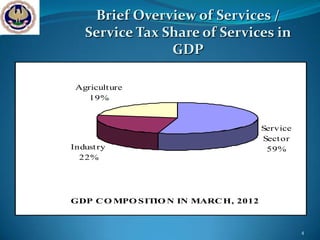
           Agriculture            19%
           Services               59%
           Industry               22%

                                             to be contd…….
                                                                 3
Brief Overview of Services /
   Service Tax Share of Services in
                GDP

 Agricult ure
    19%


                                       Service
                                       Sect or
Indust ry                               59%
  22%


GDP C O MPO S ITIO N IN MARC H, 2012


                                                 4
Service Tax in India (The Past)


 Introduced in India in 1994 as a simple, modest tax with just
  three services.
 Service tax – an indirect tax.

 Approach to Service Tax – Selective as against comprehensive
  one .
 Desirable from revenue, equity and economic view point.

 Governed by Finance Act, 1994 and a dozen of rules.

 Legislative dependence on other laws.

                                                                  5
Service Tax in India (The Past)


Selective Approach to Service Tax

   Selective v. Comprehensive approach
   Taxation by choice
   Service not defined but taxable service defined.
   > 120 taxable services [section 65(105)]
   Untapped tax potential
   Economically justified


                                                       6
Service Tax - Today

Shift to Comprehensive approach

    W.e.f. 1st July 2012

    Finance Act, 2012 – A land mark Act to shift from positive to
     negative approach.
    It took 18 years to shift from selective approach to positive
     approach to tax services
    Service’ defined for the first time.

    ‘Negative List’ and ‘declared services’ also defined.


                                                                7
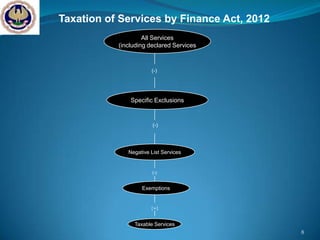
Taxation of Services by Finance Act, 2012
                    All Services
           (including declared Services


                       (-)


               Specific Exclusions


                        (-)


              Negative List Services


                        (-)


                   Exemptions


                       (=)


                Taxable Services
                                            8
Service Tax provisions no longer applicable
                      (w.e.f. 1.7.2012)

 Section 65        Old definitions of Services / Taxable
                    Services
 Section 65A       Classification of Services
 Section 66        Charge of Service Tax
 Section 66A       Charge of Service Tax on Services
                    received from outside India.

 Import of Service Rules, 2006
 Export of Service Rules, 2005


                                                            9
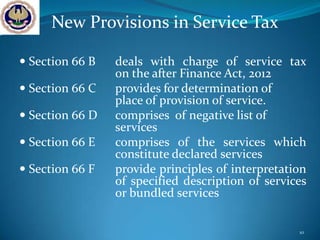
New Provisions in Service Tax

 Section 66 B   deals with charge of service tax
                 on the after Finance Act, 2012
 Section 66 C   provides for determination of
                 place of provision of service.
 Section 66 D   comprises of negative list of
                 services
 Section 66 E   comprises of the services which
                 constitute declared services
 Section 66 F   provide principles of interpretation
                 of specified description of services
                 or bundled services

                                                   10
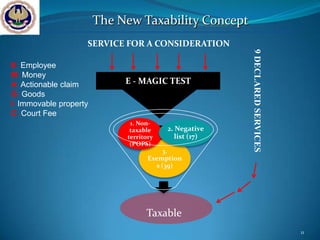
The New Taxability Concept
                    SERVICE FOR A CONSIDERATION


                                                             9 DECLARED SERVICES
E: Employee
M: Money
A: Actionable claim          E - MAGIC TEST
G: Goods
I: Immovable property
C: Court Fee
                              1. Non-
                              taxable         2. Negative
                             territory           list (17)
                              (POPS)
                                         3.
                                    Exemption
                                      s (39)


                                   Taxable
                                                                                   11
Taxable of Services w.e.f. 1.7.2012

   All services                    Taxable
     [section 65B (44)]
   Declared services               Taxable
      (section 66E)
   Services covered under          Not Taxable
      negative list of services
      (section 66D)
   Services exempt under Mega      Exempted
      Notification No. 25/2012-ST
       dated 20.6.2012
   Other specified Exemptions      Exempted


                                                  12
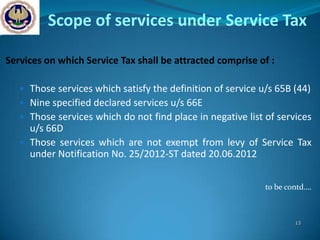
Scope of services under Service Tax

Services on which Service Tax shall be attracted comprise of :

    Those services which satisfy the definition of service u/s 65B (44)
    Nine specified declared services u/s 66E
    Those services which do not find place in negative list of services
     u/s 66D
    Those services which are not exempt from levy of Service Tax
     under Notification No. 25/2012-ST dated 20.06.2012


                                                             to be contd….


                                                                     13
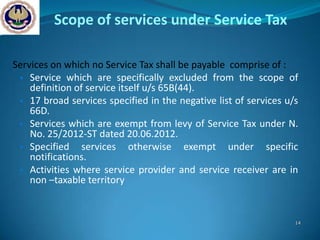
Scope of services under Service Tax

Services on which no Service Tax shall be payable comprise of :
 • Service which are specifically excluded from the scope of
    definition of service itself u/s 65B(44).
 • 17 broad services specified in the negative list of services u/s
    66D.
 • Services which are exempt from levy of Service Tax under N.
    No. 25/2012-ST dated 20.06.2012.
 • Specified services otherwise exempt under specific
    notifications.
 • Activities where service provider and service receiver are in
    non –taxable territory


                                                                  14
Negative list of Services


What is negative list

   • Defined in new section 66D


   • Section 66D specifies seventeen 17 broad categories of services.


   •   Effective from 1-7-2012

   • If an activity meets the characteristics of ‘ service ‘, it is taxable unless
       specified in Negative List.

   • Based on socio-economic–tax criterion


                                                                                     15
Sectors in Negative List

Negative list of services is drawn from seven sectors, viz.
   • services provided by specified person ie, Government
   • social welfare & public utilities
   • financial sector
   • transportation
   • construction & real estate
   • education
   • health care
   • others & miscellaneous


                                                              16
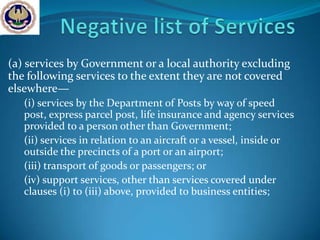
(a) services by Government or a local authority excluding
the following services to the extent they are not covered
elsewhere—
   (i) services by the Department of Posts by way of speed
   post, express parcel post, life insurance and agency services
   provided to a person other than Government;
   (ii) services in relation to an aircraft or a vessel, inside or
   outside the precincts of a port or an airport;
   (iii) transport of goods or passengers; or
   (iv) support services, other than services covered under
   clauses (i) to (iii) above, provided to business entities;
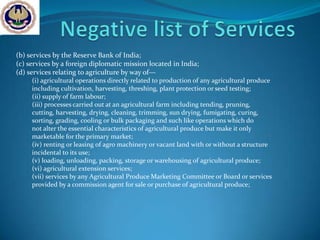
(b) services by the Reserve Bank of India;
(c) services by a foreign diplomatic mission located in India;
(d) services relating to agriculture by way of—
     (i) agricultural operations directly related to production of any agricultural produce
     including cultivation, harvesting, threshing, plant protection or seed testing;
     (ii) supply of farm labour;
     (iii) processes carried out at an agricultural farm including tending, pruning,
     cutting, harvesting, drying, cleaning, trimming, sun drying, fumigating, curing,
     sorting, grading, cooling or bulk packaging and such like operations which do
     not alter the essential characteristics of agricultural produce but make it only
     marketable for the primary market;
     (iv) renting or leasing of agro machinery or vacant land with or without a structure
     incidental to its use;
     (v) loading, unloading, packing, storage or warehousing of agricultural produce;
     (vi) agricultural extension services;
     (vii) services by any Agricultural Produce Marketing Committee or Board or services
     provided by a commission agent for sale or purchase of agricultural produce;
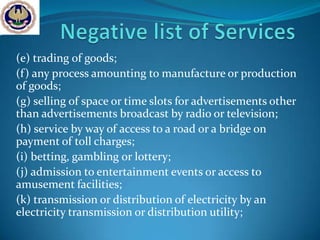
(e) trading of goods;
(f) any process amounting to manufacture or production
of goods;
(g) selling of space or time slots for advertisements other
than advertisements broadcast by radio or television;
(h) service by way of access to a road or a bridge on
payment of toll charges;
(i) betting, gambling or lottery;
(j) admission to entertainment events or access to
amusement facilities;
(k) transmission or distribution of electricity by an
electricity transmission or distribution utility;
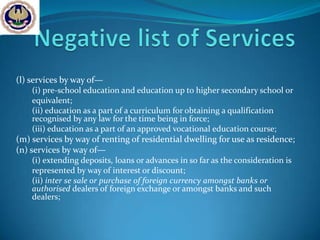
(l) services by way of—
    (i) pre-school education and education up to higher secondary school or
    equivalent;
    (ii) education as a part of a curriculum for obtaining a qualification
    recognised by any law for the time being in force;
    (iii) education as a part of an approved vocational education course;
(m) services by way of renting of residential dwelling for use as residence;
(n) services by way of—
    (i) extending deposits, loans or advances in so far as the consideration is
    represented by way of interest or discount;
    (ii) inter se sale or purchase of foreign currency amongst banks or
    authorised dealers of foreign exchange or amongst banks and such
    dealers;
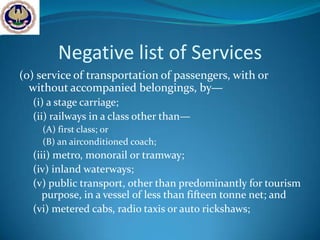
Negative list of Services
(o) service of transportation of passengers, with or
  without accompanied belongings, by—
  (i) a stage carriage;
  (ii) railways in a class other than—
    (A) first class; or
    (B) an airconditioned coach;
  (iii) metro, monorail or tramway;
  (iv) inland waterways;
  (v) public transport, other than predominantly for tourism
     purpose, in a vessel of less than fifteen tonne net; and
  (vi) metered cabs, radio taxis or auto rickshaws;
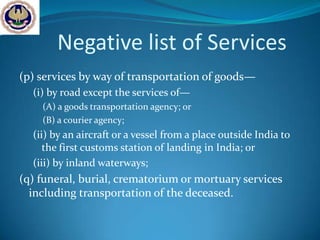
Negative list of Services
(p) services by way of transportation of goods—
  (i) by road except the services of—
    (A) a goods transportation agency; or
    (B) a courier agency;
  (ii) by an aircraft or a vessel from a place outside India to
     the first customs station of landing in India; or
  (iii) by inland waterways;
(q) funeral, burial, crematorium or mortuary services
  including transportation of the deceased.
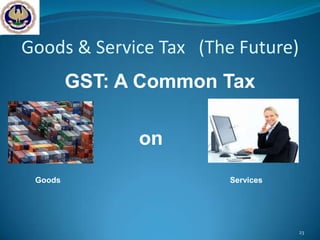
Goods & Service Tax (The Future)
         GST: A Common Tax

               on
 Goods                  Services


                                   23
Pre-requisites for migrating to a GST regime

•   Setting up of empowered committee for GST (like VAT) which can steer the road
    map into action - done
•   Broaden the tax base for excise duty (presently 40% comes from petroleum
    products) – being done
•   Finishing area based and product based exemptions – being done
•   Rationalization of concessions and exemptions including that on exports –
    being done
•   Expanding service tax to almost all services – now proposed
•   Common/unified tax rate for goods and services which may be ideally, revenue
    neutral (a suitable GST rate) – dual tax proposed
•   Avoiding or minimizing differential tax rates – under discussions
•   Abolition of other small taxes - under discussions
•   Abolition of CST in a phased manner - being done
•   Power to levy service tax on select/agreed services to States - under
    discussions
•   Issue of inter-State services and goods movement vis-à-vis levy of duty or tax
    to be sorted out - under discussions
•   Revenue sharing mechanism to be rationalized - under discussions


                                                                                 24
GST - Journey so far
 Feb. 2006 : First time introduced concept of GST and announced the
  date of its implementation in 2010

 Jan. 2007: First GST study by ASSOCHAM released by Dr. Shome

 Feb. 2007: F.M. Announced introduction of GST from 1 April 2010 in
  Budget

 April 2007 : CST phase out started - CST reduced to 3%, currently 1%

 May 2007: Joint Working Group formed by EC

 Nov. 2007: Joint Working Group submits report

 April 2008 : Empowered Committee (EC) finalizes views on GST
  Structure

 July 2009: FM announces commitment to bring GST from April 2010

 Consultation on inter-state services in progress                       25
GST - Journey so far

Budget 2010
   To achieve the roll out of GST by April 2011
   Revamping of indirect tax administration at centre/
    states internal work processes based on use of
    information technology - massive information
    technology (IT) platform
   Project ACES- ‘Automation of Central Excise and
    Service Tax’ rolled out
   Rate of service tax retained at ten per cent
   States to revamp their internal work processes


                                       to be contd……
                                                      26
GST - Journey so far

Budget 2011
 non-committal on timing and roll out but the Government
  introduced Constitutional Amendment Bill, 2011
 overall amendments targeted towards moving close to
  harmonize with GST regime in future
 major highlights of budget discussions/proposals on GST –
       DTC and GST to mark a water shed
       Decisions on GST to be taken in concert with the states
       Areas of divergence between centre and states narrowed
       Drafting of model legislation for central and state GST
        underway

                                             to be contd……
`

                                                              27
GST - Journey so far

 Establishment of IT infrastructure in process (GST
    network)
   NSDL selected as technology partner for GST
   Tax rates maintained at same level of 10% to stay on
    course towards ST
   Certain central excise rates changed to prepare the
    ground for transition to GST by reducing number of
    exemptions
   Nominal central excise duty of 1% imposed on 130
    items, no Cenvat credit allowed on such items.
   In service tax, proposals aimed to achieve a close fit
    between the present service tax regime and GST.
                                                         28
GST - Journey so far

Budget 2012
 No announcement on GST rollout date
 GST to be implemented in consultation with the States at the earliest
 GST network (GSTN) likely to be in place from August, 2012
 GSTN to     implement common PAN based registration, return filing and
  processing of payments for centre and all states on a shared platform.
 Bringing closer of Service Tax and Central Excise for transition to GST
 Drafting of model legislation for CGST and SGST under progress.
 Common forms for Service Tax and Central Excise registration and return
  proposed.
 Place of Supply Rules, 2012 to trigger debate to assess issues that may arise in
  taxation of inter state services for eventual launch of GST.

                                                                                 29
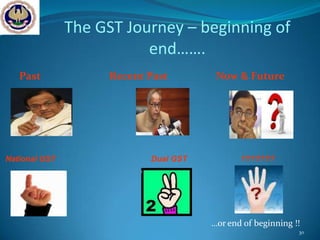
The GST Journey – beginning of
                          end…….
   Past             Recent Past        Now & Future


National GST               Dual GST          ???????


                                      …or end of beginning !!
                                                            30
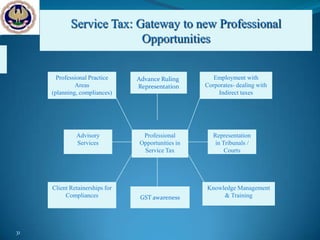
Service Tax: Gateway to new Professional
                          Opportunities

       Professional Practice    Advance Ruling        Employment with
              Areas             Representation     Corporates- dealing with
     (planning, compliances)                           Indirect taxes


              Advisory           Professional         Representation
              Services          Opportunities in       in Tribunals /
                                 Service Tax               Courts


     Client Retainerships for                      Knowledge Management
          Compliances            GST awareness          & Training


31
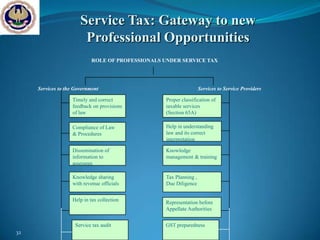
Service Tax: Gateway to new
                        Professional Opportunities
                            ROLE OF PROFESSIONALS UNDER SERVICE TAX


     Services to the Government                                     Services to Service Providers

                   Timely and correct              Proper classification of
                   feedback on provisions          taxable services
                   of law                          (Section 65A)

                   Compliance of Law               Help in understanding
                   & Procedures                    law and its correct
                                                   interpretation

                   Dissemination of                Knowledge
                   information to                  management & training
                   assessees

                   Knowledge sharing               Tax Planning ,
                   with revenue officials          Due Diligence


                   Help in tax collection         Representation before
                                                  Appellate Authorities


                     Service tax audit            GST preparedness
32
Service Tax: Gateway to new Professional
                         Opportunities

        New tax, new assessees, new opportunities
        Opportunities arising out of ignorance of law, lack of knowledge, poor
        compliance (leading to penalties etc.) frequent amendments in law and
        rules, large assessee base and heterogeneous group of assessees.
        Opportunities to grow because of –
           Large number of services covered
           Enough scope for expansion of tax net
           Rate of tax is higher, yet an upward revision is likely- higher the
            rate, larger the evasion.

     Service tax and GST are the tax of future and lot of opportunities can be
        explored in service tax, especially by young professionals


33
Service Tax: Gateway to new Professional
                        Opportunities


        Role in classification of services
        Opportunities in interpretation of provisions
        Emerging opportunities-
           Advisory and consulting services
           Tax planning issues
           Interpretation of law
           Contesting cases on behalf of client
           Knowledge dissemination- corporate presentations / training
            of client’s personnel.
     Every crossroad is a choice to play safe or be brave- take a road that
        your conscience tells

34
THANK YOU

           FOR

          YOUR

     PRECIOUS TIME

          AND

       ATTENTION

    Dr. Sanjiv Agarwal

     FCA, FCS, Jaipur

   asandco@gmail.com

sanjivservicetax@gmail.com

30.11.2012 jodhpur

  • 1.
    Regional Conference forCA Students (Waves of Change : Ocean of Opportunities ) Session On “Indirect Taxes” 30th November, 2012 By CIRC-ICAI, Jodhpur Branch Sanjiv Agarwal Jodhpur FCA, FCS © Dr. Sanjiv Agarwal
  • 2.
    This presentation covers–  Negative List Approach – Overview  Goods & Service Tax- Overview  Professional Opportunities
  • 3.
    Indian Economy –An overview  India’s economy is the 11th largest economy in the world and the second fastest growing even in today’s recession  World is presently facing recession-II but Indian economy is still better than comparable economies.  Agriculture, services and industry are the major sector of India an economy. Contribution of different sectors in March, 2012 was :  Agriculture 19%  Services 59%  Industry 22% to be contd……. 3
  • 4.
    Brief Overview ofServices / Service Tax Share of Services in GDP Agricult ure 19% Service Sect or Indust ry 59% 22% GDP C O MPO S ITIO N IN MARC H, 2012 4
  • 5.
    Service Tax inIndia (The Past)  Introduced in India in 1994 as a simple, modest tax with just three services.  Service tax – an indirect tax.  Approach to Service Tax – Selective as against comprehensive one .  Desirable from revenue, equity and economic view point.  Governed by Finance Act, 1994 and a dozen of rules.  Legislative dependence on other laws. 5
  • 6.
    Service Tax inIndia (The Past) Selective Approach to Service Tax  Selective v. Comprehensive approach  Taxation by choice  Service not defined but taxable service defined.  > 120 taxable services [section 65(105)]  Untapped tax potential  Economically justified 6
  • 7.
    Service Tax -Today Shift to Comprehensive approach  W.e.f. 1st July 2012  Finance Act, 2012 – A land mark Act to shift from positive to negative approach.  It took 18 years to shift from selective approach to positive approach to tax services  Service’ defined for the first time.  ‘Negative List’ and ‘declared services’ also defined. 7
  • 8.
    Taxation of Servicesby Finance Act, 2012 All Services (including declared Services (-) Specific Exclusions (-) Negative List Services (-) Exemptions (=) Taxable Services 8
  • 9.
    Service Tax provisionsno longer applicable (w.e.f. 1.7.2012)  Section 65 Old definitions of Services / Taxable Services  Section 65A Classification of Services  Section 66 Charge of Service Tax  Section 66A Charge of Service Tax on Services received from outside India.  Import of Service Rules, 2006  Export of Service Rules, 2005 9
  • 10.
    New Provisions inService Tax  Section 66 B deals with charge of service tax on the after Finance Act, 2012  Section 66 C provides for determination of place of provision of service.  Section 66 D comprises of negative list of services  Section 66 E comprises of the services which constitute declared services  Section 66 F provide principles of interpretation of specified description of services or bundled services 10
  • 11.
    The New TaxabilityConcept SERVICE FOR A CONSIDERATION 9 DECLARED SERVICES E: Employee M: Money A: Actionable claim E - MAGIC TEST G: Goods I: Immovable property C: Court Fee 1. Non- taxable 2. Negative territory list (17) (POPS) 3. Exemption s (39) Taxable 11
  • 12.
    Taxable of Servicesw.e.f. 1.7.2012  All services Taxable [section 65B (44)]  Declared services Taxable (section 66E)  Services covered under Not Taxable negative list of services (section 66D)  Services exempt under Mega Exempted Notification No. 25/2012-ST dated 20.6.2012  Other specified Exemptions Exempted 12
  • 13.
    Scope of servicesunder Service Tax Services on which Service Tax shall be attracted comprise of :  Those services which satisfy the definition of service u/s 65B (44)  Nine specified declared services u/s 66E  Those services which do not find place in negative list of services u/s 66D  Those services which are not exempt from levy of Service Tax under Notification No. 25/2012-ST dated 20.06.2012 to be contd…. 13
  • 14.
    Scope of servicesunder Service Tax Services on which no Service Tax shall be payable comprise of : • Service which are specifically excluded from the scope of definition of service itself u/s 65B(44). • 17 broad services specified in the negative list of services u/s 66D. • Services which are exempt from levy of Service Tax under N. No. 25/2012-ST dated 20.06.2012. • Specified services otherwise exempt under specific notifications. • Activities where service provider and service receiver are in non –taxable territory 14
  • 15.
    Negative list ofServices What is negative list • Defined in new section 66D • Section 66D specifies seventeen 17 broad categories of services. • Effective from 1-7-2012 • If an activity meets the characteristics of ‘ service ‘, it is taxable unless specified in Negative List. • Based on socio-economic–tax criterion 15
  • 16.
    Sectors in NegativeList Negative list of services is drawn from seven sectors, viz. • services provided by specified person ie, Government • social welfare & public utilities • financial sector • transportation • construction & real estate • education • health care • others & miscellaneous 16
  • 17.
    (a) services byGovernment or a local authority excluding the following services to the extent they are not covered elsewhere— (i) services by the Department of Posts by way of speed post, express parcel post, life insurance and agency services provided to a person other than Government; (ii) services in relation to an aircraft or a vessel, inside or outside the precincts of a port or an airport; (iii) transport of goods or passengers; or (iv) support services, other than services covered under clauses (i) to (iii) above, provided to business entities;
  • 18.
    (b) services bythe Reserve Bank of India; (c) services by a foreign diplomatic mission located in India; (d) services relating to agriculture by way of— (i) agricultural operations directly related to production of any agricultural produce including cultivation, harvesting, threshing, plant protection or seed testing; (ii) supply of farm labour; (iii) processes carried out at an agricultural farm including tending, pruning, cutting, harvesting, drying, cleaning, trimming, sun drying, fumigating, curing, sorting, grading, cooling or bulk packaging and such like operations which do not alter the essential characteristics of agricultural produce but make it only marketable for the primary market; (iv) renting or leasing of agro machinery or vacant land with or without a structure incidental to its use; (v) loading, unloading, packing, storage or warehousing of agricultural produce; (vi) agricultural extension services; (vii) services by any Agricultural Produce Marketing Committee or Board or services provided by a commission agent for sale or purchase of agricultural produce;
  • 19.
    (e) trading ofgoods; (f) any process amounting to manufacture or production of goods; (g) selling of space or time slots for advertisements other than advertisements broadcast by radio or television; (h) service by way of access to a road or a bridge on payment of toll charges; (i) betting, gambling or lottery; (j) admission to entertainment events or access to amusement facilities; (k) transmission or distribution of electricity by an electricity transmission or distribution utility;
  • 20.
    (l) services byway of— (i) pre-school education and education up to higher secondary school or equivalent; (ii) education as a part of a curriculum for obtaining a qualification recognised by any law for the time being in force; (iii) education as a part of an approved vocational education course; (m) services by way of renting of residential dwelling for use as residence; (n) services by way of— (i) extending deposits, loans or advances in so far as the consideration is represented by way of interest or discount; (ii) inter se sale or purchase of foreign currency amongst banks or authorised dealers of foreign exchange or amongst banks and such dealers;
  • 21.
    Negative list ofServices (o) service of transportation of passengers, with or without accompanied belongings, by— (i) a stage carriage; (ii) railways in a class other than— (A) first class; or (B) an airconditioned coach; (iii) metro, monorail or tramway; (iv) inland waterways; (v) public transport, other than predominantly for tourism purpose, in a vessel of less than fifteen tonne net; and (vi) metered cabs, radio taxis or auto rickshaws;
  • 22.
    Negative list ofServices (p) services by way of transportation of goods— (i) by road except the services of— (A) a goods transportation agency; or (B) a courier agency; (ii) by an aircraft or a vessel from a place outside India to the first customs station of landing in India; or (iii) by inland waterways; (q) funeral, burial, crematorium or mortuary services including transportation of the deceased.
  • 23.
    Goods & ServiceTax (The Future) GST: A Common Tax on Goods Services 23
  • 24.
    Pre-requisites for migratingto a GST regime • Setting up of empowered committee for GST (like VAT) which can steer the road map into action - done • Broaden the tax base for excise duty (presently 40% comes from petroleum products) – being done • Finishing area based and product based exemptions – being done • Rationalization of concessions and exemptions including that on exports – being done • Expanding service tax to almost all services – now proposed • Common/unified tax rate for goods and services which may be ideally, revenue neutral (a suitable GST rate) – dual tax proposed • Avoiding or minimizing differential tax rates – under discussions • Abolition of other small taxes - under discussions • Abolition of CST in a phased manner - being done • Power to levy service tax on select/agreed services to States - under discussions • Issue of inter-State services and goods movement vis-à-vis levy of duty or tax to be sorted out - under discussions • Revenue sharing mechanism to be rationalized - under discussions 24
  • 25.
    GST - Journeyso far  Feb. 2006 : First time introduced concept of GST and announced the date of its implementation in 2010  Jan. 2007: First GST study by ASSOCHAM released by Dr. Shome  Feb. 2007: F.M. Announced introduction of GST from 1 April 2010 in Budget  April 2007 : CST phase out started - CST reduced to 3%, currently 1%  May 2007: Joint Working Group formed by EC  Nov. 2007: Joint Working Group submits report  April 2008 : Empowered Committee (EC) finalizes views on GST Structure  July 2009: FM announces commitment to bring GST from April 2010  Consultation on inter-state services in progress 25
  • 26.
    GST - Journeyso far Budget 2010  To achieve the roll out of GST by April 2011  Revamping of indirect tax administration at centre/ states internal work processes based on use of information technology - massive information technology (IT) platform  Project ACES- ‘Automation of Central Excise and Service Tax’ rolled out  Rate of service tax retained at ten per cent  States to revamp their internal work processes to be contd…… 26
  • 27.
    GST - Journeyso far Budget 2011  non-committal on timing and roll out but the Government introduced Constitutional Amendment Bill, 2011  overall amendments targeted towards moving close to harmonize with GST regime in future  major highlights of budget discussions/proposals on GST –  DTC and GST to mark a water shed  Decisions on GST to be taken in concert with the states  Areas of divergence between centre and states narrowed  Drafting of model legislation for central and state GST underway to be contd…… ` 27
  • 28.
    GST - Journeyso far  Establishment of IT infrastructure in process (GST network)  NSDL selected as technology partner for GST  Tax rates maintained at same level of 10% to stay on course towards ST  Certain central excise rates changed to prepare the ground for transition to GST by reducing number of exemptions  Nominal central excise duty of 1% imposed on 130 items, no Cenvat credit allowed on such items.  In service tax, proposals aimed to achieve a close fit between the present service tax regime and GST. 28
  • 29.
    GST - Journeyso far Budget 2012  No announcement on GST rollout date  GST to be implemented in consultation with the States at the earliest  GST network (GSTN) likely to be in place from August, 2012  GSTN to implement common PAN based registration, return filing and processing of payments for centre and all states on a shared platform.  Bringing closer of Service Tax and Central Excise for transition to GST  Drafting of model legislation for CGST and SGST under progress.  Common forms for Service Tax and Central Excise registration and return proposed.  Place of Supply Rules, 2012 to trigger debate to assess issues that may arise in taxation of inter state services for eventual launch of GST. 29
  • 30.
    The GST Journey– beginning of end……. Past Recent Past Now & Future National GST Dual GST ??????? …or end of beginning !! 30
  • 31.
    Service Tax: Gatewayto new Professional Opportunities Professional Practice Advance Ruling Employment with Areas Representation Corporates- dealing with (planning, compliances) Indirect taxes Advisory Professional Representation Services Opportunities in in Tribunals / Service Tax Courts Client Retainerships for Knowledge Management Compliances GST awareness & Training 31
  • 32.
    Service Tax: Gatewayto new Professional Opportunities ROLE OF PROFESSIONALS UNDER SERVICE TAX Services to the Government Services to Service Providers Timely and correct Proper classification of feedback on provisions taxable services of law (Section 65A) Compliance of Law Help in understanding & Procedures law and its correct interpretation Dissemination of Knowledge information to management & training assessees Knowledge sharing Tax Planning , with revenue officials Due Diligence Help in tax collection Representation before Appellate Authorities Service tax audit GST preparedness 32
  • 33.
    Service Tax: Gatewayto new Professional Opportunities New tax, new assessees, new opportunities Opportunities arising out of ignorance of law, lack of knowledge, poor compliance (leading to penalties etc.) frequent amendments in law and rules, large assessee base and heterogeneous group of assessees. Opportunities to grow because of –  Large number of services covered  Enough scope for expansion of tax net  Rate of tax is higher, yet an upward revision is likely- higher the rate, larger the evasion. Service tax and GST are the tax of future and lot of opportunities can be explored in service tax, especially by young professionals 33
  • 34.
    Service Tax: Gatewayto new Professional Opportunities Role in classification of services Opportunities in interpretation of provisions Emerging opportunities-  Advisory and consulting services  Tax planning issues  Interpretation of law  Contesting cases on behalf of client  Knowledge dissemination- corporate presentations / training of client’s personnel. Every crossroad is a choice to play safe or be brave- take a road that your conscience tells 34
  • 35.
    THANK YOU FOR YOUR PRECIOUS TIME AND ATTENTION Dr. Sanjiv Agarwal FCA, FCS, Jaipur asandco@gmail.com sanjivservicetax@gmail.com