1
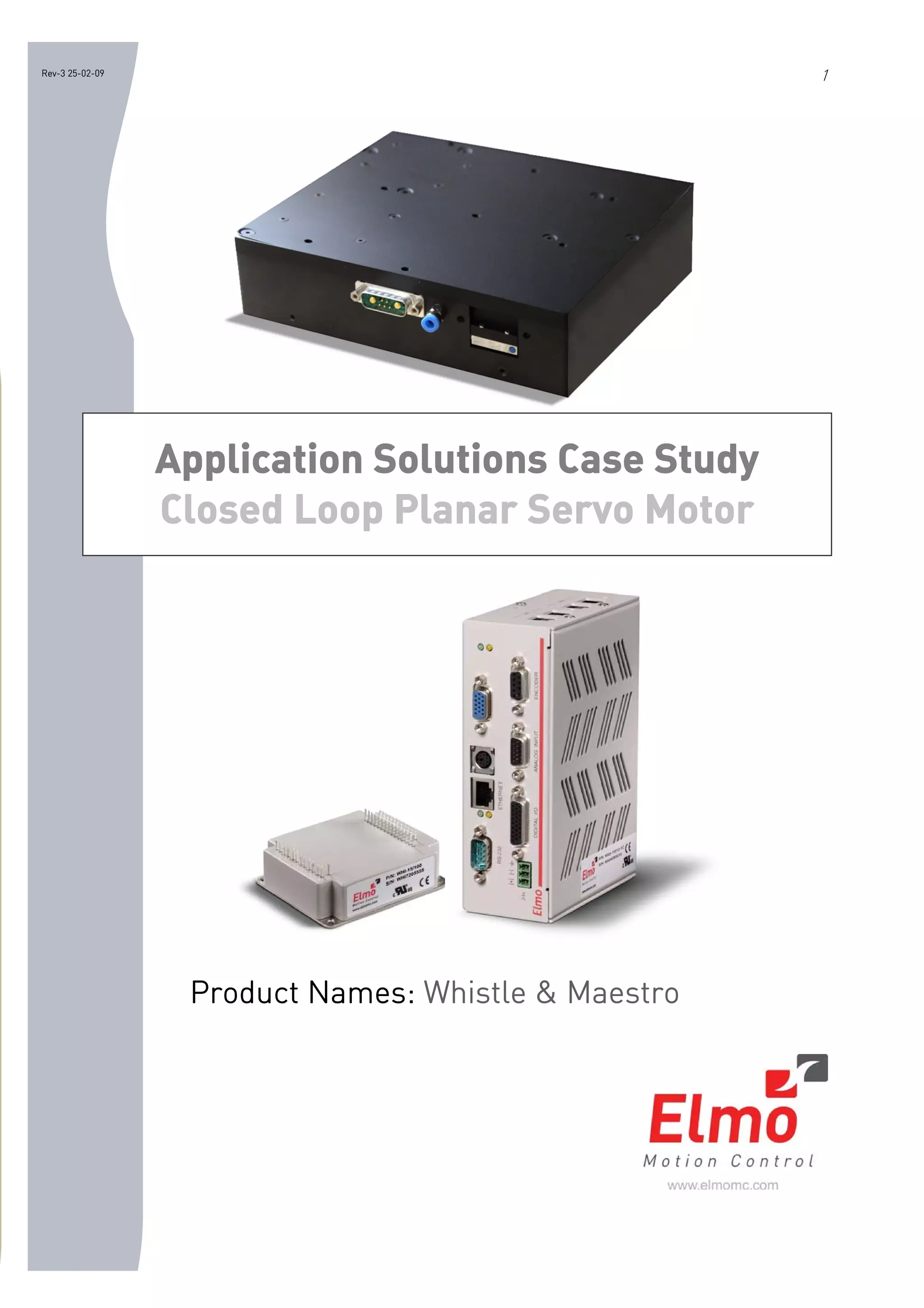
Product Names: Whistle & Maestro
Application Solutions Case Study
Closed Loop Planar Servo Motor
Rev-3 25-02-09
2
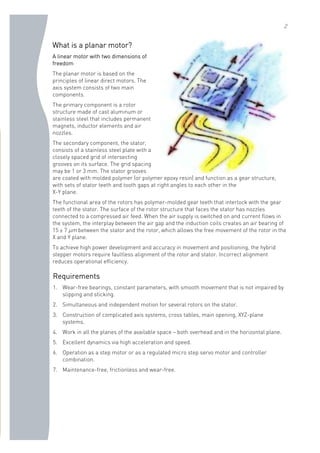
What is a planar motor?
A linear motor with two dimensions of
freedom
The planar motor is based on the
principles of linear direct motors. The
axis system consists of two main
components.
The primary component is a rotor
structure made of cast aluminum or
stainless steel that includes permanent
magnets, inductor elements and air
nozzles.
The secondary component, the stator,
consists of a stainless steel plate with a
closely spaced grid of intersecting
grooves on its surface. The grid spacing
may be 1 or 3 mm. The stator grooves
are coated with molded polymer (or polymer epoxy resin) and function as a gear structure,
with sets of stator teeth and tooth gaps at right angles to each other in the
X-Y plane.
The functional area of the rotors has polymer-molded gear teeth that interlock with the gear
teeth of the stator. The surface of the rotor structure that faces the stator has nozzles
connected to a compressed air feed. When the air supply is switched on and current flows in
the system, the interplay between the air gap and the induction coils creates an air bearing of
15 ± 7 μm between the stator and the rotor, which allows the free movement of the rotor in the
X and Y plane.
To achieve high power development and accuracy in movement and positioning, the hybrid
stepper motors require faultless alignment of the rotor and stator. Incorrect alignment
reduces operational efficiency.
Requirements
1. Wear-free bearings, constant parameters, with smooth movement that is not impaired by
slipping and sticking.
2. Simultaneous and independent motion for several rotors on the stator.
3. Construction of complicated axis systems, cross tables, main opening, XYZ-plane
systems.
4. Work in all the planes of the available space – both overhead and in the horizontal plane.
5. Excellent dynamics via high acceleration and speed.
6. Operation as a step motor or as a regulated micro step servo motor and controller
combination.
7. Maintenance-free, frictionless and wear-free.
3
Planar Motor
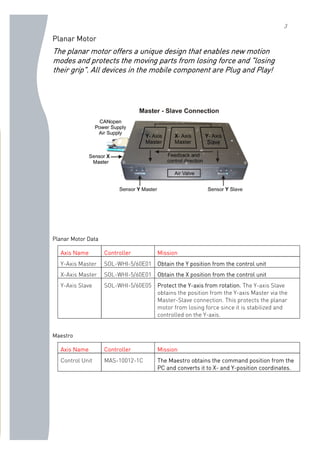
The planar motor offers a unique design that enables new motion
modes and protects the moving parts from losing force and "losing
their grip". All devices in the mobile component are Plug and Play!
Planar Motor Data
Axis Name Controller Mission
Y-Axis Master SOL-WHI-5/60E01 Obtain the Y position from the control unit
X-Axis Master SOL-WHI-5/60E01 Obtain the X position from the control unit
Y-Axis Slave SOL-WHI-5/60E05 Protect the Y-axis from rotation. The Y-axis Slave
obtains the position from the Y-axis Master via the
Master-Slave connection. This protects the planar
motor from losing force since it is stabilized and
controlled on the Y-axis.
Maestro
Axis Name Controller Mission
Control Unit MAS-10012-1C The Maestro obtains the command position from the
PC and converts it to X- and Y-position coordinates.
4
Motor Data
Feature Specification
Type Servo planar motor (air bearing hybrid stepper motor)
Weight 7 kg
Numbers of motors Three motors (1x X / 2x Y)
Force per motor Maximum 40 N (at 3 A continuous current)
Special Y-motor in Master-Slave working mode (position
control) to protect the motor against rotation
Air valve Onboard
Amplifier for addition application Onboard
Supply voltage 48 VDC, 24 VDC
Communication CANopen
Inductive encoders Encoder system AMO, resolution 0.00025 mm
Encoder measurement system Stator of the motors
The Challenge
How to commutate a system when the measurement system is moving
In contrast to other planar systems, the moving part of this planar motor includes the
measurement mechanism. This mechanism makes the planar motor cheaper and provides
more options for different measurement systems.
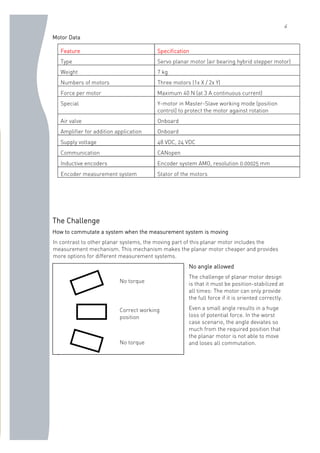
No angle allowed
The challenge of planar motor design
is that it must be position-stabilized at
all times: The motor can only provide
the full force if it is oriented correctly.
Even a small angle results in a huge
loss of potential force. In the worst
case scenario, the angle deviates so
much from the required position that
the planar motor is not able to move
and loses all commutation.
.
No torque
No torque
Correct working
position
5
The Elmo Solution
How the commutation works
Movements Description
At start-up, the location and orientation of the planar
motor is unknown. The planar motor can only acquire
force if it is positioned correctly.
All feedbacks must be inactive and all the Y-axis SimplIQ-
Whistle drives must move with the same speed relative to
the frame,
The planar motor moves to the outer frame in the
“Stepper” mode (not using the feedback), to arrive at the
correct starting position.
The twist is corrected and the SimplIQ-Whistle drives on
the Y-axis are commutated.
The planar motor must move to a corner to define its
second position. While moving, the motor must
continually verify that it is always correctly positioned with
respect to the frame.
From the corner, the motor can commutate the X-axis.
With all the axes commutating, the planar motor is able to
move in position mode and the Master-Slave protection is
activated.
How does the anti-angle work?
Because the communication is not sufficiently fast to handle the synchronization, Elmo
Motion Control recommends that both devices be set up in a Position-Follower
configuration. The YA[N]command for the SimplIQ-Whistle defines the behavior and
direction of the auxiliary position sensor signals. YA[4] is used to specify that the auxiliary
encoder pins shall be outputs, and shall repeat the pulses of the main position
incremental or analog sensors. This mode is used to enable other drives to follow,
without electrically overloading the main position sensor.
The main position incremental encoder is direct on
every controller. The Master is controlled in position or
velocity mode and sends its position over the auxiliary
encoder. YA[4] = 4 specifies that there are no auxiliary
encoder inputs and that the auxiliary encoder pin output
repeats the main encoder input (or produces an
emulated encoder signal for drives with analog encoder
or resolver feedback options).
The situation is similar for the Slave. YA[4] = 2 sets up an auxiliary encoder entry that is
used as input for external quadrate incremental encoder signals.
Master Slave
Main Feedback
6
Program example:
#@AUTOEXEC
YA[4]=2 // Set AUX feedback as quadrate incremental encoder command input.
FR[3]=1 // Set follower ratio to 100%
AG[2]=0 // Disable influence of analog input
RM=1 // Enable reference mode
UM=5 // Set position mode
MO=1 // Motor on
BG // Begin motion
Advantages of using the Maestro as a control unit
Movement Description
The Maestro controls only the Master Axis for the planar
motor.
Setting up the movement parameters. Both axes are
controlled as vectors. At the beginning, after each
movement, we want the motor to wait for new
commands:
v1.attach()
v1.vsp=70000 // max velocity
v1.vse=0 //* end velocity*/
Achieving point-to-point movement. Initially, we want
the motor to start at 0 and move to a position in the field.
v1.line(70000, 100000) //go to position (7000,10000)
v1.bg //action!
Achieving more interesting motion. It is more useful to
work as a vector from this location.
What we want:
Radius 50000,
Start angle 180°
3/4 turn=270°
v1.circle(50000, 180, 270) // create circle
v1.bg // start motion
Radius 50000
start angle 180°
(70000,10000)
7
Important considerations
• Standard voltage is 48 V DC. It is possible to work with up to 85 V DC for high
speed applications.
• Reduce the amount of cabling to greatly improve performance.
• Plug and Play functionality simplifies the motion system.
• Closed loop functionality provides very high resolution and better control.
• Smoother movement is possible because all the axes have one feedback
system.
• Control at a low level is enabled: The Master-Slave control needs to be
extremely fast and precise.
• Mass is important because all the devices are moving.
PASIM Direktantriebe GmbH was founded in 1991 by Dr. Günter Dreifke, based on the know-
how of the Technical University of Ilmenau. This expertise, coupled with knowledgeable,
experienced staff and patented solutions is, to this day, the foundation and guarantee of
sound, steady technical and corporate development.
The core business of PASIM is the development, manufacture, distribution and servicing of the
company's air-mounted direct drives and systems. The advanced mechatronic products are
produced by the company's personnel in close cooperation with regional partners. The
company employs seventeen staff members.
Why Elmo:
• Advanced motion and servo control
• Distributed networking
• High density coupled with high power
• High reliability
• High efficiency
• Easy to use: Reduction of complexity
• Compact Size
For more information on Elmo:
Elmo Motion Control Ltd.
64 Gissin St. P.O. Box 463
Petach Tikva 49103 Israel
Tel: +972-3-929-2300
Fax: +972-3-929-2322
Email: info-il@elmomc.com
www.elmomc.com

Closed loop-planar-servo-motor

  • 1.
    1 Product Names: Whistle& Maestro Application Solutions Case Study Closed Loop Planar Servo Motor Rev-3 25-02-09
  • 2.
    2 What is aplanar motor? A linear motor with two dimensions of freedom The planar motor is based on the principles of linear direct motors. The axis system consists of two main components. The primary component is a rotor structure made of cast aluminum or stainless steel that includes permanent magnets, inductor elements and air nozzles. The secondary component, the stator, consists of a stainless steel plate with a closely spaced grid of intersecting grooves on its surface. The grid spacing may be 1 or 3 mm. The stator grooves are coated with molded polymer (or polymer epoxy resin) and function as a gear structure, with sets of stator teeth and tooth gaps at right angles to each other in the X-Y plane. The functional area of the rotors has polymer-molded gear teeth that interlock with the gear teeth of the stator. The surface of the rotor structure that faces the stator has nozzles connected to a compressed air feed. When the air supply is switched on and current flows in the system, the interplay between the air gap and the induction coils creates an air bearing of 15 ± 7 μm between the stator and the rotor, which allows the free movement of the rotor in the X and Y plane. To achieve high power development and accuracy in movement and positioning, the hybrid stepper motors require faultless alignment of the rotor and stator. Incorrect alignment reduces operational efficiency. Requirements 1. Wear-free bearings, constant parameters, with smooth movement that is not impaired by slipping and sticking. 2. Simultaneous and independent motion for several rotors on the stator. 3. Construction of complicated axis systems, cross tables, main opening, XYZ-plane systems. 4. Work in all the planes of the available space – both overhead and in the horizontal plane. 5. Excellent dynamics via high acceleration and speed. 6. Operation as a step motor or as a regulated micro step servo motor and controller combination. 7. Maintenance-free, frictionless and wear-free.
  • 3.
    3 Planar Motor The planarmotor offers a unique design that enables new motion modes and protects the moving parts from losing force and "losing their grip". All devices in the mobile component are Plug and Play! Planar Motor Data Axis Name Controller Mission Y-Axis Master SOL-WHI-5/60E01 Obtain the Y position from the control unit X-Axis Master SOL-WHI-5/60E01 Obtain the X position from the control unit Y-Axis Slave SOL-WHI-5/60E05 Protect the Y-axis from rotation. The Y-axis Slave obtains the position from the Y-axis Master via the Master-Slave connection. This protects the planar motor from losing force since it is stabilized and controlled on the Y-axis. Maestro Axis Name Controller Mission Control Unit MAS-10012-1C The Maestro obtains the command position from the PC and converts it to X- and Y-position coordinates.
  • 4.
    4 Motor Data Feature Specification TypeServo planar motor (air bearing hybrid stepper motor) Weight 7 kg Numbers of motors Three motors (1x X / 2x Y) Force per motor Maximum 40 N (at 3 A continuous current) Special Y-motor in Master-Slave working mode (position control) to protect the motor against rotation Air valve Onboard Amplifier for addition application Onboard Supply voltage 48 VDC, 24 VDC Communication CANopen Inductive encoders Encoder system AMO, resolution 0.00025 mm Encoder measurement system Stator of the motors The Challenge How to commutate a system when the measurement system is moving In contrast to other planar systems, the moving part of this planar motor includes the measurement mechanism. This mechanism makes the planar motor cheaper and provides more options for different measurement systems. No angle allowed The challenge of planar motor design is that it must be position-stabilized at all times: The motor can only provide the full force if it is oriented correctly. Even a small angle results in a huge loss of potential force. In the worst case scenario, the angle deviates so much from the required position that the planar motor is not able to move and loses all commutation. . No torque No torque Correct working position
  • 5.
    5 The Elmo Solution Howthe commutation works Movements Description At start-up, the location and orientation of the planar motor is unknown. The planar motor can only acquire force if it is positioned correctly. All feedbacks must be inactive and all the Y-axis SimplIQ- Whistle drives must move with the same speed relative to the frame, The planar motor moves to the outer frame in the “Stepper” mode (not using the feedback), to arrive at the correct starting position. The twist is corrected and the SimplIQ-Whistle drives on the Y-axis are commutated. The planar motor must move to a corner to define its second position. While moving, the motor must continually verify that it is always correctly positioned with respect to the frame. From the corner, the motor can commutate the X-axis. With all the axes commutating, the planar motor is able to move in position mode and the Master-Slave protection is activated. How does the anti-angle work? Because the communication is not sufficiently fast to handle the synchronization, Elmo Motion Control recommends that both devices be set up in a Position-Follower configuration. The YA[N]command for the SimplIQ-Whistle defines the behavior and direction of the auxiliary position sensor signals. YA[4] is used to specify that the auxiliary encoder pins shall be outputs, and shall repeat the pulses of the main position incremental or analog sensors. This mode is used to enable other drives to follow, without electrically overloading the main position sensor. The main position incremental encoder is direct on every controller. The Master is controlled in position or velocity mode and sends its position over the auxiliary encoder. YA[4] = 4 specifies that there are no auxiliary encoder inputs and that the auxiliary encoder pin output repeats the main encoder input (or produces an emulated encoder signal for drives with analog encoder or resolver feedback options). The situation is similar for the Slave. YA[4] = 2 sets up an auxiliary encoder entry that is used as input for external quadrate incremental encoder signals. Master Slave Main Feedback
  • 6.
    6 Program example: #@AUTOEXEC YA[4]=2 //Set AUX feedback as quadrate incremental encoder command input. FR[3]=1 // Set follower ratio to 100% AG[2]=0 // Disable influence of analog input RM=1 // Enable reference mode UM=5 // Set position mode MO=1 // Motor on BG // Begin motion Advantages of using the Maestro as a control unit Movement Description The Maestro controls only the Master Axis for the planar motor. Setting up the movement parameters. Both axes are controlled as vectors. At the beginning, after each movement, we want the motor to wait for new commands: v1.attach() v1.vsp=70000 // max velocity v1.vse=0 //* end velocity*/ Achieving point-to-point movement. Initially, we want the motor to start at 0 and move to a position in the field. v1.line(70000, 100000) //go to position (7000,10000) v1.bg //action! Achieving more interesting motion. It is more useful to work as a vector from this location. What we want: Radius 50000, Start angle 180° 3/4 turn=270° v1.circle(50000, 180, 270) // create circle v1.bg // start motion Radius 50000 start angle 180° (70000,10000)
  • 7.
    7 Important considerations • Standardvoltage is 48 V DC. It is possible to work with up to 85 V DC for high speed applications. • Reduce the amount of cabling to greatly improve performance. • Plug and Play functionality simplifies the motion system. • Closed loop functionality provides very high resolution and better control. • Smoother movement is possible because all the axes have one feedback system. • Control at a low level is enabled: The Master-Slave control needs to be extremely fast and precise. • Mass is important because all the devices are moving. PASIM Direktantriebe GmbH was founded in 1991 by Dr. Günter Dreifke, based on the know- how of the Technical University of Ilmenau. This expertise, coupled with knowledgeable, experienced staff and patented solutions is, to this day, the foundation and guarantee of sound, steady technical and corporate development. The core business of PASIM is the development, manufacture, distribution and servicing of the company's air-mounted direct drives and systems. The advanced mechatronic products are produced by the company's personnel in close cooperation with regional partners. The company employs seventeen staff members. Why Elmo: • Advanced motion and servo control • Distributed networking • High density coupled with high power • High reliability • High efficiency • Easy to use: Reduction of complexity • Compact Size For more information on Elmo: Elmo Motion Control Ltd. 64 Gissin St. P.O. Box 463 Petach Tikva 49103 Israel Tel: +972-3-929-2300 Fax: +972-3-929-2322 Email: info-il@elmomc.com www.elmomc.com