CSE622 Network Management
CH11 : Service Level Management
Knowing What You Pay For
Presented to: Prof.Dr. Hossam Mahmoud Fahmy
Prepared by: Eng. Ahmed Abdel Hafeez Ibrahim
Eng. Wafaa Alsayed Agmi
Contents
11.1 The Motivation for Service Level Agreements
11.2 Identification of Service Level Parameters
11.3 Defining a Service Level Agreement
11.4 Managing for a Service Level
THE AUTHOR
Dr. Alexander Clemm
Books
- 6 books from 1994 - 2017
- Network-Embedded Management and Applications:
Understanding Programmable Networking Infrastructure.
Springer, July 2012
- Network Management Fundamentals.
Pearson/ Cisco Press, Indianapolis, Indiana/ USA, November 2006.
Also translated into Chinese: 网络管理技术架构.
Posts and Telecommunications Press, China, January 2008.
THE AUTHOR
Teaching
Adjunct Professor at the Faculty for Computer Engineering, Santa Clara
University , Santa Clara, California/USA (since 2008).
Class “Network Management”
Publications
- 45 publication from 1996 - 2017
- Model-Driven Analytics in SDN Networks.
IFIP/IEEE International Symposium on Integrated Network Management
(IM 2017), Lisbon, Portugal, May 2017 .
Introduction
• The network provider provide a network service as a product to a
customer or a user who pay for this service.
• technical properties, such as performance, capacity, and availability of
service in the form of a service level agreement (SLA).
• the technical terms of the service that is being provided. In addition, it
includes business terms, such as precise terms of what will happen if
the agreed-to service level is not met.
The Definition of the service level
The Definition of the service level agreement
Introduction
The Definition of the service level agreement
A service level agreement (“SLA”) is a formal document describing the level
of service a customer expects from a service provider.
SLA is intended to specify performance expectations, responsibilities and
metrics. It ensures all parties have the same understanding of and improves
each parties ability to reach planned goals.
We must remember that the SLA is an output of the Service Level
Management process. If we focus too strongly on developing SLAs without
their supporting process, then we may miss some key process activities that
are critical dependencies to ensure the efficiency and effectiveness of
delivering services.
11.1 The Motivation for Service Level Agreements
• SLA as a contract between the provider and the user of a
communications service define the service level that is
expected for the service—characteristics of the service that
relate to aspects such as its performance, capacity, and
availability properties.
• Because communication needs vary greatly between
customers, SLAs are often customized and negotiated on a
case-by-case basis according to service type such as a VPN
or Internet Data Center host web site.
11.1 The Motivation for Service Level Agreements
• In an SLA, the desired service level is defined by a set of service level
objectives. A service level objective consists of a service level
parameter and a target value for that parameter that must be met or
exceeded. For example, a service level objective might stipulate that the
capacity on a link that connects two enterprise sites is 100 Mbps.
Another service level objective that is defined by time interval might
state that on weekdays between 8 a.m. and 6 p.m., availability of the link
must be 99.9 percent.
11.1 The Motivation for Service Level Agreements
• the SLA generally also contains nontechnical aspects.
Those aspects explain what is to happen in case the service
level falls below the target and certain objectives are not
met—ranging from corrective actions that will be taken to
financial penalties that will be sustained.
11.2 Identification of Service Level Parameters
• Significance—It must be significant and meaningful for the
service that is being defined.
• Relevance—It must be relevant to the context in which the
service will be used.
• Measurability—It must be measurable and objectively
verifiable.
The criteria of the service level parameters
11.2 Identification of Service Level Parameters
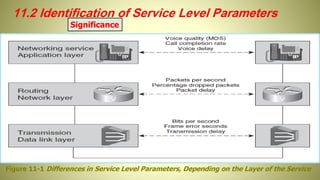
• Parameters that give a much more meaningful to users such as
dropped calls, background noise, and perceived voice quality
instead of Jitter.
• The more the parameters are significant, the more the user can
use it in complain, such as “The network dropped my call three
times,” “There is background noise on the line,” or simply “My
voice quality is crap.”
Significance
11.2 Identification of Service Level Parameters
Significance
Figure 11-1 Differences in Service Level Parameters, Depending on the Layer of the Service
11.2 Identification of Service Level Parameters
• The time that it takes until a user hears a dial tone when picking up the
phone.
• End-to-end voice delay.
• Call completion rate.
• Busy hour call attempts (BHCA), the number of call attempts during the
busiest period of the day.
• The length of time that it takes until a ring tone is received after a call is
dialed
The significant parameters for a voice service level
11.2 Identification of Service Level Parameters
• The parameters must be dependent to the context to avoid
shifting attention away from it.
• A parameter might also not be relevant when it is simply met.
For example, the BHCA parameter that we just encountered
for voice service enable users to judge the service.
Relevance
• The parameters must be measurable, verifiable and cost-effective to
test if the service is met or not.
• To make the MOS score measurable and cost effective, an automatic
software that analyzes call samples. Such software can generate
synthetic MOS scores that provide a good approximation of actual
MOS scores.
Measurability
11.2 Identification of Service Level Parameters
11.3 Defining a Service Level Agreement
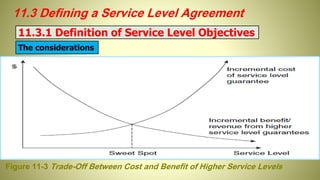
Figure 11-3 Trade-Off Between Cost and Benefit of Higher Service Levels
11.3.1 Definition of Service Level Objectives
The considerations
11.3 Defining a Service Level Agreement
•Specific: it must not be ambiguous such as “delay”.
•Realistic: it must not be fake to just complete the
contract. The provider should never make a promise
that can’t answer to keep the confidence with customer.
11.3.1 Definition of Service Level Objectives
The considerations
11.3 Defining a Service Level Agreement
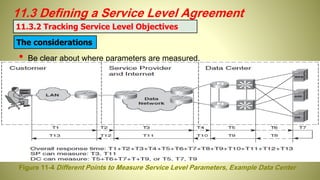
• Be clear about where parameters are measured.
Figure 11-4 Different Points to Measure Service Level Parameters, Example Data Center
11.3.2 Tracking Service Level Objectives
The considerations
11.3 Defining a Service Level Agreement
• Be clear how parameters are measured with high accuracy. When
measuring the delay, is the local time at the two nodes accurate?.
• Finally, it should be clear who measures and how your measurements
can be verified. In the earlier example, an outside party will not have
access to the incoming and outgoing firewalls ports and will not be able
to actually measure T5 + T6 + T7 + T8 + T9; the provider of the data
center sometimes includes access to service level statistics to the
customer as part of the service itself. In some cases, an independent
party might be called on to certify service levels.
11.3.2 Tracking Service Level Objectives
The considerations
11.3 Defining a Service Level Agreement
• Restoring the agreed-to service level: make an emergency plan to
solve the issues as fast as you can.
• Make up for service level that was not delivered.
• Reconsidering the future business relationship: the user should
estimate the situation and can change the SLA or change the provider.
11.3.3 Dealing with Service Level Violations
The steps
SLA Checklist
Does the SLA cover?
• Service objectives
• Parties included
• People responsible for the agreement
• Coverage period
• Definition of terms
• Procedures for updating/changing/amending the
agreement
SLA Checklist
Does the agreement include the following service factors?
• Definition of the service(s)
• Service hours and dates
• Service exclusions
SLA Checklist
Does the agreement detail coverage of customer and
service provider factors?
•Procedures for adding or changing services
•Arrangements for service interruptions
•Escalation procedures
•Customer / service provider responsibilities
SLA Checklist
Does the agreement cover communication channels?
•Contact points included for both customer and
service provider
•Communication channels and methods
SLA Checklist
Does the agreement state what and how performance
monitoring will occur?
• Service targets (expected and minimum levels)
• How to monitor and report on performance
• Frequency of reporting
• Auditing of reports and monitoring
• Quality assurance measurements
• Complaints handling
SLA Checklist
Does the agreement delineate service costs and
penalties for substandard performance?
•Service cost and financial penalties
11.4 Managing for a Service Level
Of course, we are not finished after SLA has been defined. Next, the
SLA needs to be delivered on! This involves a number of aspects:
• Service need to be setup:
oBuild out my Network and Resources.
oConnections must be dimensioned.
oPorts assignments.
oPlanning the Topology.
Before Operational
11.4 Managing for a Service Level
• Monitoring the service Level:
oEnsure that service level objectives that were promised are being
met.
oPerform scenario of flaws and define preventing actions that needed.
oGathering all statistical data.
That’s Why Service Level Monitoring is important
After Operational
11.4 Managing for a Service Level
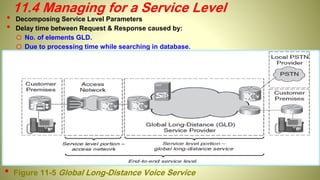
• Decomposing Service Level Parameters
• Delay time between Request & Response caused by:
o No. of elements GLD.
o Due to processing time while searching in database.
• Figure 11-5 Global Long-Distance Voice Service
11.4 Managing for a Service Level
To make management easy, you must understand each piece in service .
• Benefits:
oHelps to diagnose and detect the root problem that may degrade
SLA.
oEase to assess drop in performance of the service and taking counter
measure before customers are even impacted.
oProvides guidance to plan and design the network for a given service
level.
oHelpful to devise a strategy for how to monitor the service.
11.4 Managing for a Service Level
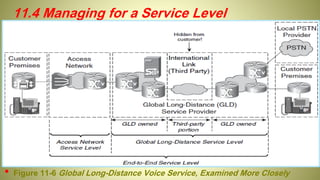
• Figure 11-6 Global Long-Distance Voice Service, Examined More Closely
11.4 Managing for a Service Level
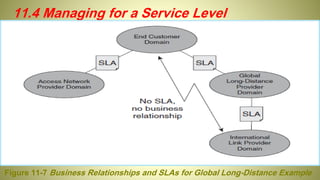
Figure 11-7 Business Relationships and SLAs for Global Long-Distance Example
Connection
BW
Processing
Power
Host
Memory
Ports
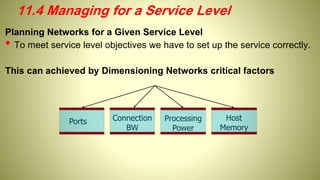
Planning Networks for a Given Service Level
• To meet service level objectives we have to set up the service correctly.
This can achieved by Dimensioning Networks critical factors
11.4 Managing for a Service Level
How to Dimensioning ?
• Determine how many resource (Quantity).
• Determine which resources.(Type).
In general we simply reserve all resources that are required
if the customer always uses the service to its fullest capacity.
For example, an enterprise might have purchased a link with 10 Mbps of bandwidth
between two sites but rarely actually uses all of that bandwidth, certainly not all the
time. This means that a service provider that reserves network resources assuming
that the service will always be used to the fullest will find that generally a significant
portion of the resources is idling. This is a problem because a network involves
cost, and having network resources that are chronically underutilized and
inefficiently used is a luxury that few can afford.  HARD GUARANTEE
11.4 Managing for a Service Level
• When it is unlikely that a service will constantly be utilized to
the fullest, and if a service level objective does not involve a
hard guarantee but a statistical guarantee, it might be
possible to oversubscribe resources. This means that the
service provider might be able to allocate the same resource to
multiple service Instances at the same time, in the hope that not
every service instance will need the same resource at the same
time. In effect, this allows the service provider to sell the same
resource multiple times.
11.4 Managing for a Service Level
• Consider the following example of a service provider that has a pool of
bandwidth, consisting of 50 units of bandwidth, one unit of which is required
for each service instance. In theory, this means that only 50 service instances
can be provisioned. However, the service provider observes that many
customers do not use the service all the time, so, on average, only 50 percent
of services are used. The service provider might therefore decide to sell 80
service instances, in the hope that no more than 50 will be used at any one
point in time. This principle is also called statistical multiplexing. This allows
service providers to squeeze more out of their existing infrastructure. As a
result, the service is provided more efficiently and economically. Cost
advantages can be passed on to the customer, so everybody benefits. The
situation is analogous to that of airline carriers who sell more seats than they
actually have on the plane.
11.4 Managing for a Service Level
Managing Oversubscription Risk
• Oversubscribing network resources can be risky when multiple users try
to access the service with same instance
• Ex . Watching world cup match on TV.
oDigital TV signals are compressed to reduce their bandwidth.
There are many techniques to mitigate those risks.
• Reprovisioning.
• Imposing admission control
11.4 Managing for a Service Level
• Reprovisioning
Monitoring the service and if there is any detection of problem
the manager make his move.
Ex. If there is a congestion the manager must be able to
increase the BW capacity to remain the service available.
11.4 Managing for a Service Level
• Imposing admission control
oPerform some customization on service setting(each user has limit)
oApply the principal of “First Come First Serve”
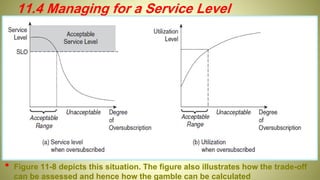
• Oversubscribing resources in the network is a calculated gamble. Its
purpose is to achieve a good balance between utilization of
resources (which, if left idling, increase the cost of providing instances
of the service) and keeping within agreed service levels (which, if
violated, lead to decreased profitability, not just because of the cost that
is associated with penalties, but because of lower customer satisfaction
and the resulting loss of revenue).
11.4 Managing for a Service Level
• Figure 11-8 depicts this situation. The figure also illustrates how the trade-off
can be assessed and hence how the gamble can be calculated
Network Maintenance Considerations
Maintenance operations consist of :
• Routine Backups.
• Hardware and Software upgrades.
During maintenance may be some errors occur ,so the service provider
must inform his clients that there is some upgrades or maintenance take
place.
11.4 Managing for a Service Level
Service Level Monitoring—Setting Up Early Warning Systems
• When the service is operational the manager has to monitor the service
incase of alerts or warning is appeared.
• This give the manager a chance to perform some
process(countermeasure actions) to prevent errors before it happened.
• Service Level Monitoring consists of:
oMonitoring SL parameters(Performance).
oDetecting when problem is about to occur.
11.4 Managing for a Service Level
1- Monitoring Service Level Parameters
a. Analyzing management information which include the following:
oNETFLOW , IPFIX(IP flow info. Export)-contains information about network
flow.
oSNMP(Simple NW Management Protocol) MIBs –it collect and organize the
MIB info. Such as device performance and device state.
oSyslog messages – if there was a problem or alert even warning ,all of this
is stored in a log file to make good use of this like history.
b. Passive Measurements.-observe NW traffic when some operational
management is unavailable.
c. Active Measurements.
11.4 Managing for a Service Level
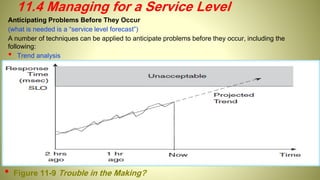
Anticipating Problems Before They Occur
(what is needed is a “service level forecast”)
A number of techniques can be applied to anticipate problems before they occur, including the
following:
• Trend analysis
11.4 Managing for a Service Level
• Figure 11-9 Trouble in the Making?
• Anomaly detection
Often service usage patterns and fluctuations in service levels
that are
observed repeat over time. In many cases (but not always), this
is a consequence of human behavior. For example, most people
watch TV between 9 and 11 at night or make most of their
business phone calls between 10:30 and 11:30 in the morning.
As a consequence, networks
get stressed during those times, which can lead to temporary
drops in service performance. Using historical data, it is possible
to establish what those patterns are.
11.4 Managing for a Service Level
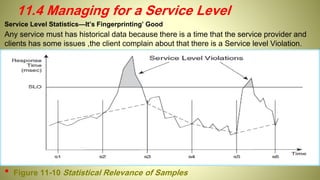
Service Level Statistics—It’s Fingerprinting’ Good
Any service must has historical data because there is a time that the service provider and
clients has some issues ,the client complain about that there is a Service level Violation.
11.4 Managing for a Service Level
• Figure 11-10 Statistical Relevance of Samples
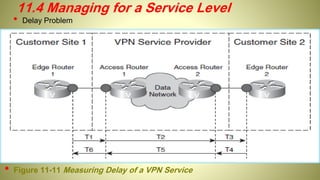
• Delay Problem
11.4 Managing for a Service Level
• Figure 11-11 Measuring Delay of a VPN Service
summary
• Service level agreements are often at the core of the business relationship between
the provider and the customer of a service.
• An SLA specifies a set of service level objectives, how those objectives will be
tracked and verified, and the course of action that needs to be taken along with
possible consequences if service level objectives are violated.
• A service level objective sets a target for a service level parameter—generally, a
parameter that is related to the performance, capacity, or availability of a service.
• Service level monitoring involves monitoring and analyzing operational and state
data that provides an indication of the service level that is currently being
experienced.
• It is important to spot developing problems early, to be able to take countermeasures
in time.
• data about the service level that is currently experienced should not be discarded,
but collected.
Thank You

Service level management

  • 1.
    CSE622 Network Management CH11: Service Level Management Knowing What You Pay For Presented to: Prof.Dr. Hossam Mahmoud Fahmy Prepared by: Eng. Ahmed Abdel Hafeez Ibrahim Eng. Wafaa Alsayed Agmi
  • 2.
    Contents 11.1 The Motivationfor Service Level Agreements 11.2 Identification of Service Level Parameters 11.3 Defining a Service Level Agreement 11.4 Managing for a Service Level
  • 3.
    THE AUTHOR Dr. AlexanderClemm Books - 6 books from 1994 - 2017 - Network-Embedded Management and Applications: Understanding Programmable Networking Infrastructure. Springer, July 2012 - Network Management Fundamentals. Pearson/ Cisco Press, Indianapolis, Indiana/ USA, November 2006. Also translated into Chinese: 网络管理技术架构. Posts and Telecommunications Press, China, January 2008.
  • 4.
    THE AUTHOR Teaching Adjunct Professorat the Faculty for Computer Engineering, Santa Clara University , Santa Clara, California/USA (since 2008). Class “Network Management” Publications - 45 publication from 1996 - 2017 - Model-Driven Analytics in SDN Networks. IFIP/IEEE International Symposium on Integrated Network Management (IM 2017), Lisbon, Portugal, May 2017 .
  • 5.
    Introduction • The networkprovider provide a network service as a product to a customer or a user who pay for this service. • technical properties, such as performance, capacity, and availability of service in the form of a service level agreement (SLA). • the technical terms of the service that is being provided. In addition, it includes business terms, such as precise terms of what will happen if the agreed-to service level is not met. The Definition of the service level The Definition of the service level agreement
  • 6.
    Introduction The Definition ofthe service level agreement A service level agreement (“SLA”) is a formal document describing the level of service a customer expects from a service provider. SLA is intended to specify performance expectations, responsibilities and metrics. It ensures all parties have the same understanding of and improves each parties ability to reach planned goals. We must remember that the SLA is an output of the Service Level Management process. If we focus too strongly on developing SLAs without their supporting process, then we may miss some key process activities that are critical dependencies to ensure the efficiency and effectiveness of delivering services.
  • 7.
    11.1 The Motivationfor Service Level Agreements • SLA as a contract between the provider and the user of a communications service define the service level that is expected for the service—characteristics of the service that relate to aspects such as its performance, capacity, and availability properties. • Because communication needs vary greatly between customers, SLAs are often customized and negotiated on a case-by-case basis according to service type such as a VPN or Internet Data Center host web site.
  • 8.
    11.1 The Motivationfor Service Level Agreements • In an SLA, the desired service level is defined by a set of service level objectives. A service level objective consists of a service level parameter and a target value for that parameter that must be met or exceeded. For example, a service level objective might stipulate that the capacity on a link that connects two enterprise sites is 100 Mbps. Another service level objective that is defined by time interval might state that on weekdays between 8 a.m. and 6 p.m., availability of the link must be 99.9 percent.
  • 9.
    11.1 The Motivationfor Service Level Agreements • the SLA generally also contains nontechnical aspects. Those aspects explain what is to happen in case the service level falls below the target and certain objectives are not met—ranging from corrective actions that will be taken to financial penalties that will be sustained.
  • 10.
    11.2 Identification ofService Level Parameters • Significance—It must be significant and meaningful for the service that is being defined. • Relevance—It must be relevant to the context in which the service will be used. • Measurability—It must be measurable and objectively verifiable. The criteria of the service level parameters
  • 11.
    11.2 Identification ofService Level Parameters • Parameters that give a much more meaningful to users such as dropped calls, background noise, and perceived voice quality instead of Jitter. • The more the parameters are significant, the more the user can use it in complain, such as “The network dropped my call three times,” “There is background noise on the line,” or simply “My voice quality is crap.” Significance
  • 12.
    11.2 Identification ofService Level Parameters Significance Figure 11-1 Differences in Service Level Parameters, Depending on the Layer of the Service
  • 13.
    11.2 Identification ofService Level Parameters • The time that it takes until a user hears a dial tone when picking up the phone. • End-to-end voice delay. • Call completion rate. • Busy hour call attempts (BHCA), the number of call attempts during the busiest period of the day. • The length of time that it takes until a ring tone is received after a call is dialed The significant parameters for a voice service level
  • 14.
    11.2 Identification ofService Level Parameters • The parameters must be dependent to the context to avoid shifting attention away from it. • A parameter might also not be relevant when it is simply met. For example, the BHCA parameter that we just encountered for voice service enable users to judge the service. Relevance
  • 15.
    • The parametersmust be measurable, verifiable and cost-effective to test if the service is met or not. • To make the MOS score measurable and cost effective, an automatic software that analyzes call samples. Such software can generate synthetic MOS scores that provide a good approximation of actual MOS scores. Measurability 11.2 Identification of Service Level Parameters
  • 16.
    11.3 Defining aService Level Agreement Figure 11-3 Trade-Off Between Cost and Benefit of Higher Service Levels 11.3.1 Definition of Service Level Objectives The considerations
  • 17.
    11.3 Defining aService Level Agreement •Specific: it must not be ambiguous such as “delay”. •Realistic: it must not be fake to just complete the contract. The provider should never make a promise that can’t answer to keep the confidence with customer. 11.3.1 Definition of Service Level Objectives The considerations
  • 18.
    11.3 Defining aService Level Agreement • Be clear about where parameters are measured. Figure 11-4 Different Points to Measure Service Level Parameters, Example Data Center 11.3.2 Tracking Service Level Objectives The considerations
  • 19.
    11.3 Defining aService Level Agreement • Be clear how parameters are measured with high accuracy. When measuring the delay, is the local time at the two nodes accurate?. • Finally, it should be clear who measures and how your measurements can be verified. In the earlier example, an outside party will not have access to the incoming and outgoing firewalls ports and will not be able to actually measure T5 + T6 + T7 + T8 + T9; the provider of the data center sometimes includes access to service level statistics to the customer as part of the service itself. In some cases, an independent party might be called on to certify service levels. 11.3.2 Tracking Service Level Objectives The considerations
  • 20.
    11.3 Defining aService Level Agreement • Restoring the agreed-to service level: make an emergency plan to solve the issues as fast as you can. • Make up for service level that was not delivered. • Reconsidering the future business relationship: the user should estimate the situation and can change the SLA or change the provider. 11.3.3 Dealing with Service Level Violations The steps
  • 21.
    SLA Checklist Does theSLA cover? • Service objectives • Parties included • People responsible for the agreement • Coverage period • Definition of terms • Procedures for updating/changing/amending the agreement
  • 22.
    SLA Checklist Does theagreement include the following service factors? • Definition of the service(s) • Service hours and dates • Service exclusions
  • 23.
    SLA Checklist Does theagreement detail coverage of customer and service provider factors? •Procedures for adding or changing services •Arrangements for service interruptions •Escalation procedures •Customer / service provider responsibilities
  • 24.
    SLA Checklist Does theagreement cover communication channels? •Contact points included for both customer and service provider •Communication channels and methods
  • 25.
    SLA Checklist Does theagreement state what and how performance monitoring will occur? • Service targets (expected and minimum levels) • How to monitor and report on performance • Frequency of reporting • Auditing of reports and monitoring • Quality assurance measurements • Complaints handling
  • 26.
    SLA Checklist Does theagreement delineate service costs and penalties for substandard performance? •Service cost and financial penalties
  • 27.
    11.4 Managing fora Service Level Of course, we are not finished after SLA has been defined. Next, the SLA needs to be delivered on! This involves a number of aspects: • Service need to be setup: oBuild out my Network and Resources. oConnections must be dimensioned. oPorts assignments. oPlanning the Topology. Before Operational
  • 28.
    11.4 Managing fora Service Level • Monitoring the service Level: oEnsure that service level objectives that were promised are being met. oPerform scenario of flaws and define preventing actions that needed. oGathering all statistical data. That’s Why Service Level Monitoring is important After Operational
  • 29.
    11.4 Managing fora Service Level • Decomposing Service Level Parameters • Delay time between Request & Response caused by: o No. of elements GLD. o Due to processing time while searching in database. • Figure 11-5 Global Long-Distance Voice Service
  • 30.
    11.4 Managing fora Service Level To make management easy, you must understand each piece in service . • Benefits: oHelps to diagnose and detect the root problem that may degrade SLA. oEase to assess drop in performance of the service and taking counter measure before customers are even impacted. oProvides guidance to plan and design the network for a given service level. oHelpful to devise a strategy for how to monitor the service.
  • 31.
    11.4 Managing fora Service Level • Figure 11-6 Global Long-Distance Voice Service, Examined More Closely
  • 32.
    11.4 Managing fora Service Level Figure 11-7 Business Relationships and SLAs for Global Long-Distance Example
  • 33.
    Connection BW Processing Power Host Memory Ports Planning Networks fora Given Service Level • To meet service level objectives we have to set up the service correctly. This can achieved by Dimensioning Networks critical factors 11.4 Managing for a Service Level
  • 34.
    How to Dimensioning? • Determine how many resource (Quantity). • Determine which resources.(Type). In general we simply reserve all resources that are required if the customer always uses the service to its fullest capacity. For example, an enterprise might have purchased a link with 10 Mbps of bandwidth between two sites but rarely actually uses all of that bandwidth, certainly not all the time. This means that a service provider that reserves network resources assuming that the service will always be used to the fullest will find that generally a significant portion of the resources is idling. This is a problem because a network involves cost, and having network resources that are chronically underutilized and inefficiently used is a luxury that few can afford.  HARD GUARANTEE 11.4 Managing for a Service Level
  • 35.
    • When itis unlikely that a service will constantly be utilized to the fullest, and if a service level objective does not involve a hard guarantee but a statistical guarantee, it might be possible to oversubscribe resources. This means that the service provider might be able to allocate the same resource to multiple service Instances at the same time, in the hope that not every service instance will need the same resource at the same time. In effect, this allows the service provider to sell the same resource multiple times. 11.4 Managing for a Service Level
  • 36.
    • Consider thefollowing example of a service provider that has a pool of bandwidth, consisting of 50 units of bandwidth, one unit of which is required for each service instance. In theory, this means that only 50 service instances can be provisioned. However, the service provider observes that many customers do not use the service all the time, so, on average, only 50 percent of services are used. The service provider might therefore decide to sell 80 service instances, in the hope that no more than 50 will be used at any one point in time. This principle is also called statistical multiplexing. This allows service providers to squeeze more out of their existing infrastructure. As a result, the service is provided more efficiently and economically. Cost advantages can be passed on to the customer, so everybody benefits. The situation is analogous to that of airline carriers who sell more seats than they actually have on the plane. 11.4 Managing for a Service Level
  • 37.
    Managing Oversubscription Risk •Oversubscribing network resources can be risky when multiple users try to access the service with same instance • Ex . Watching world cup match on TV. oDigital TV signals are compressed to reduce their bandwidth. There are many techniques to mitigate those risks. • Reprovisioning. • Imposing admission control 11.4 Managing for a Service Level
  • 38.
    • Reprovisioning Monitoring theservice and if there is any detection of problem the manager make his move. Ex. If there is a congestion the manager must be able to increase the BW capacity to remain the service available. 11.4 Managing for a Service Level
  • 39.
    • Imposing admissioncontrol oPerform some customization on service setting(each user has limit) oApply the principal of “First Come First Serve” • Oversubscribing resources in the network is a calculated gamble. Its purpose is to achieve a good balance between utilization of resources (which, if left idling, increase the cost of providing instances of the service) and keeping within agreed service levels (which, if violated, lead to decreased profitability, not just because of the cost that is associated with penalties, but because of lower customer satisfaction and the resulting loss of revenue). 11.4 Managing for a Service Level
  • 40.
    11.4 Managing fora Service Level • Figure 11-8 depicts this situation. The figure also illustrates how the trade-off can be assessed and hence how the gamble can be calculated
  • 41.
    Network Maintenance Considerations Maintenanceoperations consist of : • Routine Backups. • Hardware and Software upgrades. During maintenance may be some errors occur ,so the service provider must inform his clients that there is some upgrades or maintenance take place. 11.4 Managing for a Service Level
  • 42.
    Service Level Monitoring—SettingUp Early Warning Systems • When the service is operational the manager has to monitor the service incase of alerts or warning is appeared. • This give the manager a chance to perform some process(countermeasure actions) to prevent errors before it happened. • Service Level Monitoring consists of: oMonitoring SL parameters(Performance). oDetecting when problem is about to occur. 11.4 Managing for a Service Level
  • 43.
    1- Monitoring ServiceLevel Parameters a. Analyzing management information which include the following: oNETFLOW , IPFIX(IP flow info. Export)-contains information about network flow. oSNMP(Simple NW Management Protocol) MIBs –it collect and organize the MIB info. Such as device performance and device state. oSyslog messages – if there was a problem or alert even warning ,all of this is stored in a log file to make good use of this like history. b. Passive Measurements.-observe NW traffic when some operational management is unavailable. c. Active Measurements. 11.4 Managing for a Service Level
  • 44.
    Anticipating Problems BeforeThey Occur (what is needed is a “service level forecast”) A number of techniques can be applied to anticipate problems before they occur, including the following: • Trend analysis 11.4 Managing for a Service Level • Figure 11-9 Trouble in the Making?
  • 45.
    • Anomaly detection Oftenservice usage patterns and fluctuations in service levels that are observed repeat over time. In many cases (but not always), this is a consequence of human behavior. For example, most people watch TV between 9 and 11 at night or make most of their business phone calls between 10:30 and 11:30 in the morning. As a consequence, networks get stressed during those times, which can lead to temporary drops in service performance. Using historical data, it is possible to establish what those patterns are. 11.4 Managing for a Service Level
  • 46.
    Service Level Statistics—It’sFingerprinting’ Good Any service must has historical data because there is a time that the service provider and clients has some issues ,the client complain about that there is a Service level Violation. 11.4 Managing for a Service Level • Figure 11-10 Statistical Relevance of Samples
  • 47.
    • Delay Problem 11.4Managing for a Service Level • Figure 11-11 Measuring Delay of a VPN Service
  • 48.
    summary • Service levelagreements are often at the core of the business relationship between the provider and the customer of a service. • An SLA specifies a set of service level objectives, how those objectives will be tracked and verified, and the course of action that needs to be taken along with possible consequences if service level objectives are violated. • A service level objective sets a target for a service level parameter—generally, a parameter that is related to the performance, capacity, or availability of a service. • Service level monitoring involves monitoring and analyzing operational and state data that provides an indication of the service level that is currently being experienced. • It is important to spot developing problems early, to be able to take countermeasures in time. • data about the service level that is currently experienced should not be discarded, but collected.
  • 49.