ITIL Introduction Linpei Zhang April, 2006
What’s ITIL? ITIL (Information Technology Infrastructure Library) is a framework of best practices approaches intended to facilitate the delivery of high quality information technology services.  - Wikipedia
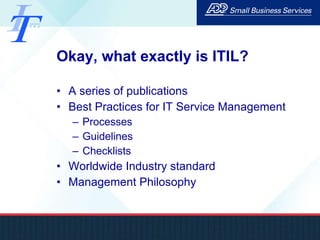
Okay, what exactly is ITIL? A series of publications Best Practices for IT Service Management Processes Guidelines Checklists  Worldwide Industry standard Management Philosophy
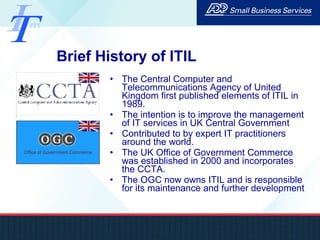
Brief History of ITIL The Central Computer and Telecommunications Agency of United Kingdom first published elements of ITIL in 1989. The intention is to improve the management of IT services in UK Central Government Contributed to by expert IT practitioners around the world.  The UK Office of Government Commerce was established in 2000 and incorporates the CCTA. The OGC now owns ITIL and is responsible for its maintenance and further development
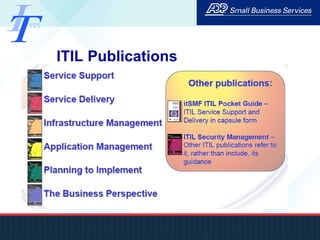
ITIL Publications
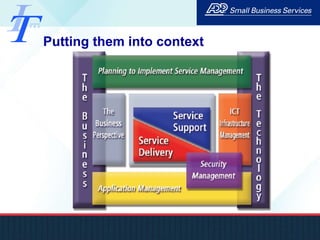
Putting them into context
ITIL is the industry standard Widely accepted in Europe, Asia and Australia 170,000 ITIL certified professionals worldwide Over 10,000 companies adopted ITIL worldwide Started to gain momentum in United States Over 2000 people attended itSMF USA Conference in Chicago, 2005, the ITIL “trade show”, representing over 700 companies More than 1000 IT Professionals got ITIL certifications every month since 2005
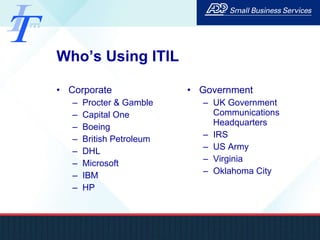
Who’s Using ITIL Corporate Procter & Gamble Capital One Boeing British Petroleum DHL Microsoft IBM HP Government UK Government Communications Headquarters IRS US Army Virginia Oklahoma City
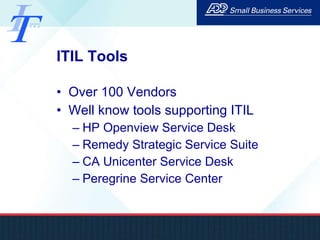
ITIL Tools Over 100 Vendors Well know tools supporting ITIL HP Openview Service Desk Remedy Strategic Service Suite CA Unicenter Service Desk Peregrine Service Center
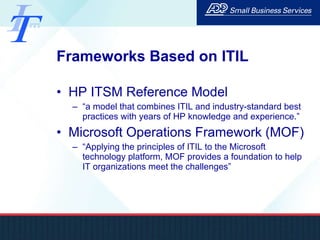
Frameworks Based on ITIL HP ITSM Reference Model “ a model that combines ITIL and industry-standard best practices with years of HP knowledge and experience.” Microsoft Operations Framework (MOF) “ Applying the principles of ITIL to the Microsoft technology platform, MOF provides a foundation to help IT organizations meet the challenges”
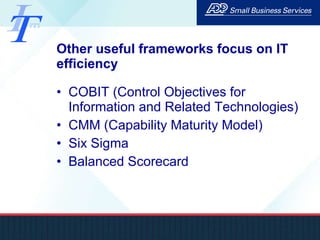
Other useful frameworks focus on IT efficiency COBIT (Control Objectives for Information and Related Technologies) CMM (Capability Maturity Model) Six Sigma Balanced Scorecard
International Industry Standards BS15000 Published by BSI (British Standards Institution) in 2000 as national standard for UK ISO20000 Published by ISO (International Organization for Standardization) on 12/15/2005 The first International standard for IT Service Management. It’s based on and has superseded BS15000. Both standards are based heavily upon ITIL
ITIL Philosophy Service Quality Process Measurement Cost Proactive
ITIL Philosophy One - Service IT Service Management (ITSM) means managing IT as a  service  business.  Deploy and manage resources to a discrete set of  defined services Thinking ourselves as  Service Providers
What kinds of services are we providing? Application Services EasyPay EasyPayNet TeleNet DAS AOS FLT EEE … Construction Services Support Services Network Support Service Application Maintenance Service Database Maintenance Service Infrastructure Maintenance Service Management Services Statistics and report Communication and Training Consulting
Behave like Service Providers Align IT services to the customer and business needs. Find out what the customer needs and make those services available Partner with the customer to create new ways of doing business. Create new competitive advantages.  Increase the quality of the existing services by organizing around services and working to make those service efficient
Realize the promise  “We care about our Customer!” Documenting, negotiating and agreeing Customer and business quality targets and responsibilities in Service Level Agreements (SLAs) Regular assessment of Customer opinions in Customer Feedback and Customer Satisfaction Surveys IT personnel regularly taking the ‘Customer journey’ and sampling the ‘Customer experience’ IT personnel taking the Customer and Business perspective and always trying to keep Customer interactions as simple and enjoyable as possible
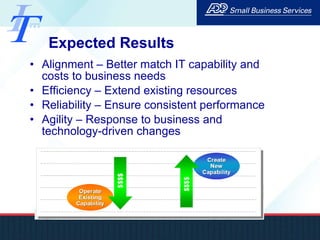
Expected Results Alignment – Better match IT capability and costs to business needs Efficiency – Extend existing resources Reliability – Ensure consistent performance Agility – Response to business and technology-driven changes
ITIL Philosophy Two - Quality Quality is the “degree to which a set of inherent characteristics fulfils requirements” as in ISO 9000 Service Quality is “about ensuring customers get what they want” as in  Managing Service Quality Quality is a interactive term. It’s all about satisfying and exceeding  Customer Expectations .
What does that mean? High quality of the product cannot be achieved without understanding what customer wants (requirements) Quality cannot be measured without asking the customer’s opinions High quality service cannot be delivered without thinking in customer’s perspective
How Customer Evaluate Service Quality? Did the service satisfy my expectation? Can I get the same service next time? Is the service provided by a reasonable cost?
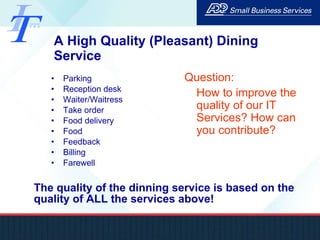
A High Quality (Pleasant) Dining Service Parking Reception desk Waiter/Waitress Take order Food delivery Food Feedback Billing Farewell The quality of the dinning service is based on the quality of ALL the services above! Question:  How to improve the quality of our IT Services? How can you contribute?
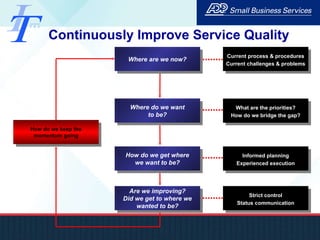
Continuously Improve Service Quality How do we keep the momentum going Where are we now? Current process & procedures Current challenges & problems Where do we want to be? What are the priorities? How do we bridge the gap? How do we get where we want to be? Informed planning Experienced execution Are we improving? Did we get to where we wanted to be? Strict control Status communication
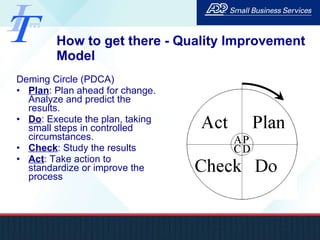
How to get there - Quality Improvement Model Deming Circle (PDCA) Plan : Plan ahead for change. Analyze and predict the results. Do : Execute the plan, taking small steps in controlled circumstances. Check : Study the results Act : Take action to standardize or improve the process
ITIL Philosophy Three - Process “ A process is a specific ordering of work activities across time and space, with a beginning and an end, and clearly defined inputs and outputs: a structure for action. ... Taking a process approach implies adopting the customer’s point of view. Processes are the structure by which an organization does what is necessary to produce value for its customers.”  - Thomas Davenport,  “Process Innovation”
Characteristics of Processes Definability : It must have clearly defined input and output Order : It must consists of activities that are ordered by time and space Customer : There must be a recipient of the process’ outcome Value-adding : The transformation taking place within the process must add value to the recipient
Result vs. Process Result Oriented Management Results can map to Activities Results are measurable and worth measuring Only applicable for low risk task Process Oriented Management Define a process to achieve the result Break down the overall result into smaller intermediate results More control and lower risk
Why we need Process to provide high quality service? Service Intangible: Customer Experience Interactive: One-time, Cannot be stored Process can help Consistent performance Reduce risk Repeatable: Customer experience can be repeated next time
But, what does process mean to me? Give Understand the whole picture Know what to do in any circumstances Clearly defined Roles/Responsibilities Measurable performance Save time and efforts Take May change way we used to carry out our tasks Take away some flexibilities
ITIL Philosophy Four - Measurement If you cannot  measure  it, you cannot  manage  it If you cannot  measure  it, you cannot  improve  it If you cannot  measure  it, you probably don’t  care  about it If you cannot  influence  it, you don’t need to  measure  it
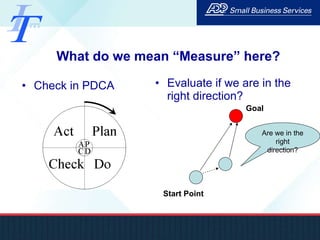
What do we mean “Measure” here? Check in PDCA Evaluate if we are in the right direction? Are we in the right direction? Start Point Goal
Why “Best Effort” is not good enough? “ Best Effort”, “Some Progress”, “Improved Performance”… are not measurable.  “ Performance is improved 10%”, “Time to Market decreased from 100 days to 50 days”, “Customer Satisfaction Rate improves 23 percents”. Those are good measurements. All the measurements must be quantitative!
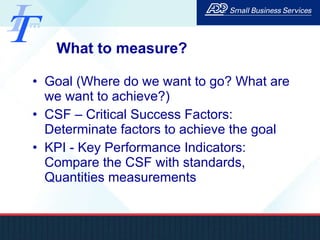
What to measure? Goal (Where do we want to go? What are we want to achieve?) CSF – Critical Success Factors: Determinate factors to achieve the goal KPI - Key Performance Indicators: Compare the CSF with standards, Quantities measurements
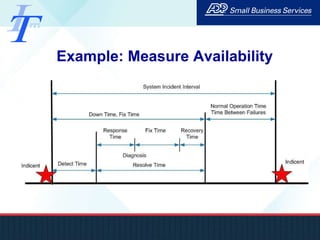
Example: Measure Availability
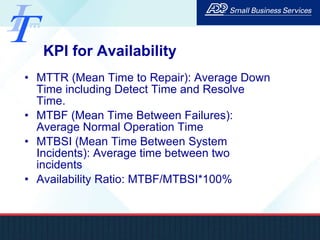
KPI for Availability MTTR (Mean Time to Repair): Average Down Time including Detect Time and Resolve Time. MTBF (Mean Time Between Failures): Average Normal Operation Time MTBSI (Mean Time Between System Incidents): Average time between two incidents Availability Ratio: MTBF/MTBSI*100%
Not too little, not too much Measurement has costs Tools Time Report Analysis Too many measurements only ends up with  No  measurement Only measure the  KEY  performance indicators
ITIL Philosophy Five - Cost Everything comes with a cost Equipment Cost Software Cost Organization Cost Accommodation Cost Transfer Cost Cost Accounting
How Cost are related to us? Budget Salary/Bonus Reimbursement Training Cost Tools Hiring It’s everywhere in our working life! (Personal life too)
Cost Awareness – Thinking as the Management  Budget Can we make the ends meet? New Project ROI (Return Of Investment) = Profit / Investiment New Software/Hardware/Tool TOS (Total Ownership Cost): Cost in its lifetime
Hidden costs Management cost Statistics and Report Communication and Training Support cost Installation/Upgrade Incident Support Performance Tuning
Efficient IT Service Quality Capacity Availability Performance Support Disaster Recovery Cost Investment Spending Customer Requirement Can quality and cost satisfy the business needs?
ITIL Philosophy Six - Proactive Common feelings about work I am too busy Work is chasing me. I am stressed out I don’t have time to do the meaningful things.  Those issues are so bugging. They kept coming back!
Breaking things down Reactive activities Handle customer complains Handle production outage Last minute purchase Deal with disasters Preventative activities Create contingency plan Setup knowledge database Setup Production Monitors Capacity Planning Create Disaster Recovery Plan
First thing first  The more you work on Preventative Activities, the less you need to work on Reactive Activities Take the control back!  Preventative activities are under your control while Reactive Activities control you.
Some Proactive Activities Suggested by ITIL Problem Management: Study the trend of the incidents. Dig out and fix the fundamental problem.  Configuration Management: Keep track of important things and their relationships Capacity Management: Project the workload. Plan the capacity ahead of time And a lot more….
What’s actually in ITIL? Goals/Benefits Processes Guidelines Check lists Critical Success Factors Key Performance Indicators Implementation tips
Service Lifecycle Design: Requirements Define: Service Level Agreement Delivery: Construct, Test, Release Support: Incident, Problem, Change Measure: Service Level Report Improve: Service Improvement Plan
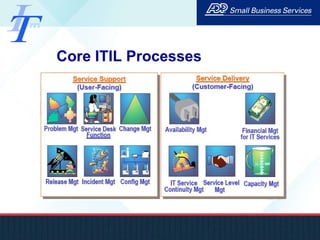
Core ITIL Processes
Service Delivery Face the Customer. Satisfy Customer requirements Business driven Strategic level processes Forward-looking, planning, proactive activities Do the right things
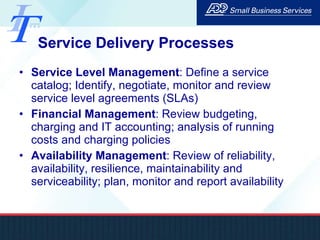
Service Delivery Processes Service Level Management : Define a service catalog; Identify, negotiate, monitor and review service level agreements (SLAs) Financial Management : Review budgeting, charging and IT accounting; analysis of running costs and charging policies Availability Management : Review of reliability, availability, resilience, maintainability and serviceability; plan, monitor and report availability
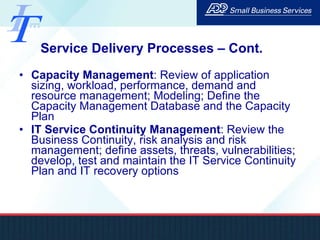
Service Delivery Processes – Cont. Capacity Management : Review of application sizing, workload, performance, demand and resource management; Modeling; Define the Capacity Management Database and the Capacity Plan IT Service Continuity Management : Review the Business Continuity, risk analysis and risk management; define assets, threats, vulnerabilities; develop, test and maintain the IT Service Continuity Plan and IT recovery options
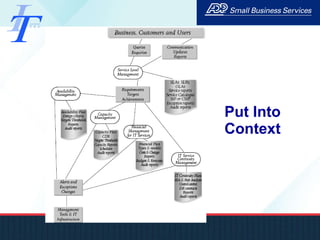
Put Into Context
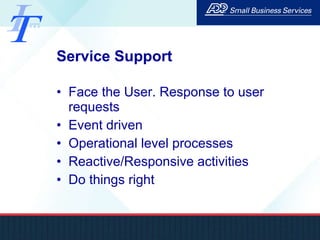
Service Support Face the User. Response to user requests Event driven Operational level processes Reactive/Responsive activities Do things right
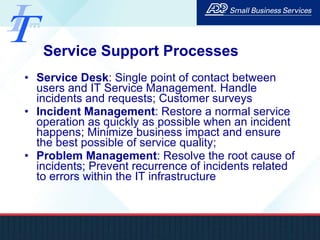
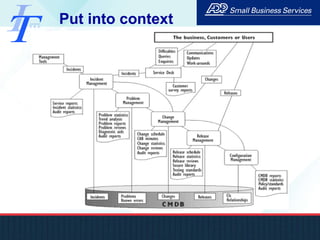
Service Support Processes Service Desk : Single point of contact between users and IT Service Management. Handle incidents and requests; Customer surveys Incident Management : Restore a normal service operation as quickly as possible when an incident happens; Minimize business impact and ensure the best possible of service quality;  Problem Management : Resolve the root cause of incidents; Prevent recurrence of incidents related to errors within the IT infrastructure
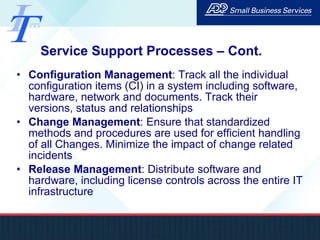
Service Support Processes – Cont. Configuration Management : Track all the individual configuration items (CI) in a system including software, hardware, network and documents. Track their versions, status and relationships Change Management : Ensure that standardized methods and procedures are used for efficient handling of all Changes. Minimize the impact of change related incidents Release Management : Distribute software and hardware, including license controls across the entire IT infrastructure
Put into context
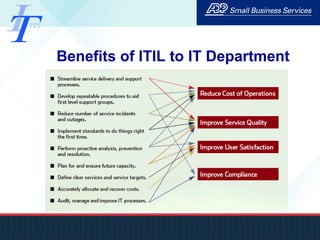
Benefits of ITIL to IT Department
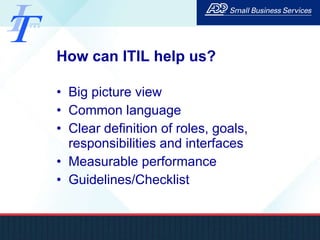
How can ITIL help us? Big picture view Common language Clear definition of roles, goals, responsibilities and interfaces Measurable performance Guidelines/Checklist
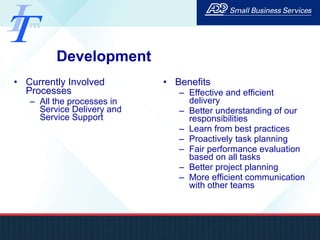
Development Currently Involved Processes All the processes in Service Delivery and Service Support Benefits Effective and efficient delivery Better understanding of our responsibilities Learn from best practices Proactively task planning Fair performance evaluation based on all tasks Better project planning More efficient communication with other teams
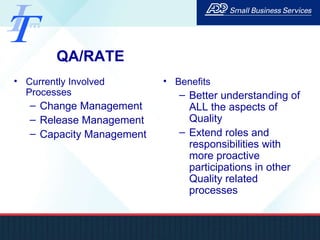
QA/RATE Currently Involved Processes Change Management Release Management Capacity Management Benefits Better understanding of ALL the aspects of Quality Extend roles and responsibilities with more proactive participations in other Quality related processes
Release Management Currently Involved Processes Change Management Release Management Benefits Better understanding of all the aspects of Change and Release Leverage Best Practices to establish a more efficient release process Extend responsibilities in full cycle of Change Management and Release Management
Infrastructure Currently Involved Processes Capacity Management Availability Management IT Service Continuity Management Configuration Management Incident Management Problem Management Change Management Release Management Benefits Better understanding of the big picture Clearer understanding of the tasks More efficient interfaces with other team Leverage best practices to provide better services
Support Currently Involved Processes Incident Management Problem Management Configuration Management Benefits Establish an more efficient incident management process based on the best practices Better understand the value of work Measurable performance More efficient communications with other teams
Implement ITIL Full of Challenges A complete culture and organizational change: change how people work and how work are organized Wide impact: internal and external  Extensive and complicate materials Without current benchmarks, it’s hard to measure ROI Time consuming and resource intensive
Face the challenge Management commitment Pick a ITIL Project owner Focus on people: training and early involvement in redefining the processes Take baby steps. One process, then another Don’t reinvent the wheel: build upon existing processes Produce quick-wins Bring in experts Tools: Cannot solely count on it, cannot live without
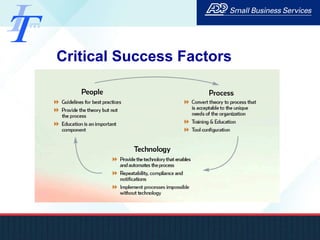
Critical Success Factors
Interesting! Now what? Read more about ITIL Publication Articles Success Stories Get certified in ITIL Apply the best practices to improve your everyday work Support department adoption of ITIL!

ITIL Introduction

  • 1.
    ITIL Introduction LinpeiZhang April, 2006
  • 2.
    What’s ITIL? ITIL(Information Technology Infrastructure Library) is a framework of best practices approaches intended to facilitate the delivery of high quality information technology services. - Wikipedia
  • 3.
    Okay, what exactlyis ITIL? A series of publications Best Practices for IT Service Management Processes Guidelines Checklists Worldwide Industry standard Management Philosophy
  • 4.
    Brief History ofITIL The Central Computer and Telecommunications Agency of United Kingdom first published elements of ITIL in 1989. The intention is to improve the management of IT services in UK Central Government Contributed to by expert IT practitioners around the world. The UK Office of Government Commerce was established in 2000 and incorporates the CCTA. The OGC now owns ITIL and is responsible for its maintenance and further development
  • 5.
  • 6.
  • 7.
    ITIL is theindustry standard Widely accepted in Europe, Asia and Australia 170,000 ITIL certified professionals worldwide Over 10,000 companies adopted ITIL worldwide Started to gain momentum in United States Over 2000 people attended itSMF USA Conference in Chicago, 2005, the ITIL “trade show”, representing over 700 companies More than 1000 IT Professionals got ITIL certifications every month since 2005
  • 8.
    Who’s Using ITILCorporate Procter & Gamble Capital One Boeing British Petroleum DHL Microsoft IBM HP Government UK Government Communications Headquarters IRS US Army Virginia Oklahoma City
  • 9.
    ITIL Tools Over100 Vendors Well know tools supporting ITIL HP Openview Service Desk Remedy Strategic Service Suite CA Unicenter Service Desk Peregrine Service Center
  • 10.
    Frameworks Based onITIL HP ITSM Reference Model “ a model that combines ITIL and industry-standard best practices with years of HP knowledge and experience.” Microsoft Operations Framework (MOF) “ Applying the principles of ITIL to the Microsoft technology platform, MOF provides a foundation to help IT organizations meet the challenges”
  • 11.
    Other useful frameworksfocus on IT efficiency COBIT (Control Objectives for Information and Related Technologies) CMM (Capability Maturity Model) Six Sigma Balanced Scorecard
  • 12.
    International Industry StandardsBS15000 Published by BSI (British Standards Institution) in 2000 as national standard for UK ISO20000 Published by ISO (International Organization for Standardization) on 12/15/2005 The first International standard for IT Service Management. It’s based on and has superseded BS15000. Both standards are based heavily upon ITIL
  • 13.
    ITIL Philosophy ServiceQuality Process Measurement Cost Proactive
  • 14.
    ITIL Philosophy One- Service IT Service Management (ITSM) means managing IT as a service business. Deploy and manage resources to a discrete set of defined services Thinking ourselves as Service Providers
  • 15.
    What kinds ofservices are we providing? Application Services EasyPay EasyPayNet TeleNet DAS AOS FLT EEE … Construction Services Support Services Network Support Service Application Maintenance Service Database Maintenance Service Infrastructure Maintenance Service Management Services Statistics and report Communication and Training Consulting
  • 16.
    Behave like ServiceProviders Align IT services to the customer and business needs. Find out what the customer needs and make those services available Partner with the customer to create new ways of doing business. Create new competitive advantages. Increase the quality of the existing services by organizing around services and working to make those service efficient
  • 17.
    Realize the promise “We care about our Customer!” Documenting, negotiating and agreeing Customer and business quality targets and responsibilities in Service Level Agreements (SLAs) Regular assessment of Customer opinions in Customer Feedback and Customer Satisfaction Surveys IT personnel regularly taking the ‘Customer journey’ and sampling the ‘Customer experience’ IT personnel taking the Customer and Business perspective and always trying to keep Customer interactions as simple and enjoyable as possible
  • 18.
    Expected Results Alignment– Better match IT capability and costs to business needs Efficiency – Extend existing resources Reliability – Ensure consistent performance Agility – Response to business and technology-driven changes
  • 19.
    ITIL Philosophy Two- Quality Quality is the “degree to which a set of inherent characteristics fulfils requirements” as in ISO 9000 Service Quality is “about ensuring customers get what they want” as in Managing Service Quality Quality is a interactive term. It’s all about satisfying and exceeding Customer Expectations .
  • 20.
    What does thatmean? High quality of the product cannot be achieved without understanding what customer wants (requirements) Quality cannot be measured without asking the customer’s opinions High quality service cannot be delivered without thinking in customer’s perspective
  • 21.
    How Customer EvaluateService Quality? Did the service satisfy my expectation? Can I get the same service next time? Is the service provided by a reasonable cost?
  • 22.
    A High Quality(Pleasant) Dining Service Parking Reception desk Waiter/Waitress Take order Food delivery Food Feedback Billing Farewell The quality of the dinning service is based on the quality of ALL the services above! Question: How to improve the quality of our IT Services? How can you contribute?
  • 23.
    Continuously Improve ServiceQuality How do we keep the momentum going Where are we now? Current process & procedures Current challenges & problems Where do we want to be? What are the priorities? How do we bridge the gap? How do we get where we want to be? Informed planning Experienced execution Are we improving? Did we get to where we wanted to be? Strict control Status communication
  • 24.
    How to getthere - Quality Improvement Model Deming Circle (PDCA) Plan : Plan ahead for change. Analyze and predict the results. Do : Execute the plan, taking small steps in controlled circumstances. Check : Study the results Act : Take action to standardize or improve the process
  • 25.
    ITIL Philosophy Three- Process “ A process is a specific ordering of work activities across time and space, with a beginning and an end, and clearly defined inputs and outputs: a structure for action. ... Taking a process approach implies adopting the customer’s point of view. Processes are the structure by which an organization does what is necessary to produce value for its customers.” - Thomas Davenport, “Process Innovation”
  • 26.
    Characteristics of ProcessesDefinability : It must have clearly defined input and output Order : It must consists of activities that are ordered by time and space Customer : There must be a recipient of the process’ outcome Value-adding : The transformation taking place within the process must add value to the recipient
  • 27.
    Result vs. ProcessResult Oriented Management Results can map to Activities Results are measurable and worth measuring Only applicable for low risk task Process Oriented Management Define a process to achieve the result Break down the overall result into smaller intermediate results More control and lower risk
  • 28.
    Why we needProcess to provide high quality service? Service Intangible: Customer Experience Interactive: One-time, Cannot be stored Process can help Consistent performance Reduce risk Repeatable: Customer experience can be repeated next time
  • 29.
    But, what doesprocess mean to me? Give Understand the whole picture Know what to do in any circumstances Clearly defined Roles/Responsibilities Measurable performance Save time and efforts Take May change way we used to carry out our tasks Take away some flexibilities
  • 30.
    ITIL Philosophy Four- Measurement If you cannot measure it, you cannot manage it If you cannot measure it, you cannot improve it If you cannot measure it, you probably don’t care about it If you cannot influence it, you don’t need to measure it
  • 31.
    What do wemean “Measure” here? Check in PDCA Evaluate if we are in the right direction? Are we in the right direction? Start Point Goal
  • 32.
    Why “Best Effort”is not good enough? “ Best Effort”, “Some Progress”, “Improved Performance”… are not measurable. “ Performance is improved 10%”, “Time to Market decreased from 100 days to 50 days”, “Customer Satisfaction Rate improves 23 percents”. Those are good measurements. All the measurements must be quantitative!
  • 33.
    What to measure?Goal (Where do we want to go? What are we want to achieve?) CSF – Critical Success Factors: Determinate factors to achieve the goal KPI - Key Performance Indicators: Compare the CSF with standards, Quantities measurements
  • 34.
  • 35.
    KPI for AvailabilityMTTR (Mean Time to Repair): Average Down Time including Detect Time and Resolve Time. MTBF (Mean Time Between Failures): Average Normal Operation Time MTBSI (Mean Time Between System Incidents): Average time between two incidents Availability Ratio: MTBF/MTBSI*100%
  • 36.
    Not too little,not too much Measurement has costs Tools Time Report Analysis Too many measurements only ends up with No measurement Only measure the KEY performance indicators
  • 37.
    ITIL Philosophy Five- Cost Everything comes with a cost Equipment Cost Software Cost Organization Cost Accommodation Cost Transfer Cost Cost Accounting
  • 38.
    How Cost arerelated to us? Budget Salary/Bonus Reimbursement Training Cost Tools Hiring It’s everywhere in our working life! (Personal life too)
  • 39.
    Cost Awareness –Thinking as the Management Budget Can we make the ends meet? New Project ROI (Return Of Investment) = Profit / Investiment New Software/Hardware/Tool TOS (Total Ownership Cost): Cost in its lifetime
  • 40.
    Hidden costs Managementcost Statistics and Report Communication and Training Support cost Installation/Upgrade Incident Support Performance Tuning
  • 41.
    Efficient IT ServiceQuality Capacity Availability Performance Support Disaster Recovery Cost Investment Spending Customer Requirement Can quality and cost satisfy the business needs?
  • 42.
    ITIL Philosophy Six- Proactive Common feelings about work I am too busy Work is chasing me. I am stressed out I don’t have time to do the meaningful things. Those issues are so bugging. They kept coming back!
  • 43.
    Breaking things downReactive activities Handle customer complains Handle production outage Last minute purchase Deal with disasters Preventative activities Create contingency plan Setup knowledge database Setup Production Monitors Capacity Planning Create Disaster Recovery Plan
  • 44.
    First thing first The more you work on Preventative Activities, the less you need to work on Reactive Activities Take the control back! Preventative activities are under your control while Reactive Activities control you.
  • 45.
    Some Proactive ActivitiesSuggested by ITIL Problem Management: Study the trend of the incidents. Dig out and fix the fundamental problem. Configuration Management: Keep track of important things and their relationships Capacity Management: Project the workload. Plan the capacity ahead of time And a lot more….
  • 46.
    What’s actually inITIL? Goals/Benefits Processes Guidelines Check lists Critical Success Factors Key Performance Indicators Implementation tips
  • 47.
    Service Lifecycle Design:Requirements Define: Service Level Agreement Delivery: Construct, Test, Release Support: Incident, Problem, Change Measure: Service Level Report Improve: Service Improvement Plan
  • 48.
  • 49.
    Service Delivery Facethe Customer. Satisfy Customer requirements Business driven Strategic level processes Forward-looking, planning, proactive activities Do the right things
  • 50.
    Service Delivery ProcessesService Level Management : Define a service catalog; Identify, negotiate, monitor and review service level agreements (SLAs) Financial Management : Review budgeting, charging and IT accounting; analysis of running costs and charging policies Availability Management : Review of reliability, availability, resilience, maintainability and serviceability; plan, monitor and report availability
  • 51.
    Service Delivery Processes– Cont. Capacity Management : Review of application sizing, workload, performance, demand and resource management; Modeling; Define the Capacity Management Database and the Capacity Plan IT Service Continuity Management : Review the Business Continuity, risk analysis and risk management; define assets, threats, vulnerabilities; develop, test and maintain the IT Service Continuity Plan and IT recovery options
  • 52.
  • 53.
    Service Support Facethe User. Response to user requests Event driven Operational level processes Reactive/Responsive activities Do things right
  • 54.
    Service Support ProcessesService Desk : Single point of contact between users and IT Service Management. Handle incidents and requests; Customer surveys Incident Management : Restore a normal service operation as quickly as possible when an incident happens; Minimize business impact and ensure the best possible of service quality; Problem Management : Resolve the root cause of incidents; Prevent recurrence of incidents related to errors within the IT infrastructure
  • 55.
    Service Support Processes– Cont. Configuration Management : Track all the individual configuration items (CI) in a system including software, hardware, network and documents. Track their versions, status and relationships Change Management : Ensure that standardized methods and procedures are used for efficient handling of all Changes. Minimize the impact of change related incidents Release Management : Distribute software and hardware, including license controls across the entire IT infrastructure
  • 56.
  • 57.
    Benefits of ITILto IT Department
  • 58.
    How can ITILhelp us? Big picture view Common language Clear definition of roles, goals, responsibilities and interfaces Measurable performance Guidelines/Checklist
  • 59.
    Development Currently InvolvedProcesses All the processes in Service Delivery and Service Support Benefits Effective and efficient delivery Better understanding of our responsibilities Learn from best practices Proactively task planning Fair performance evaluation based on all tasks Better project planning More efficient communication with other teams
  • 60.
    QA/RATE Currently InvolvedProcesses Change Management Release Management Capacity Management Benefits Better understanding of ALL the aspects of Quality Extend roles and responsibilities with more proactive participations in other Quality related processes
  • 61.
    Release Management CurrentlyInvolved Processes Change Management Release Management Benefits Better understanding of all the aspects of Change and Release Leverage Best Practices to establish a more efficient release process Extend responsibilities in full cycle of Change Management and Release Management
  • 62.
    Infrastructure Currently InvolvedProcesses Capacity Management Availability Management IT Service Continuity Management Configuration Management Incident Management Problem Management Change Management Release Management Benefits Better understanding of the big picture Clearer understanding of the tasks More efficient interfaces with other team Leverage best practices to provide better services
  • 63.
    Support Currently InvolvedProcesses Incident Management Problem Management Configuration Management Benefits Establish an more efficient incident management process based on the best practices Better understand the value of work Measurable performance More efficient communications with other teams
  • 64.
    Implement ITIL Fullof Challenges A complete culture and organizational change: change how people work and how work are organized Wide impact: internal and external Extensive and complicate materials Without current benchmarks, it’s hard to measure ROI Time consuming and resource intensive
  • 65.
    Face the challengeManagement commitment Pick a ITIL Project owner Focus on people: training and early involvement in redefining the processes Take baby steps. One process, then another Don’t reinvent the wheel: build upon existing processes Produce quick-wins Bring in experts Tools: Cannot solely count on it, cannot live without
  • 66.
  • 67.
    Interesting! Now what?Read more about ITIL Publication Articles Success Stories Get certified in ITIL Apply the best practices to improve your everyday work Support department adoption of ITIL!