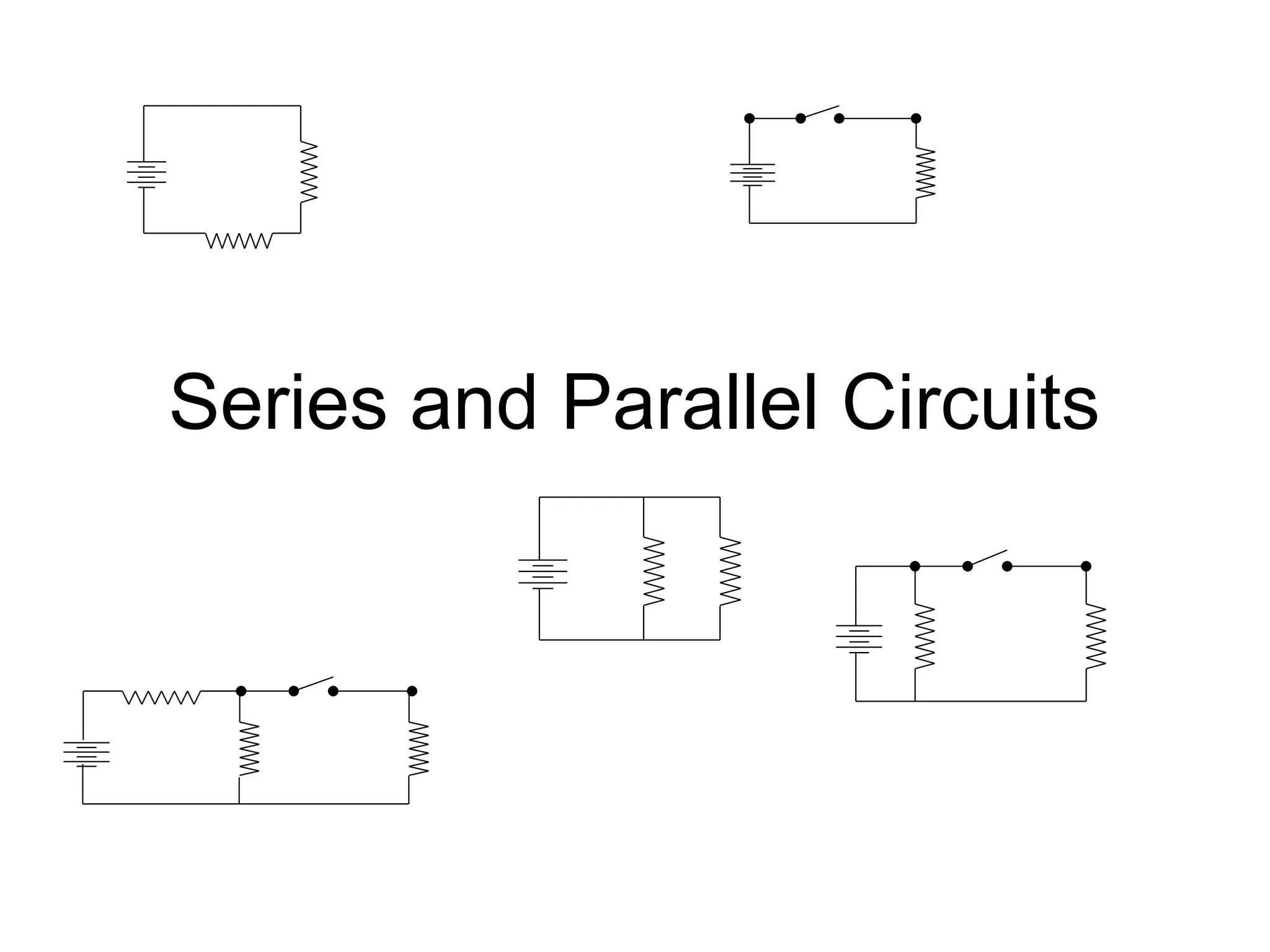
In a series circuit, there is only one path for electricity to flow through the loads. The total resistance is calculated by adding the individual resistances together. The same current flows through each load and the total voltage is the sum of the voltages across each load.
In a parallel circuit, there are multiple paths for electricity to flow. The total current is calculated by adding the currents through each load. The equivalent resistance is calculated using the individual resistances and Ohm's law.
Series Circuit
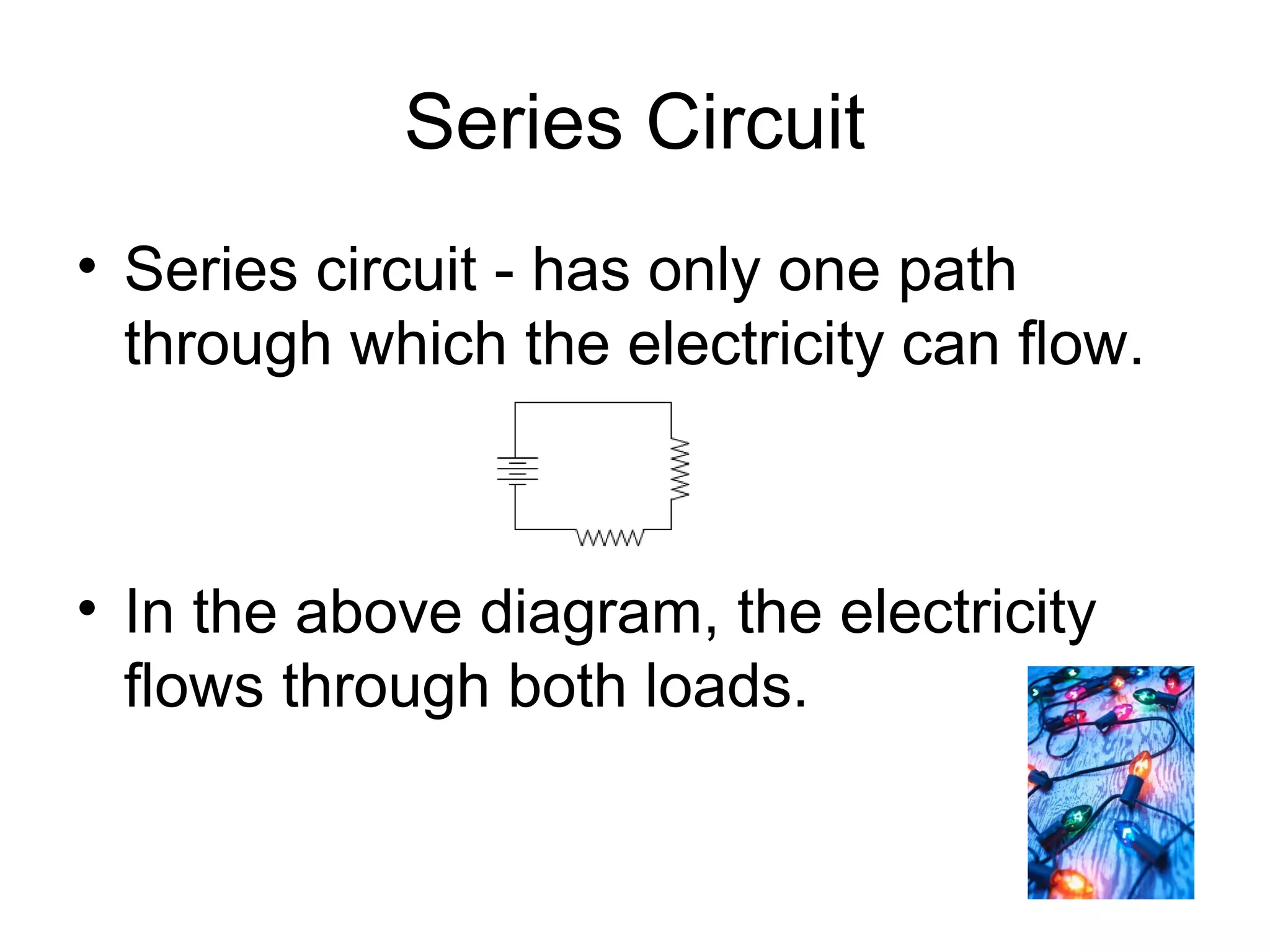
• Seriescircuit - has only one path
through which the electricity can flow.
• In the above diagram, the electricity
flows through both loads.
3.
Current and Resistancein Series
Circuits
• For the series circuit the same current flows
through both loads.
• The loads can be added together to calculate
the total load.
• Rtot = R1 + R2, where Rtot is the total
resistance, R1 is the resistance of one load, and
R2 is the resistance of the other.
• The total load (resistance) in a series circuit with
“n” loads is the sum of the resistance of the “n”
objects. Rtot = R1 + R2 + … + Rn.
4.
Total Voltage ina Series Circuit
• Ohm’s Law can be used to calculate the
total voltage in a series circuit by
calculating the sum of the voltage parts.
• V = V1 + V2, where V is the total voltage
(battery voltage), V1 is the voltage at the
first load, and V2 is the voltage at the
other load.
5.
Parallel Circuits
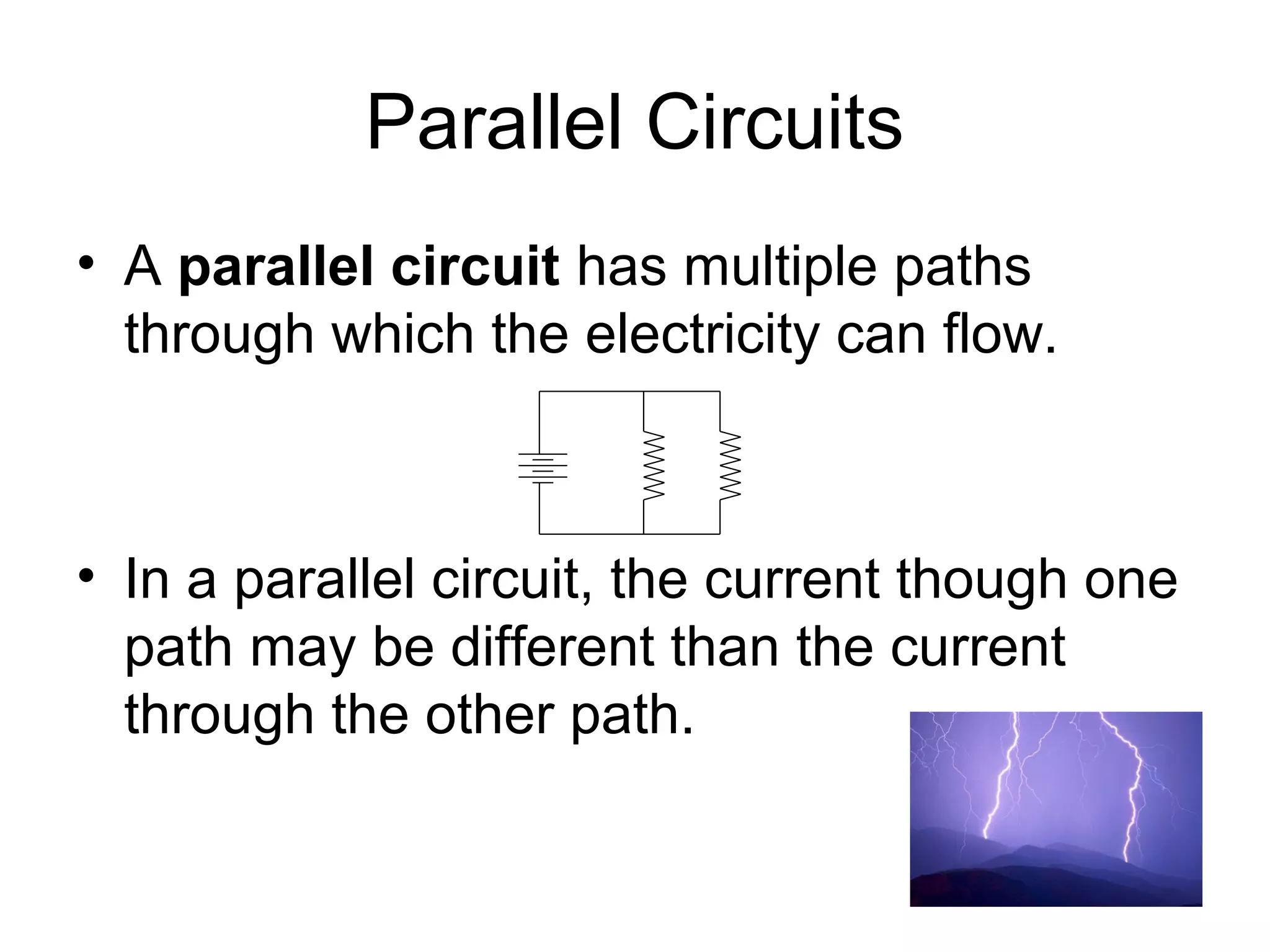
• Aparallel circuit has multiple paths
through which the electricity can flow.
• In a parallel circuit, the current though one
path may be different than the current
through the other path.
6.
Current in aParallel Circuit
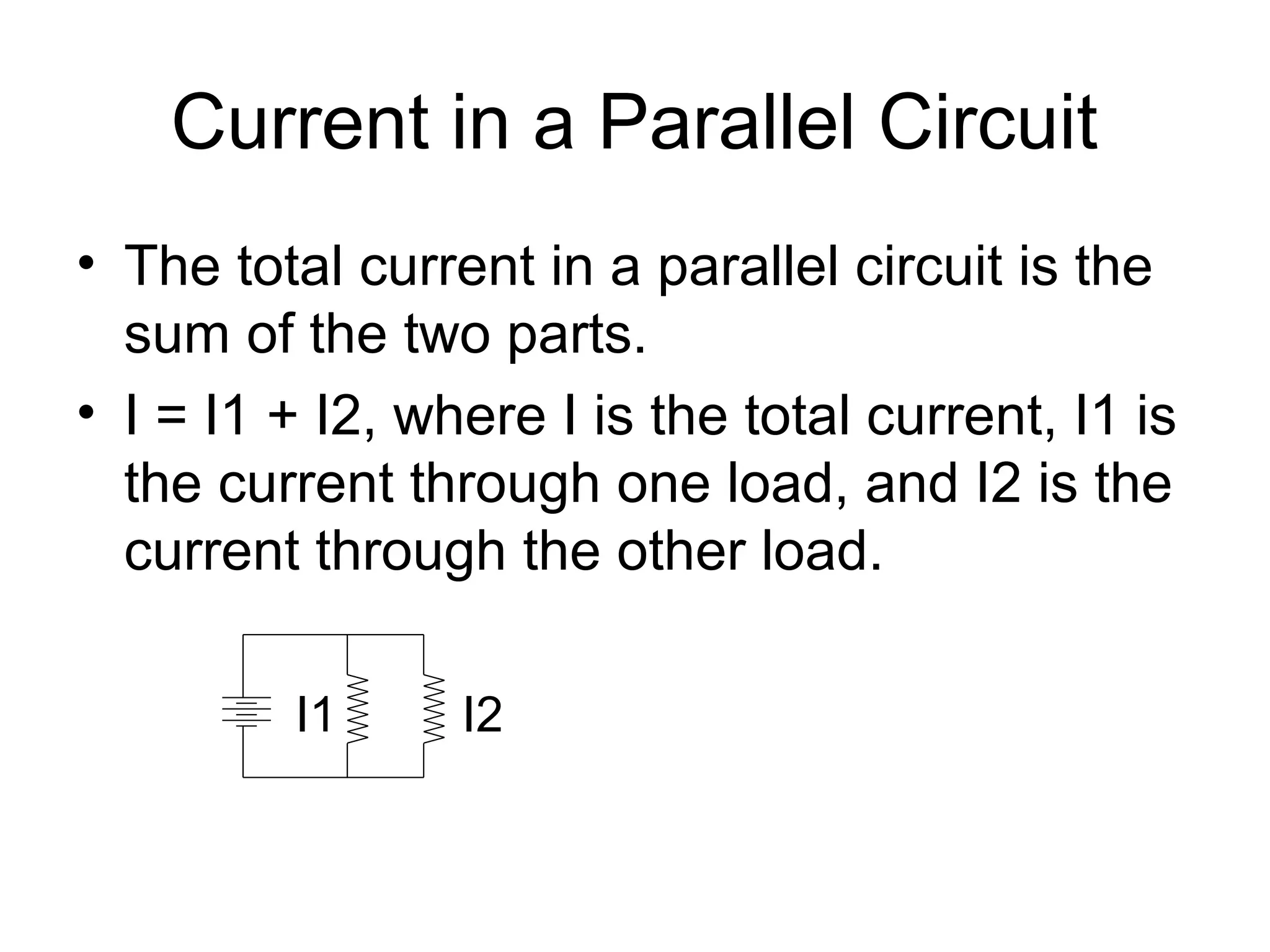
• The total current in a parallel circuit is the
sum of the two parts.
• I = I1 + I2, where I is the total current, I1 is
the current through one load, and I2 is the
current through the other load.
I1 I2
7.
Resistance in ParallelCircuits
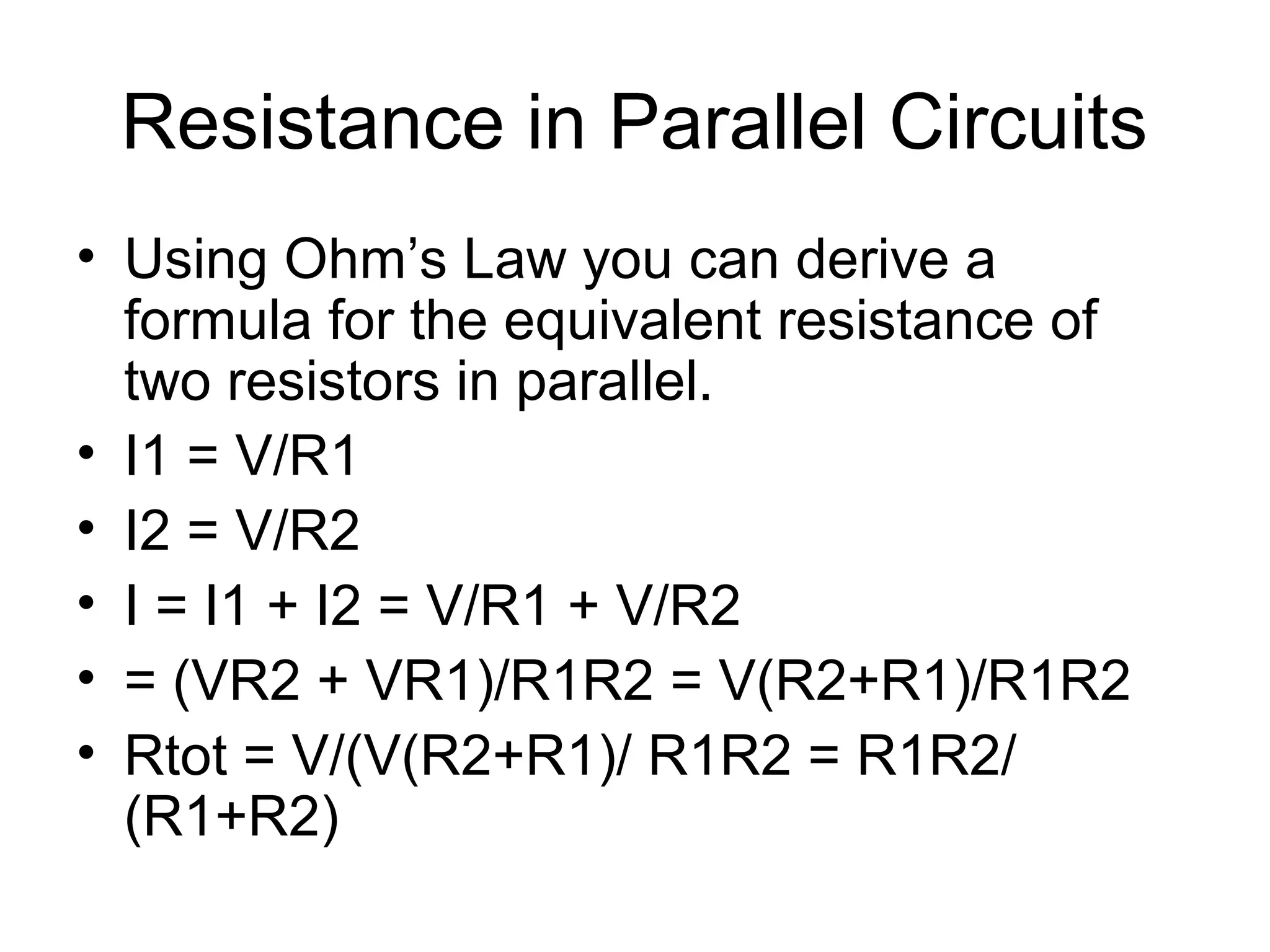
• Using Ohm’s Law you can derive a
formula for the equivalent resistance of
two resistors in parallel.
• I1 = V/R1
• I2 = V/R2
• I = I1 + I2 = V/R1 + V/R2
• = (VR2 + VR1)/R1R2 = V(R2+R1)/R1R2
• Rtot = V/(V(R2+R1)/ R1R2 = R1R2/
(R1+R2)