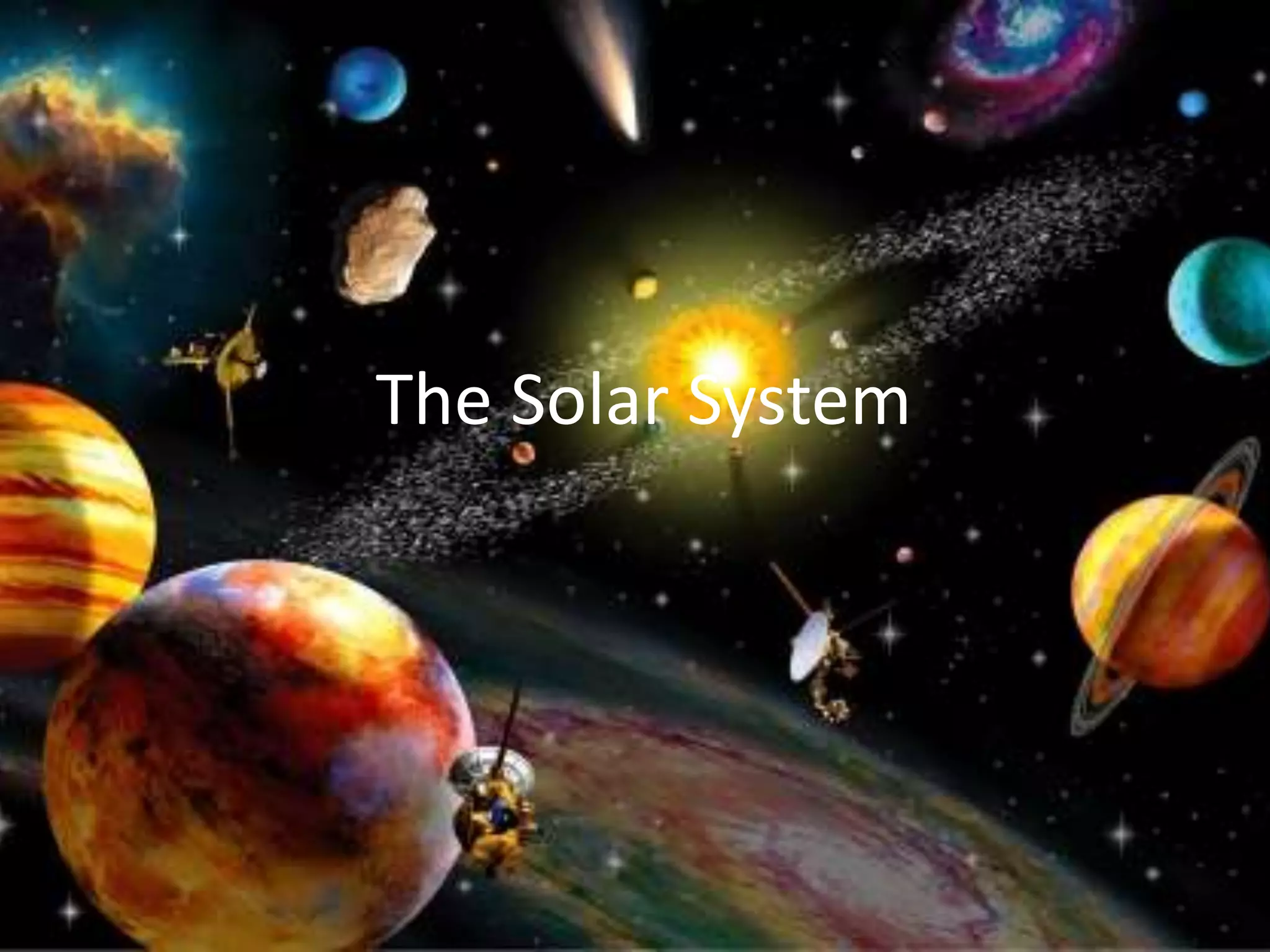
The Solar System
Sun: 
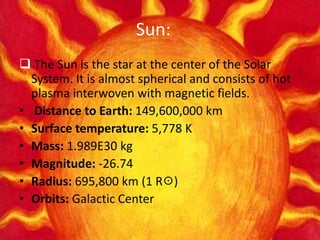
 The Sun is the star at the center of the Solar 
System. It is almost spherical and consists of hot 
plasma interwoven with magnetic fields. 
• Distance to Earth: 149,600,000 km 
• Surface temperature: 5,778 K 
• Mass: 1.989E30 kg 
• Magnitude: -26.74 
• Radius: 695,800 km (1 R☉) 
• Orbits: Galactic Center
Mercury: 
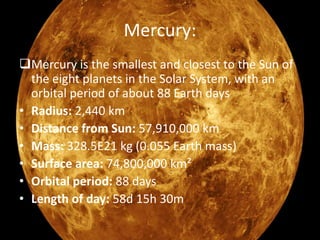
Mercury is the smallest and closest to the Sun of 
the eight planets in the Solar System, with an 
orbital period of about 88 Earth days 
• Radius: 2,440 km 
• Distance from Sun: 57,910,000 km 
• Mass: 328.5E21 kg (0.055 Earth mass) 
• Surface area: 74,800,000 km² 
• Orbital period: 88 days 
• Length of day: 58d 15h 30m
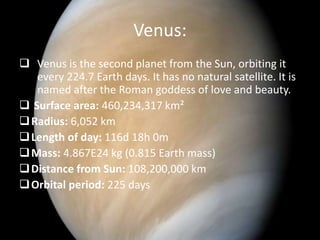
Venus: 
 Venus is the second planet from the Sun, orbiting it 
every 224.7 Earth days. It has no natural satellite. It is 
named after the Roman goddess of love and beauty. 
 Surface area: 460,234,317 km² 
Radius: 6,052 km 
Length of day: 116d 18h 0m 
Mass: 4.867E24 kg (0.815 Earth mass) 
Distance from Sun: 108,200,000 km 
Orbital period: 225 days
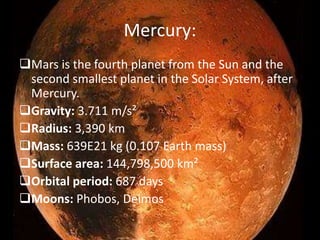
Mercury: 
Mars is the fourth planet from the Sun and the 
second smallest planet in the Solar System, after 
Mercury. 
Gravity: 3.711 m/s² 
Radius: 3,390 km 
Mass: 639E21 kg (0.107 Earth mass) 
Surface area: 144,798,500 km² 
Orbital period: 687 days 
Moons: Phobos, Deimos
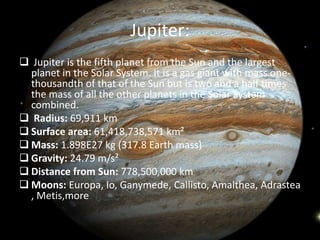
Jupiter: 
 Jupiter is the fifth planet from the Sun and the largest 
planet in the Solar System. It is a gas giant with mass one-thousandth 
of that of the Sun but is two and a half times 
the mass of all the other planets in the Solar System 
combined. 
 Radius: 69,911 km 
 Surface area: 61,418,738,571 km² 
 Mass: 1.898E27 kg (317.8 Earth mass) 
 Gravity: 24.79 m/s² 
 Distance from Sun: 778,500,000 km 
 Moons: Europa, Io, Ganymede, Callisto, Amalthea, Adrastea 
, Metis,more
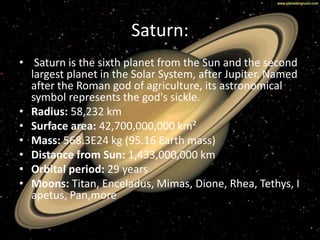
Saturn: 
• Saturn is the sixth planet from the Sun and the second 
largest planet in the Solar System, after Jupiter. Named 
after the Roman god of agriculture, its astronomical 
symbol represents the god's sickle. 
• Radius: 58,232 km 
• Surface area: 42,700,000,000 km² 
• Mass: 568.3E24 kg (95.16 Earth mass) 
• Distance from Sun: 1,433,000,000 km 
• Orbital period: 29 years 
• Moons: Titan, Enceladus, Mimas, Dione, Rhea, Tethys, I 
apetus, Pan,more
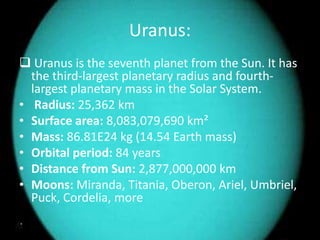
Uranus: 
 Uranus is the seventh planet from the Sun. It has 
the third-largest planetary radius and fourth-largest 
planetary mass in the Solar System. 
• Radius: 25,362 km 
• Surface area: 8,083,079,690 km² 
• Mass: 86.81E24 kg (14.54 Earth mass) 
• Orbital period: 84 years 
• Distance from Sun: 2,877,000,000 km 
• Moons: Miranda, Titania, Oberon, Ariel, Umbriel, 
Puck, Cordelia, more
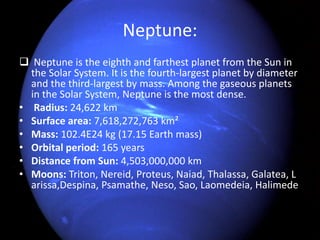
Neptune: 
 Neptune is the eighth and farthest planet from the Sun in 
the Solar System. It is the fourth-largest planet by diameter 
and the third-largest by mass. Among the gaseous planets 
in the Solar System, Neptune is the most dense. 
• Radius: 24,622 km 
• Surface area: 7,618,272,763 km² 
• Mass: 102.4E24 kg (17.15 Earth mass) 
• Orbital period: 165 years 
• Distance from Sun: 4,503,000,000 km 
• Moons: Triton, Nereid, Proteus, Naiad, Thalassa, Galatea, L 
arissa,Despina, Psamathe, Neso, Sao, Laomedeia, Halimede
The solar system

The solar system

  • 1.
  • 2.
    Sun:  TheSun is the star at the center of the Solar System. It is almost spherical and consists of hot plasma interwoven with magnetic fields. • Distance to Earth: 149,600,000 km • Surface temperature: 5,778 K • Mass: 1.989E30 kg • Magnitude: -26.74 • Radius: 695,800 km (1 R☉) • Orbits: Galactic Center
  • 3.
    Mercury: Mercury isthe smallest and closest to the Sun of the eight planets in the Solar System, with an orbital period of about 88 Earth days • Radius: 2,440 km • Distance from Sun: 57,910,000 km • Mass: 328.5E21 kg (0.055 Earth mass) • Surface area: 74,800,000 km² • Orbital period: 88 days • Length of day: 58d 15h 30m
  • 4.
    Venus:  Venusis the second planet from the Sun, orbiting it every 224.7 Earth days. It has no natural satellite. It is named after the Roman goddess of love and beauty.  Surface area: 460,234,317 km² Radius: 6,052 km Length of day: 116d 18h 0m Mass: 4.867E24 kg (0.815 Earth mass) Distance from Sun: 108,200,000 km Orbital period: 225 days
  • 5.
    Mercury: Mars isthe fourth planet from the Sun and the second smallest planet in the Solar System, after Mercury. Gravity: 3.711 m/s² Radius: 3,390 km Mass: 639E21 kg (0.107 Earth mass) Surface area: 144,798,500 km² Orbital period: 687 days Moons: Phobos, Deimos
  • 6.
    Jupiter:  Jupiteris the fifth planet from the Sun and the largest planet in the Solar System. It is a gas giant with mass one-thousandth of that of the Sun but is two and a half times the mass of all the other planets in the Solar System combined.  Radius: 69,911 km  Surface area: 61,418,738,571 km²  Mass: 1.898E27 kg (317.8 Earth mass)  Gravity: 24.79 m/s²  Distance from Sun: 778,500,000 km  Moons: Europa, Io, Ganymede, Callisto, Amalthea, Adrastea , Metis,more
  • 7.
    Saturn: • Saturnis the sixth planet from the Sun and the second largest planet in the Solar System, after Jupiter. Named after the Roman god of agriculture, its astronomical symbol represents the god's sickle. • Radius: 58,232 km • Surface area: 42,700,000,000 km² • Mass: 568.3E24 kg (95.16 Earth mass) • Distance from Sun: 1,433,000,000 km • Orbital period: 29 years • Moons: Titan, Enceladus, Mimas, Dione, Rhea, Tethys, I apetus, Pan,more
  • 8.
    Uranus:  Uranusis the seventh planet from the Sun. It has the third-largest planetary radius and fourth-largest planetary mass in the Solar System. • Radius: 25,362 km • Surface area: 8,083,079,690 km² • Mass: 86.81E24 kg (14.54 Earth mass) • Orbital period: 84 years • Distance from Sun: 2,877,000,000 km • Moons: Miranda, Titania, Oberon, Ariel, Umbriel, Puck, Cordelia, more
  • 9.
    Neptune:  Neptuneis the eighth and farthest planet from the Sun in the Solar System. It is the fourth-largest planet by diameter and the third-largest by mass. Among the gaseous planets in the Solar System, Neptune is the most dense. • Radius: 24,622 km • Surface area: 7,618,272,763 km² • Mass: 102.4E24 kg (17.15 Earth mass) • Orbital period: 165 years • Distance from Sun: 4,503,000,000 km • Moons: Triton, Nereid, Proteus, Naiad, Thalassa, Galatea, L arissa,Despina, Psamathe, Neso, Sao, Laomedeia, Halimede