Basic Electricity
Series and Parallel Circuits
Series Circuits
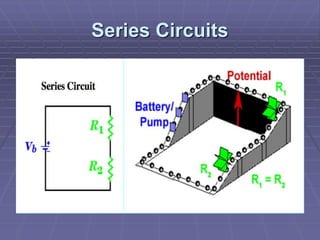
 When components are connected in
successive order.
 Only one path for electron flow.
 Current is the same for all series
components.
Series Circuits
Total R = sum of all series
resistances:
 RT = R1+ R2+ R3 ...+ etc.
 Where RT is the total resistance and R1,
R2, R3 are individual series resistances.
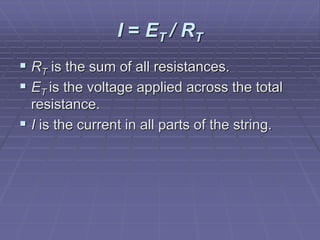
I = ET / RT
 RT is the sum of all resistances.
 ET is the voltage applied across the total
resistance.
 I is the current in all parts of the string.
Series IR Voltage Drops
 The IR voltage across each resistance is
known as an IR drop or a voltage drop.
 It reduces the potential difference available
for the remaining resistance in a series
circuit.
 V1, V2 etc are used for the voltage drops
across each resistor to distinguish them from
the applied voltage source ET. V1 = IT X R1,
V2 = IT X R2, etc
 ET = V1 + V2 + .... + etc
Total Power in Series Circuits
 The total power is the sum of the power
dissipated in each part of the circuit or:
 PT = P1 + P2 + ...+ etc
 Remember: 3 Power Formulas
 P = E x I
 P = I2 x R
 P = E2 / R
Effect of an open is a series
circuit
 Because the current is the same in each
part of a series circuit -
 An open results in no current for the entire
circuit.
Parallel Circuits
 Each parallel path is a branch with its own
individual current.
 Parallel circuits have one common voltage
across all branches, however -
 Individual branch currents can be different.
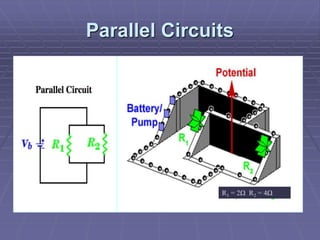
Parallel Circuits
R1 = 2Ω R2 = 4Ω
Voltage is equal across
parallel branches
 Since components are directly connected across
the voltage source, they must have the same
potential as the source.
 Therefore, the voltage is the same across
components connected in parallel.
 Components requiring the same voltage would
be connected in parallel.
Each branch I = E / R
 I1 = E / R1
 I2 = E / R2 and so on.
 If individual resistances are the same, then
individual branch currents would also be
the same.
Main-line IT = sum of branch
currents
 IT = I1 + I2 + ...+ etc
Resistances in parallel
 Total resistance across the main line can
be found by Ohm’s Law: Divide the
common voltage by the total current.
 RT = E / IT
 RT is always less than the smallest
individual branch resistance
Reciprocal resistance
formulae
 1 / RT = 1/R1 + 1/R2 + 1/R3 + ... etc
 This formulae works for any number of
parallel resistances of any value
If the values of R are the
same
 If all resistors in parallel are the same
value, then use this shortcut:
 The value of one resistor/total number of
resistors = Total resistance
If the there are only 2
resistors of differing values
 If there are only two resistors in parallel
and they are different in value, then use
this shortcut:
 R1 x R2/R1 + R2 = Total resistance
Power in parallel circuits
 Total power equals the sum of the
individual power in each branch.
 PT = P1 + P2 + ...+ etc
 In both series and parallel circuits the sum
of the individual values of power
dissipated in the circuit = the total power
generated by the source.
Effect of an open in a parallel
circuit
 An open in the main line results in no
current in all branches
 An open in a branch results in no current
for that individual branch - other branches
are not affected
Effect of a short circuit in
parallel
 A short circuit has practically zero
resistance
 A short results in excessive current

Series Ckt. and Parallel.ppt

  • 1.
  • 2.
    Series Circuits  Whencomponents are connected in successive order.  Only one path for electron flow.  Current is the same for all series components.
  • 3.
  • 4.
    Total R =sum of all series resistances:  RT = R1+ R2+ R3 ...+ etc.  Where RT is the total resistance and R1, R2, R3 are individual series resistances.
  • 5.
    I = ET/ RT  RT is the sum of all resistances.  ET is the voltage applied across the total resistance.  I is the current in all parts of the string.
  • 6.
    Series IR VoltageDrops  The IR voltage across each resistance is known as an IR drop or a voltage drop.  It reduces the potential difference available for the remaining resistance in a series circuit.  V1, V2 etc are used for the voltage drops across each resistor to distinguish them from the applied voltage source ET. V1 = IT X R1, V2 = IT X R2, etc  ET = V1 + V2 + .... + etc
  • 7.
    Total Power inSeries Circuits  The total power is the sum of the power dissipated in each part of the circuit or:  PT = P1 + P2 + ...+ etc  Remember: 3 Power Formulas  P = E x I  P = I2 x R  P = E2 / R
  • 8.
    Effect of anopen is a series circuit  Because the current is the same in each part of a series circuit -  An open results in no current for the entire circuit.
  • 9.
    Parallel Circuits  Eachparallel path is a branch with its own individual current.  Parallel circuits have one common voltage across all branches, however -  Individual branch currents can be different.
  • 10.
  • 11.
    Voltage is equalacross parallel branches  Since components are directly connected across the voltage source, they must have the same potential as the source.  Therefore, the voltage is the same across components connected in parallel.  Components requiring the same voltage would be connected in parallel.
  • 12.
    Each branch I= E / R  I1 = E / R1  I2 = E / R2 and so on.  If individual resistances are the same, then individual branch currents would also be the same.
  • 13.
    Main-line IT =sum of branch currents  IT = I1 + I2 + ...+ etc
  • 14.
    Resistances in parallel Total resistance across the main line can be found by Ohm’s Law: Divide the common voltage by the total current.  RT = E / IT  RT is always less than the smallest individual branch resistance
  • 15.
    Reciprocal resistance formulae  1/ RT = 1/R1 + 1/R2 + 1/R3 + ... etc  This formulae works for any number of parallel resistances of any value
  • 16.
    If the valuesof R are the same  If all resistors in parallel are the same value, then use this shortcut:  The value of one resistor/total number of resistors = Total resistance
  • 17.
    If the thereare only 2 resistors of differing values  If there are only two resistors in parallel and they are different in value, then use this shortcut:  R1 x R2/R1 + R2 = Total resistance
  • 18.
    Power in parallelcircuits  Total power equals the sum of the individual power in each branch.  PT = P1 + P2 + ...+ etc  In both series and parallel circuits the sum of the individual values of power dissipated in the circuit = the total power generated by the source.
  • 19.
    Effect of anopen in a parallel circuit  An open in the main line results in no current in all branches  An open in a branch results in no current for that individual branch - other branches are not affected
  • 20.
    Effect of ashort circuit in parallel  A short circuit has practically zero resistance  A short results in excessive current