Latch Introduction &
RS Latch
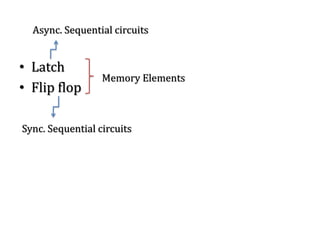
• Latch
• Flip flop
Memory Elements
Async. Sequential circuits
Sync. Sequential circuits
Today's Topic
Combinational Logic Circuits
• Latches
Storage Elements
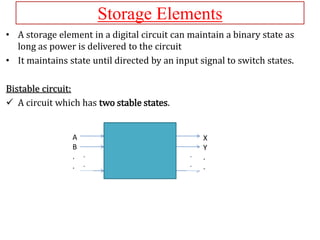
• A storage element in a digital circuit can maintain a binary state as
long as power is delivered to the circuit
• It maintains state until directed by an input signal to switch states.
Bistable circuit:
 A circuit which has two stable states.
.
.
.
.
A
B
.
.
X
Y
.
.
Storage elements
• That operate with signal levels are referred to as latches
• Those controlled by a clock transition are flip-flops .
• The two types of storage elements are related because latches
are the basic circuits from which all flip-flops are constructed.
Latches
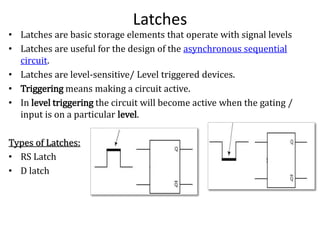
• Latches are basic storage elements that operate with signal levels
• Latches are useful for the design of the asynchronous sequential
circuit.
• Latches are level-sensitive/ Level triggered devices.
• Triggering means making a circuit active.
• In level triggering the circuit will become active when the gating /
input is on a particular level.
Types of Latches:
• RS Latch
• D latch
RS Latch
Reset - Set Latch
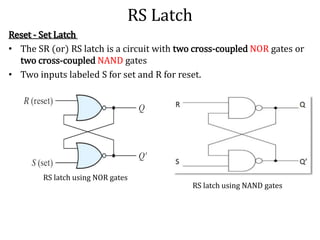
• The SR (or) RS latch is a circuit with two cross-coupled NOR gates or
two cross-coupled NAND gates
• Two inputs labeled S for set and R for reset.
RS latch using NAND gates
RS latch using NOR gates
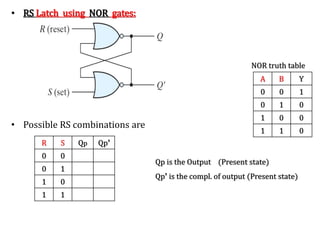
• RS Latch using NOR gates:
• Possible RS combinations are
R S Qp Qp’
0 0
0 1
1 0
1 1
A B Y
0 0 1
0 1 0
1 0 0
1 1 0
NOR truth table
Qp is the Output (Present state)
Qp’ is the compl. of output (Present state)
 S=0 , R=1
Qp = 0 Qp’ = 1
• S=0 , R=0
Qp = 0 Qp’ = 1
------------------------------------------
 S=1 , R=0
Qp = 1 Qp’ = 0
• S=0 , R=0
Qp = 1 Qp’ = 0
Used to RESET the o/p
Used to SET the o/p to 1
A B Y
0 0 1
0 1 0
1 0 0
1 1 0
NOR :
It is clear that S=0 , R=0 condition is used as a memory/storage
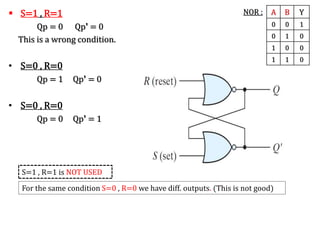
 S=1 , R=1
Qp = 0 Qp’ = 0
This is a wrong condition.
• S=0 , R=0
Qp = 1 Qp’ = 0
• S=0 , R=0
Qp = 0 Qp’ = 1
A B Y
0 0 1
0 1 0
1 0 0
1 1 0
NOR :
For the same condition S=0 , R=0 we have diff. outputs. (This is not good)
S=1 , R=1 is NOT USED
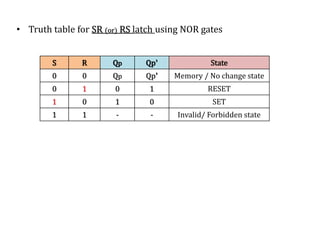
• Truth table for SR (or) RS latch using NOR gates
S R Qp Qp’ State
0 0 Qp Qp’ Memory / No change state
0 1 0 1 RESET
1 0 1 0 SET
1 1 - - Invalid/ Forbidden state
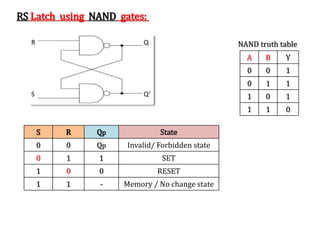
RS Latch using NAND gates:
A B Y
0 0 1
0 1 1
1 0 1
1 1 0
NAND truth table
S R Qp State
0 0 Qp Invalid/ Forbidden state
0 1 1 SET
1 0 0 RESET
1 1 - Memory / No change state
In Next Class
• D Lacth
• A

Latch Introduction & RS Latch

  • 1.
  • 2.
    • Latch • Flipflop Memory Elements Async. Sequential circuits Sync. Sequential circuits
  • 3.
  • 4.
    Storage Elements • Astorage element in a digital circuit can maintain a binary state as long as power is delivered to the circuit • It maintains state until directed by an input signal to switch states. Bistable circuit:  A circuit which has two stable states. . . . . A B . . X Y . .
  • 5.
    Storage elements • Thatoperate with signal levels are referred to as latches • Those controlled by a clock transition are flip-flops . • The two types of storage elements are related because latches are the basic circuits from which all flip-flops are constructed.
  • 6.
    Latches • Latches arebasic storage elements that operate with signal levels • Latches are useful for the design of the asynchronous sequential circuit. • Latches are level-sensitive/ Level triggered devices. • Triggering means making a circuit active. • In level triggering the circuit will become active when the gating / input is on a particular level. Types of Latches: • RS Latch • D latch
  • 7.
    RS Latch Reset -Set Latch • The SR (or) RS latch is a circuit with two cross-coupled NOR gates or two cross-coupled NAND gates • Two inputs labeled S for set and R for reset. RS latch using NAND gates RS latch using NOR gates
  • 8.
    • RS Latchusing NOR gates: • Possible RS combinations are R S Qp Qp’ 0 0 0 1 1 0 1 1 A B Y 0 0 1 0 1 0 1 0 0 1 1 0 NOR truth table Qp is the Output (Present state) Qp’ is the compl. of output (Present state)
  • 9.
     S=0 ,R=1 Qp = 0 Qp’ = 1 • S=0 , R=0 Qp = 0 Qp’ = 1 ------------------------------------------  S=1 , R=0 Qp = 1 Qp’ = 0 • S=0 , R=0 Qp = 1 Qp’ = 0 Used to RESET the o/p Used to SET the o/p to 1 A B Y 0 0 1 0 1 0 1 0 0 1 1 0 NOR : It is clear that S=0 , R=0 condition is used as a memory/storage
  • 10.
     S=1 ,R=1 Qp = 0 Qp’ = 0 This is a wrong condition. • S=0 , R=0 Qp = 1 Qp’ = 0 • S=0 , R=0 Qp = 0 Qp’ = 1 A B Y 0 0 1 0 1 0 1 0 0 1 1 0 NOR : For the same condition S=0 , R=0 we have diff. outputs. (This is not good) S=1 , R=1 is NOT USED
  • 11.
    • Truth tablefor SR (or) RS latch using NOR gates S R Qp Qp’ State 0 0 Qp Qp’ Memory / No change state 0 1 0 1 RESET 1 0 1 0 SET 1 1 - - Invalid/ Forbidden state
  • 12.
    RS Latch usingNAND gates: A B Y 0 0 1 0 1 1 1 0 1 1 1 0 NAND truth table S R Qp State 0 0 Qp Invalid/ Forbidden state 0 1 1 SET 1 0 0 RESET 1 1 - Memory / No change state
  • 13.
  • 14.