Presentation Topic:
Latches and Flip-Flops...
… Nousheen Arshad...
R1F15BSCS0040
Punjab University (UCP CAmpus)
: Sequential Circuits :
• Sequential Circuits are those whose outputs are also dependent upon
past inputs, and hence outputs.
• In other words, the output of the sequential circuits may depend upon its
previous outputs.
• The two most popular varieties of storage cells used to build sequential
circuits are:
• Latches.
• Flip-Flop.
: Latches :
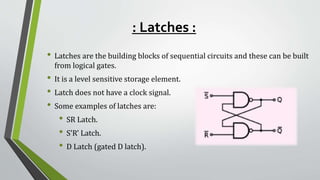
• Latches are the building blocks of sequential circuits and these can be built
from logical gates.
• It is a level sensitive storage element.
• Latch does not have a clock signal.
• Some examples of latches are:
• SR Latch.
• S'R' Latch.
• D Latch (gated D latch).
:SR Latch: :S'R' Latch:
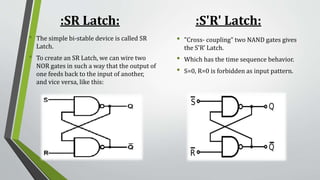
• The simple bi-stable device is called SR
Latch.
• To create an SR Latch, we can wire two
NOR gates in such a way that the output of
one feeds back to the input of another,
and vice versa, like this:
• "Cross- coupling" two NAND gates gives
the S'R' Latch.
• Which has the time sequence behavior.
• S=0, R=0 is forbidden as input pattern.
: D Latch (Gated Latch) :
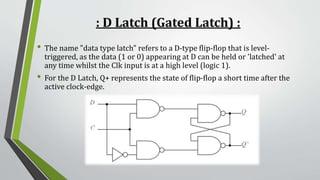
• The name "data type latch" refers to a D-type flip-flop that is level-
triggered, as the data (1 or 0) appearing at D can be held or 'latched' at
any time whilst the Clk input is at a high level (logic 1).
• For the D Latch, Q+ represents the state of flip-flop a short time after the
active clock-edge.
: Flip-Flop :
• Flip-flop are also the building blocks of sequential circuits.
• But, these can be built from the latches.
• It works on the basis of clock pulses.
• They are used as a registers.
• Flip flops are edge-triggered.
• Flip flop is sensitive to a signal change.They can transfer only at single
instant, and data cannot be changed until next signal change.
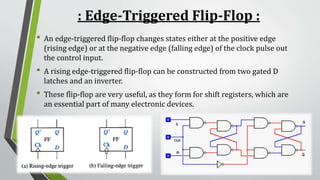
: Edge-Triggered Flip-Flop :
• An edge-triggered flip-flop changes states either at the positive edge
(rising edge) or at the negative edge (falling edge) of the clock pulse out
the control input.
• A rising edge-triggered flip-flop can be constructed from two gated D
latches and an inverter.
• These flip-flop are very useful, as they form for shift registers, which are
an essential part of many electronic devices.
: Flip-Flop with Additional Inputs :
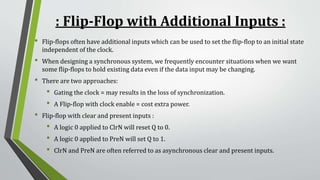
• Flip-flops often have additional inputs which can be used to set the flip-flop to an initial state
independent of the clock.
• When designing a synchronous system, we frequently encounter situations when we want
some flip-flops to hold existing data even if the data input may be changing.
• There are two approaches:
• Gating the clock = may results in the loss of synchronization.
• A Flip-flop with clock enable = cost extra power.
• Flip-flop with clear and present inputs :
• A logic 0 applied to ClrN will reset Q to 0.
• A logic 0 applied to PreN will set Q to 1.
• ClrN and PreN are often referred to as asynchronous clear and present inputs.
: Asynchronous Sequential Circuits :
• Asynchronous inputs on a flip-flop have control over the outputs (Q and
Not-Q) regardless of clock input status.
• These inputs are called preset (PRE) and clear (CLR).
• The preset input drives the flip-flop to a set state while the clear input
drives it to a reset state.
• It is possible to drive the outputs of a J-K flip-flop to an invalid condition
using the asynchronous inputs, because all feedback within the
multivibrator circuit is overridden.
Latches & flip flop

Latches & flip flop

  • 1.
    Presentation Topic: Latches andFlip-Flops... … Nousheen Arshad... R1F15BSCS0040 Punjab University (UCP CAmpus)
  • 2.
    : Sequential Circuits: • Sequential Circuits are those whose outputs are also dependent upon past inputs, and hence outputs. • In other words, the output of the sequential circuits may depend upon its previous outputs. • The two most popular varieties of storage cells used to build sequential circuits are: • Latches. • Flip-Flop.
  • 3.
    : Latches : •Latches are the building blocks of sequential circuits and these can be built from logical gates. • It is a level sensitive storage element. • Latch does not have a clock signal. • Some examples of latches are: • SR Latch. • S'R' Latch. • D Latch (gated D latch).
  • 4.
    :SR Latch: :S'R'Latch: • The simple bi-stable device is called SR Latch. • To create an SR Latch, we can wire two NOR gates in such a way that the output of one feeds back to the input of another, and vice versa, like this: • "Cross- coupling" two NAND gates gives the S'R' Latch. • Which has the time sequence behavior. • S=0, R=0 is forbidden as input pattern.
  • 5.
    : D Latch(Gated Latch) : • The name "data type latch" refers to a D-type flip-flop that is level- triggered, as the data (1 or 0) appearing at D can be held or 'latched' at any time whilst the Clk input is at a high level (logic 1). • For the D Latch, Q+ represents the state of flip-flop a short time after the active clock-edge.
  • 6.
    : Flip-Flop : •Flip-flop are also the building blocks of sequential circuits. • But, these can be built from the latches. • It works on the basis of clock pulses. • They are used as a registers. • Flip flops are edge-triggered. • Flip flop is sensitive to a signal change.They can transfer only at single instant, and data cannot be changed until next signal change.
  • 7.
    : Edge-Triggered Flip-Flop: • An edge-triggered flip-flop changes states either at the positive edge (rising edge) or at the negative edge (falling edge) of the clock pulse out the control input. • A rising edge-triggered flip-flop can be constructed from two gated D latches and an inverter. • These flip-flop are very useful, as they form for shift registers, which are an essential part of many electronic devices.
  • 8.
    : Flip-Flop withAdditional Inputs : • Flip-flops often have additional inputs which can be used to set the flip-flop to an initial state independent of the clock. • When designing a synchronous system, we frequently encounter situations when we want some flip-flops to hold existing data even if the data input may be changing. • There are two approaches: • Gating the clock = may results in the loss of synchronization. • A Flip-flop with clock enable = cost extra power. • Flip-flop with clear and present inputs : • A logic 0 applied to ClrN will reset Q to 0. • A logic 0 applied to PreN will set Q to 1. • ClrN and PreN are often referred to as asynchronous clear and present inputs.
  • 9.
    : Asynchronous SequentialCircuits : • Asynchronous inputs on a flip-flop have control over the outputs (Q and Not-Q) regardless of clock input status. • These inputs are called preset (PRE) and clear (CLR). • The preset input drives the flip-flop to a set state while the clear input drives it to a reset state. • It is possible to drive the outputs of a J-K flip-flop to an invalid condition using the asynchronous inputs, because all feedback within the multivibrator circuit is overridden.