Sentence Types:
compound
Subject and predicate
A sentence broadly consists of two components
i.e. A Subject and Predicate.
Subject
The part of a sentence which names the person or
thing we are talking about is known as a subject.
Predicate
The part of the sentence which tells something
about the subject is known as the predicate.
Example
Akbar was a great emperor.
Akbar is the subject of the sentence and was a great emperor is its
predicate.
Thus the subject
• occurs at the beginning of the sentence.
• Consists of a noun phrase.
• Indicates the topic.
The predicate
• Follows the subject
• Starts with a verb indicating an action or state of being
• Conveys a thought about subject.
What is clause?
•A clause is a group of words that
contains both a subject and a predicate.
•Clause can be either independent
clauses (main clauses) or dependent
clauses(subordinate clauses)
Independent clause(main clause)
Independent clause contains both a subject
and a predicate, can stand alone as a
sentence (a simple sentence), or be a part of
a multi-clause sentence (compound sentence)
coordinating conjunctions (and, but, for, nor,
or, so, yet) are use to connect.
Dependent clause(subordinate clause)
Contains both subject and a verb but cannot
stand alone as a sentence. It must always
be a part of a sentence.
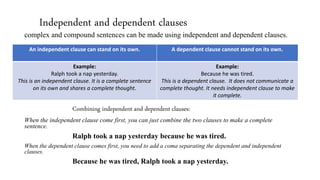
Independent and dependent clauses
complex and compound sentences can be made using independent and dependent clauses.
Combining independent and dependent clauses:
When the independent clause come first, you can just combine the two clauses to make a complete
sentence.
Ralph took a nap yesterday because he was tired.
When the dependent clause comes first, you need to add a coma separating the dependent and independent
clauses.
Because he was tired, Ralph took a nap yesterday.
An independent clause can stand on its own. A dependent clause cannot stand on its own.
Example:
Ralph took a nap yesterday.
This is an independent clause. It is a complete sentence
on its own and shares a complete thought.
Example:
Because he was tired.
This is a dependent clause. It does not communicate a
complete thought. It needs independent clause to make
it complete.
Sentence types
Simple sentences
Simple sentences
• A simple sentence contains a subject and a verb.
• It expresses a single complete thought that can stand on its own.
Simple sentence
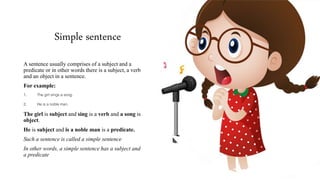
A sentence usually comprises of a subject and a
predicate or in other words there is a subject, a verb
and an object in a sentence.
For example:
1. The girl sings a song.
2. He is a noble man.
The girl is subject and sing is a verb and a song is
object.
He is subject and is a noble man is a predicate.
Such a sentence is called a simple sentence
In other words, a simple sentence has a subject and
a predicate
Simple sentences
• Examples
The baby cried for food. (there is a subject and a
verb that expresses a complete thought)
Megan and Ron ate too much and felt sick. (although
there are two subjects and two verbs it is
still simple sentence and it express one
complete thought)
Compound sentence
Compound sentence
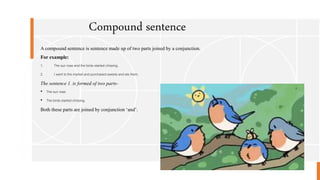
A compound sentence is sentence made up of two parts joined by a conjunction.
For example:
1. The sun rose and the birds started chirping.
2. I went to the market and purchased sweets and ate them.
The sentence 1. is formed of two parts-
• The sun rose.
• The birds started chirping.
Both these parts are joined by conjunction ‘and’.
Similarly sentence 2 is also a compound sentence. It
comprises of three coordinating clauses –
I went to the market.
Purchased sweets.
Ate them.
All these three clauses are joined by conjunctions ‘and’.
These two sentences are called compound sentences.
Compound sentences
A compound sentence has two independent clauses.
An independent clause is a part of a sentence that stand alone because
it contains a subject and a verb and expresses a complete thought.
Basically, a compound contains two simple sentences.
These independent clauses are joined by a conjunction(for, and, nor,
but, or, yet, so).
Compound sentence
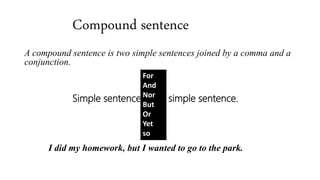
A compound sentence is two simple sentences joined by a comma and a
conjunction.
Simple sentence, simple sentence.
I did my homework, but I wanted to go to the park.
For
And
Nor
But
Or
Yet
so
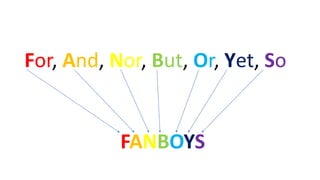
For, And, Nor, But, Or, Yet, So
FANBOYS
Compound sentences
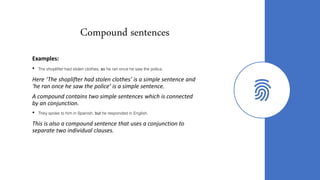
Examples:
• The shoplifter had stolen clothes, so he ran once he saw the police.
Here ‘The shoplifter had stolen clothes’ is a simple sentence and
‘he ran once he saw the police’ is a simple sentence.
A compound contains two simple sentences which is connected
by an conjunction.
• They spoke to him in Spanish, but he responded in English.
This is also a compound sentence that uses a conjunction to
separate two individual clauses.
Complex sentence
Complex sentence
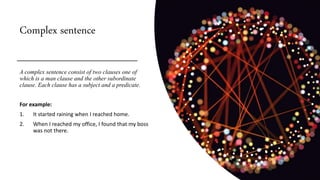
A complex sentence consist of two clauses one of
which is a man clause and the other subordinate
clause. Each clause has a subject and a predicate.
For example:
1. It started raining when I reached home.
2. When I reached my office, I found that my boss
was not there.
Complex sentence
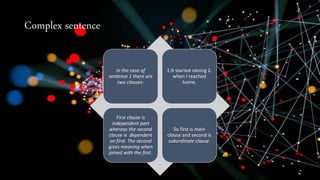
In the case of
sentence 1 there are
two clauses:
1.It started raining 2.
when I reached
home.
First clause is
independent part
whereas the second
clause is dependent
on first. The second
gives meaning when
joined with the first.
So first is main
clause and second is
subordinate clause.
Complex sentence
In the sentence 2 there are three clauses-
1. I found
2. That my boss was not there.
3. When I reached my office.
Subordinate clauses are of three types: adverbial clause, adjective clause
and noun clause.
Complex sentence
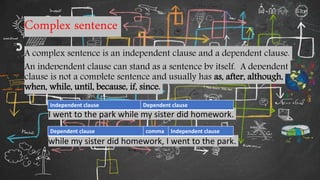
A complex sentence is an independent clause and a dependent clause.
An independent clause can stand as a sentence by itself. A dependent
clause is not a complete sentence and usually has as, after, although,
when, while, until, because, if, since.
I went to the park while my sister did homework.
while my sister did homework, I went to the park.
Independent clause Dependent clause
Dependent clause comma Independent clause
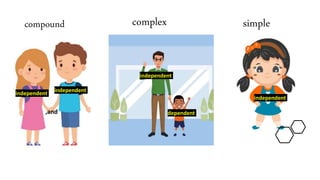
independent
independent
independent
independent
,and dependent
simplecomplexcompound
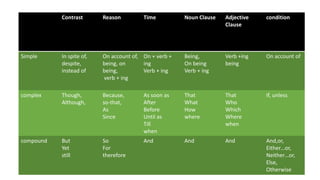
Contrast Reason Time Noun Clause Adjective
Clause
condition
Simple In spite of,
despite,
instead of
On account of,
being, on
being,
verb + ing
On + verb +
ing
Verb + ing
Being,
On being
Verb + ing
Verb +ing
being
On account of
complex Though,
Although,
Because,
so-that,
As
Since
As soon as
After
Before
Until as
Till
when
That
What
How
where
That
Who
Which
Where
when
If, unless
compound But
Yet
still
So
For
therefore
And And And And,or,
Either…or,
Neither…or,
Else,
Otherwise
Transformation of sentences
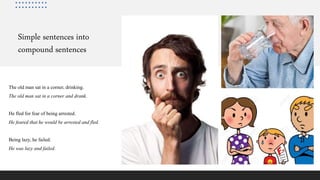
Simple sentences into
compound sentences
The old man sat in a corner, drinking.
The old man sat in a corner and drank.
He fled for fear of being arrested.
He feared that he would be arrested and fled.
Being lazy, he failed.
He was lazy and failed.
Complex sentences into compound sentences
1. As soon as we heard the gunshot, we
rushed to the spot.
We heard the gunshot and rushed to the
spot.
2. Although she is rich, she is not
happy.
She is rich but she is not happy.
3. If you are honest, you need not fear
anybody.
Be honest and fear nobody.
Simple sentences into complex
sentences
John admitted his guilt.
John admitted that he was guilty.
I have informed him of his success.
I have informed him that he has
succeeded.
Alice is said to be a good doctor.
It is said that Alice is a good doctor.
1. He is too weak to walk(simple)
He is so weak that he cannot walk.(complex)
He is very weak and he cannot walk.(compound)
2. In spite of his poverty, he is honest(simple)
Though he is poor, he is honest.(complex)
He is poor but he is honest.(compound)
By reading attentively, you will pass.(simple)
If you read attentively, you will pass.(complex)
Read attentively and you will pass.(compound)
Going home, I found him ill.(simple)
When I went home, I found him ill.(complex)
I went home and I found him ill.(compound)
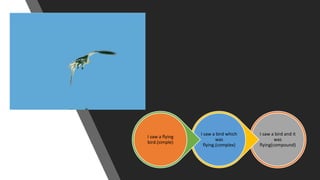
I saw a bird and it
was
flying(compound)
I saw a bird which
was
flying.(complex)
I saw a flying
bird.(simple)
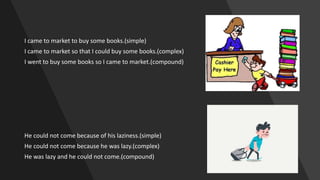
I came to market to buy some books.(simple)
I came to market so that I could buy some books.(complex)
I went to buy some books so I came to market.(compound)
He could not come because of his laziness.(simple)
He could not come because he was lazy.(complex)
He was lazy and he could not come.(compound)
simple
Thankyou

Sentence types simple,compound,complex powerpoint

  • 1.
  • 2.
    Subject and predicate Asentence broadly consists of two components i.e. A Subject and Predicate. Subject The part of a sentence which names the person or thing we are talking about is known as a subject. Predicate The part of the sentence which tells something about the subject is known as the predicate.
  • 3.
    Example Akbar was agreat emperor. Akbar is the subject of the sentence and was a great emperor is its predicate. Thus the subject • occurs at the beginning of the sentence. • Consists of a noun phrase. • Indicates the topic. The predicate • Follows the subject • Starts with a verb indicating an action or state of being • Conveys a thought about subject.
  • 4.
    What is clause? •Aclause is a group of words that contains both a subject and a predicate. •Clause can be either independent clauses (main clauses) or dependent clauses(subordinate clauses)
  • 5.
    Independent clause(main clause) Independentclause contains both a subject and a predicate, can stand alone as a sentence (a simple sentence), or be a part of a multi-clause sentence (compound sentence) coordinating conjunctions (and, but, for, nor, or, so, yet) are use to connect.
  • 6.
    Dependent clause(subordinate clause) Containsboth subject and a verb but cannot stand alone as a sentence. It must always be a part of a sentence.
  • 7.
    Independent and dependentclauses complex and compound sentences can be made using independent and dependent clauses. Combining independent and dependent clauses: When the independent clause come first, you can just combine the two clauses to make a complete sentence. Ralph took a nap yesterday because he was tired. When the dependent clause comes first, you need to add a coma separating the dependent and independent clauses. Because he was tired, Ralph took a nap yesterday. An independent clause can stand on its own. A dependent clause cannot stand on its own. Example: Ralph took a nap yesterday. This is an independent clause. It is a complete sentence on its own and shares a complete thought. Example: Because he was tired. This is a dependent clause. It does not communicate a complete thought. It needs independent clause to make it complete.
  • 8.
  • 9.
  • 10.
    Simple sentences • Asimple sentence contains a subject and a verb. • It expresses a single complete thought that can stand on its own.
  • 11.
    Simple sentence A sentenceusually comprises of a subject and a predicate or in other words there is a subject, a verb and an object in a sentence. For example: 1. The girl sings a song. 2. He is a noble man. The girl is subject and sing is a verb and a song is object. He is subject and is a noble man is a predicate. Such a sentence is called a simple sentence In other words, a simple sentence has a subject and a predicate
  • 12.
    Simple sentences • Examples Thebaby cried for food. (there is a subject and a verb that expresses a complete thought) Megan and Ron ate too much and felt sick. (although there are two subjects and two verbs it is still simple sentence and it express one complete thought)
  • 13.
  • 14.
    Compound sentence A compoundsentence is sentence made up of two parts joined by a conjunction. For example: 1. The sun rose and the birds started chirping. 2. I went to the market and purchased sweets and ate them. The sentence 1. is formed of two parts- • The sun rose. • The birds started chirping. Both these parts are joined by conjunction ‘and’.
  • 15.
    Similarly sentence 2is also a compound sentence. It comprises of three coordinating clauses – I went to the market. Purchased sweets. Ate them. All these three clauses are joined by conjunctions ‘and’. These two sentences are called compound sentences.
  • 16.
    Compound sentences A compoundsentence has two independent clauses. An independent clause is a part of a sentence that stand alone because it contains a subject and a verb and expresses a complete thought. Basically, a compound contains two simple sentences. These independent clauses are joined by a conjunction(for, and, nor, but, or, yet, so).
  • 17.
    Compound sentence A compoundsentence is two simple sentences joined by a comma and a conjunction. Simple sentence, simple sentence. I did my homework, but I wanted to go to the park. For And Nor But Or Yet so
  • 18.
    For, And, Nor,But, Or, Yet, So FANBOYS
  • 19.
    Compound sentences Examples: • Theshoplifter had stolen clothes, so he ran once he saw the police. Here ‘The shoplifter had stolen clothes’ is a simple sentence and ‘he ran once he saw the police’ is a simple sentence. A compound contains two simple sentences which is connected by an conjunction. • They spoke to him in Spanish, but he responded in English. This is also a compound sentence that uses a conjunction to separate two individual clauses.
  • 20.
  • 21.
    Complex sentence A complexsentence consist of two clauses one of which is a man clause and the other subordinate clause. Each clause has a subject and a predicate. For example: 1. It started raining when I reached home. 2. When I reached my office, I found that my boss was not there.
  • 22.
    Complex sentence In thecase of sentence 1 there are two clauses: 1.It started raining 2. when I reached home. First clause is independent part whereas the second clause is dependent on first. The second gives meaning when joined with the first. So first is main clause and second is subordinate clause.
  • 23.
    Complex sentence In thesentence 2 there are three clauses- 1. I found 2. That my boss was not there. 3. When I reached my office. Subordinate clauses are of three types: adverbial clause, adjective clause and noun clause.
  • 24.
    Complex sentence A complexsentence is an independent clause and a dependent clause. An independent clause can stand as a sentence by itself. A dependent clause is not a complete sentence and usually has as, after, although, when, while, until, because, if, since. I went to the park while my sister did homework. while my sister did homework, I went to the park. Independent clause Dependent clause Dependent clause comma Independent clause
  • 25.
  • 26.
    Contrast Reason TimeNoun Clause Adjective Clause condition Simple In spite of, despite, instead of On account of, being, on being, verb + ing On + verb + ing Verb + ing Being, On being Verb + ing Verb +ing being On account of complex Though, Although, Because, so-that, As Since As soon as After Before Until as Till when That What How where That Who Which Where when If, unless compound But Yet still So For therefore And And And And,or, Either…or, Neither…or, Else, Otherwise
  • 27.
  • 28.
    Simple sentences into compoundsentences The old man sat in a corner, drinking. The old man sat in a corner and drank. He fled for fear of being arrested. He feared that he would be arrested and fled. Being lazy, he failed. He was lazy and failed.
  • 29.
    Complex sentences intocompound sentences 1. As soon as we heard the gunshot, we rushed to the spot. We heard the gunshot and rushed to the spot. 2. Although she is rich, she is not happy. She is rich but she is not happy. 3. If you are honest, you need not fear anybody. Be honest and fear nobody.
  • 30.
    Simple sentences intocomplex sentences John admitted his guilt. John admitted that he was guilty. I have informed him of his success. I have informed him that he has succeeded. Alice is said to be a good doctor. It is said that Alice is a good doctor.
  • 31.
    1. He istoo weak to walk(simple) He is so weak that he cannot walk.(complex) He is very weak and he cannot walk.(compound) 2. In spite of his poverty, he is honest(simple) Though he is poor, he is honest.(complex) He is poor but he is honest.(compound)
  • 32.
    By reading attentively,you will pass.(simple) If you read attentively, you will pass.(complex) Read attentively and you will pass.(compound) Going home, I found him ill.(simple) When I went home, I found him ill.(complex) I went home and I found him ill.(compound)
  • 33.
    I saw abird and it was flying(compound) I saw a bird which was flying.(complex) I saw a flying bird.(simple)
  • 34.
    I came tomarket to buy some books.(simple) I came to market so that I could buy some books.(complex) I went to buy some books so I came to market.(compound) He could not come because of his laziness.(simple) He could not come because he was lazy.(complex) He was lazy and he could not come.(compound)
  • 35.