Subject
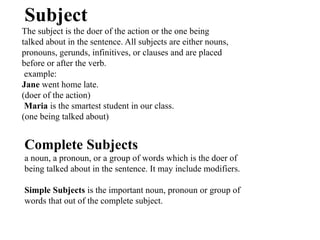
The subject is the doer of the action or the one being
talked about in the sentence. All subjects are either nouns,
pronouns, gerunds, infinitives, or clauses and are placed
before or after the verb.
example:
Jane went home late.
(doer of the action)
Maria is the smartest student in our class.
(one being talked about)
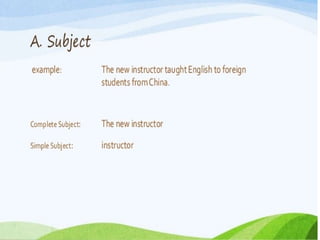
Complete Subjects
a noun, a pronoun, or a group of words which is the doer of
being talked about in the sentence. It may include modifiers.
Simple Subjects is the important noun, pronoun or group of
words that out of the complete subject.
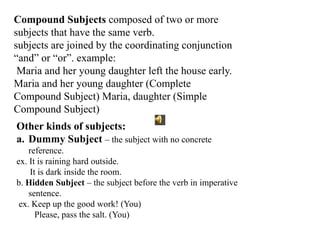
Compound Subjects composed of two or more
subjects that have the same verb.
subjects are joined by the coordinating conjunction
“and” or “or”. example:
Maria and her young daughter left the house early.
Maria and her young daughter (Complete
Compound Subject) Maria, daughter (Simple
Compound Subject)
Other kinds of subjects:
a. Dummy Subject – the subject with no concrete
reference.
ex. It is raining hard outside.
It is dark inside the room.
b. Hidden Subject – the subject before the verb in imperative
sentence.
ex. Keep up the good work! (You)
Please, pass the salt. (You)
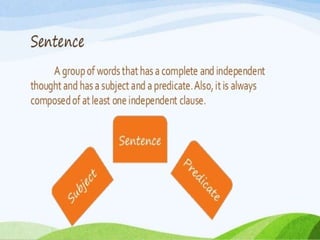
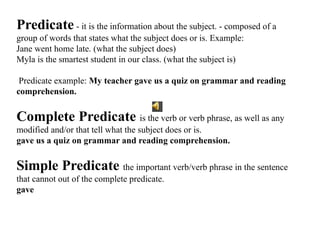
Predicate - it is the information about the subject. - composed of a
group of words that states what the subject does or is. Example:
Jane went home late. (what the subject does)
Myla is the smartest student in our class. (what the subject is)
Predicate example: My teacher gave us a quiz on grammar and reading
comprehension.
Complete Predicate is the verb or verb phrase, as well as any
modified and/or that tell what the subject does or is.
gave us a quiz on grammar and reading comprehension.
Simple Predicate the important verb/verb phrase in the sentence
that cannot out of the complete predicate.
gave
Compound Predicate composed of two or more verbs that have
the same subject. are joined by a coordinating conjunction. example:
Maria left the house early but arrived late for work. …
left the house early but arrived late for work (Complete Predicate) …
left, arrived (Simple Predicate)
Elliptical A word or group of words that do not express a subject or
predicate or both, but the thought is complete if it is in relation with the
previous statement.
Example:
1. Who called? Marta. (predicate) [ Marta called. ]
2. What did you do? Asked her to come in. (subject) [ I asked her to
come in ]
3. What did she want?Tickets for the concert. (s&p) [ She wanted
tickets for the concert ]
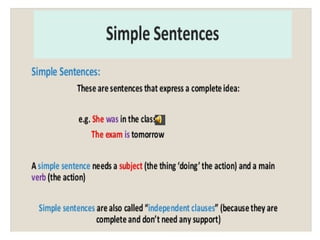
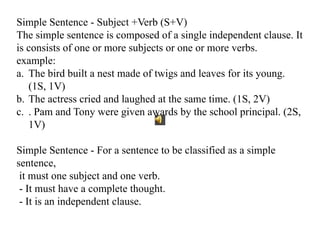
Simple Sentence - Subject +Verb (S+V)
The simple sentence is composed of a single independent clause. It
is consists of one or more subjects or one or more verbs.
example:
a. The bird built a nest made of twigs and leaves for its young.
(1S, 1V)
b. The actress cried and laughed at the same time. (1S, 2V)
c. . Pam and Tony were given awards by the school principal. (2S,
1V)
Simple Sentence - For a sentence to be classified as a simple
sentence,
it must one subject and one verb.
- It must have a complete thought.
- It is an independent clause.
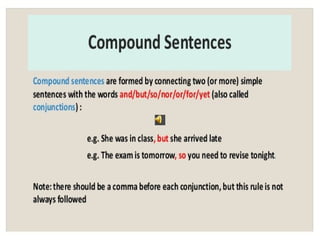
Compound Sentence
- Independent Clause + Independent Clause (I+I) –
It has two or more independent clauses joined by a coordinating
conjunction.
- Two or more simple sentences, when put together, can make up a
compound sentence.
Compound Sentence example:
a. She dictated, and I typed. (I+I) [the coordinating conjunction and
joins the two independent clauses]
b. The meal was expensive, but it was spoiled, so I threw it.
[the coordinating conjunction but and so join the three independent
clauses.]
* For a sentence to be classified as a compound sentence it must have at
least two two independent clauses combined by a coordinating
conjunction.
Coordinating Conj *FANBOYS • for • and • nor • but • or • yet • so
Subordinating Conj after although as as if as long as as soon as as though
because before even though if in order that since so that that though till
unless until when where whenever wherever while
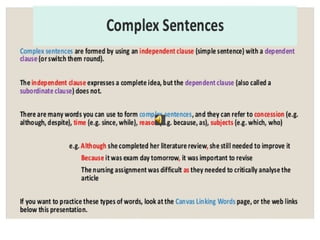
Complex Sentence
-Independent Clause + Dependent Clause (I+D) –
-It contains one independent clause (I) and one or more dependent clauses
(D) joined by a subordinating conjunction.
-Example #1
- [complex] He went abroad because he wanted to earn money.
- [independent] He went abroad
-[dependent] because he wanted to earn money.
Example #2
[complex] The school which was built ten years ago was already renovated
when I saw it
[independent] The school was already renovated [dependent] which was
built the years ago
[dependent] when I saw it
Compound Complex Sentences
-Independent Clause + Independent Clause + Dependent Clause
(I+I+D) –
-This contains two or more independent clauses and one or more
dependent clauses.
-Example #1
- [compound complex] We can talk about anything, and we will go
anywhere just as long as we are together.
-[independent] We can talk about anything
-[independent] we will go anywhere [dependent] just as long as we are
together.
-Example #2
- [compound complex] When afternoon comes, most employees chat
in the Internet and write e-mail, but others prefer to eat their snack.
[dependent] When afternoon comes
- [independent] most employees chat in the Internet and write e-mail.
[independent] others prefer to eat their snacks.
Compound Complex Sentences
Example #3 [compound complex]
The school, which was built ten years ago, was vey popular,
yet I saw it torn down.
[independent] The school was very popular
[dependent] which was built ten years ago
[independent] I saw it torn down.
Example #4
[compound complex] I danced while he sang, but they won
because also played the piano.
[independent] The school was very popular
[dependent] which was built ten years ago [independent] I saw
it torn down.
* Compound complex sentences must contain at least two
independent clauses and one dependent clause.

Sentence Structure, Simple, complex, etc ppt

  • 4.
    Subject The subject isthe doer of the action or the one being talked about in the sentence. All subjects are either nouns, pronouns, gerunds, infinitives, or clauses and are placed before or after the verb. example: Jane went home late. (doer of the action) Maria is the smartest student in our class. (one being talked about) Complete Subjects a noun, a pronoun, or a group of words which is the doer of being talked about in the sentence. It may include modifiers. Simple Subjects is the important noun, pronoun or group of words that out of the complete subject.
  • 6.
    Compound Subjects composedof two or more subjects that have the same verb. subjects are joined by the coordinating conjunction “and” or “or”. example: Maria and her young daughter left the house early. Maria and her young daughter (Complete Compound Subject) Maria, daughter (Simple Compound Subject) Other kinds of subjects: a. Dummy Subject – the subject with no concrete reference. ex. It is raining hard outside. It is dark inside the room. b. Hidden Subject – the subject before the verb in imperative sentence. ex. Keep up the good work! (You) Please, pass the salt. (You)
  • 7.
    Predicate - itis the information about the subject. - composed of a group of words that states what the subject does or is. Example: Jane went home late. (what the subject does) Myla is the smartest student in our class. (what the subject is) Predicate example: My teacher gave us a quiz on grammar and reading comprehension. Complete Predicate is the verb or verb phrase, as well as any modified and/or that tell what the subject does or is. gave us a quiz on grammar and reading comprehension. Simple Predicate the important verb/verb phrase in the sentence that cannot out of the complete predicate. gave
  • 8.
    Compound Predicate composedof two or more verbs that have the same subject. are joined by a coordinating conjunction. example: Maria left the house early but arrived late for work. … left the house early but arrived late for work (Complete Predicate) … left, arrived (Simple Predicate) Elliptical A word or group of words that do not express a subject or predicate or both, but the thought is complete if it is in relation with the previous statement. Example: 1. Who called? Marta. (predicate) [ Marta called. ] 2. What did you do? Asked her to come in. (subject) [ I asked her to come in ] 3. What did she want?Tickets for the concert. (s&p) [ She wanted tickets for the concert ]
  • 13.
    Simple Sentence -Subject +Verb (S+V) The simple sentence is composed of a single independent clause. It is consists of one or more subjects or one or more verbs. example: a. The bird built a nest made of twigs and leaves for its young. (1S, 1V) b. The actress cried and laughed at the same time. (1S, 2V) c. . Pam and Tony were given awards by the school principal. (2S, 1V) Simple Sentence - For a sentence to be classified as a simple sentence, it must one subject and one verb. - It must have a complete thought. - It is an independent clause.
  • 15.
    Compound Sentence - IndependentClause + Independent Clause (I+I) – It has two or more independent clauses joined by a coordinating conjunction. - Two or more simple sentences, when put together, can make up a compound sentence. Compound Sentence example: a. She dictated, and I typed. (I+I) [the coordinating conjunction and joins the two independent clauses] b. The meal was expensive, but it was spoiled, so I threw it. [the coordinating conjunction but and so join the three independent clauses.] * For a sentence to be classified as a compound sentence it must have at least two two independent clauses combined by a coordinating conjunction. Coordinating Conj *FANBOYS • for • and • nor • but • or • yet • so Subordinating Conj after although as as if as long as as soon as as though because before even though if in order that since so that that though till unless until when where whenever wherever while
  • 17.
    Complex Sentence -Independent Clause+ Dependent Clause (I+D) – -It contains one independent clause (I) and one or more dependent clauses (D) joined by a subordinating conjunction. -Example #1 - [complex] He went abroad because he wanted to earn money. - [independent] He went abroad -[dependent] because he wanted to earn money. Example #2 [complex] The school which was built ten years ago was already renovated when I saw it [independent] The school was already renovated [dependent] which was built the years ago [dependent] when I saw it
  • 18.
    Compound Complex Sentences -IndependentClause + Independent Clause + Dependent Clause (I+I+D) – -This contains two or more independent clauses and one or more dependent clauses. -Example #1 - [compound complex] We can talk about anything, and we will go anywhere just as long as we are together. -[independent] We can talk about anything -[independent] we will go anywhere [dependent] just as long as we are together. -Example #2 - [compound complex] When afternoon comes, most employees chat in the Internet and write e-mail, but others prefer to eat their snack. [dependent] When afternoon comes - [independent] most employees chat in the Internet and write e-mail. [independent] others prefer to eat their snacks.
  • 19.
    Compound Complex Sentences Example#3 [compound complex] The school, which was built ten years ago, was vey popular, yet I saw it torn down. [independent] The school was very popular [dependent] which was built ten years ago [independent] I saw it torn down. Example #4 [compound complex] I danced while he sang, but they won because also played the piano. [independent] The school was very popular [dependent] which was built ten years ago [independent] I saw it torn down. * Compound complex sentences must contain at least two independent clauses and one dependent clause.