This presentation includes explanations and examples of the 
structure of Simple Sentences, Compound Sentences, Complex 
Sentences and Compound – Complex Sentences. 
The images do not belong to me and are not used under any sort of lucrative circumstance. 
Their purpose is only to make this teaching material more appealing for my students.
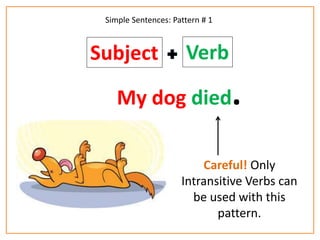
Subject Verb 
My dog died. 
Careful! Only 
Intransitive Verbs can 
be used with this 
pattern. 
Simple Sentences: Pattern # 1
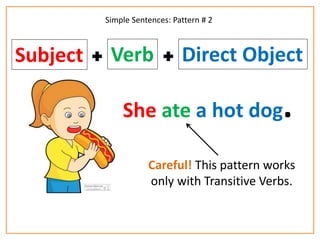
Simple Sentences: Pattern # 2 
Subject Verb Direct Object 
She ate a hot dog. 
Careful! This pattern works 
only with Transitive Verbs.
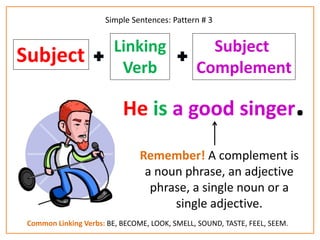
Simple Sentences: Pattern # 3 
Subject Linking 
Verb 
Subject 
Complement 
He is a good singer. 
Remember! A complement is 
a noun phrase, an adjective 
phrase, a single noun or a 
single adjective. 
Common Linking Verbs: BE, BECOME, LOOK, SMELL, SOUND, TASTE, FEEL, SEEM.
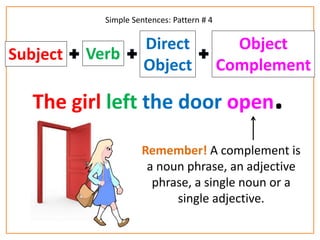
Simple Sentences: Pattern # 4 
Subject Verb 
Direct 
Object 
Object 
Complement 
The girl left the door open. 
Remember! A complement is 
a noun phrase, an adjective 
phrase, a single noun or a 
single adjective.
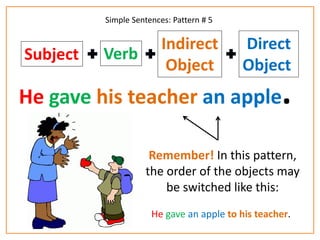
Simple Sentences: Pattern # 5 
Remember! In this pattern, 
the order of the objects may 
be switched like this: 
Subject Verb 
Indirect 
Object 
Direct 
Object 
He gave his teacher an apple. 
He gave an apple to his teacher.
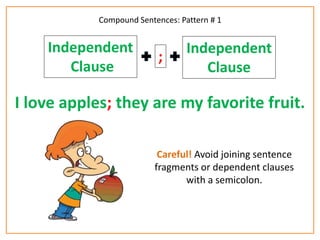
Compound Sentences: Pattern # 1 
Independent 
Clause 
; 
Independent 
Clause 
I love apples; they are my favorite fruit. 
Careful! Avoid joining sentence 
fragments or dependent clauses 
with a semicolon.
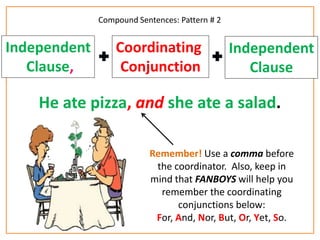
Independent 
Clause, 
Compound Sentences: Pattern # 2 
Coordinating 
Conjunction 
Independent 
Clause 
He ate pizza, and she ate a salad. 
Remember! Use a comma before 
the coordinator. Also, keep in 
mind that FANBOYS will help you 
remember the coordinating 
conjunctions below: 
For, And, Nor, But, Or, Yet, So.
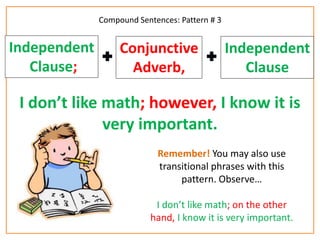
Independent 
Clause; 
Independent 
Clause 
Compound Sentences: Pattern # 3 
Conjunctive 
Adverb, 
I don’t like math; however, I know it is 
very important. 
Remember! You may also use 
transitional phrases with this 
pattern. Observe… 
I don’t like math; on the other 
hand, I know it is very important.
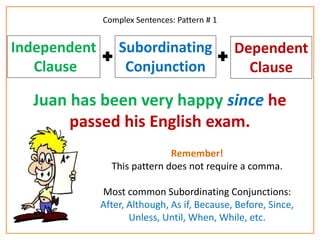
Independent 
Clause 
Complex Sentences: Pattern # 1 
Subordinating 
Conjunction 
Dependent 
Clause 
Juan has been very happy since he 
passed his English exam. 
Remember! 
This pattern does not require a comma. 
Most common Subordinating Conjunctions: 
After, Although, As if, Because, Before, Since, 
Unless, Until, When, While, etc.
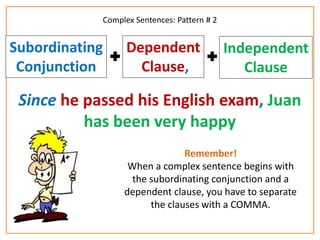
Complex Sentences: Pattern # 2 
Dependent 
Clause, 
Subordinating 
Conjunction 
Independent 
Clause 
Since he passed his English exam, Juan 
has been very happy 
Remember! 
When a complex sentence begins with 
the subordinating conjunction and a 
dependent clause, you have to separate 
the clauses with a COMMA.
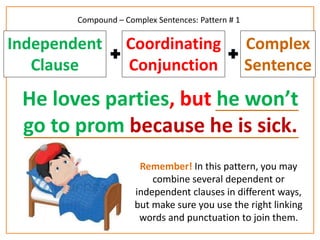
Compound – Complex Sentences: Pattern # 1 
Remember! In this pattern, you may 
combine several dependent or 
independent clauses in different ways, 
but make sure you use the right linking 
words and punctuation to join them. 
Independent 
Clause 
Coordinating 
Conjunction 
Complex 
Sentence 
He loves parties, but he won’t 
go to prom because he is sick.

Sentence Structure

  • 1.
    This presentation includesexplanations and examples of the structure of Simple Sentences, Compound Sentences, Complex Sentences and Compound – Complex Sentences. The images do not belong to me and are not used under any sort of lucrative circumstance. Their purpose is only to make this teaching material more appealing for my students.
  • 2.
    Subject Verb Mydog died. Careful! Only Intransitive Verbs can be used with this pattern. Simple Sentences: Pattern # 1
  • 3.
    Simple Sentences: Pattern# 2 Subject Verb Direct Object She ate a hot dog. Careful! This pattern works only with Transitive Verbs.
  • 4.
    Simple Sentences: Pattern# 3 Subject Linking Verb Subject Complement He is a good singer. Remember! A complement is a noun phrase, an adjective phrase, a single noun or a single adjective. Common Linking Verbs: BE, BECOME, LOOK, SMELL, SOUND, TASTE, FEEL, SEEM.
  • 5.
    Simple Sentences: Pattern# 4 Subject Verb Direct Object Object Complement The girl left the door open. Remember! A complement is a noun phrase, an adjective phrase, a single noun or a single adjective.
  • 6.
    Simple Sentences: Pattern# 5 Remember! In this pattern, the order of the objects may be switched like this: Subject Verb Indirect Object Direct Object He gave his teacher an apple. He gave an apple to his teacher.
  • 7.
    Compound Sentences: Pattern# 1 Independent Clause ; Independent Clause I love apples; they are my favorite fruit. Careful! Avoid joining sentence fragments or dependent clauses with a semicolon.
  • 8.
    Independent Clause, CompoundSentences: Pattern # 2 Coordinating Conjunction Independent Clause He ate pizza, and she ate a salad. Remember! Use a comma before the coordinator. Also, keep in mind that FANBOYS will help you remember the coordinating conjunctions below: For, And, Nor, But, Or, Yet, So.
  • 9.
    Independent Clause; Independent Clause Compound Sentences: Pattern # 3 Conjunctive Adverb, I don’t like math; however, I know it is very important. Remember! You may also use transitional phrases with this pattern. Observe… I don’t like math; on the other hand, I know it is very important.
  • 10.
    Independent Clause ComplexSentences: Pattern # 1 Subordinating Conjunction Dependent Clause Juan has been very happy since he passed his English exam. Remember! This pattern does not require a comma. Most common Subordinating Conjunctions: After, Although, As if, Because, Before, Since, Unless, Until, When, While, etc.
  • 11.
    Complex Sentences: Pattern# 2 Dependent Clause, Subordinating Conjunction Independent Clause Since he passed his English exam, Juan has been very happy Remember! When a complex sentence begins with the subordinating conjunction and a dependent clause, you have to separate the clauses with a COMMA.
  • 12.
    Compound – ComplexSentences: Pattern # 1 Remember! In this pattern, you may combine several dependent or independent clauses in different ways, but make sure you use the right linking words and punctuation to join them. Independent Clause Coordinating Conjunction Complex Sentence He loves parties, but he won’t go to prom because he is sick.