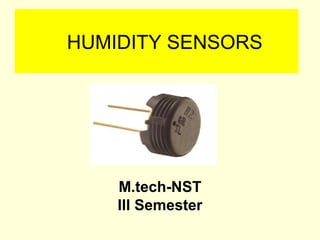
HUMIDITY SENSORS
M.tech-NST
III Semester
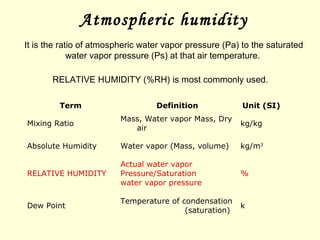
Term Definition Unit (SI)
Mixing Ratio
Mass, Water vapor Mass, Dry
air
kg/kg
Absolute Humidity Water vapor (Mass, volume) kg/m3
RELATIVE HUMIDITY
Actual water vapor
Pressure/Saturation
water vapor pressure
%
Dew Point
Temperature of condensation
(saturation)
k
RELATIVE HUMIDITY (%RH) is most commonly used.
Atmospheric humidity
It is the ratio of atmospheric water vapor pressure (Pa) to the saturated
water vapor pressure (Ps) at that air temperature.
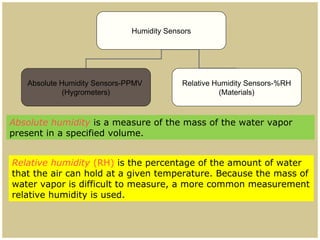
Humidity Sensors
Absolute Humidity Sensors-PPMV
(Hygrometers)
Relative Humidity Sensors-%RH
(Materials)
Absolute humidity is a measure of the mass of the water vapor
present in a specified volume.
Relative humidity (RH) is the percentage of the amount of water
that the air can hold at a given temperature. Because the mass of
water vapor is difficult to measure, a more common measurement
relative humidity is used.
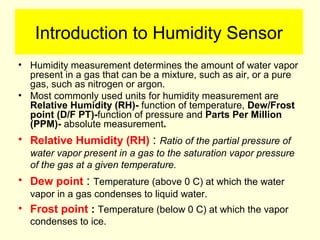
Introduction to Humidity Sensor
• Humidity measurement determines the amount of water vapor
present in a gas that can be a mixture, such as air, or a pure
gas, such as nitrogen or argon.
• Most commonly used units for humidity measurement are
Relative Humidity (RH)- function of temperature, Dew/Frost
point (D/F PT)-function of pressure and Parts Per Million
(PPM)- absolute measurement.
• Relative Humidity (RH) : Ratio of the partial pressure of
water vapor present in a gas to the saturation vapor pressure
of the gas at a given temperature.
• Dew point : Temperature (above 0 C) at which the water
vapor in a gas condenses to liquid water.
• Frost point : Temperature (below 0 C) at which the vapor
condenses to ice.
Relative Humidity Sensors
• Relative humidity sensors are classified into ceramic,
semiconductor, and polymer humidity sensors.
Ceramic Sensing Material
• Humidity sensors based on water-phase protonic
ceramic materials are used widely in industry and
research laboratories.
• The adsorbed water condensed on the surface of the
materials and protons will be conducted in the formed
aquatic layers.
• For ionic sensing materials, if the humidity increases,
the conductivity decreases and the dielectric constant
increases.
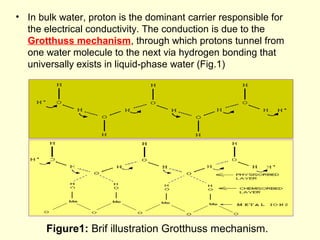
• In bulk water, proton is the dominant carrier responsible for
the electrical conductivity. The conduction is due to the
Grotthuss mechanism, through which protons tunnel from
one water molecule to the next via hydrogen bonding that
universally exists in liquid-phase water (Fig.1)
Figure1: Brif illustration Grotthuss mechanism.
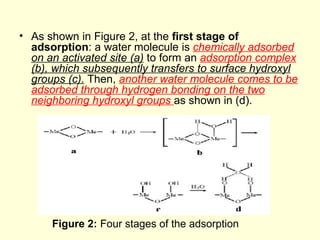
• As shown in Figure 2, at the first stage of
adsorption: a water molecule is chemically adsorbed
on an activated site (a) to form an adsorption complex
(b), which subsequently transfers to surface hydroxyl
groups (c). Then, another water molecule comes to be
adsorbed through hydrogen bonding on the two
neighboring hydroxyl groups as shown in (d).
Figure 2: Four stages of the adsorption
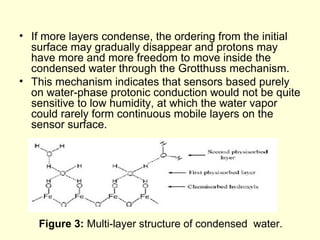
• If more layers condense, the ordering from the initial
surface may gradually disappear and protons may
have more and more freedom to move inside the
condensed water through the Grotthuss mechanism.
• This mechanism indicates that sensors based purely
on water-phase protonic conduction would not be quite
sensitive to low humidity, at which the water vapor
could rarely form continuous mobile layers on the
sensor surface.
Figure 3: Multi-layer structure of condensed water.
• The two immobile layers, the chemisorbed and the first
physiosorbed ones, while cannot contribute to proton
-conducting activity, could provide electron tunneling
between donor water sites.
• The tunneling effect , along with the energy induced by
the surface anions, facilitates electrons to hop along
the surface that is covered by the immobile layers and
therefore contributes to the conductivity.
• This mechanism is quite helpful for detecting low
humidity levels, at which there is not effective protonic
conduction.
Methods for Atmospheric Moisture
Measurement
There are several methods for humidity measurements, best
method depends on measurement requirements
Measurement techniques:
Cooling of a wet surface by evaporation (Psychrometers)
Absorption of radiation by water vapor (Optical hygrometers)
Temperature of a surface at dew formation (Chilled Mirror
Optical Sensors)
Physical or electrical properties of a substance (Relative
Humidity Sensors)
Psychrometers
o Regular (dry bulb) thermometer and thermometer with wet bulb
o Cooling of wet thermometer or “wet bulb” by evaporation (Latent heat of vaporization)
o Accomplished by rotation (sling) or fan (Assmann).
Optical Hygrometer
Water vapor strongly absorbs radiation at particular wavelengths in ultraviolet and
infrared range
Absorption of radiation at specific wavelengths.
Chilled Mirror Optical Sensor
Chilled Mirror Dew Point Mirror is chilled until dew is formed. The temperature at which
saturation is achieved is determined by observing condensation on a chilled surface
(mirror).
Advantages
Very high accuracy & High reliability.
Disadvantages
Need clean mirror & More expensive.
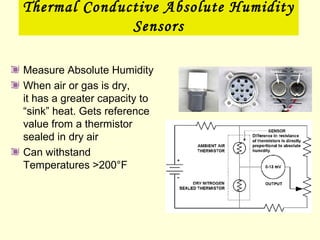
Thermal Conductive Absolute Humidity
Sensors
Measure Absolute Humidity
When air or gas is dry,
it has a greater capacity to
“sink” heat. Gets reference
value from a thermistor
sealed in dry air
Can withstand
Temperatures >200°F
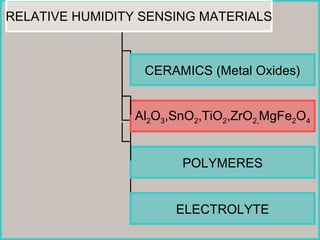
RELATIVE HUMIDITY SENSING MATERIALS
CERAMICS (Metal Oxides)
POLYMERES
ELECTROLYTE
Al2O3,SnO2,TiO2,ZrO2,MgFe2O4
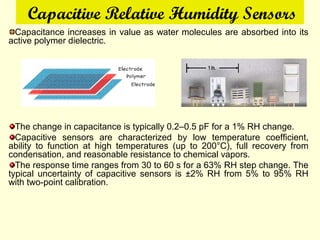
Capacitive Relative Humidity Sensors
Capacitance increases in value as water molecules are absorbed into its
active polymer dielectric.
The change in capacitance is typically 0.2–0.5 pF for a 1% RH change.
Capacitive sensors are characterized by low temperature coefficient,
ability to function at high temperatures (up to 200°C), full recovery from
condensation, and reasonable resistance to chemical vapors.
The response time ranges from 30 to 60 s for a 63% RH step change. The
typical uncertainty of capacitive sensors is ±2% RH from 5% to 95% RH
with two-point calibration.
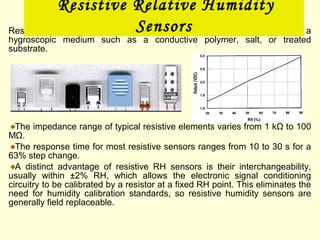
Resistive humidity sensors measure the change in electrical impedance of a
hygroscopic medium such as a conductive polymer, salt, or treated
substrate.
The impedance range of typical resistive elements varies from 1 kΩ to 100
MΩ.
The response time for most resistive sensors ranges from 10 to 30 s for a
63% step change.
A distinct advantage of resistive RH sensors is their interchangeability,
usually within ±2% RH, which allows the electronic signal conditioning
circuitry to be calibrated by a resistor at a fixed RH point. This eliminates the
need for humidity calibration standards, so resistive humidity sensors are
generally field replaceable.
Resistive Relative Humidity
Sensors
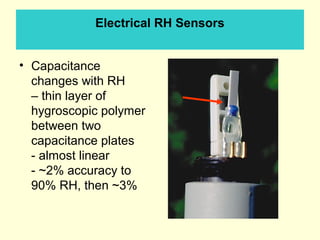
Electrical RH Sensors
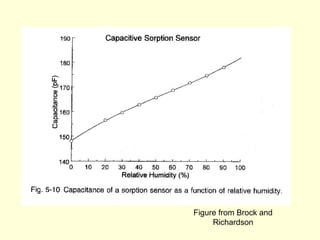
• Capacitance
changes with RH
– thin layer of
hygroscopic polymer
between two
capacitance plates
- almost linear
- ~2% accuracy to
90% RH, then ~3%
Electrical RH Sensors
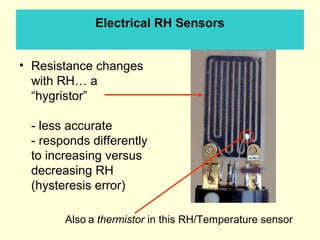
• Resistance changes
with RH… a
“hygristor”
- less accurate
- responds differently
to increasing versus
decreasing RH
(hysteresis error)
Also a thermistor in this RH/Temperature sensor
Figure from Brock and
Richardson
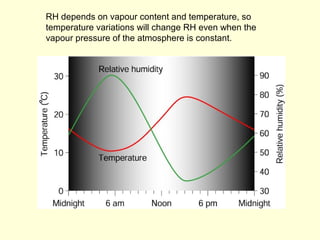
RH depends on vapour content and temperature, so
temperature variations will change RH even when the
vapour pressure of the atmosphere is constant.
Radiation absorption hygrometers
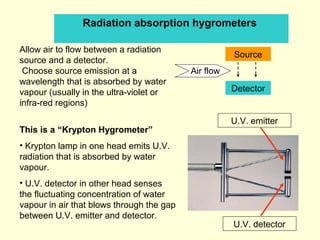
Allow air to flow between a radiation
source and a detector.
Choose source emission at a
wavelength that is absorbed by water
vapour (usually in the ultra-violet or
infra-red regions)
This is a “Krypton Hygrometer”
• Krypton lamp in one head emits U.V.
radiation that is absorbed by water
vapour.
• U.V. detector in other head senses
the fluctuating concentration of water
vapour in air that blows through the gap
between U.V. emitter and detector.
U.V. emitter
U.V. detector
Source
Detector
Air flow
Radiation absorption hygrometers
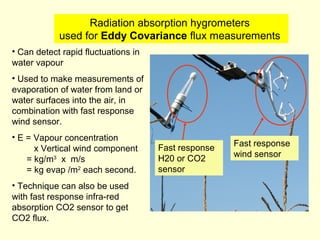
used for Eddy Covariance flux measurements
• Can detect rapid fluctuations in
water vapour
• Used to make measurements of
evaporation of water from land or
water surfaces into the air, in
combination with fast response
wind sensor.
• E = Vapour concentration
x Vertical wind component
= kg/m3
x m/s
= kg evap /m2
each second.
• Technique can also be used
with fast response infra-red
absorption CO2 sensor to get
CO2 flux.
Fast response
H20 or CO2
sensor
Fast response
wind sensor
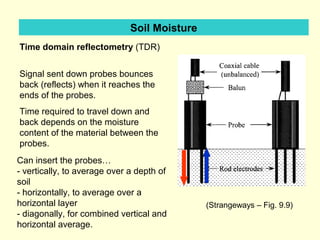
Soil Moisture
(Strangeways – Fig. 9.9)
Time domain reflectometry (TDR)
Signal sent down probes bounces
back (reflects) when it reaches the
ends of the probes.
Time required to travel down and
back depends on the moisture
content of the material between the
probes.
Can insert the probes…
- vertically, to average over a depth of
soil
- horizontally, to average over a
horizontal layer
- diagonally, for combined vertical and
horizontal average.
Applications
 Industrial process control systems. Storage and warehouses
 Climate control for green houses
 Meteorological applications
 Office automation, room comfort control
 Automotive cabin air control
 Home appliances, Air conditioners
 Food processing
 Medical applications
 Chicken Coops, Pig Barns
Thank you

humidity sensor

  • 1.
  • 2.
    Term Definition Unit(SI) Mixing Ratio Mass, Water vapor Mass, Dry air kg/kg Absolute Humidity Water vapor (Mass, volume) kg/m3 RELATIVE HUMIDITY Actual water vapor Pressure/Saturation water vapor pressure % Dew Point Temperature of condensation (saturation) k RELATIVE HUMIDITY (%RH) is most commonly used. Atmospheric humidity It is the ratio of atmospheric water vapor pressure (Pa) to the saturated water vapor pressure (Ps) at that air temperature.
  • 3.
    Humidity Sensors Absolute HumiditySensors-PPMV (Hygrometers) Relative Humidity Sensors-%RH (Materials) Absolute humidity is a measure of the mass of the water vapor present in a specified volume. Relative humidity (RH) is the percentage of the amount of water that the air can hold at a given temperature. Because the mass of water vapor is difficult to measure, a more common measurement relative humidity is used.
  • 4.
    Introduction to HumiditySensor • Humidity measurement determines the amount of water vapor present in a gas that can be a mixture, such as air, or a pure gas, such as nitrogen or argon. • Most commonly used units for humidity measurement are Relative Humidity (RH)- function of temperature, Dew/Frost point (D/F PT)-function of pressure and Parts Per Million (PPM)- absolute measurement. • Relative Humidity (RH) : Ratio of the partial pressure of water vapor present in a gas to the saturation vapor pressure of the gas at a given temperature. • Dew point : Temperature (above 0 C) at which the water vapor in a gas condenses to liquid water. • Frost point : Temperature (below 0 C) at which the vapor condenses to ice.
  • 5.
    Relative Humidity Sensors •Relative humidity sensors are classified into ceramic, semiconductor, and polymer humidity sensors. Ceramic Sensing Material • Humidity sensors based on water-phase protonic ceramic materials are used widely in industry and research laboratories. • The adsorbed water condensed on the surface of the materials and protons will be conducted in the formed aquatic layers. • For ionic sensing materials, if the humidity increases, the conductivity decreases and the dielectric constant increases.
  • 6.
    • In bulkwater, proton is the dominant carrier responsible for the electrical conductivity. The conduction is due to the Grotthuss mechanism, through which protons tunnel from one water molecule to the next via hydrogen bonding that universally exists in liquid-phase water (Fig.1) Figure1: Brif illustration Grotthuss mechanism.
  • 7.
    • As shownin Figure 2, at the first stage of adsorption: a water molecule is chemically adsorbed on an activated site (a) to form an adsorption complex (b), which subsequently transfers to surface hydroxyl groups (c). Then, another water molecule comes to be adsorbed through hydrogen bonding on the two neighboring hydroxyl groups as shown in (d). Figure 2: Four stages of the adsorption
  • 8.
    • If morelayers condense, the ordering from the initial surface may gradually disappear and protons may have more and more freedom to move inside the condensed water through the Grotthuss mechanism. • This mechanism indicates that sensors based purely on water-phase protonic conduction would not be quite sensitive to low humidity, at which the water vapor could rarely form continuous mobile layers on the sensor surface. Figure 3: Multi-layer structure of condensed water.
  • 9.
    • The twoimmobile layers, the chemisorbed and the first physiosorbed ones, while cannot contribute to proton -conducting activity, could provide electron tunneling between donor water sites. • The tunneling effect , along with the energy induced by the surface anions, facilitates electrons to hop along the surface that is covered by the immobile layers and therefore contributes to the conductivity. • This mechanism is quite helpful for detecting low humidity levels, at which there is not effective protonic conduction.
  • 10.
    Methods for AtmosphericMoisture Measurement There are several methods for humidity measurements, best method depends on measurement requirements Measurement techniques: Cooling of a wet surface by evaporation (Psychrometers) Absorption of radiation by water vapor (Optical hygrometers) Temperature of a surface at dew formation (Chilled Mirror Optical Sensors) Physical or electrical properties of a substance (Relative Humidity Sensors)
  • 11.
    Psychrometers o Regular (drybulb) thermometer and thermometer with wet bulb o Cooling of wet thermometer or “wet bulb” by evaporation (Latent heat of vaporization) o Accomplished by rotation (sling) or fan (Assmann). Optical Hygrometer Water vapor strongly absorbs radiation at particular wavelengths in ultraviolet and infrared range Absorption of radiation at specific wavelengths. Chilled Mirror Optical Sensor Chilled Mirror Dew Point Mirror is chilled until dew is formed. The temperature at which saturation is achieved is determined by observing condensation on a chilled surface (mirror). Advantages Very high accuracy & High reliability. Disadvantages Need clean mirror & More expensive.
  • 12.
    Thermal Conductive AbsoluteHumidity Sensors Measure Absolute Humidity When air or gas is dry, it has a greater capacity to “sink” heat. Gets reference value from a thermistor sealed in dry air Can withstand Temperatures >200°F
  • 13.
    RELATIVE HUMIDITY SENSINGMATERIALS CERAMICS (Metal Oxides) POLYMERES ELECTROLYTE Al2O3,SnO2,TiO2,ZrO2,MgFe2O4
  • 14.
    Capacitive Relative HumiditySensors Capacitance increases in value as water molecules are absorbed into its active polymer dielectric. The change in capacitance is typically 0.2–0.5 pF for a 1% RH change. Capacitive sensors are characterized by low temperature coefficient, ability to function at high temperatures (up to 200°C), full recovery from condensation, and reasonable resistance to chemical vapors. The response time ranges from 30 to 60 s for a 63% RH step change. The typical uncertainty of capacitive sensors is ±2% RH from 5% to 95% RH with two-point calibration.
  • 15.
    Resistive humidity sensorsmeasure the change in electrical impedance of a hygroscopic medium such as a conductive polymer, salt, or treated substrate. The impedance range of typical resistive elements varies from 1 kΩ to 100 MΩ. The response time for most resistive sensors ranges from 10 to 30 s for a 63% step change. A distinct advantage of resistive RH sensors is their interchangeability, usually within ±2% RH, which allows the electronic signal conditioning circuitry to be calibrated by a resistor at a fixed RH point. This eliminates the need for humidity calibration standards, so resistive humidity sensors are generally field replaceable. Resistive Relative Humidity Sensors
  • 16.
    Electrical RH Sensors •Capacitance changes with RH – thin layer of hygroscopic polymer between two capacitance plates - almost linear - ~2% accuracy to 90% RH, then ~3%
  • 17.
    Electrical RH Sensors •Resistance changes with RH… a “hygristor” - less accurate - responds differently to increasing versus decreasing RH (hysteresis error) Also a thermistor in this RH/Temperature sensor
  • 18.
    Figure from Brockand Richardson
  • 19.
    RH depends onvapour content and temperature, so temperature variations will change RH even when the vapour pressure of the atmosphere is constant.
  • 20.
    Radiation absorption hygrometers Allowair to flow between a radiation source and a detector. Choose source emission at a wavelength that is absorbed by water vapour (usually in the ultra-violet or infra-red regions) This is a “Krypton Hygrometer” • Krypton lamp in one head emits U.V. radiation that is absorbed by water vapour. • U.V. detector in other head senses the fluctuating concentration of water vapour in air that blows through the gap between U.V. emitter and detector. U.V. emitter U.V. detector Source Detector Air flow
  • 21.
    Radiation absorption hygrometers usedfor Eddy Covariance flux measurements • Can detect rapid fluctuations in water vapour • Used to make measurements of evaporation of water from land or water surfaces into the air, in combination with fast response wind sensor. • E = Vapour concentration x Vertical wind component = kg/m3 x m/s = kg evap /m2 each second. • Technique can also be used with fast response infra-red absorption CO2 sensor to get CO2 flux. Fast response H20 or CO2 sensor Fast response wind sensor
  • 22.
    Soil Moisture (Strangeways –Fig. 9.9) Time domain reflectometry (TDR) Signal sent down probes bounces back (reflects) when it reaches the ends of the probes. Time required to travel down and back depends on the moisture content of the material between the probes. Can insert the probes… - vertically, to average over a depth of soil - horizontally, to average over a horizontal layer - diagonally, for combined vertical and horizontal average.
  • 23.
    Applications  Industrial processcontrol systems. Storage and warehouses  Climate control for green houses  Meteorological applications  Office automation, room comfort control  Automotive cabin air control  Home appliances, Air conditioners  Food processing  Medical applications  Chicken Coops, Pig Barns
  • 24.