Sense
Organs
3rd Grade
OBJECTIVE
❑ Describe the functions of the sense
organs of the human body
Introduction
NOSE
EARS
EYES TONGUE
SKIN
Sense Organs and
How to Care for
Them
Introduction
01
Introduction
Each sense organ has special nerve cells. These nerve cells
gather information from your environment.
Messages from most parts of your body travel through the
spinal cord. The spinal cord is a soft organ that connects your
brain with the nerves in your body. The
The nerves in the spinal cord carry the information to the
brain and back to the part which will perform the desired
function.
02
EYES
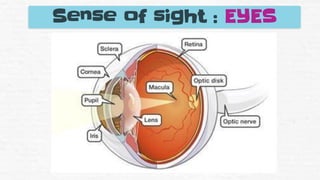
Sense of sight : EYES
03
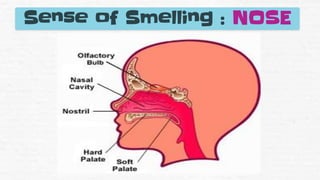
NOSE
Nose
➢ organ for smelling
An odor is a chemical given off by an
object. When this chemical gets into the
nose, the nerve send signals to the brain
which tells you what you just smell.
Sense of Smelling : NOSE
Parts of the Nose and How
Each Works
The nose is divided
into the external and
internal parts
External Part
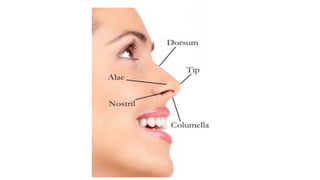
Nostrils
❑ two openings of your nose
❑ serve as entrance to your nasal
cavities
Parts of the Nose and How
Each Works
Internal Part
❑ The interior part of nose is divided into two
major passages called nostrils
❑ Each has:
✓ respiratory region
✓ olfactory region
Parts of the Nose and How
Each Works
Internal Part
✓ respiratory region
❑ used for breathing
✓ olfactory region
❑ used for smelling
Parts of the Nose and How
Each Works
Nasal cavities – are lined with small,
hair-like structures cilia.
❑ These cavities also contain mucous
membranes that secrete a sticky fluid
called mucus, and warmed by the blood
within the blood vessels.
Parts of the Nose and How
Each Works
Parts of the Ear and How Each
Works
The olfactory region, which is
located within mucous membrane,
contains olfactory cells.
Olfactory
❑ Are nerve cells sensitive to
odor.
Parts of the Nose and How
Each Works
Common Nose
Ailments
Nosebleed
Proper Care for
the Nose
04
EARS
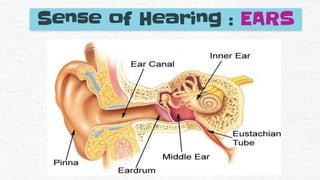
Sense of Hearing : EARS
EARS
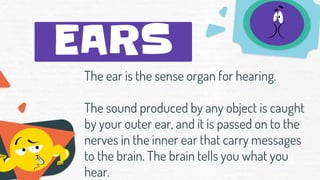
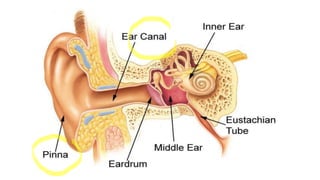
The ear is the sense organ for hearing.
The sound produced by any object is caught
by your outer ear, and it is passed on to the
nerves in the inner ear that carry messages
to the brain. The brain tells you what you
hear.
Parts of the Ear and How Each
Works
What are the functions
of the human ear?
1. Hearing
2. Maintaining balance of the body or
equilibrium
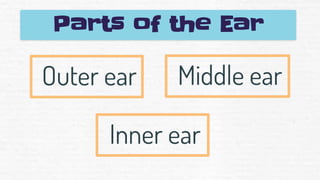
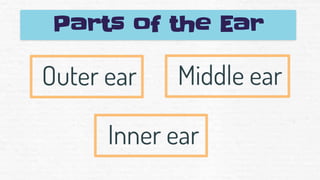
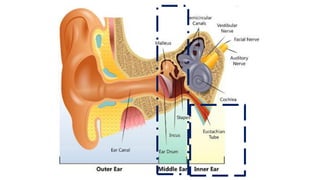
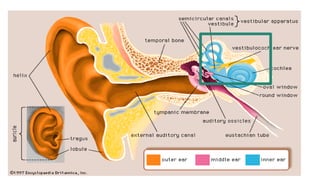
Outer ear
Parts of the Ear
Inner ear
Middle ear
Outer Ear
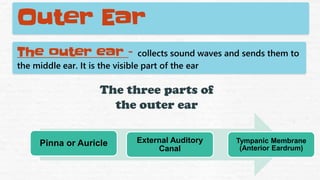
The outer ear – collects sound waves and sends them to
the middle ear. It is the visible part of the ear
The three parts of
the outer ear
Pinna or Auricle External Auditory
Canal
Tympanic Membrane
(Anterior Eardrum)
Outer Ear
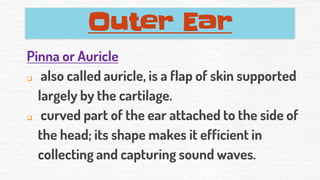
Pinna or Auricle
❑ also called auricle, is a flap of skin supported
largely by the cartilage.
❑ curved part of the ear attached to the side of
the head; its shape makes it efficient in
collecting and capturing sound waves.
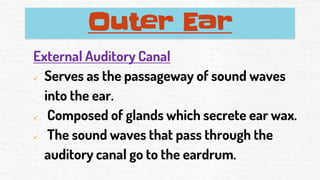
External Auditory Canal
✓ Serves as the passageway of sound waves
into the ear.
✓ Composed of glands which secrete ear wax.
✓ The sound waves that pass through the
auditory canal go to the eardrum.
Outer Ear
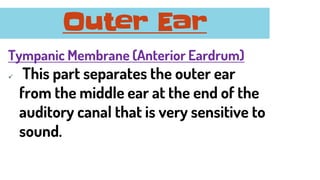
Tympanic Membrane (Anterior Eardrum)
✓ This part separates the outer ear
from the middle ear at the end of the
auditory canal that is very sensitive to
sound.
Outer Ear
Outer ear
Parts of the Ear
Inner ear
Middle ear
Middle Ear
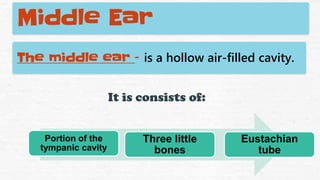
The middle ear – is a hollow air-filled cavity.
It is consists of:
Portion of the
tympanic cavity
Three little
bones
Eustachian
tube
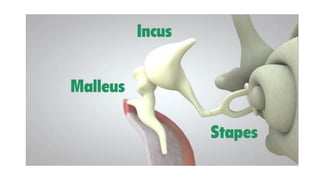
Three tiniest bones of the body:
✓ Hammer, Anvil, and Stirrup
✓ These bones form a chain across the middle
ear, linking the eardrum to another
membrane.
Middle Ear
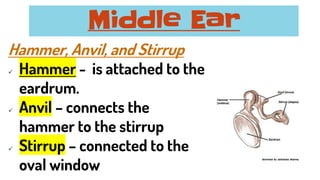
Hammer, Anvil, and Stirrup
✓ Hammer - is attached to the
eardrum.
✓ Anvil – connects the
hammer to the stirrup
✓ Stirrup – connected to the
oval window
Middle Ear
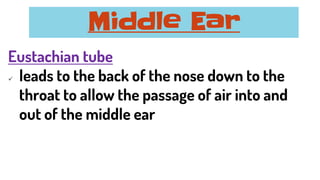
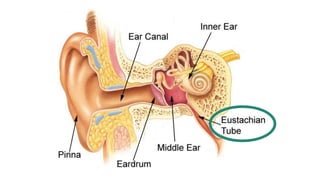
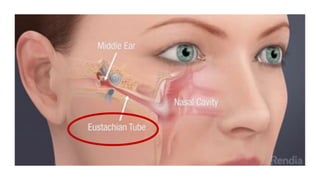
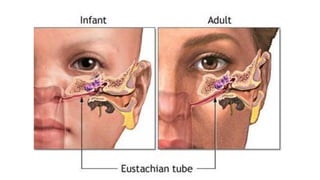
Eustachian tube
✓ leads to the back of the nose down to the
throat to allow the passage of air into and
out of the middle ear
Middle Ear
Outer ear
Parts of the Ear
Inner ear
Middle ear
Inner Ear
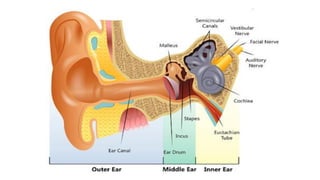
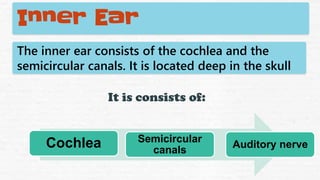
The inner ear consists of the cochlea and the
semicircular canals. It is located deep in the skull
It is consists of:
Cochlea Semicircular
canals
Auditory nerve
Cochlea
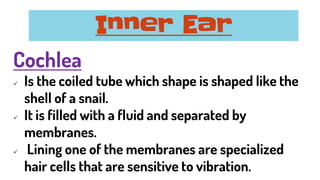
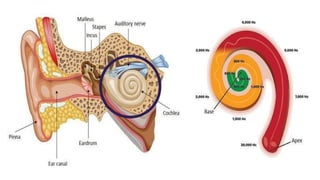
✓ Is the coiled tube which shape is shaped like the
shell of a snail.
✓ It is filled with a fluid and separated by
membranes.
✓ Lining one of the membranes are specialized
hair cells that are sensitive to vibration.
Inner Ear
Cochlea
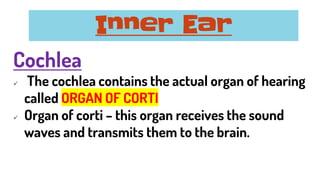
✓ The cochlea contains the actual organ of hearing
called ORGAN OF CORTI
✓ Organ of corti – this organ receives the sound
waves and transmits them to the brain.
Inner Ear
Semicircular canals
✓ Enable the body to maintain balance.
✓ Consist of interconnected loop-shaped
tubes.
✓ Contains fluid and hairlike projections that
detect changes in body positions
Inner Ear
Auditory nerve
✓ Responsible for sending message to the
brain.
Inner Ear
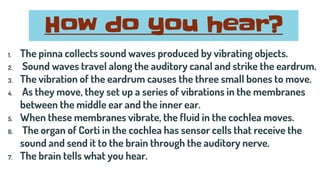
How do you hear?
1. The pinna collects sound waves produced by vibrating objects.
2. Sound waves travel along the auditory canal and strike the eardrum.
3. The vibration of the eardrum causes the three small bones to move.
4. As they move, they set up a series of vibrations in the membranes
between the middle ear and the inner ear.
5. When these membranes vibrate, the fluid in the cochlea moves.
6. The organ of Corti in the cochlea has sensor cells that receive the
sound and send it to the brain through the auditory nerve.
7. The brain tells what you hear.
Common Ear Ailments
and Defects
Ear infection
Ear boil
Deafness
Proper Care for
the Ears
05
TONGUE
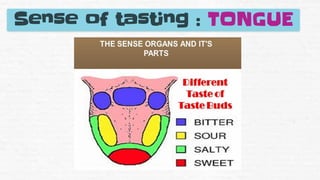
Sense of tasting : TONGUE
Parts of the Tongue and How
Each Works
The surface of the
tongue is covered with
small projections called
papillae
Parts of the Tongue and How
Each Works
Within the papillae are the
taste receptors or taste buds.
Each taste bud consists of a
number of sense cells that are
responsible for receiving
different taste sensations
Common Tongue
Ailments
Cracks
White Mouth or Oral Thrush
Sore tongue
Stomatitis
Proper Care for
the Tongue
06
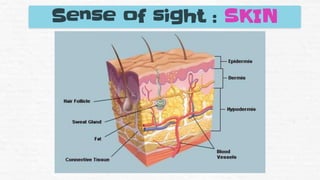
SKIN
Sense of sight : SKIN
Skin
The skin is made up of:
Outer layer
Inner layer
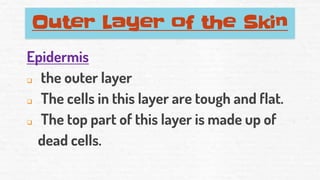
Outer Layer of the Skin
Epidermis
❑ the outer layer
❑ The cells in this layer are tough and flat.
❑ The top part of this layer is made up of
dead cells.
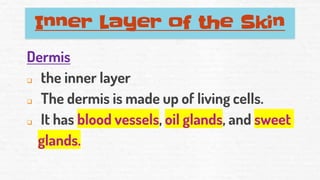
Inner Layer of the Skin
Dermis
❑ the inner layer
❑ The dermis is made up of living cells.
❑ It has blood vessels, oil glands, and sweet
glands.
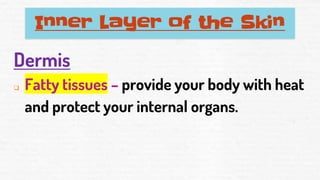
Inner Layer of the Skin
Dermis
❑ Fatty tissues – provide your body with heat
and protect your internal organs.
Inner Layer of the Skin
Dermis
❑ blood vessels
- produce oil to make your skin shiny and keep
it from drying.
❑ sweat glands
- produce sweat or perspiration to keep your
body cool
Common Skin
Ailments
Scabies
Ringworm Athlete’s foot
Tinea flava (an-an
Boil (pigsa)
Acne
Proper Care for
the Skin
CREDITS: This presentation template was created
by Slidesgo, including icons by Flaticon, and
infographics & images by Freepik

Sense organs

  • 1.
  • 2.
    OBJECTIVE ❑ Describe thefunctions of the sense organs of the human body
  • 3.
  • 4.
    Sense Organs and Howto Care for Them
  • 5.
  • 6.
    Introduction Each sense organhas special nerve cells. These nerve cells gather information from your environment. Messages from most parts of your body travel through the spinal cord. The spinal cord is a soft organ that connects your brain with the nerves in your body. The The nerves in the spinal cord carry the information to the brain and back to the part which will perform the desired function.
  • 7.
  • 8.
  • 9.
  • 10.
    Nose ➢ organ forsmelling An odor is a chemical given off by an object. When this chemical gets into the nose, the nerve send signals to the brain which tells you what you just smell.
  • 11.
  • 12.
    Parts of theNose and How Each Works The nose is divided into the external and internal parts
  • 13.
    External Part Nostrils ❑ twoopenings of your nose ❑ serve as entrance to your nasal cavities Parts of the Nose and How Each Works
  • 15.
    Internal Part ❑ Theinterior part of nose is divided into two major passages called nostrils ❑ Each has: ✓ respiratory region ✓ olfactory region Parts of the Nose and How Each Works
  • 16.
    Internal Part ✓ respiratoryregion ❑ used for breathing ✓ olfactory region ❑ used for smelling Parts of the Nose and How Each Works
  • 17.
    Nasal cavities –are lined with small, hair-like structures cilia. ❑ These cavities also contain mucous membranes that secrete a sticky fluid called mucus, and warmed by the blood within the blood vessels. Parts of the Nose and How Each Works
  • 18.
    Parts of theEar and How Each Works The olfactory region, which is located within mucous membrane, contains olfactory cells.
  • 19.
    Olfactory ❑ Are nervecells sensitive to odor. Parts of the Nose and How Each Works
  • 20.
  • 21.
  • 22.
  • 23.
  • 24.
  • 25.
    EARS The ear isthe sense organ for hearing. The sound produced by any object is caught by your outer ear, and it is passed on to the nerves in the inner ear that carry messages to the brain. The brain tells you what you hear.
  • 26.
    Parts of theEar and How Each Works What are the functions of the human ear? 1. Hearing 2. Maintaining balance of the body or equilibrium
  • 27.
    Outer ear Parts ofthe Ear Inner ear Middle ear
  • 30.
    Outer Ear The outerear – collects sound waves and sends them to the middle ear. It is the visible part of the ear The three parts of the outer ear Pinna or Auricle External Auditory Canal Tympanic Membrane (Anterior Eardrum)
  • 31.
    Outer Ear Pinna orAuricle ❑ also called auricle, is a flap of skin supported largely by the cartilage. ❑ curved part of the ear attached to the side of the head; its shape makes it efficient in collecting and capturing sound waves.
  • 32.
    External Auditory Canal ✓Serves as the passageway of sound waves into the ear. ✓ Composed of glands which secrete ear wax. ✓ The sound waves that pass through the auditory canal go to the eardrum. Outer Ear
  • 33.
    Tympanic Membrane (AnteriorEardrum) ✓ This part separates the outer ear from the middle ear at the end of the auditory canal that is very sensitive to sound. Outer Ear
  • 34.
    Outer ear Parts ofthe Ear Inner ear Middle ear
  • 36.
    Middle Ear The middleear – is a hollow air-filled cavity. It is consists of: Portion of the tympanic cavity Three little bones Eustachian tube
  • 37.
    Three tiniest bonesof the body: ✓ Hammer, Anvil, and Stirrup ✓ These bones form a chain across the middle ear, linking the eardrum to another membrane. Middle Ear
  • 38.
    Hammer, Anvil, andStirrup ✓ Hammer - is attached to the eardrum. ✓ Anvil – connects the hammer to the stirrup ✓ Stirrup – connected to the oval window Middle Ear
  • 40.
    Eustachian tube ✓ leadsto the back of the nose down to the throat to allow the passage of air into and out of the middle ear Middle Ear
  • 44.
    Outer ear Parts ofthe Ear Inner ear Middle ear
  • 46.
    Inner Ear The innerear consists of the cochlea and the semicircular canals. It is located deep in the skull It is consists of: Cochlea Semicircular canals Auditory nerve
  • 47.
    Cochlea ✓ Is thecoiled tube which shape is shaped like the shell of a snail. ✓ It is filled with a fluid and separated by membranes. ✓ Lining one of the membranes are specialized hair cells that are sensitive to vibration. Inner Ear
  • 48.
    Cochlea ✓ The cochleacontains the actual organ of hearing called ORGAN OF CORTI ✓ Organ of corti – this organ receives the sound waves and transmits them to the brain. Inner Ear
  • 50.
    Semicircular canals ✓ Enablethe body to maintain balance. ✓ Consist of interconnected loop-shaped tubes. ✓ Contains fluid and hairlike projections that detect changes in body positions Inner Ear
  • 51.
    Auditory nerve ✓ Responsiblefor sending message to the brain. Inner Ear
  • 52.
    How do youhear? 1. The pinna collects sound waves produced by vibrating objects. 2. Sound waves travel along the auditory canal and strike the eardrum. 3. The vibration of the eardrum causes the three small bones to move. 4. As they move, they set up a series of vibrations in the membranes between the middle ear and the inner ear. 5. When these membranes vibrate, the fluid in the cochlea moves. 6. The organ of Corti in the cochlea has sensor cells that receive the sound and send it to the brain through the auditory nerve. 7. The brain tells what you hear.
  • 53.
  • 54.
  • 55.
  • 56.
  • 57.
  • 58.
    Parts of theTongue and How Each Works The surface of the tongue is covered with small projections called papillae
  • 59.
    Parts of theTongue and How Each Works Within the papillae are the taste receptors or taste buds. Each taste bud consists of a number of sense cells that are responsible for receiving different taste sensations
  • 60.
  • 61.
    Cracks White Mouth orOral Thrush Sore tongue Stomatitis
  • 62.
  • 63.
  • 64.
  • 65.
    Skin The skin ismade up of: Outer layer Inner layer
  • 66.
    Outer Layer ofthe Skin Epidermis ❑ the outer layer ❑ The cells in this layer are tough and flat. ❑ The top part of this layer is made up of dead cells.
  • 67.
    Inner Layer ofthe Skin Dermis ❑ the inner layer ❑ The dermis is made up of living cells. ❑ It has blood vessels, oil glands, and sweet glands.
  • 68.
    Inner Layer ofthe Skin Dermis ❑ Fatty tissues – provide your body with heat and protect your internal organs.
  • 69.
    Inner Layer ofthe Skin Dermis ❑ blood vessels - produce oil to make your skin shiny and keep it from drying. ❑ sweat glands - produce sweat or perspiration to keep your body cool
  • 70.
  • 71.
    Scabies Ringworm Athlete’s foot Tineaflava (an-an Boil (pigsa) Acne
  • 72.
  • 73.
    CREDITS: This presentationtemplate was created by Slidesgo, including icons by Flaticon, and infographics & images by Freepik