MAYAMOT ELEMENTARY
SCHOOL
Senses
Sense of Sight
• The eye is the organ of vision. The retina is
covered with two basic types of light-sensitive
cells-rods and cones. The eye is connected to
the brain through the optic nerve.
Sense of Smell
• Olfaction or olfactory perception is
the sense of smell. This sense is mediated by
specialized sensory cells of the nasal cavity of
vertebrates, which can be considered
analogous to sensory cells of the antennae of
invertebrates. In humans, olfaction occurs
when odorant molecules bind to specific sites
on the olfactory receptors. These receptors
are used to detect the presence of smell
Sense of Taste
• Humans detect taste with taste receptor cells. These are
clustered in taste buds and scattered in other areas of the
body. Each taste bud has a pore that opens out to the
surface of the tongue enabling molecules and ions taken
into the mouth to reach the receptor cells inside.
• There are five primary taste sensations:
• salty
• sour
• sweet
• bitter
• umami
Sense of Hearing
• Like your other sense organs, your ears are extremely well-
designed. In fact, they serve two very important purposes. Do you
know what they are? You were probably able to figure out that your
ears help you to hear sounds, but what you probably did not know
is that your ears also help you to keep your balance. How You Hear
When an object makes a noise, it sends vibrations (better known as
sound waves) speeding through the air. These vibrations are then
funneled into your ear canal by your outer ear. As the vibrations
move into your middle ear, they hit your eardrum and cause it to
vibrate as well. This sets off a chain reaction of vibrations. Your
eardrum, which is smaller and thinner than the nail on your pinky
finger, vibrates the three smallest bones in your body: first, the
hammer, then the anvil, and finally, the stirrup. The stirrup passes
the vibrations into a coiled tube in the inner ear called the cochlea.
Sense of Touch
• While your other four senses
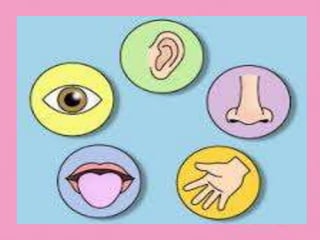
(sight, hearing, smell, and taste) are located in
specific parts of the body, your sense of touch is
found all over. This is because your sense of touch
originates in the bottom layer of your skin called the
dermis. The dermis is filled with many tiny nerve
endings which give you information about the things
with which your body comes in contact. They do this
by carrying the information to the spinal cord, which
sends messages to the brain where the feeling is
registered.
• The nerve endings in your skin can tell you if
something is hot or cold. They can also feel if
something is hurting you. Your body has about
twenty different types of nerve endings that
all send messages to your brain. However, the
most common receptors are
heat, cold, pain, and pressure or touch
receptors. Pain receptors are probably the
most important for your safety because they
can protect you by warning your brain that
your body is hurt!
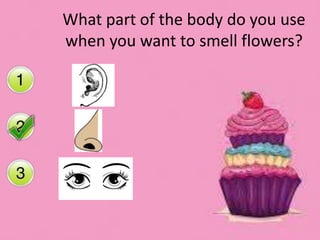
What part of the body do you use
when you want to smell flowers?
Yes
No
Do you use your ears to hear the
coming of the train?
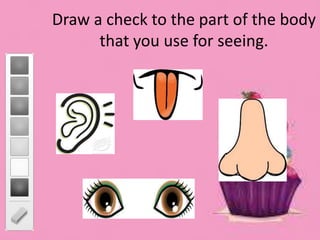
Draw a check to the part of the body
that you use for seeing.

My presentation

  • 1.
  • 2.
  • 4.
    Sense of Sight •The eye is the organ of vision. The retina is covered with two basic types of light-sensitive cells-rods and cones. The eye is connected to the brain through the optic nerve.
  • 5.
    Sense of Smell •Olfaction or olfactory perception is the sense of smell. This sense is mediated by specialized sensory cells of the nasal cavity of vertebrates, which can be considered analogous to sensory cells of the antennae of invertebrates. In humans, olfaction occurs when odorant molecules bind to specific sites on the olfactory receptors. These receptors are used to detect the presence of smell
  • 6.
    Sense of Taste •Humans detect taste with taste receptor cells. These are clustered in taste buds and scattered in other areas of the body. Each taste bud has a pore that opens out to the surface of the tongue enabling molecules and ions taken into the mouth to reach the receptor cells inside. • There are five primary taste sensations: • salty • sour • sweet • bitter • umami
  • 7.
    Sense of Hearing •Like your other sense organs, your ears are extremely well- designed. In fact, they serve two very important purposes. Do you know what they are? You were probably able to figure out that your ears help you to hear sounds, but what you probably did not know is that your ears also help you to keep your balance. How You Hear When an object makes a noise, it sends vibrations (better known as sound waves) speeding through the air. These vibrations are then funneled into your ear canal by your outer ear. As the vibrations move into your middle ear, they hit your eardrum and cause it to vibrate as well. This sets off a chain reaction of vibrations. Your eardrum, which is smaller and thinner than the nail on your pinky finger, vibrates the three smallest bones in your body: first, the hammer, then the anvil, and finally, the stirrup. The stirrup passes the vibrations into a coiled tube in the inner ear called the cochlea.
  • 8.
    Sense of Touch •While your other four senses (sight, hearing, smell, and taste) are located in specific parts of the body, your sense of touch is found all over. This is because your sense of touch originates in the bottom layer of your skin called the dermis. The dermis is filled with many tiny nerve endings which give you information about the things with which your body comes in contact. They do this by carrying the information to the spinal cord, which sends messages to the brain where the feeling is registered.
  • 9.
    • The nerveendings in your skin can tell you if something is hot or cold. They can also feel if something is hurting you. Your body has about twenty different types of nerve endings that all send messages to your brain. However, the most common receptors are heat, cold, pain, and pressure or touch receptors. Pain receptors are probably the most important for your safety because they can protect you by warning your brain that your body is hurt!
  • 10.
    What part ofthe body do you use when you want to smell flowers?
  • 11.
    Yes No Do you useyour ears to hear the coming of the train?
  • 12.
    Draw a checkto the part of the body that you use for seeing.