International Journal of Trend in Scientific Research and Development (IJTSRD)
Volume 5 Issue 5, July-August 2021 Available Online: www.ijtsrd.com e-ISSN: 2456 – 6470
@ IJTSRD | Unique Paper ID – IJTSRD44951 | Volume – 5 | Issue – 5 | Jul-Aug 2021 Page 1352
Security Issues Related to Biometrics
Sushmita Raulo, Saurabh Gawade
Department of MCA, ASM Institute of Management & Computer Studies, Thane, Maharashtra, India
ABSTRACT
With the growth of technology their grows threat to our data which is
just secured by passwords so to make it more secure biometrics came
into existence. As biometric systems are adopted and accepted for
security purpose for various information and security systems. Hence
it is immune to attacks.
This paper deals with the security of biometric details of individuals.
In this paper we will be discussing about biometrics and its types and
the threats and security issues which is not talked about usually. The
different technologies evolved and had contributed to biometrics in
long run and their effects.
KEYWORDS: security, biometrics, technology, data, cryptography
How to cite this paper: Sushmita Raulo |
Saurabh Gawade "Security Issues
Related to Biometrics" Published in
International
Journal of Trend in
Scientific Research
and Development
(ijtsrd), ISSN: 2456-
6470, Volume-5 |
Issue-5, August
2021, pp.1352-
1356, URL:
www.ijtsrd.com/papers/ijtsrd44951.pdf
Copyright © 2021 by author (s) and
International Journal of Trend in
Scientific Research and Development
Journal. This is an
Open Access article
distributed under the
terms of the Creative Commons
Attribution License (CC BY 4.0)
(http://creativecommons.org/licenses/by/4.0)
INTRODUCTION
Protection of individuals, their belongings,
environment, etc., are all given utmost importance but
in the era technology has added one more priority –
protection of individual’s data. Data collected through
biometrics is collected, stored and utilized when it is
needed. But as we all know there is a threat to
anything out there in the world so do our data too. We
as an individual working with technology have a
responsibility to protect our fellow citizen’s data.
Biometrics has opened a way through which we can
identify a person’s identity using his/her fingerprints,
iris scan, face recognition and many more. Biometrics
serves as a way for identification or verification of a
person. But biometrics has also paved way for the
hackers or the illegal tech practitioners to access data
easily. As we are moving towards a digital era, we
will be experiencing more of this security threats
which we may be unaware of. [1]
Biometrics
The biometrics word has a large meaning in the study
of identification’s persons from a number of
characteristics. A complex human inheritance, very
rich in combinations, and perfectly adapted to such
systems of user identification, and/or authentication.
It’s a Mathematical analysis of biological
characteristics of a person to determine his identity
decisively. Biometrics based on the principle of some
characteristics recognition’s. Fingerprints, face, iris,
retina, hand, keystroke and voice, provide irrefutable
proof of the identity of a person they are unique
biological characteristics distinguishing one person
from another.
Both identification and authentication differentiate
the definition of the biometrics:
Identification: The confirmation of the identityof
the individual which is identity papers or
automatic teller machines.
Authentication: Identification of an individual
from a quantity of biometric recorded people.
This type of biometric recognition is especially
used in the high fields with low number of users
or ends of police investigation.
Types of Biometrics
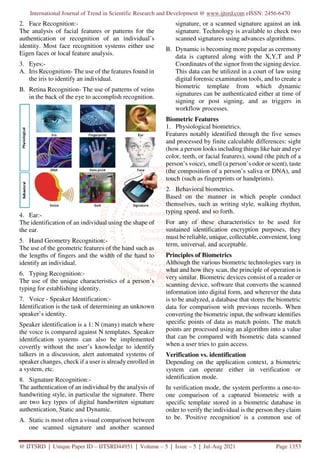
1. Fingerprint Recognition:-
The use of the ridges and valleys (minutiae) found on
the surface tips of a human finger to identify an
individual.
IJTSRD44951
International Journal of Trend in Scientific Research and Development @ www.ijtsrd.com eISSN: 2456-6470
@ IJTSRD | Unique Paper ID – IJTSRD44951 | Volume – 5 | Issue – 5 | Jul-Aug 2021 Page 1353
2. Face Recognition:-
The analysis of facial features or patterns for the
authentication or recognition of an individual’s
identity. Most face recognition systems either use
Eigen faces or local feature analysis.
3. Eyes:-
A. Iris Recognition- The use of the features found in
the iris to identify an individual.
B. Retina Recognition- The use of patterns of veins
in the back of the eye to accomplish recognition.
4. Ear:-
The identification of an individual using the shape of
the ear.
5. Hand Geometry Recognition:-
The use of the geometric features of the hand such as
the lengths of fingers and the width of the hand to
identify an individual.
6. Typing Recognition:-
The use of the unique characteristics of a person’s
typing for establishing identity.
7. Voice - Speaker Identification:-
Identification is the task of determining an unknown
speaker’s identity.
Speaker identification is a 1: N (many) match where
the voice is compared against N templates. Speaker
identification systems can also be implemented
covertly without the user’s knowledge to identify
talkers in a discussion, alert automated systems of
speaker changes, check if a user is already enrolled in
a system, etc.
8. Signature Recognition:-
The authentication of an individual by the analysis of
handwriting style, in particular the signature. There
are two key types of digital handwritten signature
authentication, Static and Dynamic.
A. Static is most often a visual comparison between
one scanned signature and another scanned
signature, or a scanned signature against an ink
signature. Technology is available to check two
scanned signatures using advances algorithms.
B. Dynamic is becoming more popular as ceremony
data is captured along with the X,Y,T and P
Coordinates of the signor from the signing device.
This data can be utilized in a court of law using
digital forensic examination tools, and to create a
biometric template from which dynamic
signatures can be authenticated either at time of
signing or post signing, and as triggers in
workflow processes.
Biometric Features
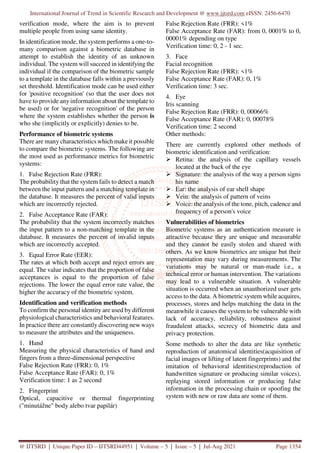
1. Physiological biometrics.
Features notably identified through the five senses
and processed by finite calculable differences: sight
(how a person looks including things like hair and eye
color, teeth, or facial features), sound (the pitch of a
person’s voice), smell (a person’s odor or scent), taste
(the composition of a person’s saliva or DNA), and
touch (such as fingerprints or handprints).
2. Behavioral biometrics.
Based on the manner in which people conduct
themselves, such as writing style, walking rhythm,
typing speed, and so forth.
For any of these characteristics to be used for
sustained identification encryption purposes, they
must be reliable, unique, collectable, convenient, long
term, universal, and acceptable.
Principles of Biometrics
Although the various biometric technologies vary in
what and how they scan, the principle of operation is
very similar. Biometric devices consist of a reader or
scanning device, software that converts the scanned
information into digital form, and wherever the data
is to be analyzed, a database that stores the biometric
data for comparison with previous records. When
converting the biometric input, the software identifies
specific points of data as match points. The match
points are processed using an algorithm into a value
that can be compared with biometric data scanned
when a user tries to gain access.
Verification vs. identification
Depending on the application context, a biometric
system can operate either in verification or
identification mode.
In verification mode, the system performs a one-to-
one comparison of a captured biometric with a
specific template stored in a biometric database in
order to verify the individual is the person they claim
to be. 'Positive recognition' is a common use of
International Journal of Trend in Scientific Research and Development @ www.ijtsrd.com eISSN: 2456-6470
@ IJTSRD | Unique Paper ID – IJTSRD44951 | Volume – 5 | Issue – 5 | Jul-Aug 2021 Page 1354
verification mode, where the aim is to prevent
multiple people from using same identity.
In identification mode, the system performs a one-to-
many comparison against a biometric database in
attempt to establish the identity of an unknown
individual. The system will succeed in identifying the
individual if the comparison of the biometric sample
to a template in the database falls within a previously
set threshold. Identification mode can be used either
for 'positive recognition' (so that the user does not
have to provide any information about the template to
be used) or for 'negative recognition' of the person
where the system establishes whether the person is
who she (implicitly or explicitly) denies to be.
Performance of biometric systems
There are many characteristics which make it possible
to compare the biometric systems. The following are
the most used as performance metrics for biometric
systems:
1. False Rejection Rate (FRR):
The probability that the system fails to detect a match
between the input pattern and a matching template in
the database. It measures the percent of valid inputs
which are incorrectly rejected.
2. False Acceptance Rate (FAR):
The probability that the system incorrectly matches
the input pattern to a non-matching template in the
database. It measures the percent of invalid inputs
which are incorrectly accepted.
3. Equal Error Rate (EER):
The rates at which both accept and reject errors are
equal. The value indicates that the proportion of false
acceptances is equal to the proportion of false
rejections. The lower the equal error rate value, the
higher the accuracy of the biometric system.
Identification and verification methods
To confirm the personal identity are used by different
physiological characteristics and behavioral features.
In practice there are constantly discovering new ways
to measure the attributes and the uniqueness.
1. Hand
Measuring the physical characteristics of hand and
fingers from a three-dimensional perspective
False Rejection Rate (FRR): 0, 1%
False Acceptance Rate (FAR): 0, 1%
Verification time: 1 as 2 second
2. Fingerprint
Optical, capacitive or thermal fingerprinting
("minutážne" body alebo tvar papilár)
False Rejection Rate (FRR): <1%
False Acceptance Rate (FAR): from 0, 0001% to 0,
00001% depending on type
Verification time: 0, 2 - 1 sec.
3. Face
Facial recognition
False Rejection Rate (FRR): <1%
False Acceptance Rate (FAR): 0, 1%
Verification time: 3 sec.
4. Eye
Iris scanning
False Rejection Rate (FRR): 0, 00066%
False Acceptance Rate (FAR): 0, 00078%
Verification time: 2 second
Other methods:
There are currently explored other methods of
biometric identification and verification:
Retina: the analysis of the capillary vessels
located at the back of the eye
Signature: the analysis of the way a person signs
his name
Ear: the analysis of ear shell shape
Vein: the analysis of pattern of veins
Voice: the analysis of the tone, pitch, cadence and
frequency of a person's voice
Vulnerabilities of biometrics
Biometric systems as an authentication measure is
attractive because they are unique and measurable
and they cannot be easily stolen and shared with
others. As we know biometrics are unique but their
representation may vary during measurements. The
variations may be natural or man-made i.e., a
technical error or human intervention. The variations
may lead to a vulnerable situation. A vulnerable
situation is occurred when an unauthorized user gets
access to the data. A biometric system while acquires,
processes, stores and helps matching the data in the
meanwhile it causes the system to be vulnerable with
lack of accuracy, reliability, robustness against
fraudulent attacks, secrecy of biometric data and
privacy protection.
Some methods to alter the data are like synthetic
reproduction of anatomical identities(acquisition of
facial images or lifting of latent fingerprints) and the
imitation of behavioral identities(reproduction of
handwritten signature or producing similar voices),
replaying stored information or producing false
information in the processing chain or spoofing the
system with new or raw data are some of them.
International Journal of Trend in Scientific Research and Development @ www.ijtsrd.com eISSN: 2456-6470
@ IJTSRD | Unique Paper ID – IJTSRD44951 | Volume – 5 | Issue – 5 | Jul-Aug 2021 Page 1355
Fig 1 Vulnerabilities of biometric system
Vulnerabilities often call for threats in a biometric
system which can be classified as faults, failures and
security attacks.
Fig 2 Vulnerability threats
Security of biometric system
A biometric system can directly be attacked on
machine or the man who is supervising the machine.
Biometric system attacks can be classified as direct
and indirect attacks according to Martinez-Diaz et al.
(2011). Indirect attacks require the information of the
development phase e.g., data representation which is
in order to done to impersonate a real user. Indirect
attacks include attacks on template database or on the
communication channel as reported by Ratha et al.
(2001). [2]
According to Cappelli et al. (2007) the most common
attack is stealing biometric templates and that is
spoofing and manipulating the data for use. In generic
encryption methods like AES, RSA, etc. the templates
can be vulnerable in each of the recognition
transaction during decryption because the templates
maybe unprotected during encryption. (Nagar et al.,
2008). [3]
Biometric when combined with cryptography adds
the strength to both fields. [4] Symmetric
cryptosystem are very strong for attacks but the
weakness lies in our symmetric cryptosystems is
regular attempt of cracking the system through
different passwords i.e., brute forcing the secret key.
[5]
Conclusion
Safety of our biometric systems is the need of the
hour. A company or organization should have a solid,
effective and accurate biometric system to ensure that
their data is safe. As discussed above one should be
aware of the threats related to biometric data he/she
submits as there are many fraudulent activities are
carried out on the of well recognized institutions or
offices.
References
[1] Drahansky, M.: Fingerabdruckerkennung
mittels neuronaler Netze, Diploma thesis, 2001
[2] Smolik, L., Drahansky, M.: Exploitation of
smart cards and human biometric attributes,
CATE, 2001
[3] Yogendra narain Singh, Sanjay Kumar Singh,
“A taxonomy of biometric system
vulnerabilities and defences, Int. J. Biometrics,
Vol. 5, No. 2, 2013.
International Journal of Trend in Scientific Research and Development @ www.ijtsrd.com eISSN: 2456-6470
@ IJTSRD | Unique Paper ID – IJTSRD44951 | Volume – 5 | Issue – 5 | Jul-Aug 2021 Page 1356
[4] Edwin T. L. Rampine, Cynthia H. Ngejane, “A
brief overview of hybrid schemes for biometric
fingerprint template security”, ICISSP 2016 –
2nd
International Conference on Information
Systems Security and Privacy
[5] Alisher kholmatov, Berrin Yanikoglu,
“Biometric cryptosystem using online
signatures”, Computer and Information
Sciences – ISCIS 2006.
[6] Mohammad Shahnawaz Nasir, Prakash
Kuppuswamy Perumal, “Implementation of
biometric security using hybrid combination of
RSA and simple symmetric key algorithm”,
International Journal of Innovative Research in
Computer and Communication Engineering,
Vol.1, Issue 8, October 2013.

Security Issues Related to Biometrics

  • 1.
    International Journal ofTrend in Scientific Research and Development (IJTSRD) Volume 5 Issue 5, July-August 2021 Available Online: www.ijtsrd.com e-ISSN: 2456 – 6470 @ IJTSRD | Unique Paper ID – IJTSRD44951 | Volume – 5 | Issue – 5 | Jul-Aug 2021 Page 1352 Security Issues Related to Biometrics Sushmita Raulo, Saurabh Gawade Department of MCA, ASM Institute of Management & Computer Studies, Thane, Maharashtra, India ABSTRACT With the growth of technology their grows threat to our data which is just secured by passwords so to make it more secure biometrics came into existence. As biometric systems are adopted and accepted for security purpose for various information and security systems. Hence it is immune to attacks. This paper deals with the security of biometric details of individuals. In this paper we will be discussing about biometrics and its types and the threats and security issues which is not talked about usually. The different technologies evolved and had contributed to biometrics in long run and their effects. KEYWORDS: security, biometrics, technology, data, cryptography How to cite this paper: Sushmita Raulo | Saurabh Gawade "Security Issues Related to Biometrics" Published in International Journal of Trend in Scientific Research and Development (ijtsrd), ISSN: 2456- 6470, Volume-5 | Issue-5, August 2021, pp.1352- 1356, URL: www.ijtsrd.com/papers/ijtsrd44951.pdf Copyright © 2021 by author (s) and International Journal of Trend in Scientific Research and Development Journal. This is an Open Access article distributed under the terms of the Creative Commons Attribution License (CC BY 4.0) (http://creativecommons.org/licenses/by/4.0) INTRODUCTION Protection of individuals, their belongings, environment, etc., are all given utmost importance but in the era technology has added one more priority – protection of individual’s data. Data collected through biometrics is collected, stored and utilized when it is needed. But as we all know there is a threat to anything out there in the world so do our data too. We as an individual working with technology have a responsibility to protect our fellow citizen’s data. Biometrics has opened a way through which we can identify a person’s identity using his/her fingerprints, iris scan, face recognition and many more. Biometrics serves as a way for identification or verification of a person. But biometrics has also paved way for the hackers or the illegal tech practitioners to access data easily. As we are moving towards a digital era, we will be experiencing more of this security threats which we may be unaware of. [1] Biometrics The biometrics word has a large meaning in the study of identification’s persons from a number of characteristics. A complex human inheritance, very rich in combinations, and perfectly adapted to such systems of user identification, and/or authentication. It’s a Mathematical analysis of biological characteristics of a person to determine his identity decisively. Biometrics based on the principle of some characteristics recognition’s. Fingerprints, face, iris, retina, hand, keystroke and voice, provide irrefutable proof of the identity of a person they are unique biological characteristics distinguishing one person from another. Both identification and authentication differentiate the definition of the biometrics: Identification: The confirmation of the identityof the individual which is identity papers or automatic teller machines. Authentication: Identification of an individual from a quantity of biometric recorded people. This type of biometric recognition is especially used in the high fields with low number of users or ends of police investigation. Types of Biometrics 1. Fingerprint Recognition:- The use of the ridges and valleys (minutiae) found on the surface tips of a human finger to identify an individual. IJTSRD44951
  • 2.
    International Journal ofTrend in Scientific Research and Development @ www.ijtsrd.com eISSN: 2456-6470 @ IJTSRD | Unique Paper ID – IJTSRD44951 | Volume – 5 | Issue – 5 | Jul-Aug 2021 Page 1353 2. Face Recognition:- The analysis of facial features or patterns for the authentication or recognition of an individual’s identity. Most face recognition systems either use Eigen faces or local feature analysis. 3. Eyes:- A. Iris Recognition- The use of the features found in the iris to identify an individual. B. Retina Recognition- The use of patterns of veins in the back of the eye to accomplish recognition. 4. Ear:- The identification of an individual using the shape of the ear. 5. Hand Geometry Recognition:- The use of the geometric features of the hand such as the lengths of fingers and the width of the hand to identify an individual. 6. Typing Recognition:- The use of the unique characteristics of a person’s typing for establishing identity. 7. Voice - Speaker Identification:- Identification is the task of determining an unknown speaker’s identity. Speaker identification is a 1: N (many) match where the voice is compared against N templates. Speaker identification systems can also be implemented covertly without the user’s knowledge to identify talkers in a discussion, alert automated systems of speaker changes, check if a user is already enrolled in a system, etc. 8. Signature Recognition:- The authentication of an individual by the analysis of handwriting style, in particular the signature. There are two key types of digital handwritten signature authentication, Static and Dynamic. A. Static is most often a visual comparison between one scanned signature and another scanned signature, or a scanned signature against an ink signature. Technology is available to check two scanned signatures using advances algorithms. B. Dynamic is becoming more popular as ceremony data is captured along with the X,Y,T and P Coordinates of the signor from the signing device. This data can be utilized in a court of law using digital forensic examination tools, and to create a biometric template from which dynamic signatures can be authenticated either at time of signing or post signing, and as triggers in workflow processes. Biometric Features 1. Physiological biometrics. Features notably identified through the five senses and processed by finite calculable differences: sight (how a person looks including things like hair and eye color, teeth, or facial features), sound (the pitch of a person’s voice), smell (a person’s odor or scent), taste (the composition of a person’s saliva or DNA), and touch (such as fingerprints or handprints). 2. Behavioral biometrics. Based on the manner in which people conduct themselves, such as writing style, walking rhythm, typing speed, and so forth. For any of these characteristics to be used for sustained identification encryption purposes, they must be reliable, unique, collectable, convenient, long term, universal, and acceptable. Principles of Biometrics Although the various biometric technologies vary in what and how they scan, the principle of operation is very similar. Biometric devices consist of a reader or scanning device, software that converts the scanned information into digital form, and wherever the data is to be analyzed, a database that stores the biometric data for comparison with previous records. When converting the biometric input, the software identifies specific points of data as match points. The match points are processed using an algorithm into a value that can be compared with biometric data scanned when a user tries to gain access. Verification vs. identification Depending on the application context, a biometric system can operate either in verification or identification mode. In verification mode, the system performs a one-to- one comparison of a captured biometric with a specific template stored in a biometric database in order to verify the individual is the person they claim to be. 'Positive recognition' is a common use of
  • 3.
    International Journal ofTrend in Scientific Research and Development @ www.ijtsrd.com eISSN: 2456-6470 @ IJTSRD | Unique Paper ID – IJTSRD44951 | Volume – 5 | Issue – 5 | Jul-Aug 2021 Page 1354 verification mode, where the aim is to prevent multiple people from using same identity. In identification mode, the system performs a one-to- many comparison against a biometric database in attempt to establish the identity of an unknown individual. The system will succeed in identifying the individual if the comparison of the biometric sample to a template in the database falls within a previously set threshold. Identification mode can be used either for 'positive recognition' (so that the user does not have to provide any information about the template to be used) or for 'negative recognition' of the person where the system establishes whether the person is who she (implicitly or explicitly) denies to be. Performance of biometric systems There are many characteristics which make it possible to compare the biometric systems. The following are the most used as performance metrics for biometric systems: 1. False Rejection Rate (FRR): The probability that the system fails to detect a match between the input pattern and a matching template in the database. It measures the percent of valid inputs which are incorrectly rejected. 2. False Acceptance Rate (FAR): The probability that the system incorrectly matches the input pattern to a non-matching template in the database. It measures the percent of invalid inputs which are incorrectly accepted. 3. Equal Error Rate (EER): The rates at which both accept and reject errors are equal. The value indicates that the proportion of false acceptances is equal to the proportion of false rejections. The lower the equal error rate value, the higher the accuracy of the biometric system. Identification and verification methods To confirm the personal identity are used by different physiological characteristics and behavioral features. In practice there are constantly discovering new ways to measure the attributes and the uniqueness. 1. Hand Measuring the physical characteristics of hand and fingers from a three-dimensional perspective False Rejection Rate (FRR): 0, 1% False Acceptance Rate (FAR): 0, 1% Verification time: 1 as 2 second 2. Fingerprint Optical, capacitive or thermal fingerprinting ("minutážne" body alebo tvar papilár) False Rejection Rate (FRR): <1% False Acceptance Rate (FAR): from 0, 0001% to 0, 00001% depending on type Verification time: 0, 2 - 1 sec. 3. Face Facial recognition False Rejection Rate (FRR): <1% False Acceptance Rate (FAR): 0, 1% Verification time: 3 sec. 4. Eye Iris scanning False Rejection Rate (FRR): 0, 00066% False Acceptance Rate (FAR): 0, 00078% Verification time: 2 second Other methods: There are currently explored other methods of biometric identification and verification: Retina: the analysis of the capillary vessels located at the back of the eye Signature: the analysis of the way a person signs his name Ear: the analysis of ear shell shape Vein: the analysis of pattern of veins Voice: the analysis of the tone, pitch, cadence and frequency of a person's voice Vulnerabilities of biometrics Biometric systems as an authentication measure is attractive because they are unique and measurable and they cannot be easily stolen and shared with others. As we know biometrics are unique but their representation may vary during measurements. The variations may be natural or man-made i.e., a technical error or human intervention. The variations may lead to a vulnerable situation. A vulnerable situation is occurred when an unauthorized user gets access to the data. A biometric system while acquires, processes, stores and helps matching the data in the meanwhile it causes the system to be vulnerable with lack of accuracy, reliability, robustness against fraudulent attacks, secrecy of biometric data and privacy protection. Some methods to alter the data are like synthetic reproduction of anatomical identities(acquisition of facial images or lifting of latent fingerprints) and the imitation of behavioral identities(reproduction of handwritten signature or producing similar voices), replaying stored information or producing false information in the processing chain or spoofing the system with new or raw data are some of them.
  • 4.
    International Journal ofTrend in Scientific Research and Development @ www.ijtsrd.com eISSN: 2456-6470 @ IJTSRD | Unique Paper ID – IJTSRD44951 | Volume – 5 | Issue – 5 | Jul-Aug 2021 Page 1355 Fig 1 Vulnerabilities of biometric system Vulnerabilities often call for threats in a biometric system which can be classified as faults, failures and security attacks. Fig 2 Vulnerability threats Security of biometric system A biometric system can directly be attacked on machine or the man who is supervising the machine. Biometric system attacks can be classified as direct and indirect attacks according to Martinez-Diaz et al. (2011). Indirect attacks require the information of the development phase e.g., data representation which is in order to done to impersonate a real user. Indirect attacks include attacks on template database or on the communication channel as reported by Ratha et al. (2001). [2] According to Cappelli et al. (2007) the most common attack is stealing biometric templates and that is spoofing and manipulating the data for use. In generic encryption methods like AES, RSA, etc. the templates can be vulnerable in each of the recognition transaction during decryption because the templates maybe unprotected during encryption. (Nagar et al., 2008). [3] Biometric when combined with cryptography adds the strength to both fields. [4] Symmetric cryptosystem are very strong for attacks but the weakness lies in our symmetric cryptosystems is regular attempt of cracking the system through different passwords i.e., brute forcing the secret key. [5] Conclusion Safety of our biometric systems is the need of the hour. A company or organization should have a solid, effective and accurate biometric system to ensure that their data is safe. As discussed above one should be aware of the threats related to biometric data he/she submits as there are many fraudulent activities are carried out on the of well recognized institutions or offices. References [1] Drahansky, M.: Fingerabdruckerkennung mittels neuronaler Netze, Diploma thesis, 2001 [2] Smolik, L., Drahansky, M.: Exploitation of smart cards and human biometric attributes, CATE, 2001 [3] Yogendra narain Singh, Sanjay Kumar Singh, “A taxonomy of biometric system vulnerabilities and defences, Int. J. Biometrics, Vol. 5, No. 2, 2013.
  • 5.
    International Journal ofTrend in Scientific Research and Development @ www.ijtsrd.com eISSN: 2456-6470 @ IJTSRD | Unique Paper ID – IJTSRD44951 | Volume – 5 | Issue – 5 | Jul-Aug 2021 Page 1356 [4] Edwin T. L. Rampine, Cynthia H. Ngejane, “A brief overview of hybrid schemes for biometric fingerprint template security”, ICISSP 2016 – 2nd International Conference on Information Systems Security and Privacy [5] Alisher kholmatov, Berrin Yanikoglu, “Biometric cryptosystem using online signatures”, Computer and Information Sciences – ISCIS 2006. [6] Mohammad Shahnawaz Nasir, Prakash Kuppuswamy Perumal, “Implementation of biometric security using hybrid combination of RSA and simple symmetric key algorithm”, International Journal of Innovative Research in Computer and Communication Engineering, Vol.1, Issue 8, October 2013.