ACCESS CONTROL SYSTEM
S.PAHEERATHAN P a g e | 1
ACCESS CONTROL
1. access control is a means of controlling who enters a location
and when.
2. The person entering may be an employee, a contractor or a
visitor and they may be on foot, driving a vehicle or using
another mode of transport.
3. The location they’re entering may be, for example, a site, a
building, a room or a cabinet.
Two Types of Access Control:
1. Physical And
2. Logical.
1. Physical access control limits access to campuses, buildings,
rooms and physical IT assets.
2. Logical access control limits connections to computer networks,
system files and data.
Access control systems perform identification authentication and
authorization of users and entities by evaluating required login
credentials that can include passwords, personal identification
numbers (PINs), biometric scans, security tokens or other
authentication factors.
Why is access control important?
The access control is to minimize the security risk of unauthorized
access to physical and logical systems.
Physical access control system is usually referring to an electronic
security system.
ACCESS CONTROL SYSTEM
S.PAHEERATHAN P a g e | 2
Passwords, PINs, Smart Keys, Smart Cards, etc. are generally used
to authenticate people and allow them access to both physical as
well as digital domains.
But the problems with this type of authentication is that passwords
and PINs can be easily forgotten (or hard to remember) or can be
stolen; smart keys and tokens can be easily misplaced, duplicated
or forgotten; smart cards with magnetic strips can be easily
corrupted.
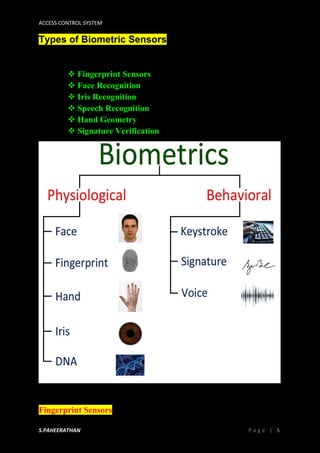
 Use of Biometrics in authentication and verification
1. Every human being possesses certain unique features in terms
of both physiological and behavioural characteristics that are
different from everybody else.
2. a person’s biometrics or biological traits cannot be stolen,
forgotten or misplaced and hence they provide a much better,
secure and reliable way to authenticate an individual when
compared to the traditional methods.
3. commonly used Biometrics are fingerprints, iris, face,
geometry of hand, speech, gait, signature and keystroke.
Biometric Sensors
A Biometric Sensor is a device (or a transducer, to be specific)
that converts the biometric trait of an individual into
electrical signals.
ACCESS CONTROL SYSTEM
S.PAHEERATHAN P a g e | 3
Biometric Sensors are usually semiconductor devices that
processes images from an individual’s physical
characteristics using complex algorithms.
Many physical characteristics of a person like face, iris,
fingerprints, etc. are scanned by a Biometric Sensor and are
converted to a digital image using an Analog – to – Digital
Converter.
This digital information of the person is stored in a memory
and is used to verify or authenticate his/her identity.
Biometric System
There are two types of Biometric operations that can be
performed using the images captured by Biometric Sensors.
They are:
1. Identification
2. Verification
 In Identification mode, a Biometric System identifies a
person from the pool of enrolled personnel by searching the
database and based on match for biometrics. This mode
answers the “Who am I?” question about a person.
 I verification mode, the Biometric System verifies the
person’s identity based on the previously enrolled
ACCESS CONTROL SYSTEM
S.PAHEERATHAN P a g e | 4
biometrics. In this mode, the “Am I whom I claim to be?”
question about an individual is answered.
 MICROPHONE/MIC (WIRED & WIRELESS)
 SPEAKER/LOUD SPEAKER
 SOUND MIXER / MIXING CONSOLE
 SOUND AMPLIFIER/POWER AMPLIFIER
 MUSIC PLAYER
 CABLES
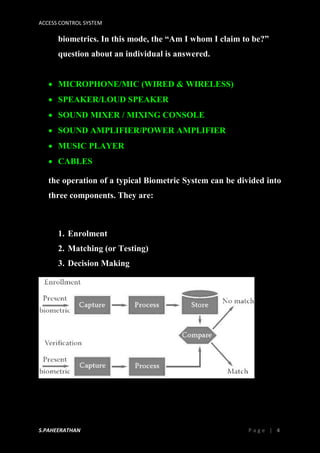
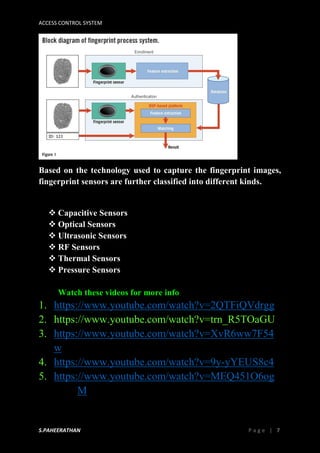
the operation of a typical Biometric System can be divided into
three components. They are:
1. Enrolment
2. Matching (or Testing)
3. Decision Making
ACCESS CONTROL SYSTEM
S.PAHEERATHAN P a g e | 5
Types of Biometric Sensors
 Fingerprint Sensors
 Face Recognition
 Iris Recognition
 Speech Recognition
 Hand Geometry
 Signature Verification
Fingerprint Sensors
ACCESS CONTROL SYSTEM
S.PAHEERATHAN P a g e | 6
The device that is used to capture digital image of a fingerprint
pattern is known as Fingerprint Sensor.
The captured image, which is known as live image, is processed to
create a digital template with extracted features.
This template is stored in the database for matching.
Based on the fingerprint ridges, there are three fingerprint
patterns called:
1. Loop
2. Arch
3. Whorl
ACCESS CONTROL SYSTEM
S.PAHEERATHAN P a g e | 7
Based on the technology used to capture the fingerprint images,
fingerprint sensors are further classified into different kinds.
 Capacitive Sensors
 Optical Sensors
 Ultrasonic Sensors
 RF Sensors
 Thermal Sensors
 Pressure Sensors
Watch these videos for more info
1. https://www.youtube.com/watch?v=2QTFiQVdrgg
2. https://www.youtube.com/watch?v=trn_R5TOaGU
3. https://www.youtube.com/watch?v=XvR6ww7F54
w
4. https://www.youtube.com/watch?v=9y-yYEUS8c4
5. https://www.youtube.com/watch?v=MEQ451O6og
M

Access control system

  • 1.
    ACCESS CONTROL SYSTEM S.PAHEERATHANP a g e | 1 ACCESS CONTROL 1. access control is a means of controlling who enters a location and when. 2. The person entering may be an employee, a contractor or a visitor and they may be on foot, driving a vehicle or using another mode of transport. 3. The location they’re entering may be, for example, a site, a building, a room or a cabinet. Two Types of Access Control: 1. Physical And 2. Logical. 1. Physical access control limits access to campuses, buildings, rooms and physical IT assets. 2. Logical access control limits connections to computer networks, system files and data. Access control systems perform identification authentication and authorization of users and entities by evaluating required login credentials that can include passwords, personal identification numbers (PINs), biometric scans, security tokens or other authentication factors. Why is access control important? The access control is to minimize the security risk of unauthorized access to physical and logical systems. Physical access control system is usually referring to an electronic security system.
  • 2.
    ACCESS CONTROL SYSTEM S.PAHEERATHANP a g e | 2 Passwords, PINs, Smart Keys, Smart Cards, etc. are generally used to authenticate people and allow them access to both physical as well as digital domains. But the problems with this type of authentication is that passwords and PINs can be easily forgotten (or hard to remember) or can be stolen; smart keys and tokens can be easily misplaced, duplicated or forgotten; smart cards with magnetic strips can be easily corrupted.  Use of Biometrics in authentication and verification 1. Every human being possesses certain unique features in terms of both physiological and behavioural characteristics that are different from everybody else. 2. a person’s biometrics or biological traits cannot be stolen, forgotten or misplaced and hence they provide a much better, secure and reliable way to authenticate an individual when compared to the traditional methods. 3. commonly used Biometrics are fingerprints, iris, face, geometry of hand, speech, gait, signature and keystroke. Biometric Sensors A Biometric Sensor is a device (or a transducer, to be specific) that converts the biometric trait of an individual into electrical signals.
  • 3.
    ACCESS CONTROL SYSTEM S.PAHEERATHANP a g e | 3 Biometric Sensors are usually semiconductor devices that processes images from an individual’s physical characteristics using complex algorithms. Many physical characteristics of a person like face, iris, fingerprints, etc. are scanned by a Biometric Sensor and are converted to a digital image using an Analog – to – Digital Converter. This digital information of the person is stored in a memory and is used to verify or authenticate his/her identity. Biometric System There are two types of Biometric operations that can be performed using the images captured by Biometric Sensors. They are: 1. Identification 2. Verification  In Identification mode, a Biometric System identifies a person from the pool of enrolled personnel by searching the database and based on match for biometrics. This mode answers the “Who am I?” question about a person.  I verification mode, the Biometric System verifies the person’s identity based on the previously enrolled
  • 4.
    ACCESS CONTROL SYSTEM S.PAHEERATHANP a g e | 4 biometrics. In this mode, the “Am I whom I claim to be?” question about an individual is answered.  MICROPHONE/MIC (WIRED & WIRELESS)  SPEAKER/LOUD SPEAKER  SOUND MIXER / MIXING CONSOLE  SOUND AMPLIFIER/POWER AMPLIFIER  MUSIC PLAYER  CABLES the operation of a typical Biometric System can be divided into three components. They are: 1. Enrolment 2. Matching (or Testing) 3. Decision Making
  • 5.
    ACCESS CONTROL SYSTEM S.PAHEERATHANP a g e | 5 Types of Biometric Sensors  Fingerprint Sensors  Face Recognition  Iris Recognition  Speech Recognition  Hand Geometry  Signature Verification Fingerprint Sensors
  • 6.
    ACCESS CONTROL SYSTEM S.PAHEERATHANP a g e | 6 The device that is used to capture digital image of a fingerprint pattern is known as Fingerprint Sensor. The captured image, which is known as live image, is processed to create a digital template with extracted features. This template is stored in the database for matching. Based on the fingerprint ridges, there are three fingerprint patterns called: 1. Loop 2. Arch 3. Whorl
  • 7.
    ACCESS CONTROL SYSTEM S.PAHEERATHANP a g e | 7 Based on the technology used to capture the fingerprint images, fingerprint sensors are further classified into different kinds.  Capacitive Sensors  Optical Sensors  Ultrasonic Sensors  RF Sensors  Thermal Sensors  Pressure Sensors Watch these videos for more info 1. https://www.youtube.com/watch?v=2QTFiQVdrgg 2. https://www.youtube.com/watch?v=trn_R5TOaGU 3. https://www.youtube.com/watch?v=XvR6ww7F54 w 4. https://www.youtube.com/watch?v=9y-yYEUS8c4 5. https://www.youtube.com/watch?v=MEQ451O6og M