SEMINAR
PRESENTED BY
JANETA JOSEPH
M.Sc Nursing I year
1
OBJECTIVES
This session will highlight on,
• Definition of seminar
• Purposes of seminar
• Principles of seminar
• Types of seminar
• Characteristics of seminar
• Role of the members in seminar
• Techniques of seminar
• Parts of seminar presentation
• Implications in nursing education
2
DEFINITION
 A seminar is a discussion based on
information presented by experts
under the guidance of an eminent
person for the benefit of group
members.
Sankaranarayan.B(2009)
2
PURPOSES OF SEMINAR
 For teaching higher level students like
postgraduates and research scholars
 To express critical thought about a
topic
 To stimulate inquiry and discussion
 To study multiple aspects of the topic
under consideration
3
Sankaranarayan.B(2009).Learnin
g and teaching nursing
PRINCIPLES OF SEMINAR
 Has a focus, a main point or a guiding
question
 Narrow enough in scope to enable
significant inquiry and clear
expression in the allotted time
 Be well organized
 Be open to inquiry and discussion
4
Elsa Sanatombi
Devi(2006).Manipal manual of
nursing education
TYPES
 MINI SEMINAR
 MAIN SEMINAR
 NATIONAL SEMINAR
 INTERNATIONAL SEMINAR
5
Sankaranarayanan.B(2009).Learn
ing and teaching nursing
CHARACTERISTICS OF MINI
SEMINAR
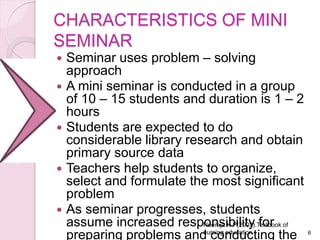
 Seminar uses problem – solving
approach
 A mini seminar is conducted in a group
of 10 – 15 students and duration is 1 – 2
hours
 Students are expected to do
considerable library research and obtain
primary source data
 Teachers help students to organize,
select and formulate the most significant
problem
 As seminar progresses, students
assume increased responsibility for
preparing problems and conducting the 6
Neeraja.K.P(2003).Textbook of
nursing education
MEMBERS
 ORGANISER
 CHAIRPERSONS
 SPEAKERS
 PARTICIPANTS
7
Sankaranarayan.B(2009).Learning and
teaching nursing
ROLE OF THE MEMBERS
8
Sankaranarayan.B(2009).Learning and
teaching nursing
ORGANISER
 Decides the topic of seminar
 formulates objectives
 Selects an eminent person as a
chairperson
 Finalize various aspects of the topic
 Selects speakers
 Selects date and time
9
CHAIRPERSONS
 Guides the seminar
 Justifies the topic selection
 Introduces the speakers and invites
them according to order
 After the presentation, opens the
discussion session
11
SPEAKERS
 Prepare and hand over the study
materials and present the information
in an interesting and comprehensive
manner with the help of A – V aids
12
PARTICIPANTS
 Ask questions ,seek clarification and
express their viewpoints.
13
SEMINAR TECHNIQUES
Organizers make necessary arrangements
and distribute the study materials to the
participants
Chairperson gives an introductory speech
and invites the speakers
Speaker presents the latest aspect
After each speech the chairperson has to
summarize it
After all have presented, chairperson opens
the discussion session
Seminar comes to an end with a concluding
note by the chairperson.
14
Sankaranarayan.B(2009).Learning and
teaching nursing
15
PARTS OF SEMINAR
PRESENTATION
Ezinearticles.com/express-
yourself-how-to-conduct-a-
seminar-partI&id=109730
 INTRODUCTION
get the audience attention
explain why the topic is important
outline the rest of the presentation
16
• DELIVERING PRESENTATION
treat audience with respect
direct seminar at the appropriate
level
provide an introduction to the
main points and outline of the
presentation before starting
for longer presentations pause in
the middle to recap and to outline
what is still to come
17
 CONCLUDE
conclude with a summary of the
main points
thank the audience at the end
and do not apologize for any aspect of
the presentation
18
IMPLICATIONS IN NURSING
EDUCATION
 Promotes self directed learning in
nursing students
 Used for postgraduate nursing
students
 to encourage active participation
 encourages professional growth and
maturity
 facilitate reflective thinking
 encourage facilitative communication
and interpersonal skills.
19
20

Unit 1 Nursing seminar and role transition

  • 1.
  • 2.
    OBJECTIVES This session willhighlight on, • Definition of seminar • Purposes of seminar • Principles of seminar • Types of seminar • Characteristics of seminar • Role of the members in seminar • Techniques of seminar • Parts of seminar presentation • Implications in nursing education 2
  • 3.
    DEFINITION  A seminaris a discussion based on information presented by experts under the guidance of an eminent person for the benefit of group members. Sankaranarayan.B(2009) 2
  • 4.
    PURPOSES OF SEMINAR For teaching higher level students like postgraduates and research scholars  To express critical thought about a topic  To stimulate inquiry and discussion  To study multiple aspects of the topic under consideration 3 Sankaranarayan.B(2009).Learnin g and teaching nursing
  • 5.
    PRINCIPLES OF SEMINAR Has a focus, a main point or a guiding question  Narrow enough in scope to enable significant inquiry and clear expression in the allotted time  Be well organized  Be open to inquiry and discussion 4 Elsa Sanatombi Devi(2006).Manipal manual of nursing education
  • 6.
    TYPES  MINI SEMINAR MAIN SEMINAR  NATIONAL SEMINAR  INTERNATIONAL SEMINAR 5 Sankaranarayanan.B(2009).Learn ing and teaching nursing
  • 7.
    CHARACTERISTICS OF MINI SEMINAR Seminar uses problem – solving approach  A mini seminar is conducted in a group of 10 – 15 students and duration is 1 – 2 hours  Students are expected to do considerable library research and obtain primary source data  Teachers help students to organize, select and formulate the most significant problem  As seminar progresses, students assume increased responsibility for preparing problems and conducting the 6 Neeraja.K.P(2003).Textbook of nursing education
  • 8.
    MEMBERS  ORGANISER  CHAIRPERSONS SPEAKERS  PARTICIPANTS 7 Sankaranarayan.B(2009).Learning and teaching nursing
  • 9.
    ROLE OF THEMEMBERS 8 Sankaranarayan.B(2009).Learning and teaching nursing
  • 10.
    ORGANISER  Decides thetopic of seminar  formulates objectives  Selects an eminent person as a chairperson  Finalize various aspects of the topic  Selects speakers  Selects date and time 9
  • 11.
    CHAIRPERSONS  Guides theseminar  Justifies the topic selection  Introduces the speakers and invites them according to order  After the presentation, opens the discussion session 11
  • 12.
    SPEAKERS  Prepare andhand over the study materials and present the information in an interesting and comprehensive manner with the help of A – V aids 12
  • 13.
    PARTICIPANTS  Ask questions,seek clarification and express their viewpoints. 13
  • 14.
    SEMINAR TECHNIQUES Organizers makenecessary arrangements and distribute the study materials to the participants Chairperson gives an introductory speech and invites the speakers Speaker presents the latest aspect After each speech the chairperson has to summarize it After all have presented, chairperson opens the discussion session Seminar comes to an end with a concluding note by the chairperson. 14 Sankaranarayan.B(2009).Learning and teaching nursing
  • 15.
  • 16.
     INTRODUCTION get theaudience attention explain why the topic is important outline the rest of the presentation 16
  • 17.
    • DELIVERING PRESENTATION treataudience with respect direct seminar at the appropriate level provide an introduction to the main points and outline of the presentation before starting for longer presentations pause in the middle to recap and to outline what is still to come 17
  • 18.
     CONCLUDE conclude witha summary of the main points thank the audience at the end and do not apologize for any aspect of the presentation 18
  • 19.
    IMPLICATIONS IN NURSING EDUCATION Promotes self directed learning in nursing students  Used for postgraduate nursing students  to encourage active participation  encourages professional growth and maturity  facilitate reflective thinking  encourage facilitative communication and interpersonal skills. 19
  • 20.