This document provides an overview of the role of information technology in healthcare. It discusses the history and basics of IT, highlights key IT tools used in healthcare like electronic medical records, telemedicine, and health information exchange. It also covers the need for IT in healthcare to improve quality, access, and efficiency. Privacy and security challenges with healthcare IT are also summarized. Finally, the current adoption of IT in healthcare settings and India's National Digital Health Mission initiative are briefly outlined.
Introduction of IT's role in healthcare, presented by Nisha Yadav under Dr. Kavita Narang.
Outline of the presentation including aspects like history, benefits, and future scope of IT in healthcare.
Definition of IT as technology aiding in information production, manipulation, storage, and dissemination.
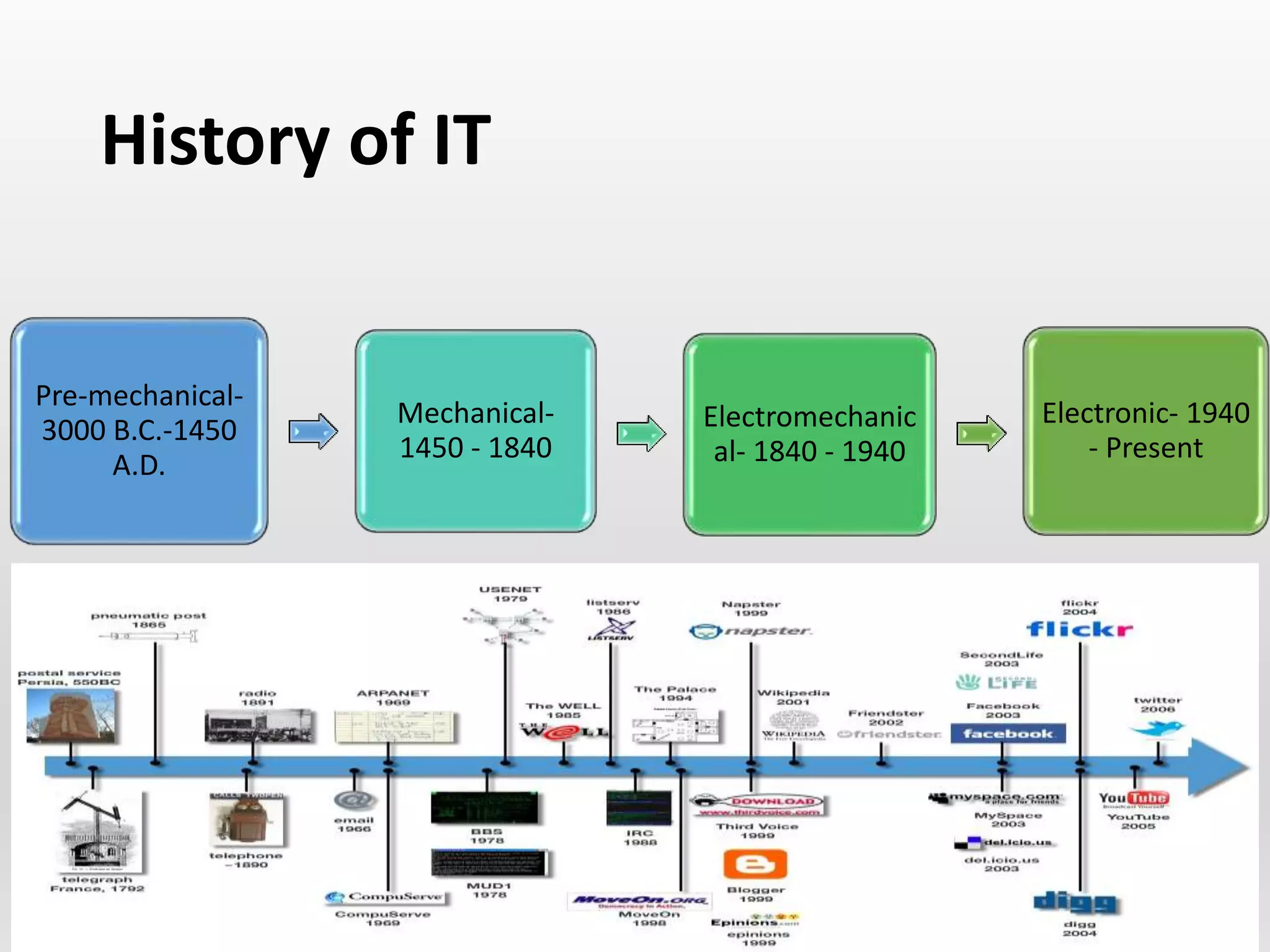
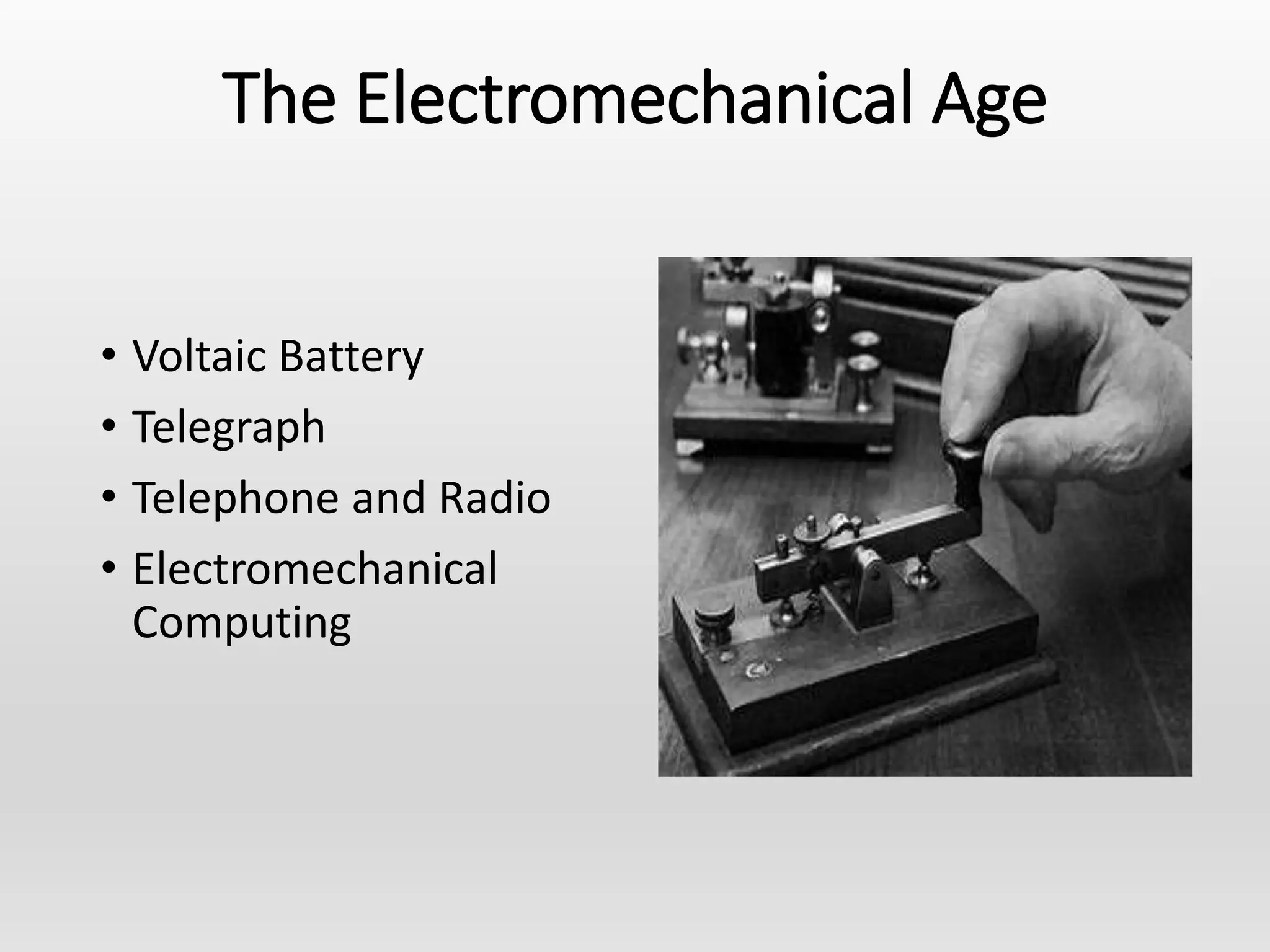
Evolution of IT across four ages: Pre-mechanical, Mechanical, Electromechanical, and Electronic.
Basics of IT includes components such as computer systems, software, storage devices, and communication technologies.
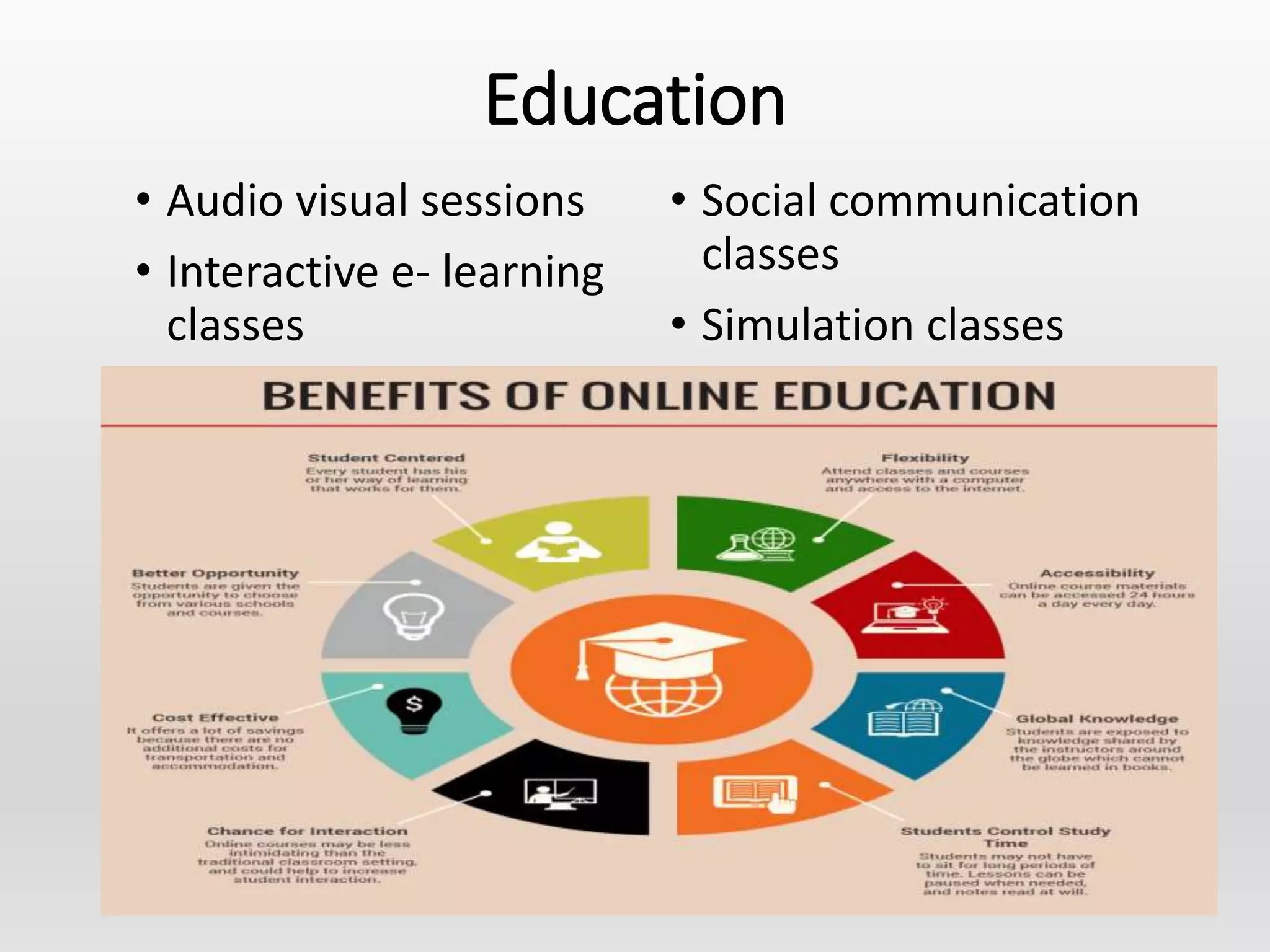
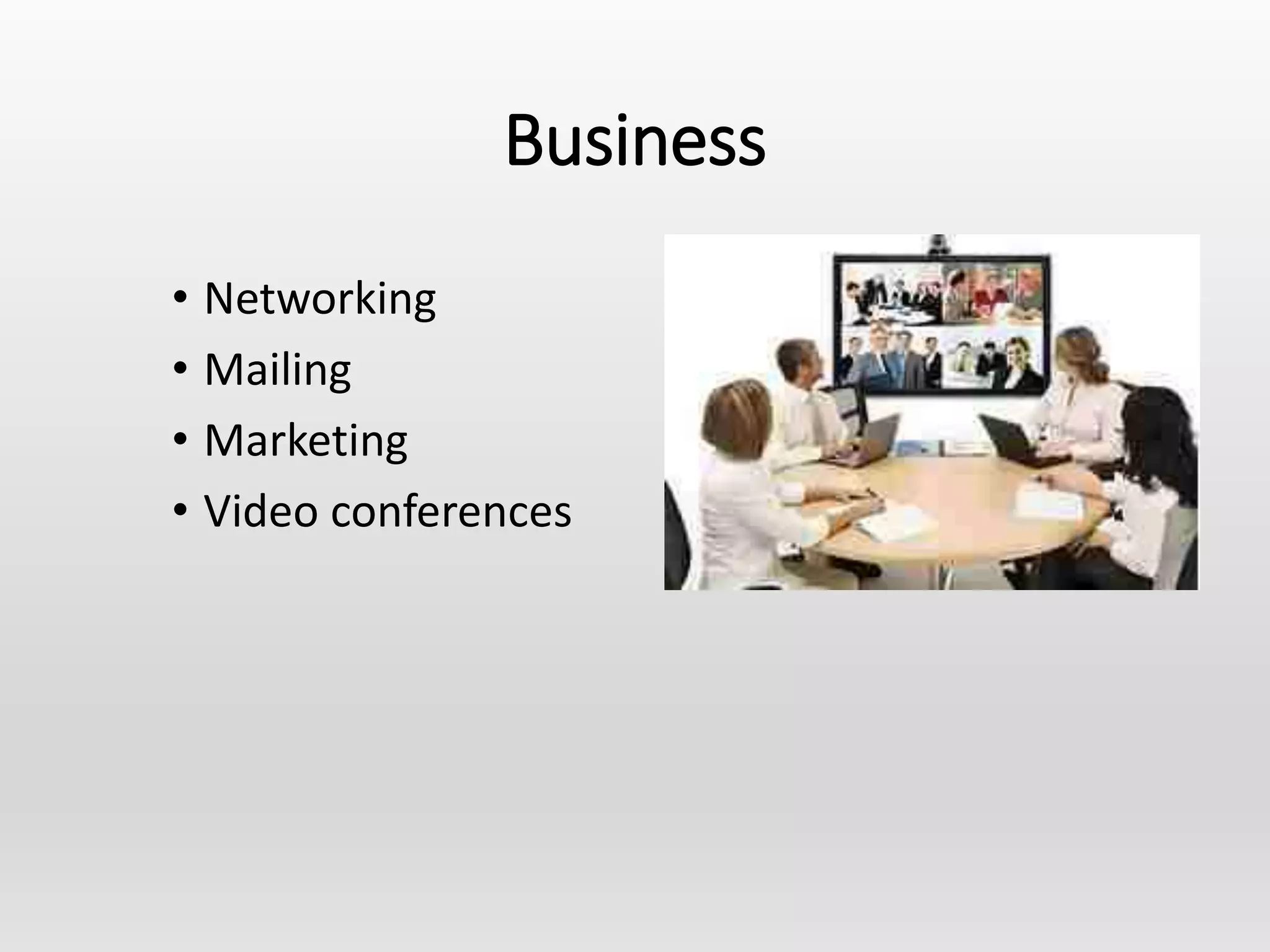
Advantages of IT in education, business, and healthcare, focusing on efficiency, quality, and communication.
IT improves healthcare quality, efficiency, and supports informed decision-making in patient care.
Growing medical knowledge and demand for IT solutions like decision support systems in healthcare.
Various ongoing and developing health IT tools aimed at improving efficiency and planning for healthcare.
Benefits of EMRs providing real-time access, improving clinician workflow, and supporting various healthcare functions.
Role of CDS in enhancing decision-making through alerts and adherence to clinical guidelines.
CPOE processes for ordering medications and tests, highlighting the importance of computerized ordering.
Transition to electronic prescriptions, emphasizing safety checks and challenges faced by healthcare providers.
HIE enables secure communication among healthcare providers for patient information sharing.
PHR allows individuals to manage their health information securely, enhancing personal control and privacy.
Remote monitoring for chronic conditions enables smoother patient management and data collection.
Telehealth's role in delivering services, improving access, convenience, and reducing costs.
Use of information technology for home monitoring of patients with chronic conditions to reduce healthcare costs.
Clinical Data Processing automates patient monitoring for timely and accurate healthcare delivery.
Integration of IT in nursing practice for patient care, administrative tasks, and educational purposes.
Importance of securing patient information through organizational policies and technical safeguards.
Examination of IT's implementation in healthcare settings, highlighting the National Digital Health Mission.NDHM aims to create a comprehensive digital health infrastructure, improving service delivery in India.
Benefits of NDHM include secure storage and access to health records, enhancing accountability and decision-making.
Potential of integrating IT to improve healthcare in underserved areas, ensuring access for rural populations.
Conclusion on IT's transformative potential in healthcare efficiency, safety, and quality improvements.
Credits and citations for data sources and referenced literature in the presentation.
ROLE OF INFORMATION
TECHNOLOGYON HEALTH
Submitted To:
Dr. Kavita Narang
Lecturer
PGIMER
Chandigarh
Prepared By:
Nisha Yadav
M.Sc. Nursing 1st Year
NINE, PGIMER
Chandigarh
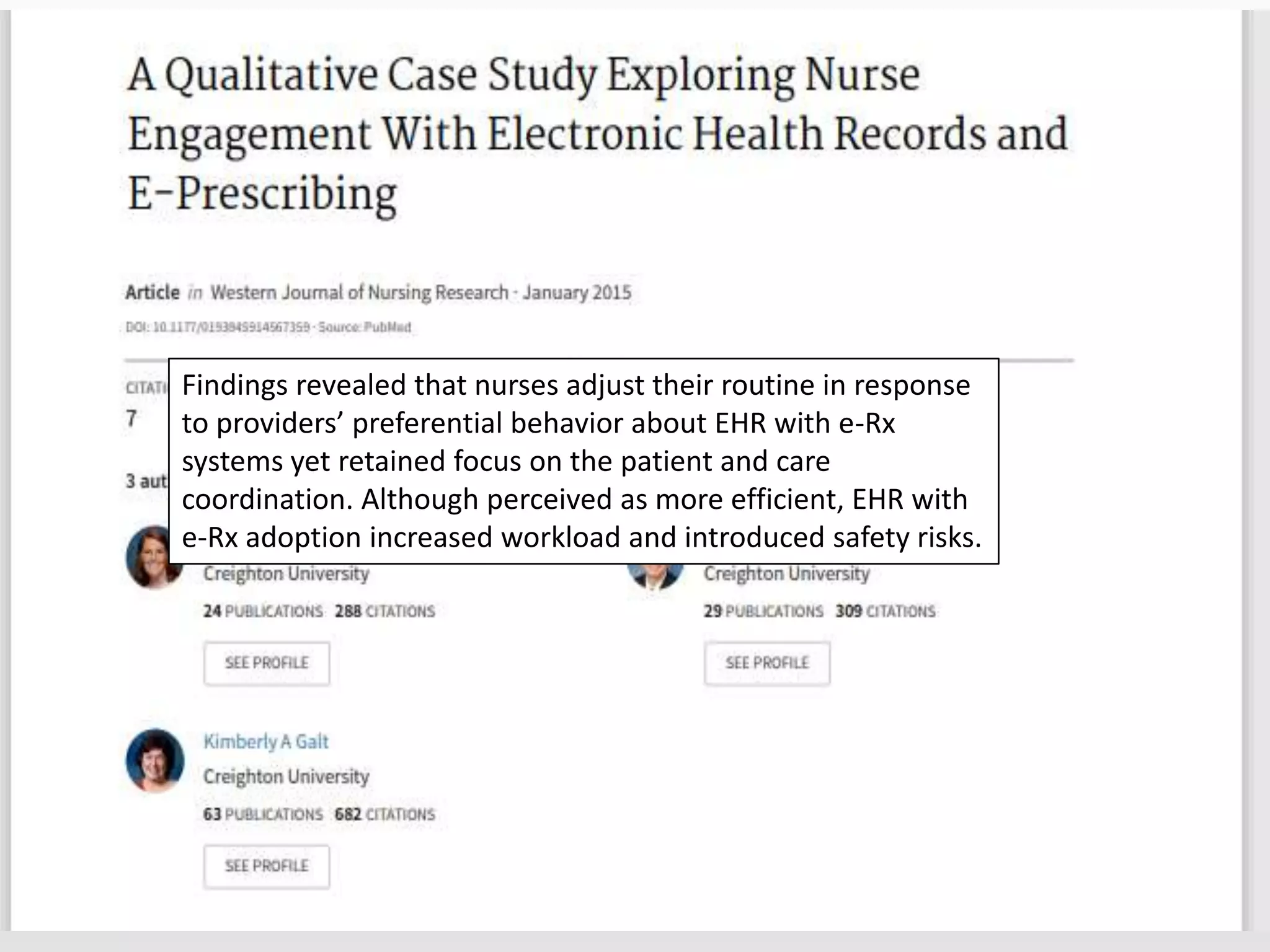
2.
Content
• Introduction toinformation technology
• History of IT
• Basics of Information Technology
• Benefits of Information Technology
• Need for IT in healthcare
• IT tools in healthcare
• Privacy and Security in Healthcare
Information Technology
• Current Status of IT in Healthcare
• NDHM
• Future scope
3.
Introduction to IT
•Information technology is a
general term that describes
any technology that helps
to produce, manipulate,
store, communicate and
disseminate information.
• IT is considered to be a
subset of information and
communications
technology (ICT).
4.
• An informationtechnology system (IT system) is
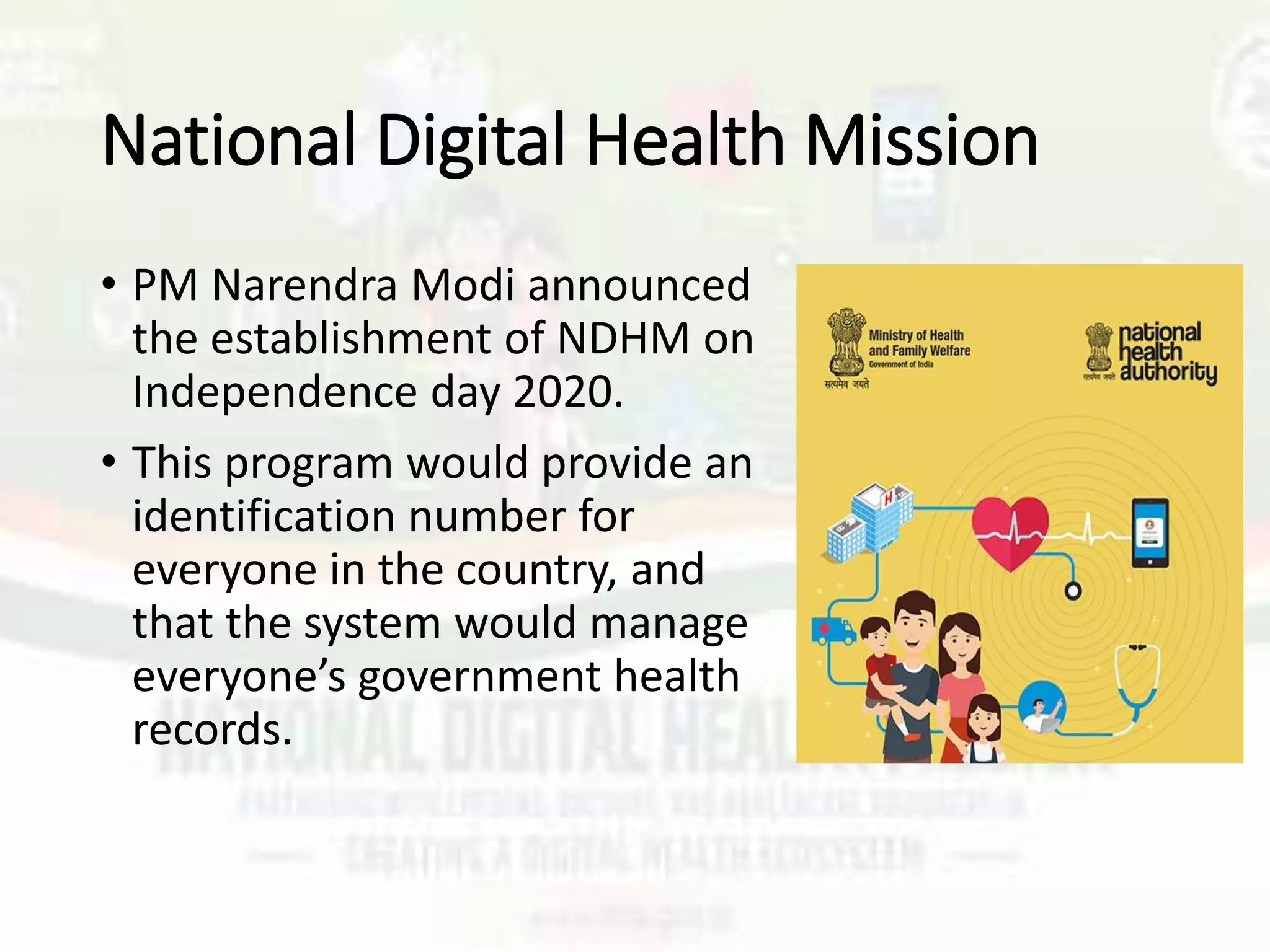
generally an information system, a communications
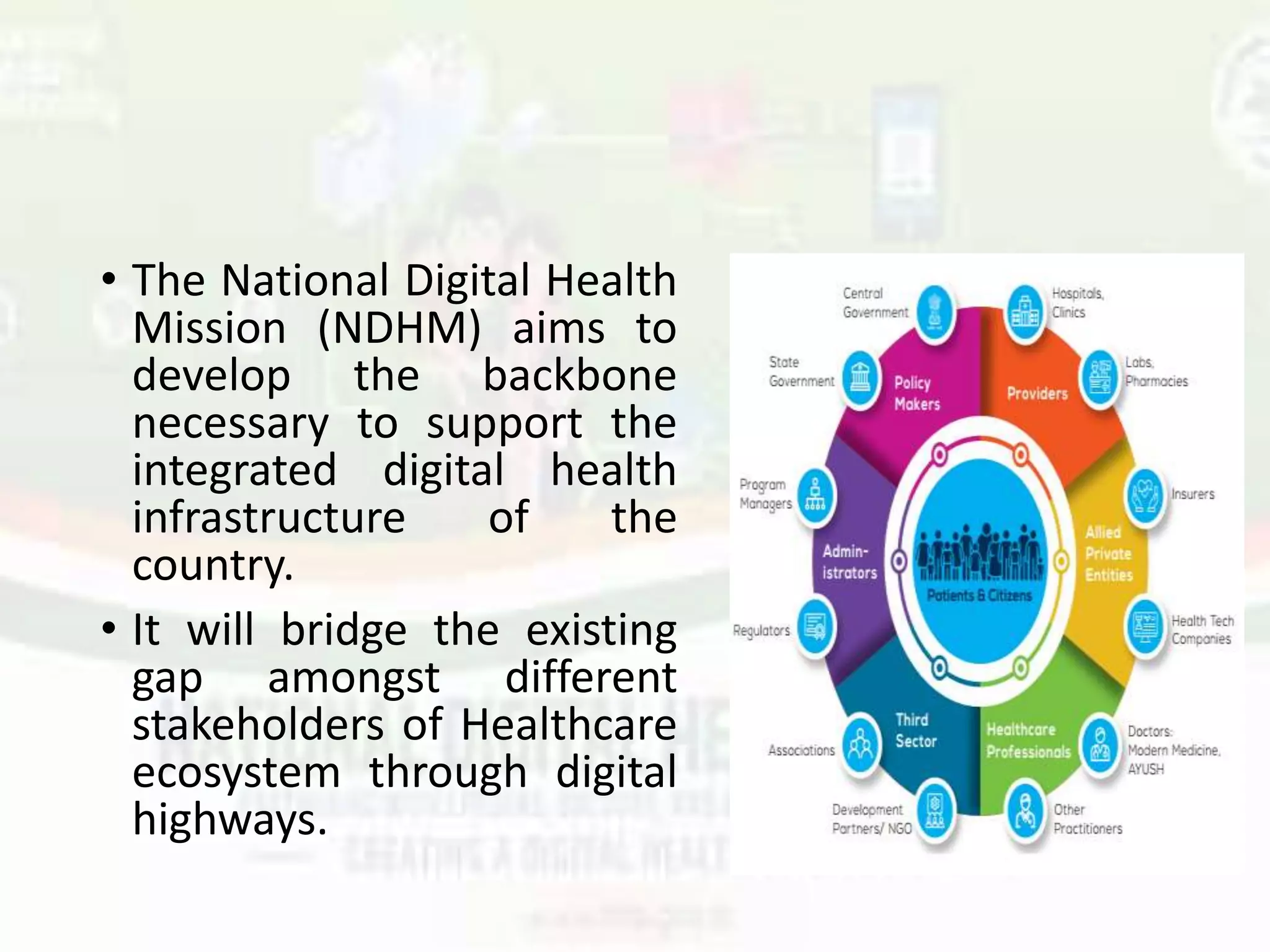
system, or, more specifically speaking, a computer
system – including all hardware, software,
and peripheral equipment.
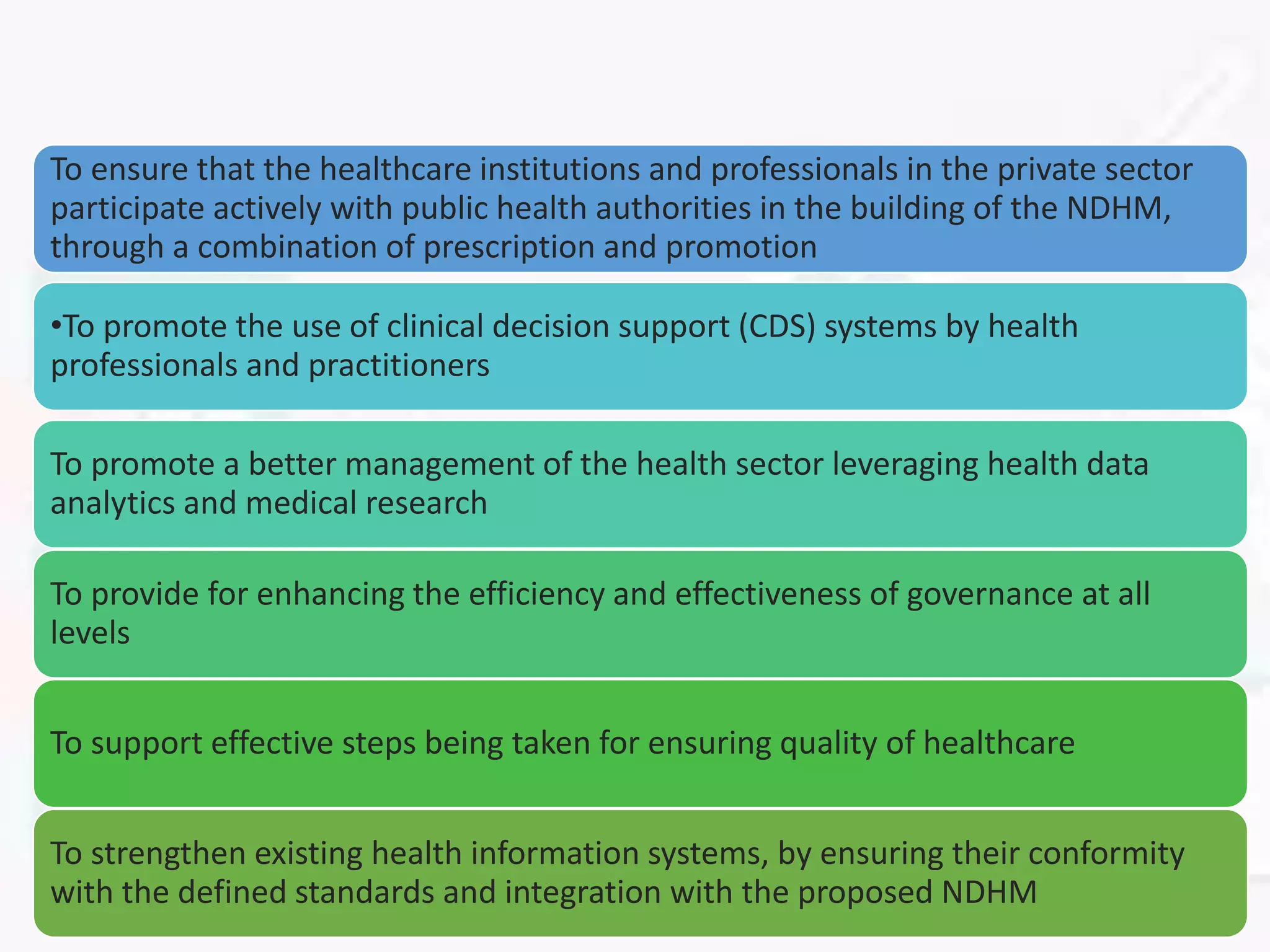
The Pre-mechanical Age
•Writing and Alphabets-
communication.
• Paper and Pens- input
technologies.
• Books and Libraries: Permanent
Storage Devices.
• The First Numbering Systems.
• The First Calculators: The Abacus
7.
The Mechanical Age:
•The First Information Explosion.
• The first general purpose
“computers” were actually
used.
• Slide Rule, the Pascaline and
Leibniz's Machine.
The Electronic Age
•First generation (1951- 1958)
• Second generation (1958- 1963)
• Third generation (1964- 1979)
• Fourth generation (1979- present)
10.
Basics of InformationTechnology
• Computer
• Communication technology
• Characteristics of a computer
• Components of a computer system
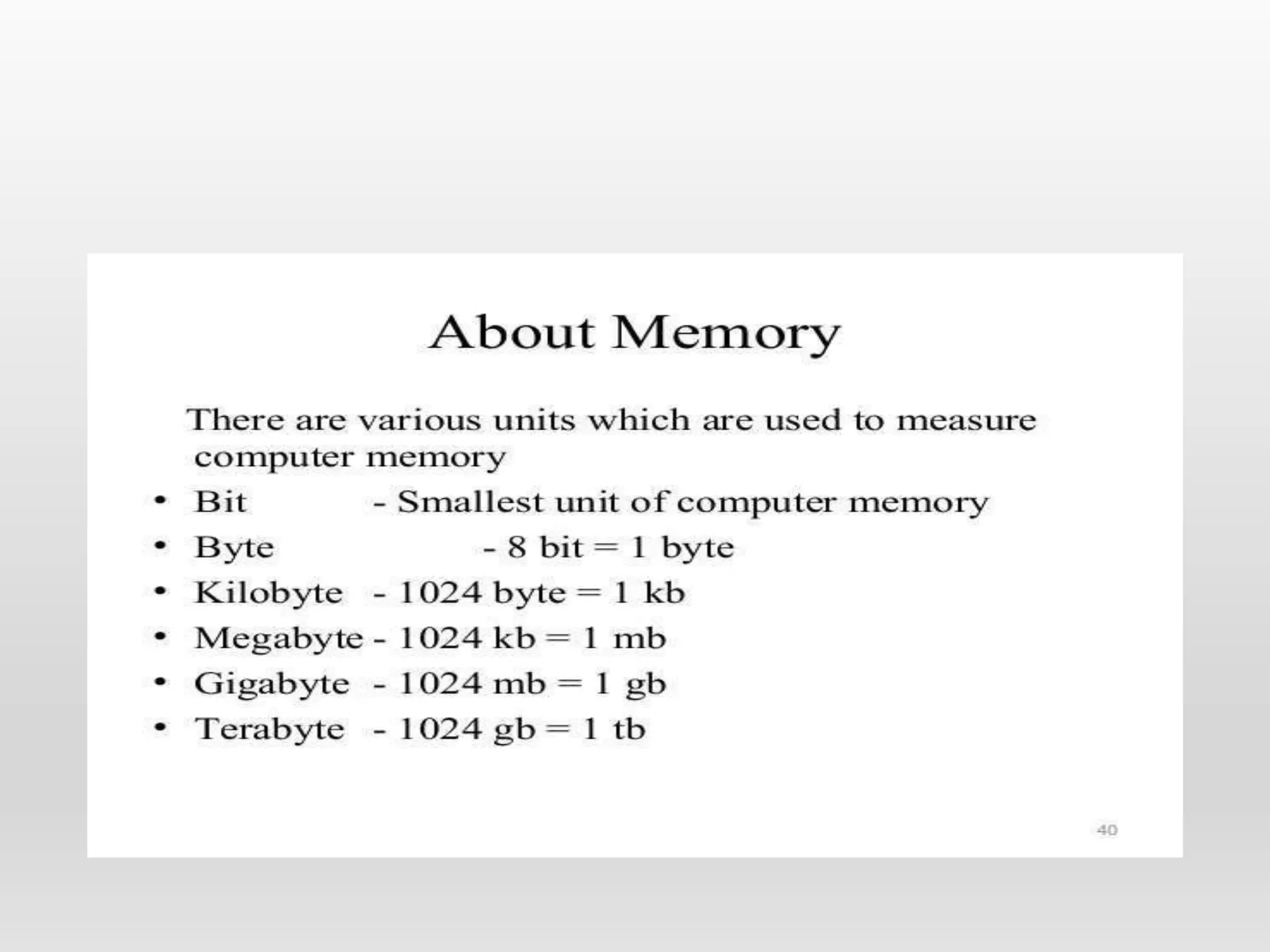
• Memory
• Units of memory
• Storage devices
• Types of software
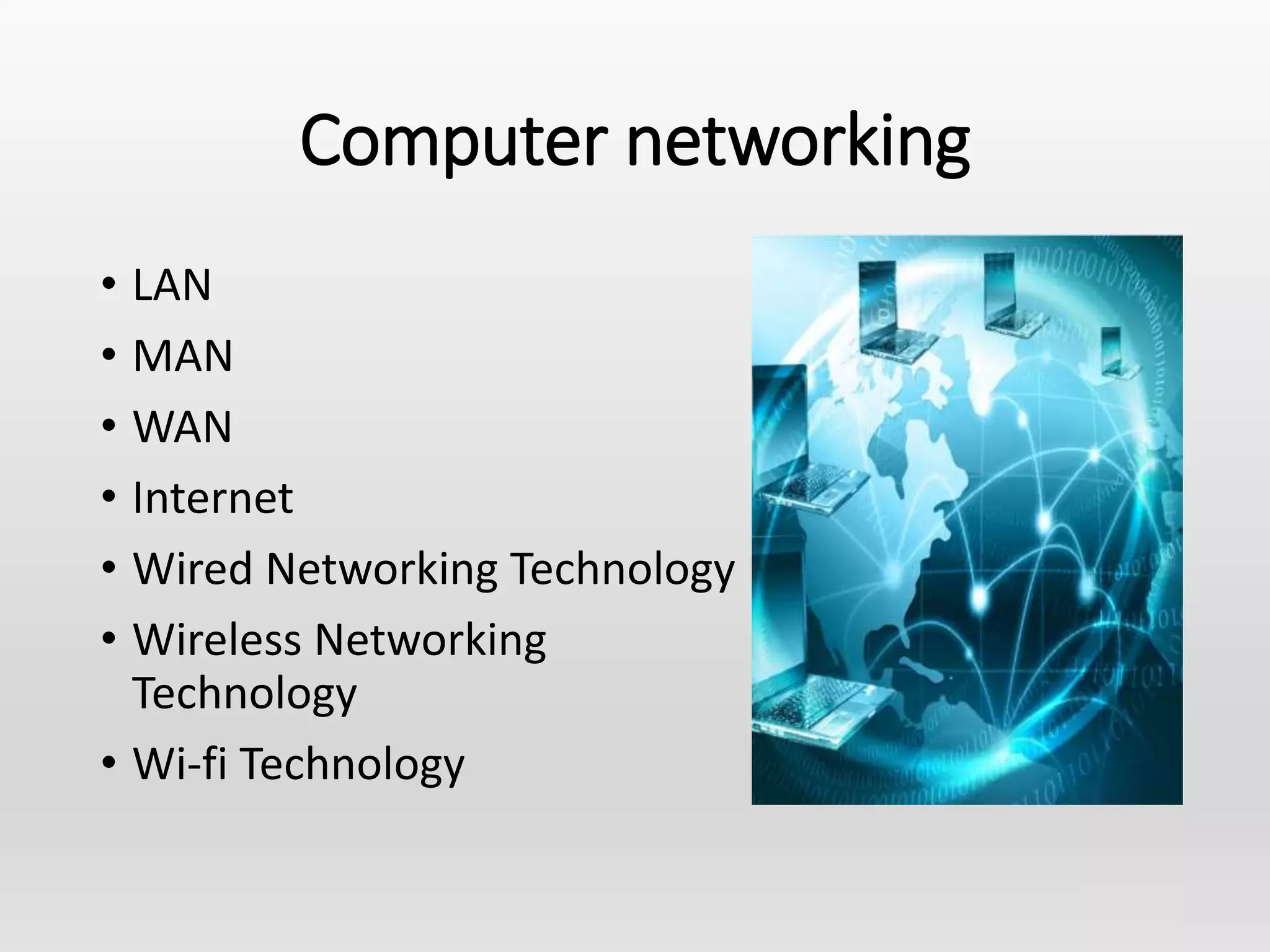
• Computer networking
11.
Computer
• A Computeris a programmable
electronic device.
• It takes data through input
devices.
• It processes the data according to
a sequence of instructions
provided in the form of a program.
• The result is called the output and
given through some output
device.
Healthcare
• Reduction inhealthcare cost
• Increase in quality of healthcare services
• Easy communication of medical data
23.
Information technology inhealthcare
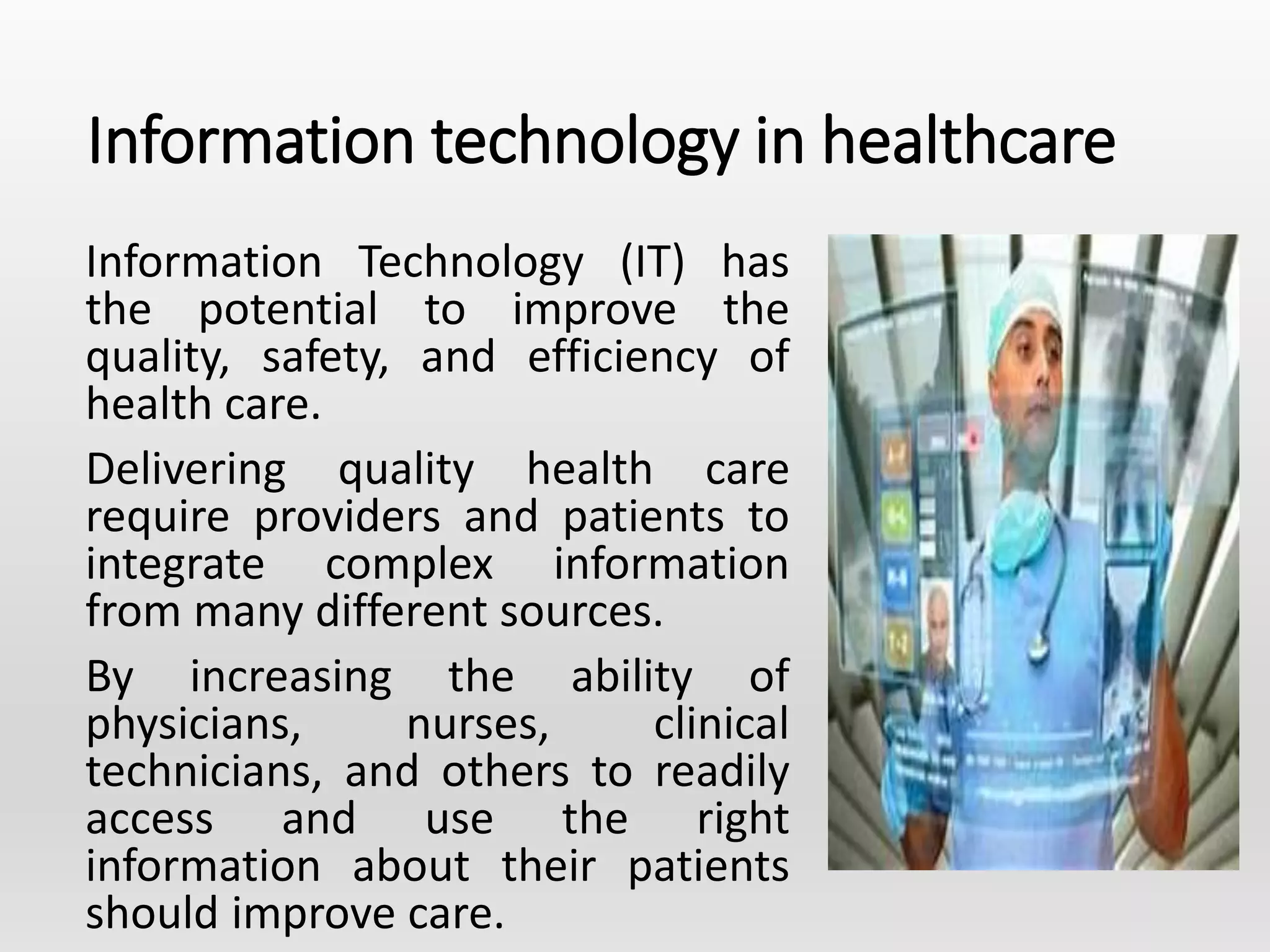
Information Technology (IT) has
the potential to improve the
quality, safety, and efficiency of
health care.
Delivering quality health care
require providers and patients to
integrate complex information
from many different sources.
By increasing the ability of
physicians, nurses, clinical
technicians, and others to readily
access and use the right
information about their patients
should improve care.
24.
• The abilityfor patients to obtain information to
better manage their condition and to communicate
with the health system can also improve the
efficiency and quality of care.
• IT allows healthcare providers to collect, store,
retrieve, and transfer information electronically.
• In comparison to traditional learning modalities,
the computer based decision support tools are
more likely to suggest treatments that are both
new and relevant to the care of a specific patient.
25.
• As aresult, the new information technology will
have greater influence on physicians and under
plausible conditions, enhance the rate of diffusion
of new knowledge.
• Participation is a vital aspect of healthcare.
26.
Need for ITin healthcare
• The ability of human to memorize
things has remained flat, but the
medical knowledge that needs to
be assimilated is increasing
geometrically.
• Rapid technology advancements
and continuous increase in
performance/price indexes have
made information technology (IT)
applicable at all levels in health
care organizations and patient
management.
27.
• In suchsituation IT based
decision support system could
help doctors to learn about new
treatments.
• Health Information Technology
(Health IT) allows comprehensive
management of medical
information and its secure
exchange between healthcare
consumers and providers.
28.
IT TOOLS INHEALTHCARE
• Today a number of tools exist and are being
developed to help health information technology
(IT) stakeholders to plan for and to evaluate health
IT.
• Health IT programs serve to bring it to individual
stakeholders such as providers, patients, hospitals,
pharmacists, and others in this industry.
• These Health IT tools support in specific areas and
promote better, more efficient healthcare through
the use of today's technologies.
29.
Commonly used healthIT tools are
IT
TOOLS
Electronic
Medical
Records
(EMR) Clinical Data
Processing
(CDP)
Telemedicine
Remote
Monitoring
Personal
Health Record
(PHR)
Health
Information
Exchange
Electronic
Prescribing
Computerized
Physician
Order Entry
(CPOE)
Home
monitoring
of Patients
30.
Electronic Medical Records(EMR)
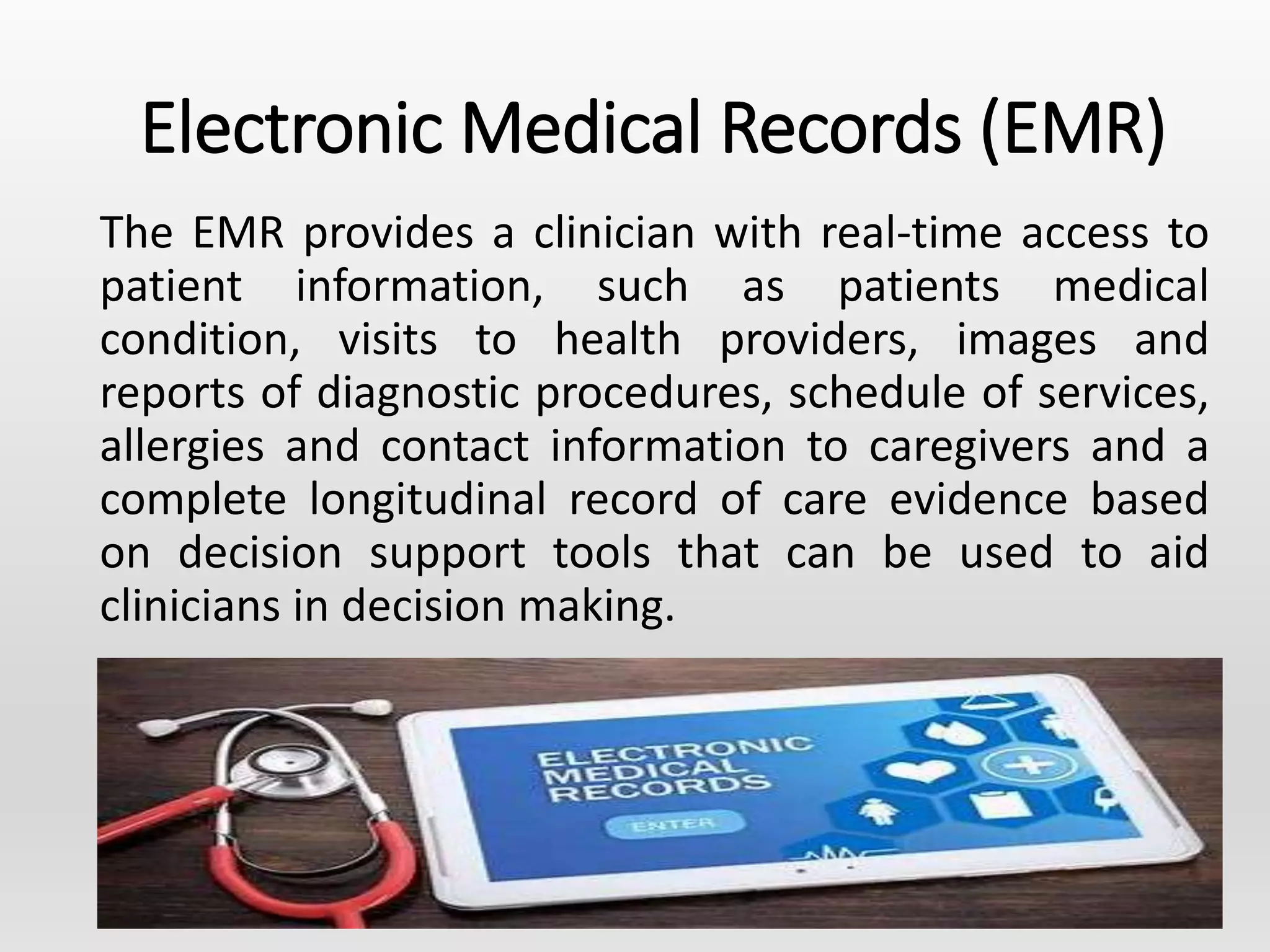
The EMR provides a clinician with real-time access to
patient information, such as patients medical
condition, visits to health providers, images and
reports of diagnostic procedures, schedule of services,
allergies and contact information to caregivers and a
complete longitudinal record of care evidence based
on decision support tools that can be used to aid
clinicians in decision making.
31.
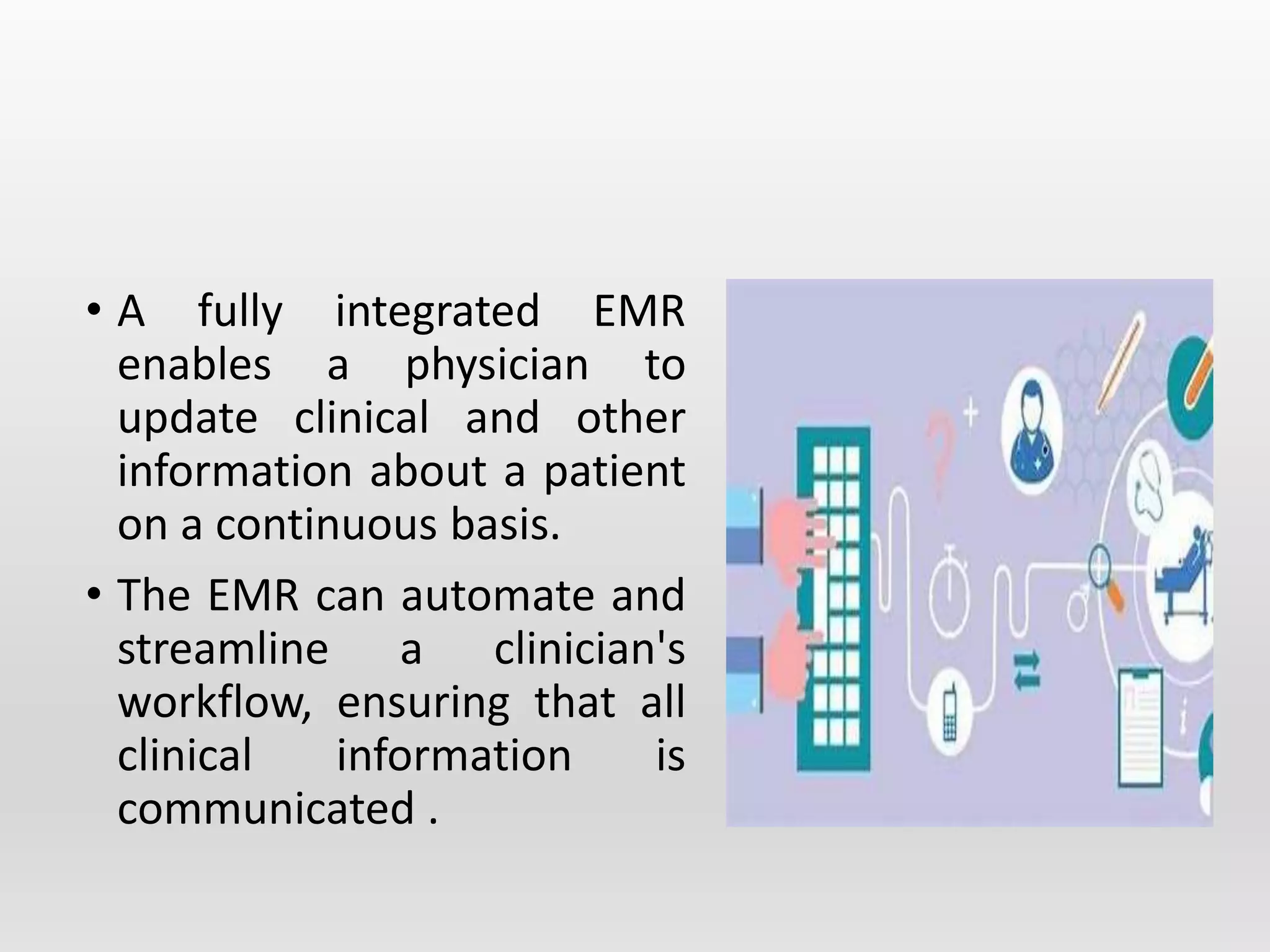
• A fullyintegrated EMR
enables a physician to
update clinical and other
information about a patient
on a continuous basis.
• The EMR can automate and
streamline a clinician's
workflow, ensuring that all
clinical information is
communicated .
32.
• The EMRcan support the collection of data for uses
such as billing, quality management, outcome
reporting, public health disease surveillance and
reporting.
33.
A total of223 providers completed all 3 surveys of which 85.6% had
outpatient practices, 56.5% were >45 Years old and 23.8% were primary care
providers. The percentage of providers with positive perceptions significantly
increased from baseline to long term follow up for patients communication,
hospital transition access to clinical information, preventive lab prompt,
satisfaction with system reliability and sharing medical information.
34.
Clinical Decision Support(CDS)
CDS encompasses computerized
alerts and reminders to care
providers and patients, clinical
guidelines, condition-focused order
sets, patient data reports and
summaries, diagnostic support, and
other tools that enhance decision
making in clinical workflow.
CDS provide clinicians, staff and
patients with knowledge and person-
specific information, presented at
appropriate times to enhance health
and health care.
35.
• CDS hasthe potential to increase adherence to
clinical guidelines, protocols and best practices
which helps to avoid medication errors, and to
prevent complications.
• CDS requires computable biomedical knowledge,
person-specific data, and a reasoning or inferencing
mechanism that combines knowledge and data to
generate “advice” to clinicians.
36.
Computerized Physician Order
Entry(CPOE)
• CPOE is used by physicians for ordering
medications, orders for x-rays and other diagnostic
procedures, referrals, discharges, and transfers.
• One important higher-level application in CPOE is
that providers write orders including prescriptions
using computers.
• Computerization of ordering is important because
most actions in health care follows an order.
37.
Electronic Prescribing (E-
prescribing)
• E-prescribing is the transmission, using electronic
media of prescription between a prescriber,
dispenser, pharmacy manager, either directly or
through an intermediary, including an e-prescribing
network.
• E-prescribing includes, two-way transmissions
between the point of care and the dispenser.
38.
• It isrecommended that electronic prescription
applications should be robust enough to include
safety checks for allergies, drug- to- drug
interaction warning, dose appropriateness, drug-
clinical condition warning, and drug-laboratory
alerts.
39.
Findings revealed thatnurses adjust their routine in response
to providers’ preferential behavior about EHR with e-Rx
systems yet retained focus on the patient and care
coordination. Although perceived as more efficient, EHR with
e-Rx adoption increased workload and introduced safety risks.
40.
Health Information Exchange
•It is the electronic connectivity via internet and
other networks that enables health care
providers to exchange patient health
information.
41.
• It isnecessary that the networks that permit
electronic communication among providers must
be secure in order to safeguard the information
from unauthorized access, use and disclosure.
• It requires to develop data and messaging
standards to establish the critical goal of
interoperability to communicate with one another.
42.
Personal Health Record(PHR)
• PHR is an electronic application through which
individuals can maintain and manage their health
information in a private, secure, and confidential
environment.
• The most salient feature of PHR, and the one that
distinguishes it from the EMR and EHR, is that
information it contains is under the control of
individual.
43.
• The individualis distinctively the guardian of
information stored who can decide what volume of
information to include, how it is maintained and
ordered, and who to read them or “check them
out.”
• It is necessary to decide standards and policy to
determine how individuals can delete or modify
information in a PHR that originated from an EHR
and how these modifications are communicated to
other providers with whom the data in the PHR are
shared.
44.
• Significant sourcesmay include health care
providers, medical devices, individuals, health
insurers, research institutes etc.
45.
Remote Monitoring
Remote monitoringis the electronic
transmission of health care data either entered
directly by a patient (or his/her caregiver) or
through a medical device to a clinician’s
Electronic Health Record (EHR) or a Patient’s
Personal Health Record (PHR).
46.
• The abilityfor a clinician to monitor patient
information about diagnostic, medication tracking,
and activities of daily living (ADL) measurements,
captured remotely is a key enabler for the
management of chronic health problems and
management of new conditions.
• Remote monitoring could include physiologic
measurements diagnostic measurements,
medication tracking ,device information, and
activities of daily living measurements
47.
Telehealth/Telemedicine
• Telehealth isthe use of telecommunication
technologies to deliver health-related services and
information that support patient care,
administrative activities, health education, health
services and information over distances.
• It is a new method of delivering health care by
sharing/exchanging the patient related data and
medical opinion between medical specialist and a
doctor in a remote location through
telecommunication networks.
48.
• The technologyis a means to improve access to
care, while reducing cost of transportation and
increasing convenience to patients care.
• Tele-homecare, video-conferencing and electronic
health records are all components of telehealth and
use information technology in delivering their
service.
• It can source expertise within seconds any where
and effectively mediates the diagnostic shortages
and surplus.
49.
Home monitoring ofPatients
• Due to the institutional healthcare costs escalating
worldwide, IT can be applied to home monitoring
of patients particularly the chronic sick aged
patients.
• In one project, a system which is linked to the
home telephone can measure ,collect and record
information about ECG, blood pressure and body
temperature of the patient with cardiovascular
problems at home.
50.
• The telephoneis modified to hold an IC memory
card and multifunction such as simple character
and picture processing functions.
• The collected information is sent from the patient’s
home to the medical facilities by using online
facility to the physician.
51.
Clinical Data Processing(CDP)
• Clinical data processing is used for patient
monitoring. Often patients have to be monitored
continuously (for ECG monitoring) or
periodically(monitoring of vital signs).
• These monitoring processes may be done for
diagnostic purposes in emergency room, for
therapeutic purposes in the operating theatre or
for surveillance purposes in the ICU.
52.
• By automatingthe monitoring process , manpower
cost can be saved as more nursing time can be
freed from recording observations for patient care
activities.
53.
Computer in nursing-nursing
informatics
• Specialty that integrates nursing science, computer
science and information science to manage and
communicate data, information, and knowledge in
nursing practice.
• Any use of information technology by nurses in
relation to:
• The care of their patients
• Administration of healthcare facilities
• Education preparation of individuals
Nursing education
• Whencomputer is used as an aid to teaching the
method of instruction it is called as computer
assisted instructions.
56.
Nursing administration
• Computersare used in the administrative areas of
nursing for basic tasks that once were done on
paper.
• Staffing and scheduling are used to construct daily,
weekly or monthly schedules.
• Budgeting and financial tracking are another way in
which computers are used in nursing
administration.
57.
Nursing research
• Applyingtechnology and informatics to the nursing
research process
oResearch problem, purpose, main question or
hypotheses
oLiterature review
oConceptual framework
oResearch design
oSample size calculation
oResearch instruments and data collection
oData analysis using spss, excel, etc.
oReferences
58.
Privacy and Securityin Healthcare
Information Technology
• In health care, accurate and complete information
about individuals is critical to provide high quality
and coordinated care.
• When physician adopt new health IT to enhance
the quality and efficiency of care in his practice, it is
necessary to reassess health information security
policies.
59.
• Information securityis achieved by ensuring the
confidentiality, integrity, and availability of
information.
• When physician assess health IT environment, then
there may be situations that may lead to
unauthorized access, use, disclosure, disruption,
modification or destruction of electronic health
information
60.
To mitigate eachrisk , physician should implement the
important steps in his practice such as :
• Review existing health information security
policies and develop new policy statements to
address new risks to electronic health
information.
• Refine who is authorized to view and administer
electronic health information, or clarify and
improve how and when electronic health
information is provided to patients or other
health care entities.
61.
• Apply updatedhealth information security
policies into the practice to mitigate new risks to
electronic health information.
• Follow administrative, physical and technical
safeguards in the practice.
62.
Quality and HealthInformation
Technology
• A New Health Care System for the 21st Century,
emphasized the need for improvement in six key
areas:
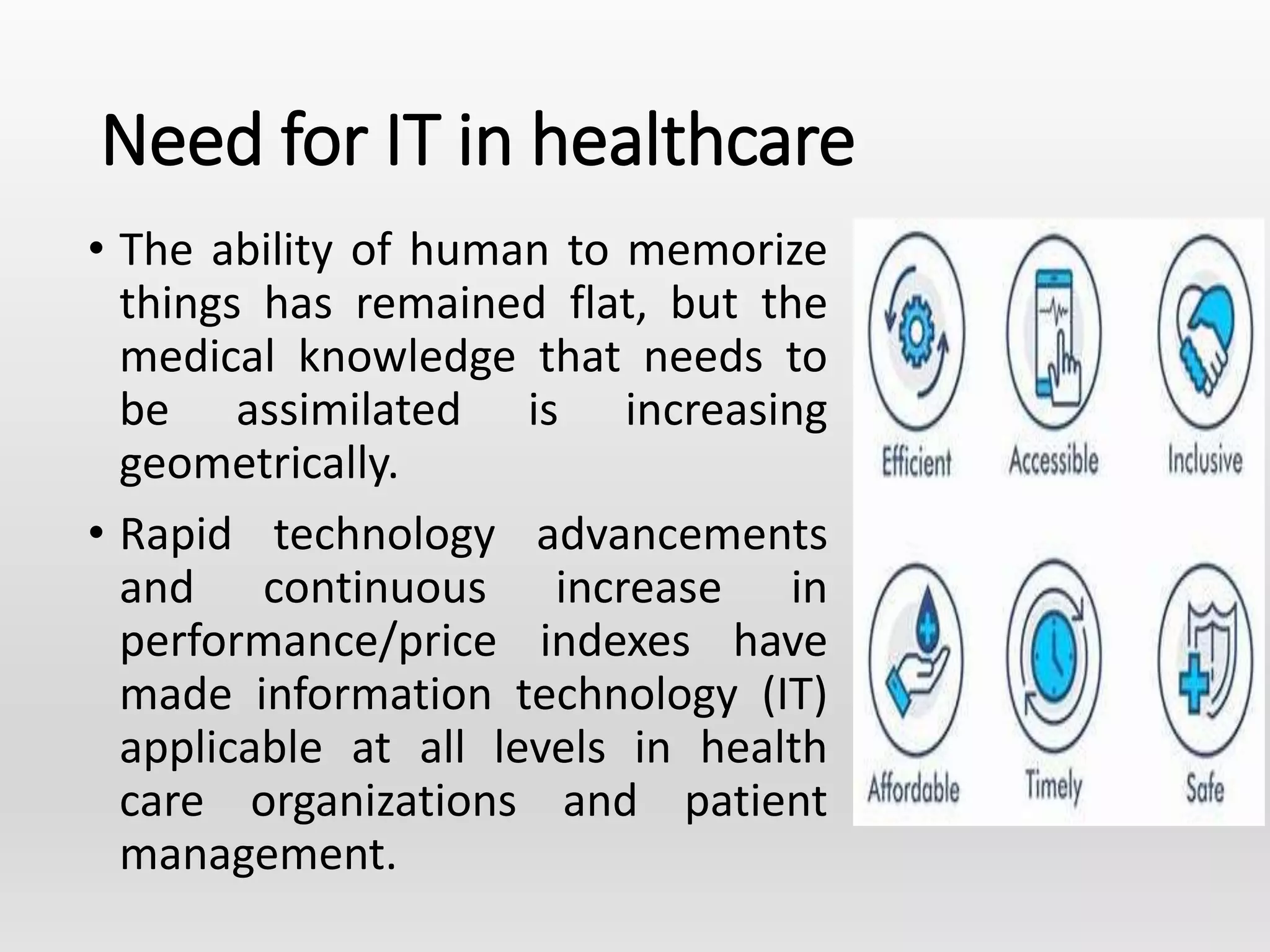
•Safety
•Effectiveness
•Responsiveness to patients
•Timeliness
•Efficiency
•Equity
63.
• Clinical decisionsupport systems(CDSS) have been
shown to improve efficiency by reducing redundant
lab tests.
• IT can also improve the effectiveness of care by
promoting compliance with clinical practice
guidelines.
• The secure transmission of patient information
among physicians will significantly improve the
coordination of care.
64.
Current Status ofIT in Healthcare
• The degree of use of IT in healthcare varies by
health care setting.
• IT and the internet had a significant impact on
consumers.
• Numerous websites have made health information
available to patients, thereby strengthening their
role in care decisions.
65.
• Now adays some technologies are emerging in
healthcare such as Clinical Data Warehouse, Clinical
Decision Support Systems (CDS), Data-mining
Techniques, Online Analytical Processing (OLAP)
and Online Transactional Processing (OLTP).
• These technologies are used to maintain and utilize
patient data intelligently , based on the user’s
requirements. Information systems are used to
educate patients about the latest developments in
medical science through the internet and specially
configured kiosks in hospitals and clinics
66.
National Digital HealthMission
• PM Narendra Modi announced
the establishment of NDHM on
Independence day 2020.
• This program would provide an
identification number for
everyone in the country, and
that the system would manage
everyone’s government health
records.
67.
• The NationalDigital Health
Mission (NDHM) aims to
develop the backbone
necessary to support the
integrated digital health
infrastructure of the
country.
• It will bridge the existing
gap amongst different
stakeholders of Healthcare
ecosystem through digital
highways.
68.
Vision
• Universal HealthCoverage
• NDHM shall create a seamless
online platform “through the
provision of a wide-range of data,
information and infrastructure
services, duly leveraging open,
interoperable, standards-based
digital systems” while ensuring the
security, confidentiality and privacy
of health-related personal
information.
69.
Objectives
To strengthen theaccessibility and equity of health services,
To create a system of personal health records, based on
international standards, easily accessible to individuals and
healthcare professionals and services providers, based on
individual’s informed consent
To enforce adoption of open standards by all national digital
health stakeholders
To establish state-of-the-art digital health systems, to manage the
core digital health data, and the infrastructure required for its
seamless exchange
70.
To ensure thatthe healthcare institutions and professionals in the private sector
participate actively with public health authorities in the building of the NDHM,
through a combination of prescription and promotion
•To promote the use of clinical decision support (CDS) systems by health
professionals and practitioners
To promote a better management of the health sector leveraging health data
analytics and medical research
To provide for enhancing the efficiency and effectiveness of governance at all
levels
To support effective steps being taken for ensuring quality of healthcare
To strengthen existing health information systems, by ensuring their conformity
with the defined standards and integration with the proposed NDHM
71.
Benefits
• The implementationof NDHM is expected to
significantly improve the efficiency, effectiveness,
and transparency of health service delivery overall.
• Patients will be able to securely store and access
their medical records (such as prescriptions,
diagnostic reports and discharge summaries), and
share them with health care providers to ensure
appropriate treatment and follow-up.
• They will also have access to more accurate
information on health facilities and service
providers.
• Further, they will have the option to access health
services remotely through tele-consultation and e-
pharmacy.
72.
• NDHM willempower individuals with accurate
information to enable informed decision making
and increase accountability of healthcare providers.
• NDHM will provide choice to individuals to access
both public and private health services, facilitate
compliance with laid down guidelines and
protocols, and ensure transparency in pricing of
services and accountability for the health services
being rendered.
73.
• Similarly, healthcare professionals across disciplines
will have better access to patient’s medical history
(with the necessary informed consent) for prescribing
more appropriate and effective health interventions.
• The integrated ecosystem will also enable better
continuum of care. NDHM will help digitize the claims
process and enable faster reimbursement.
• This will enhance the overall ease of providing services
amongst the health care providers.
• At the same time, policy makers and programme
managers will have better access to data, enabling
more informed decision making by the Government.
74.
Future Scope
• Informationtechnology has the potential to
substantially improve healthcare by bringing
decision support to the point of care, by providing
vital links and by allowing routine quality
measurement to become reality.
• Health IT may be especially beneficial for inner-city
and rural populations and other medically
underserved areas.
75.
• It isnecessary that latest IT technologies in
healthcare center that are available in urban
population to be made available to rural areas of
India.
• Rural users can access information by connecting
block headquarters to fiber optic network, using
wireless technology to achieve last mile
connectivity.
76.
CONCLUSION
With the helpof IT, it is possible to transform health care and
improve patient safety by better leveraging information
technology to improve the efficiency, accuracy, and
effectiveness of health care system.
Implementing and supporting IT applications require skills,
hence physicians must make significant changes to both office
and physician workflow and take time away to learn how to
use IT.
Health care administrators and planners should take a long
term view because the benefits will not be immediately
tangible. Hospitals are slowly moving towards clinical
information systems, which helps them to lower their cost, to
raise the quality and to improve their cash flow.
77.
References
• https://en.wikipedia.org/wiki/Information_technology
• GulavaniSS, Kulkarni RV. Role of Information Technology in Health Care. 2010.
Available from: (PDF) Role of Information Technology in Health Care
(researchgate.net)
• Abbott AA, Fuji KT, Galt KA. A Qualitative Case Study Exploring Nurse
Engagement With Electronic Health Records and E-Prescribing. Western Journal
of Nursing Research. 2015; 1-17. Available from:(PDF) A Qualitative Case Study
Exploring Nurse Engagement With Electronic Health Records and E-Prescribing
(researchgate.net)
• Shaikh SM, Furniss S, Blandford A, McLeod M, Ma T, Beykloo MY, Franklin MD.
The impact of electronic prescribing systems on healthcare professionals’
working practices in the hospital setting: a systematic review and narrative
synthesis. 2019. 19(742); 1-8. Available from: https://doi.org/10.1186/s12913-
019-4554-7