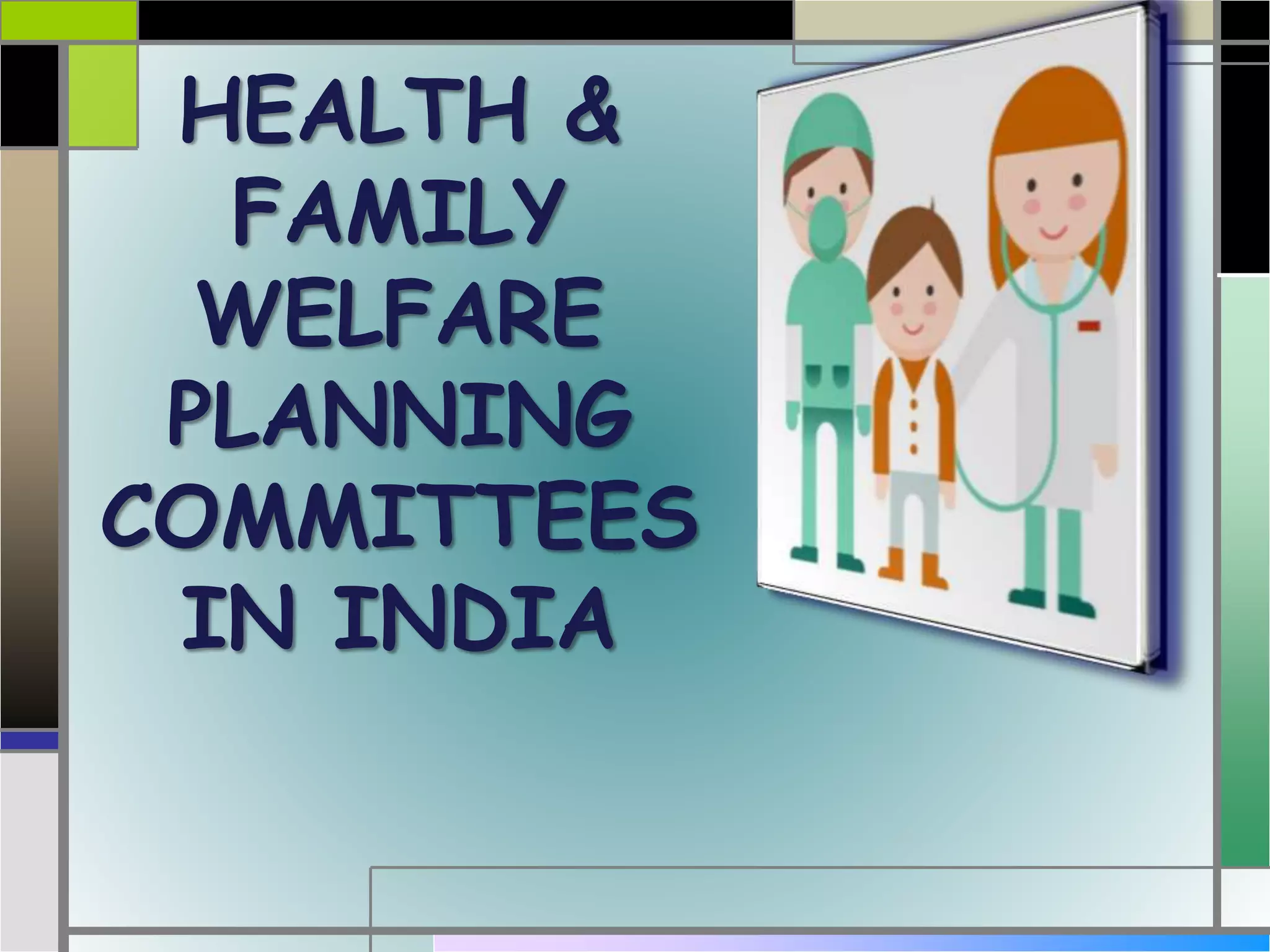
HEALTH &
FAMILY
WELFARE
PLANNING
COMMITTEES
IN INDIA
OUTLINE
Introduction
Various health and welfare committees
Bhore committee
Mudaliar committee
Chadha committee
Mukherji committee
Jungalwalla committee
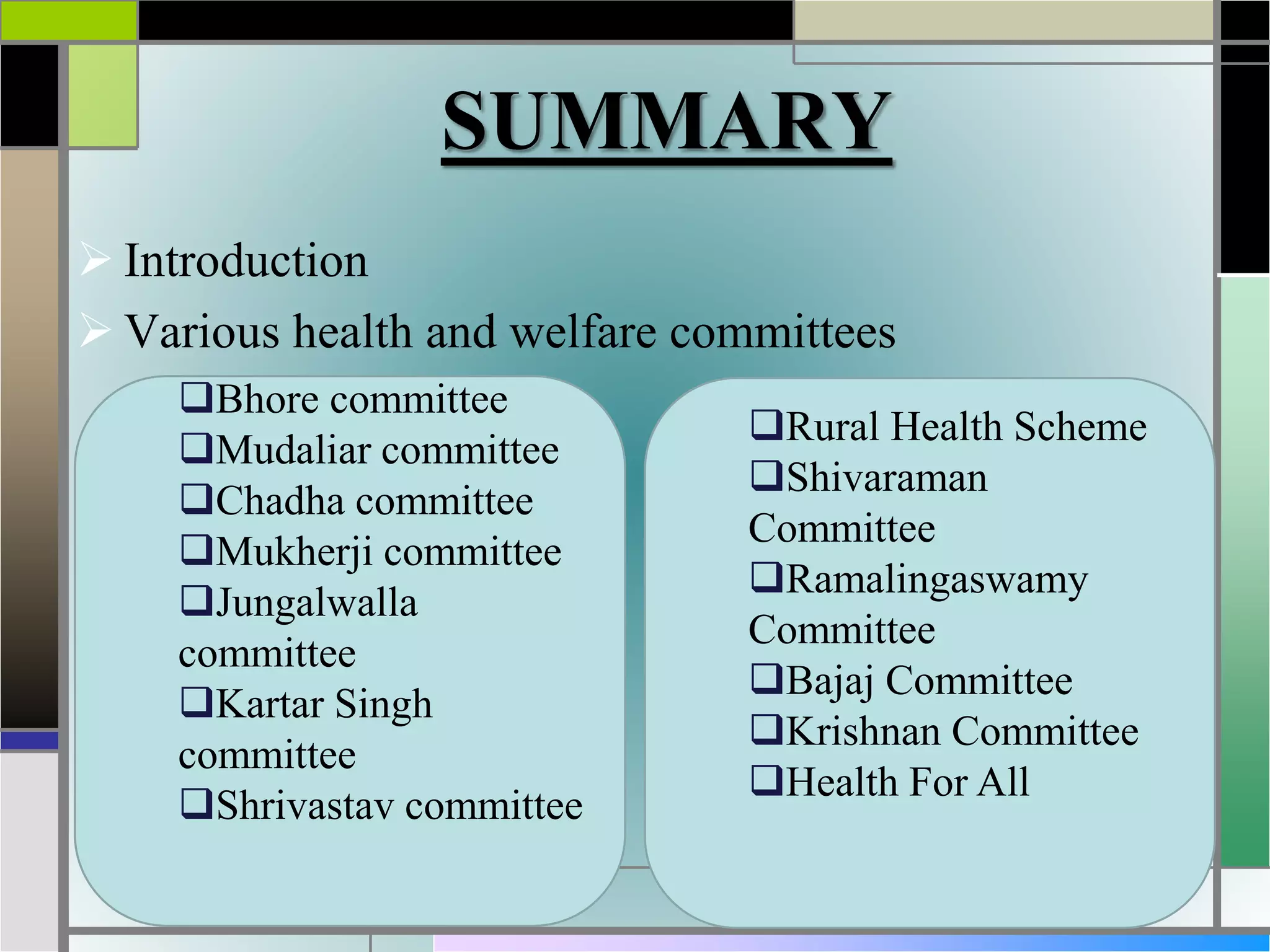
Kartar Singh committee
OUTLINE
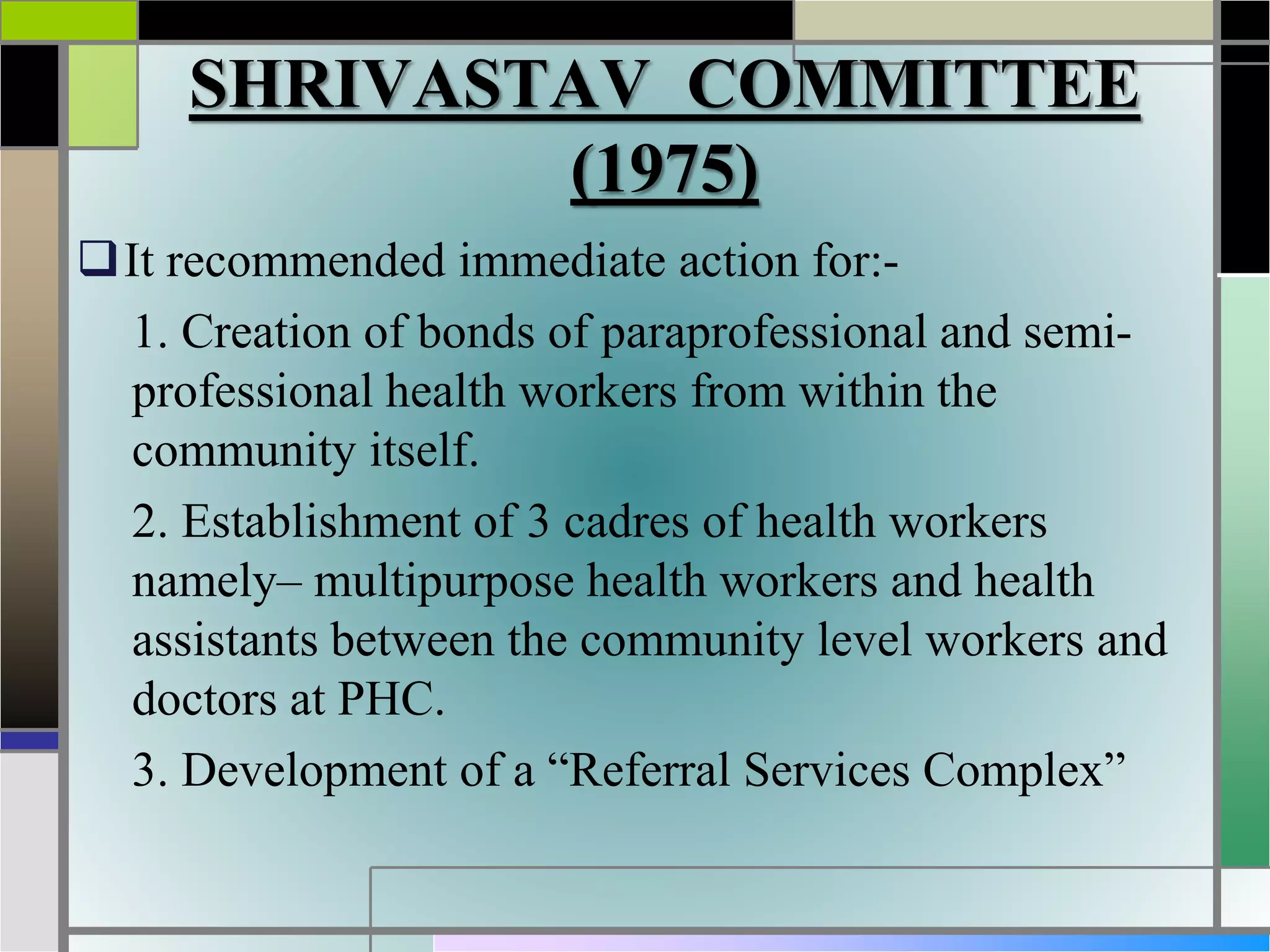
Shrivastav committee
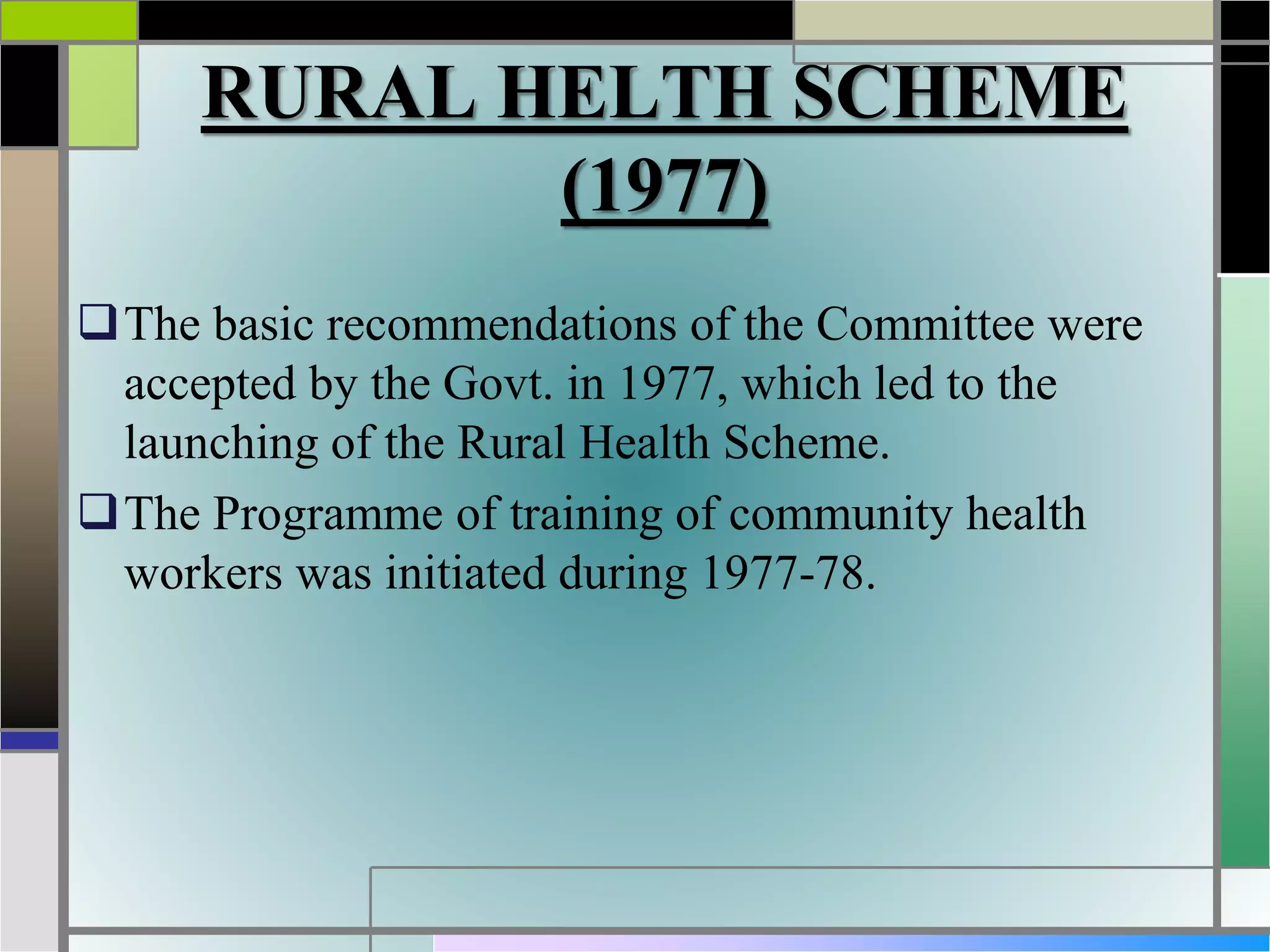
Rural Health Scheme
Shivaraman Committee
Ramalingaswamy Committee
Bajaj Committee
Krishnan Committee
Health For All
INTRODUCTION
Health planning in India is an integral part of national
socio-economic planning. The guidelines for national
health planning were provided by a number of
Committees dating back to the Bhore Committee in
1946.
These Committees were appointed by the
Government of India from time to time to review the
existing health situation and recommend measures for
further action.
INTRODUCTION
More recently the Alma Ata Declaration on primary
health care and the National Health Policy of the
Government gave a new direction to health planning
in India, making primary health care the central
function and main focus of its national health system.
The goal of national health planning in India was to
attain Health for ALL by the year 2000.
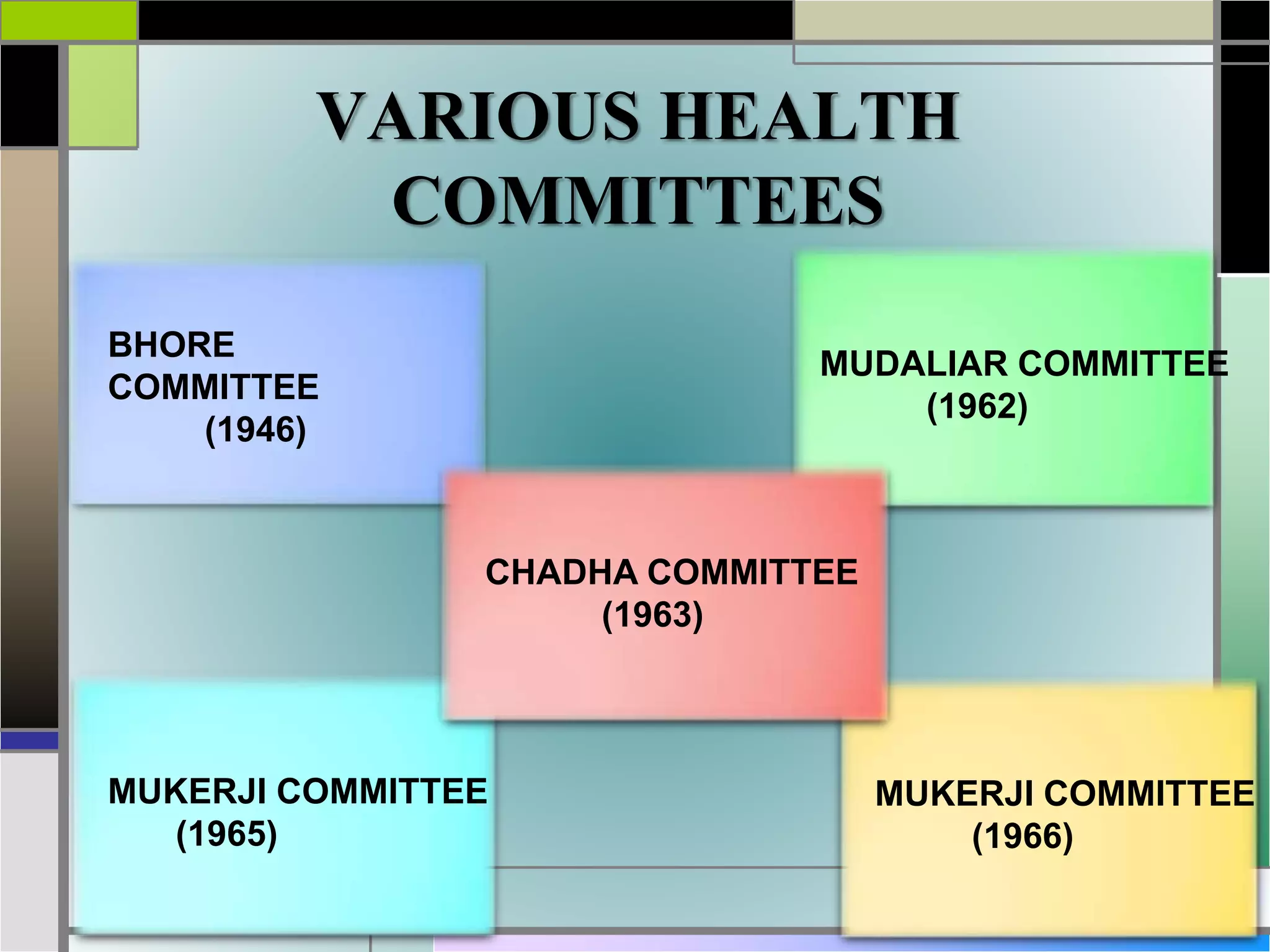
VARIOUS HEALTH
COMMITTEES
BHORE
COMMITTEE
(1946)
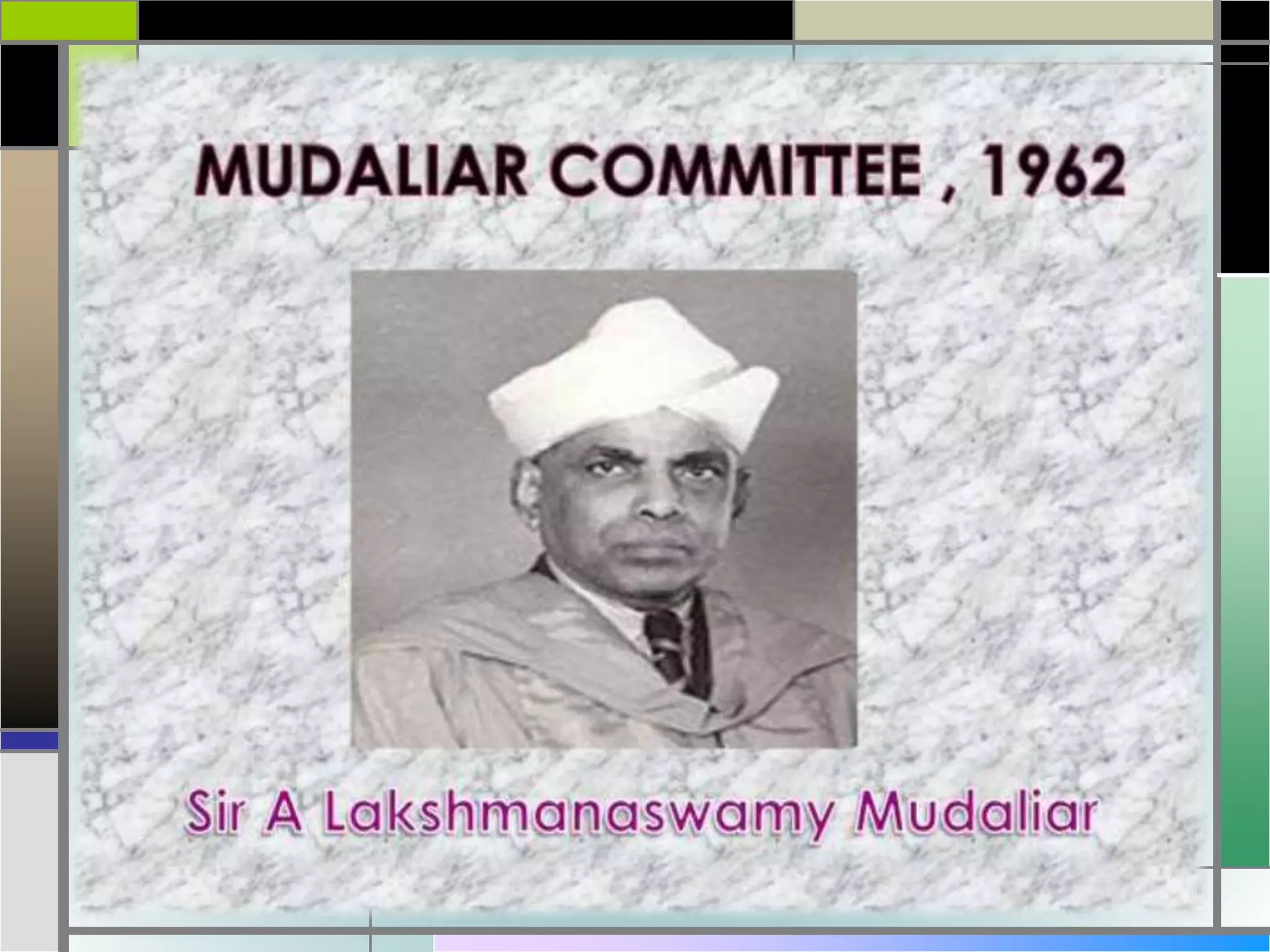
MUDALIAR COMMITTEE
(1962)
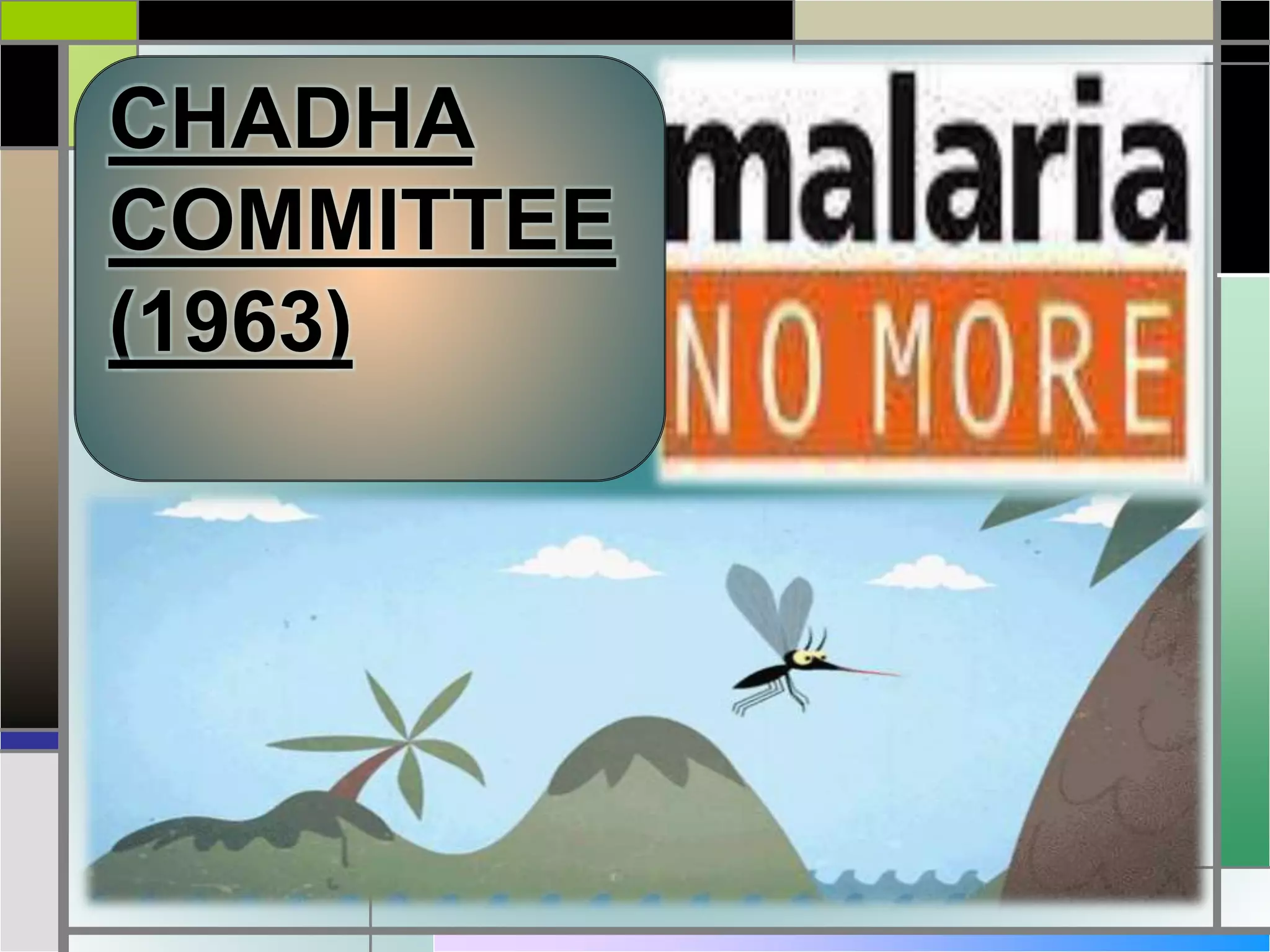
CHADHA COMMITTEE
(1963)
MUKERJI COMMITTEE
(1965)
MUKERJI COMMITTEE
(1966)
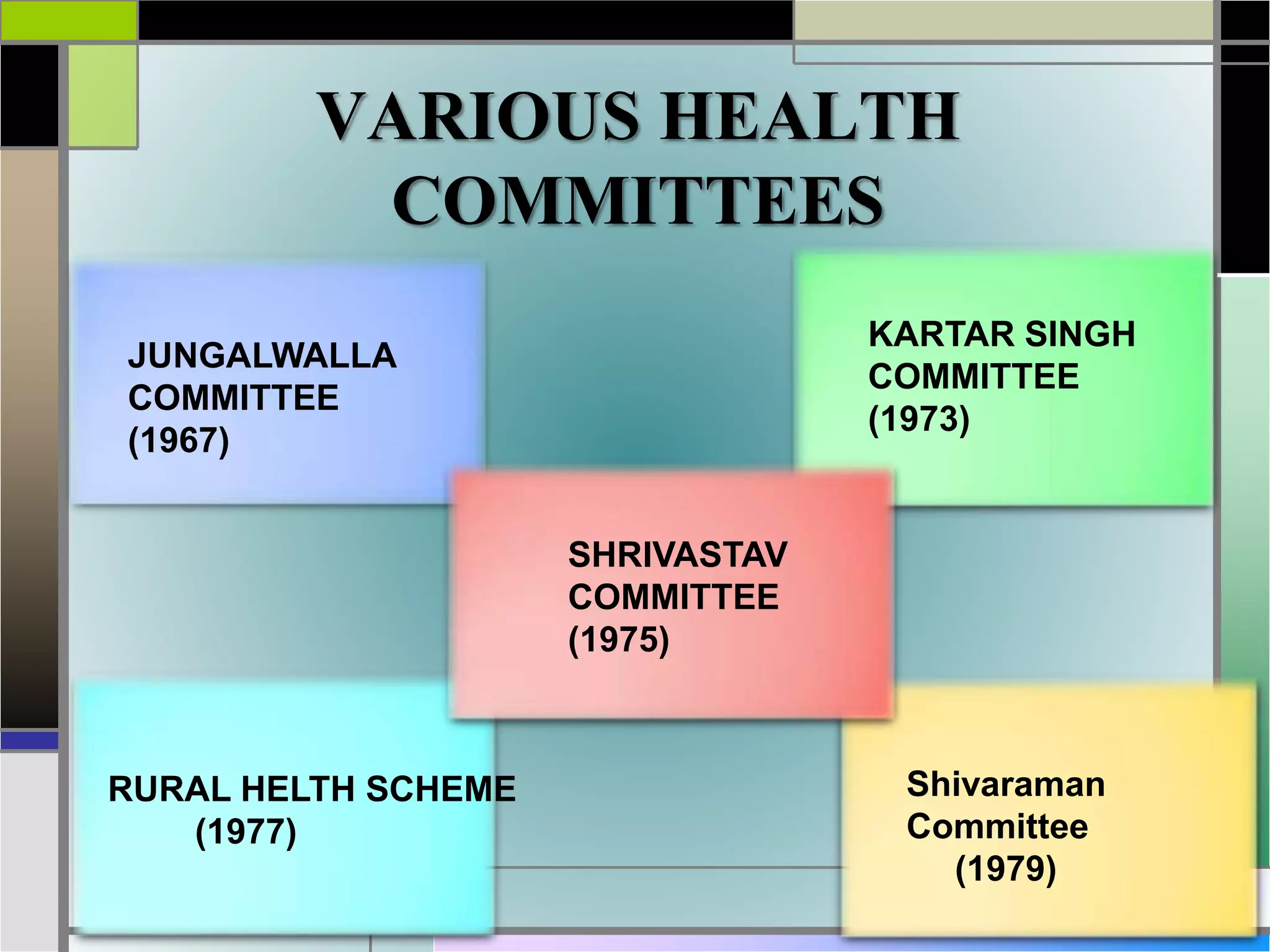
VARIOUS HEALTH
COMMITTEES
JUNGALWALLA
COMMITTEE
(1967)
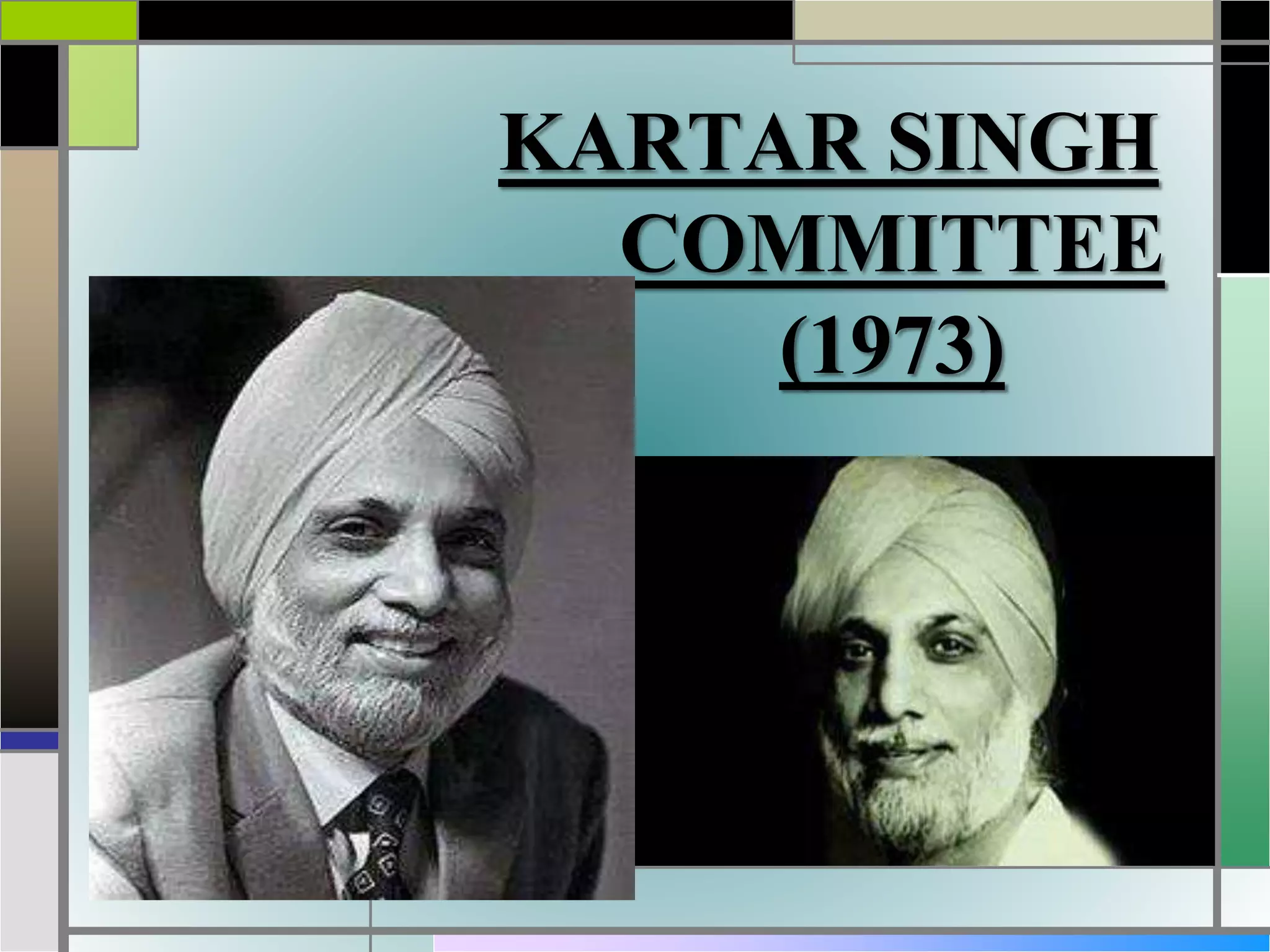
KARTAR SINGH
COMMITTEE
(1973)
SHRIVASTAV
COMMITTEE
(1975)
RURAL HELTH SCHEME
(1977)
Shivaraman
Committee
(1979)
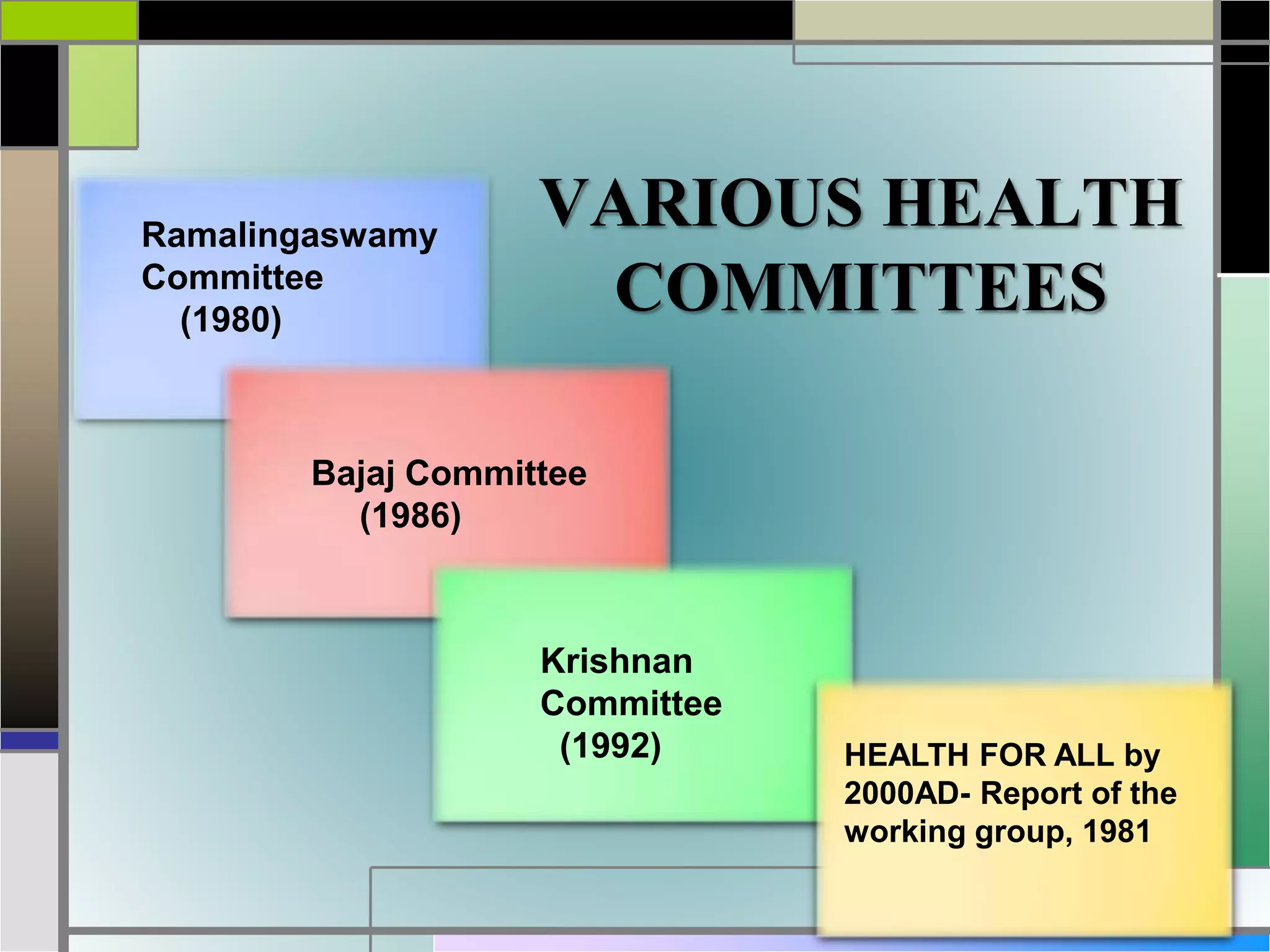
VARIOUS HEALTH
COMMITTEES
HEALTH FOR ALL by
2000AD- Report of the
working group, 1981
Krishnan
Committee
(1992)
Ramalingaswamy
Committee
(1980)
Bajaj Committee
(1986)
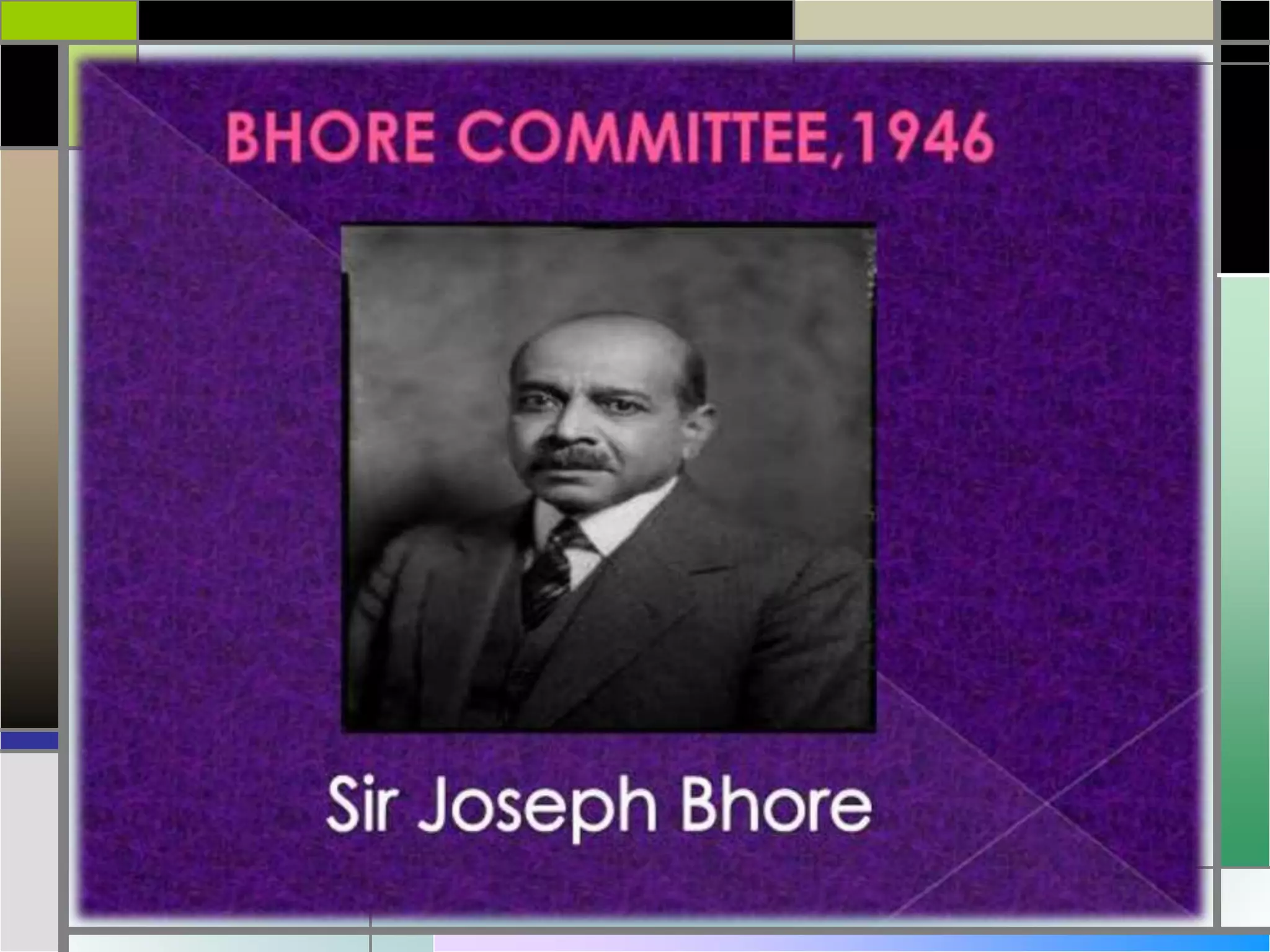
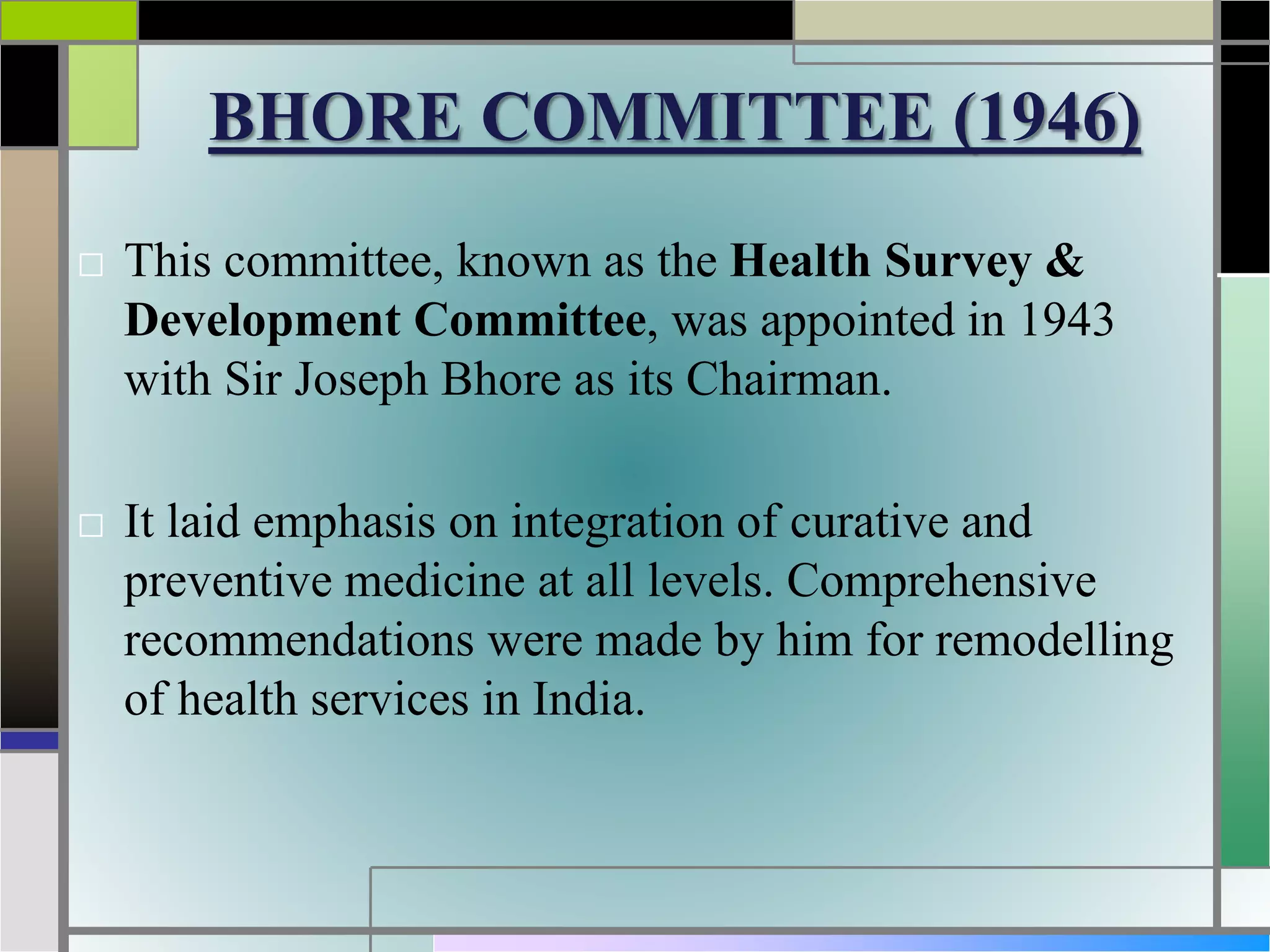
BHORE COMMITTEE (1946)
□ This committee, known as the Health Survey &
Development Committee, was appointed in 1943
with Sir Joseph Bhore as its Chairman.
□ It laid emphasis on integration of curative and
preventive medicine at all levels. Comprehensive
recommendations were made by him for remodelling
of health services in India.
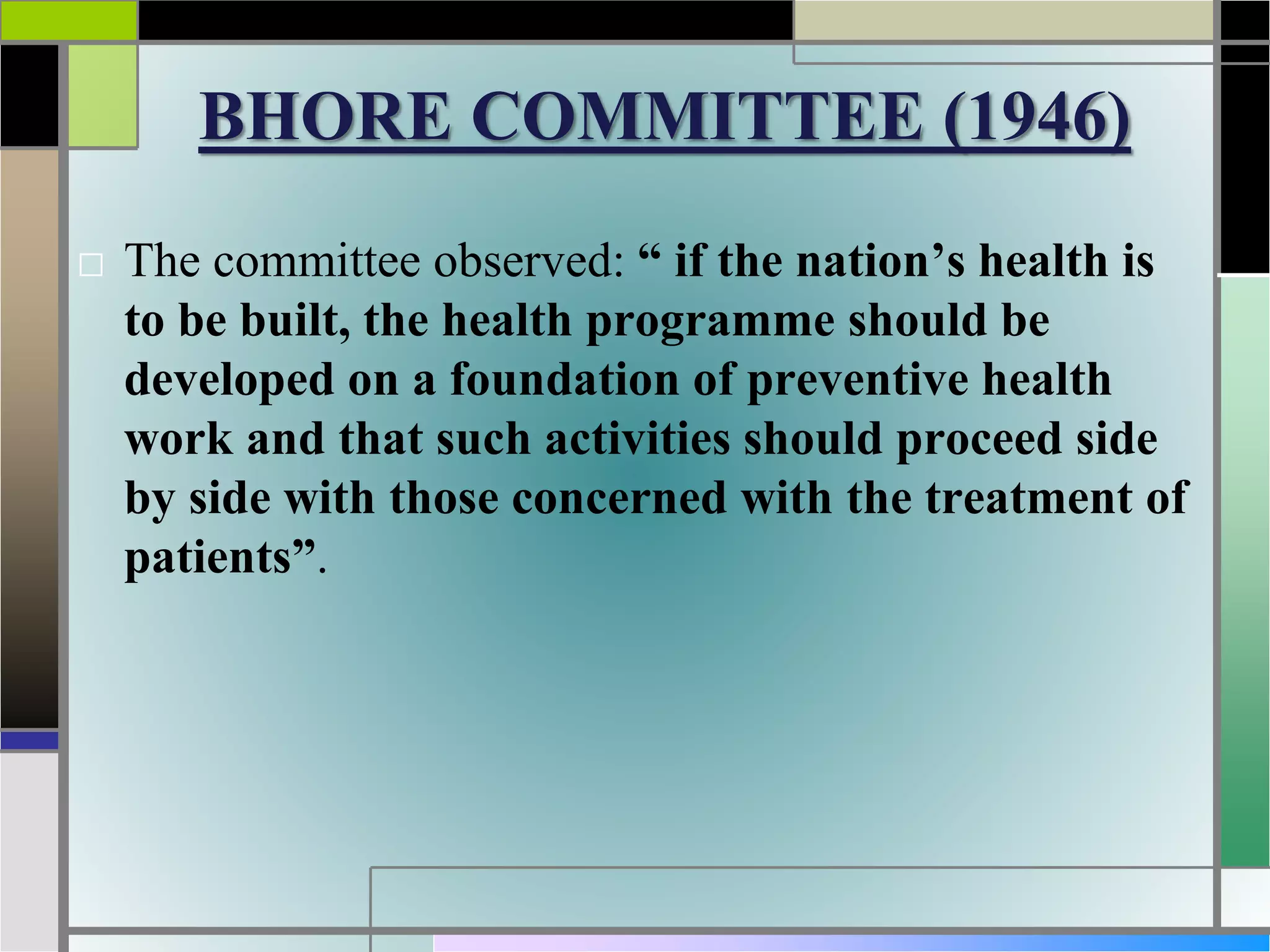
BHORE COMMITTEE (1946)
□ The committee observed: “ if the nation’s health is
to be built, the health programme should be
developed on a foundation of preventive health
work and that such activities should proceed side
by side with those concerned with the treatment of
patients”.
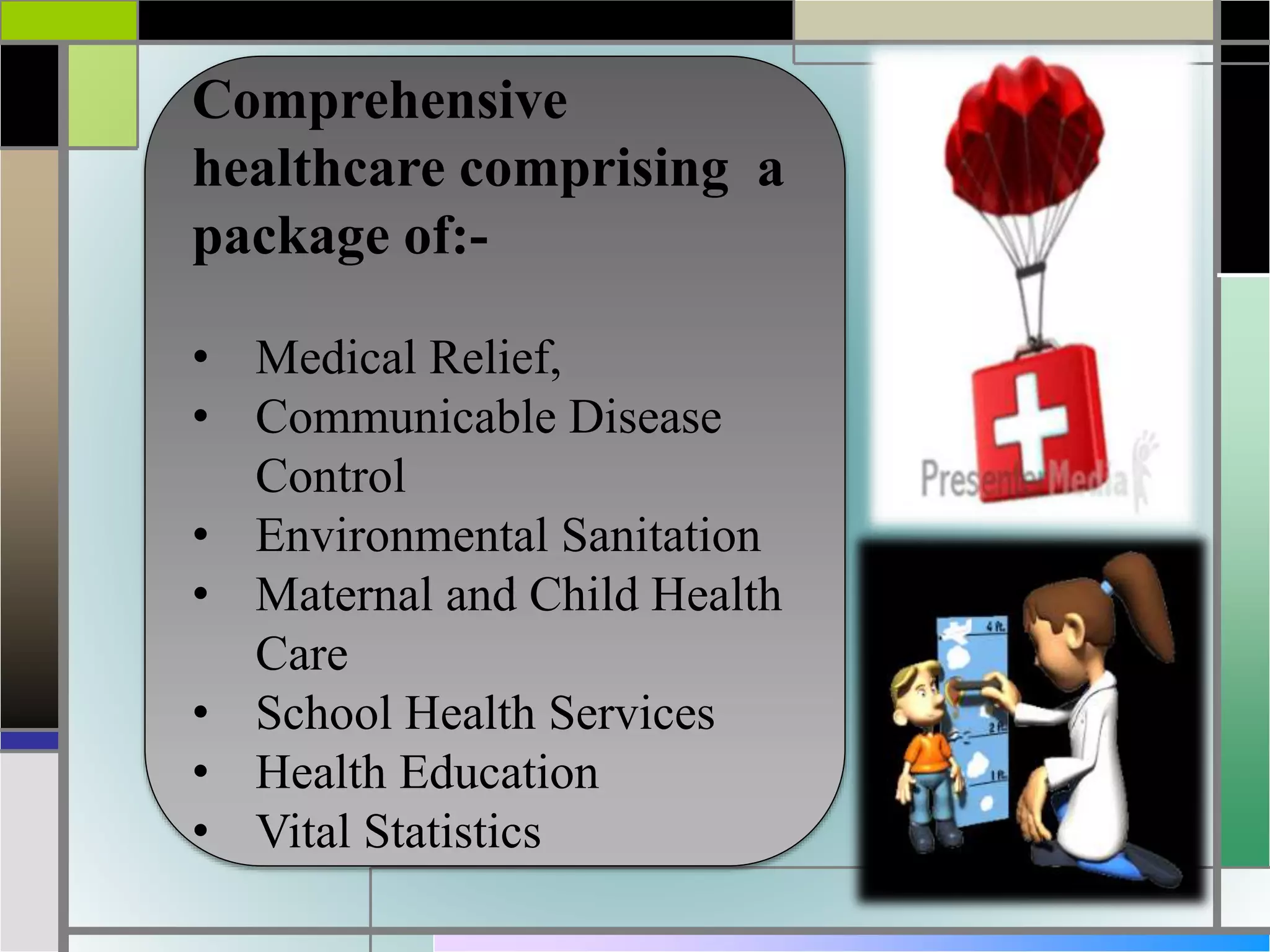
Comprehensive
healthcare comprising a
package of:-
• Medical Relief,
• Communicable Disease
Control
• Environmental Sanitation
• Maternal and Child Health
Care
• School Health Services
• Health Education
• Vital Statistics
BHORE COMMITTEE (1946)
The report, submitted in 1946, had some important
recommendations like :-
1.) Integration of preventive and curative
services of all administrative levels.
2.) Development of Primary Health Centres in
2 stages:
Short-term measures
Long-term measures
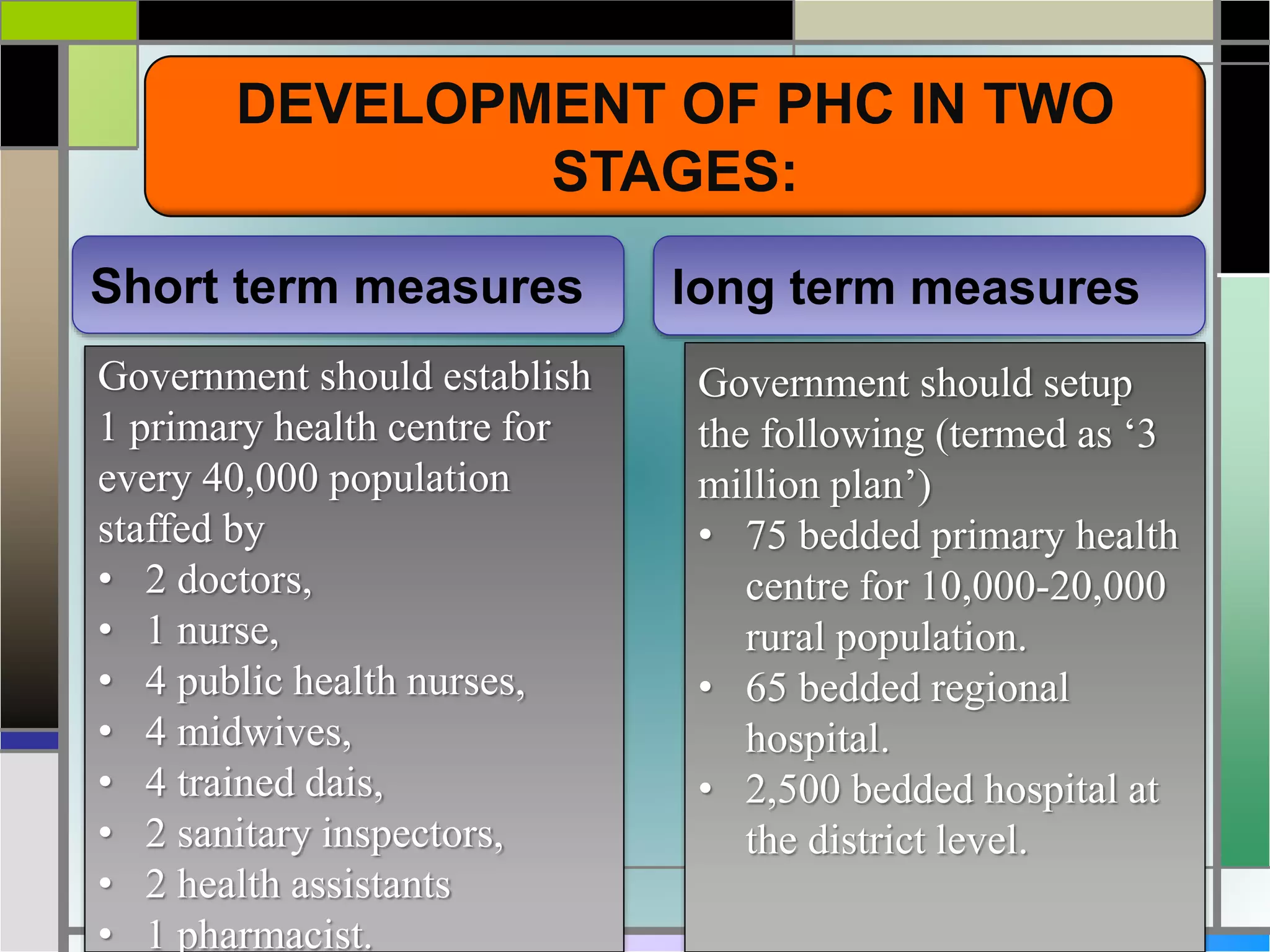
DEVELOPMENT OF PHC IN TWO
STAGES:
Short term measures long term measures
Government should establish
1 primary health centre for
every 40,000 population
staffed by
• 2 doctors,
• 1 nurse,
• 4 public health nurses,
• 4 midwives,
• 4 trained dais,
• 2 sanitary inspectors,
• 2 health assistants
• 1 pharmacist.
Government should setup
the following (termed as ‘3
million plan’)
• 75 bedded primary health
centre for 10,000-20,000
rural population.
• 65 bedded regional
hospital.
• 2,500 bedded hospital at
the district level.
BHORE COMMITTEE (1946)
3) Major changes in medical education which includes 3
- month training in preventive and social medicine to
prepare “social physicians”.
The committee’s Report continues to be a
major national document, and has provided
guidelines for national health planning in
India.
MUDALIAR COMMITTEE(1962)
This committee known as the “Health Survey and
Planning Committee”, headed by Dr. A.L.
Mudaliar, was appointed in 1959 to assess the
performance in health sector since the submission of
Bhore Committee report and to make
recommendations for future development and
expansion of health services.
This committee found the conditions in PHCs to be
unsatisfactory and suggested that the PHC, already
established should be strengthened before new ones
are opened.
Strengthening of sub divisional and district hospitals
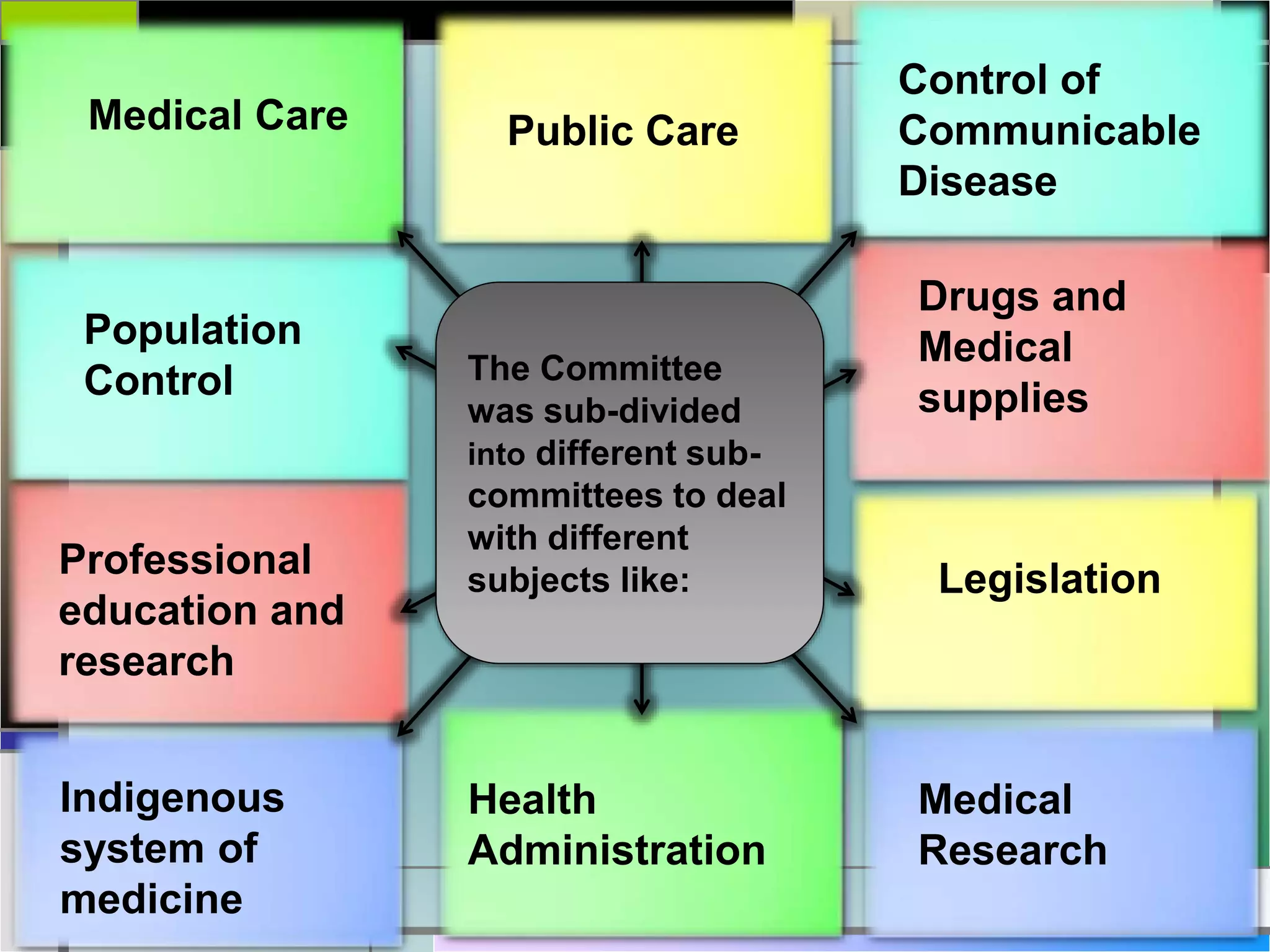
Medical Care Public Care
Control of
Communicable
Disease
Population
Control
Professional
education and
research
Indigenous
system of
medicine
Drugs and
Medical
supplies
Legislation
Health
Administration
Medical
Research
The Committee
was sub-divided
into different sub-
committees to deal
with different
subjects like:
MUDALIAR COMMITTEE
(1962)
The main recommendations of the Mudaliar Committee
were:
Consolidation of advances made in the first two five
year plans
Strengthening of the district hospitals with specialist
services to serve as central base of regional services
Regional organizations in each state is placed
between the headquarter organization and the district
as Regional Deputy or Assistant Directors to
supervise 2-3 District Medical and Health Officer.
MUDALIAR COMMITTEE
(1962)
Integration of medical and health services as
recommended by Bhore Committee
It was emphasized that a PHC should not be made to
serve to more than 40,000 populations and that the
curative, preventive and promotive services should be
all provided at the PHC.
The Mudaliar Committee also recommended that an
All India Health service should be created to replace
the erstwhile Indian Medical service.
CHADHA
COMMITTEE
(1963)
CHADHA COMMITTEE (1963)
This committee was appointed under the
chairmanship of Dr. M.S. Chadha, the then Director
General of Health Services, in 1963, to advise about
the necessary arrangements for the maintenance
phase of National Malaria Eradication Programme.
The committee suggested that the vigilance activity in
the NMEP should be carried out by primary health
centres at block level
CHADHA COMMITTEE (1963)
The committee also recommended that vigilance
operations through monthly home visits should be
implemented through basic health workers.
One basic health worker per 10,000 populations, also
function as “multipurpose workers” and would
perform, in addition to malaria work, the duties of
family planning and vital statistics data collection
under supervision of family planning health
assistants.
The Family Planning Health Assistants were to
supervise 3 to 4 of these basic health workers.
MUKERJI COMMITTEE
(1965) & (1966)
MUKERJI COMMITTEE (1965)
The recommendations of the Chadha Committee,
when implemented, were found to be impracticable
because the basic health workers, with their multiple
functions could do justice neither to malaria work nor
to family planning work.
The Mukherjee committee headed by then Secretary
of Health Shri Mukerji, was appointed in 1965, to
review the performance in the area of family
planning. The committee recommended separate staff
for the family planning programme
MUKERJI COMMITTEE (1965)
After committee recommendation, the family
planning assistants were to undertake family planning
duties only. The basic health workers were to be
utilized for purposes other than family planning.
The committee also recommended delinking the
malaria activities from family planning so that the
latter would receive undivided attention of its staff.
MUKERJI COMMITTEE (1966)
Multiple activities of the mass programmes like
family planning, small pox, leprosy, trachoma,
NMEP (maintenance phase), etc. was making it
difficult for the states to undertake these effectively
because of shortage of funds.
A committee of state health secretaries, headed by the
Union Health Secretary, Shri Mukherjee, was set up
to look into this problem.
The committee worked out the details of the BASIC
HEALTH SERVICES which should be provided at
the Block level, and some consequential
strengthening required at higher levels of
MUKERJI COMMITTEE (1966)
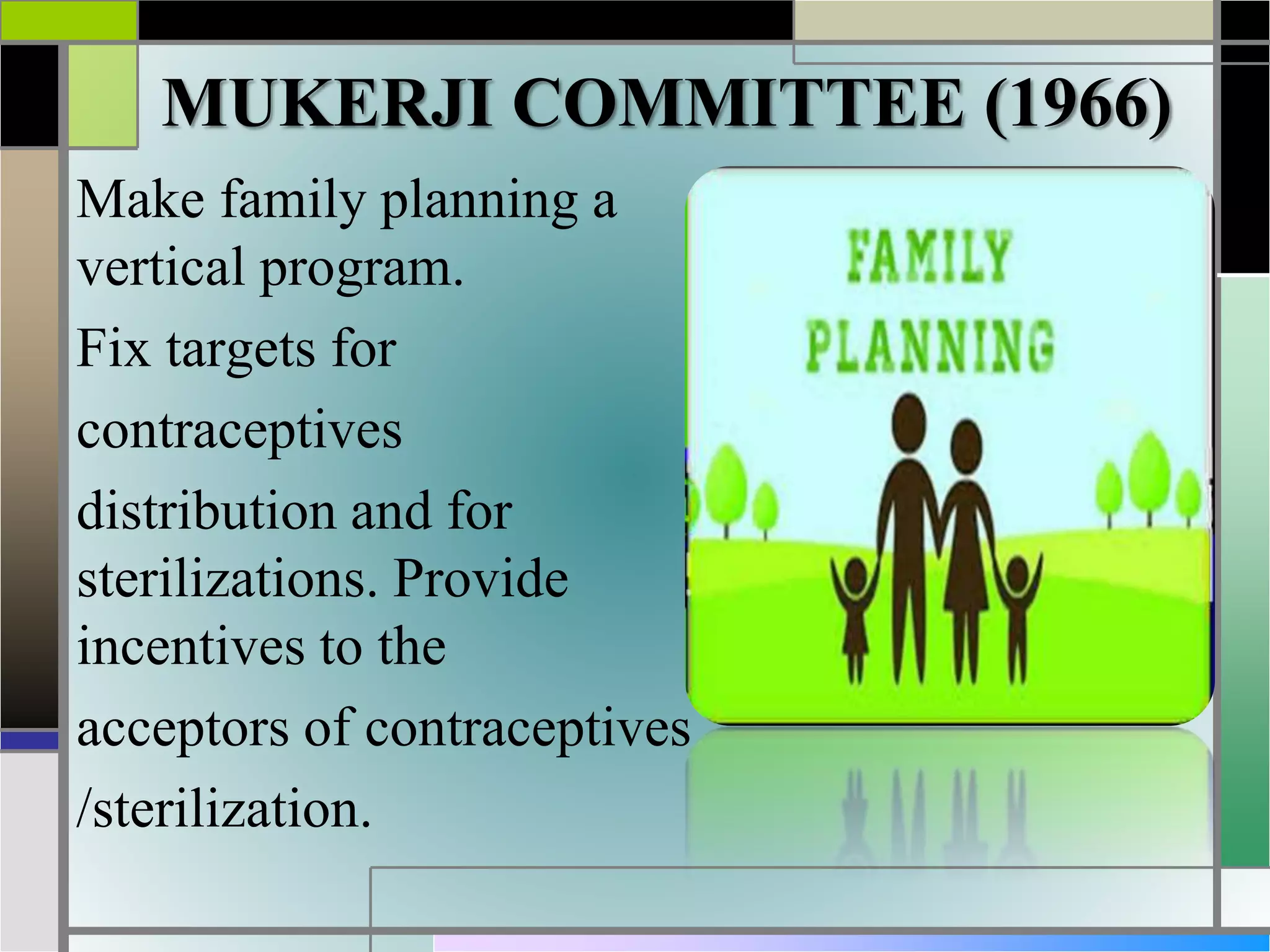
Make family planning a
vertical program.
Fix targets for
contraceptives
distribution and for
sterilizations. Provide
incentives to the
acceptors of contraceptives
/sterilization.
JUNGALWALLA COMMITTEE
(1967)
This committee, known as the “Committee on
Integration of Health Services” was set up in 1964
under the chairmanship of Dr. N. Jungalwalla, the
then Director of National Institute of Health
Administration and Education, New Delhi (currently
NIHFW).
It was asked to look into various problems related to
integration of health services, abolition of private
practice by doctors in government services, and the
service conditions of Doctors.
JUNGALWALLA COMMITTEE
(1967)
The committee defined “integrated health services”
as:-
(a.) A service with a unified approach for all
problems instead of a segmented approach for
different problems.
(b.) Medical care and public health programmes
should be put under charge of a single administrator
at all levels of hierarchy with due priority for each
programme obtaining at a point of time.
JUNGALWALLA COMMITTEE
(1967)
Following steps were recommended for the integration
at all levels of health organization in the country-
Unified Cadre
Common Seniority
Recognition of extra qualifications
Equal pay for equal work
Special pay for special work
Abolition of private practice by government doctors
Improvement in their service conditions
The committee stated that “integration should be a
process of logical evaluation rather than
revolution.”
KARTAR SINGH
COMMITTEE
(1973)
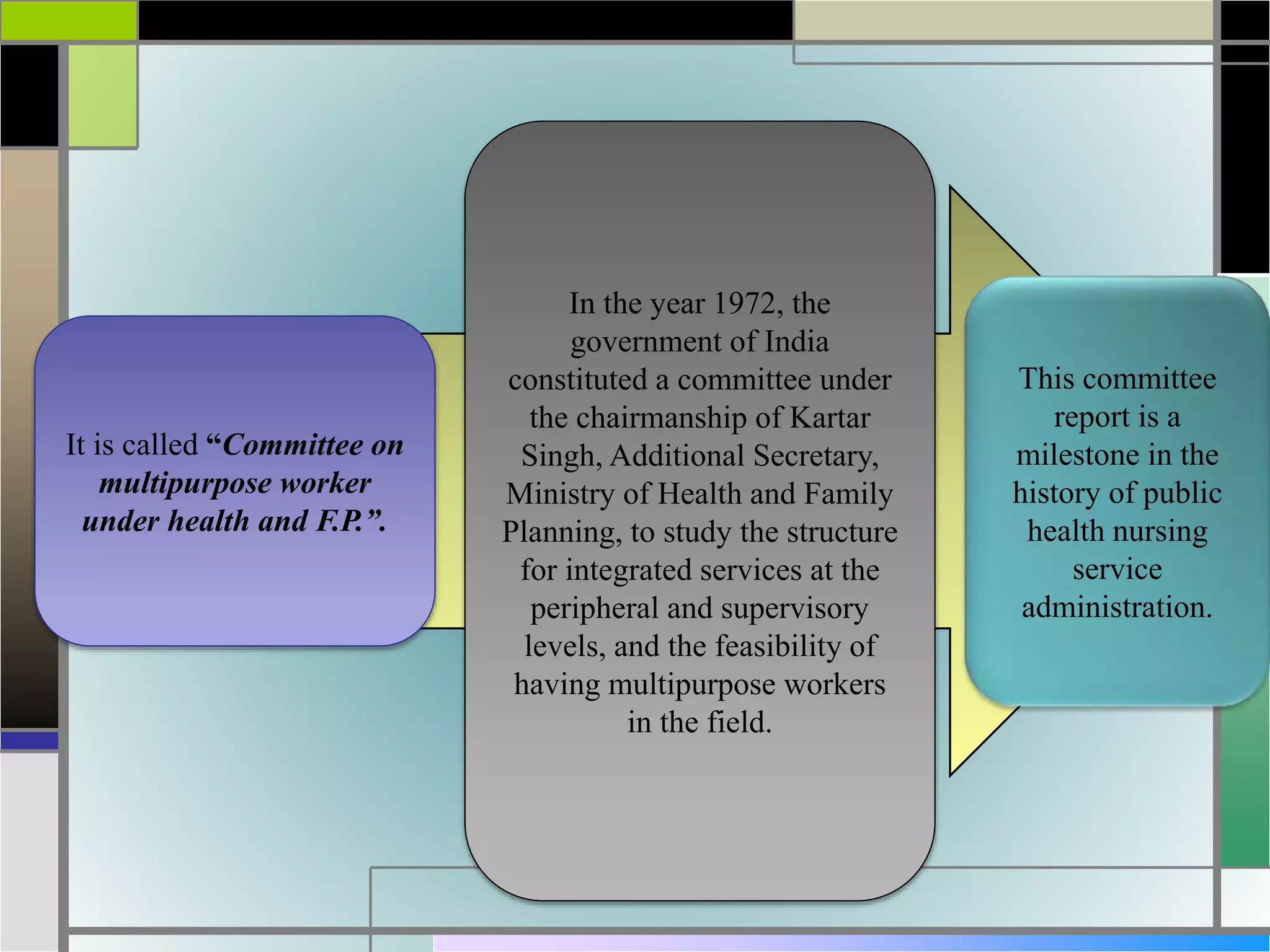
It is called “Committee on
multipurpose worker
under health and F.P.”.
In the year 1972, the
government of India
constituted a committee under
the chairmanship of Kartar
Singh, Additional Secretary,
Ministry of Health and Family
Planning, to study the structure
for integrated services at the
peripheral and supervisory
levels, and the feasibility of
having multipurpose workers
in the field.
This committee
report is a
milestone in the
history of public
health nursing
service
administration.
KARTAR SINGH COMMITTEE
(1973)
References of the committee are as follows:
The structure for integrated services at the peripheral
and supervisory levels
The feasibility of having multipurpose, bipurpose
workers in the field
The training requirements for such workers
Utilization of mobile service unit which is set-up
under Family Welfare Programme
KARTAR SINGH COMMITTEE
(1973)
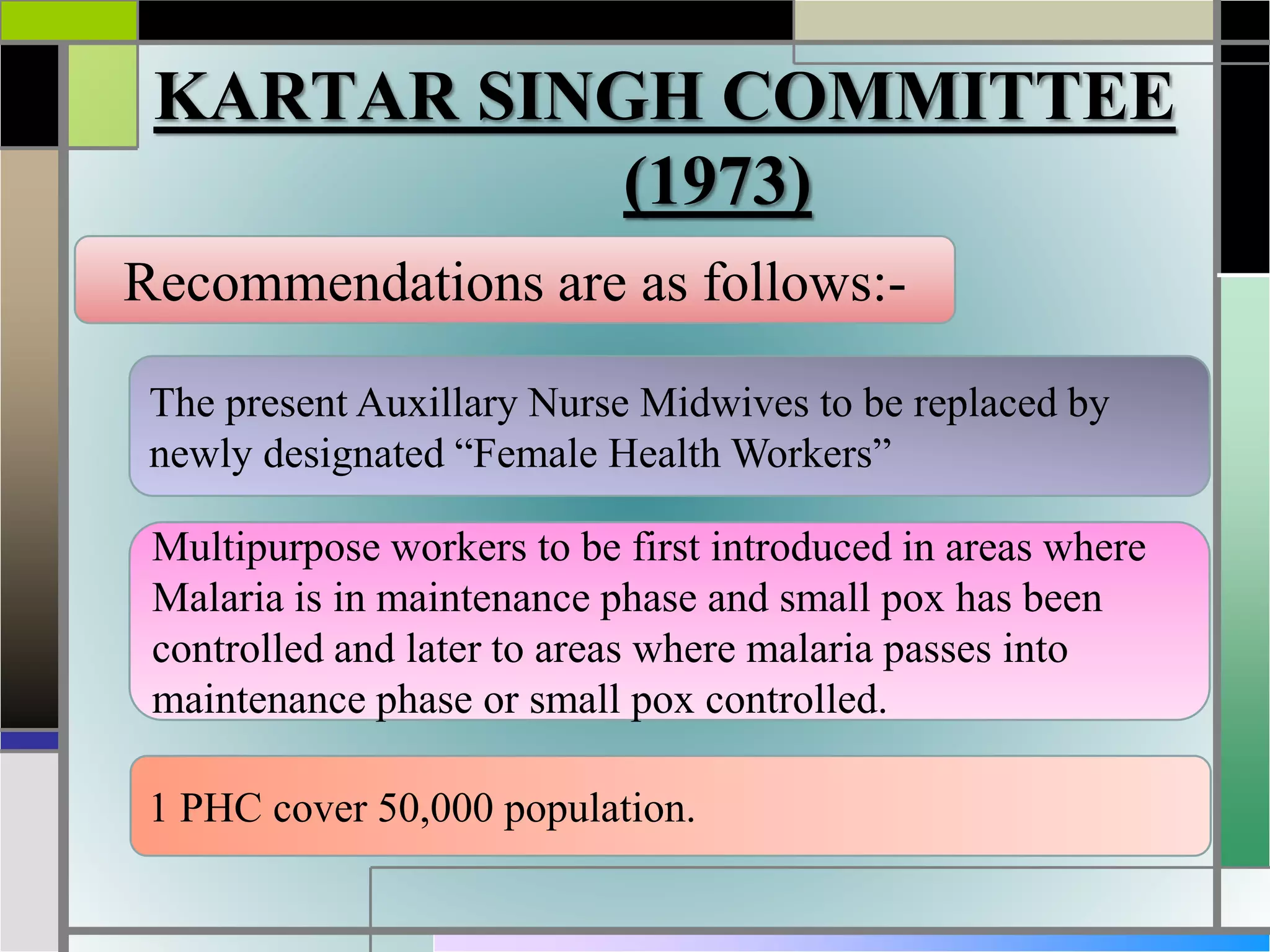
Recommendations are as follows:-
The present Auxillary Nurse Midwives to be replaced by
newly designated “Female Health Workers”
Multipurpose workers to be first introduced in areas where
Malaria is in maintenance phase and small pox has been
controlled and later to areas where malaria passes into
maintenance phase or small pox controlled.
1 PHC cover 50,000 population.
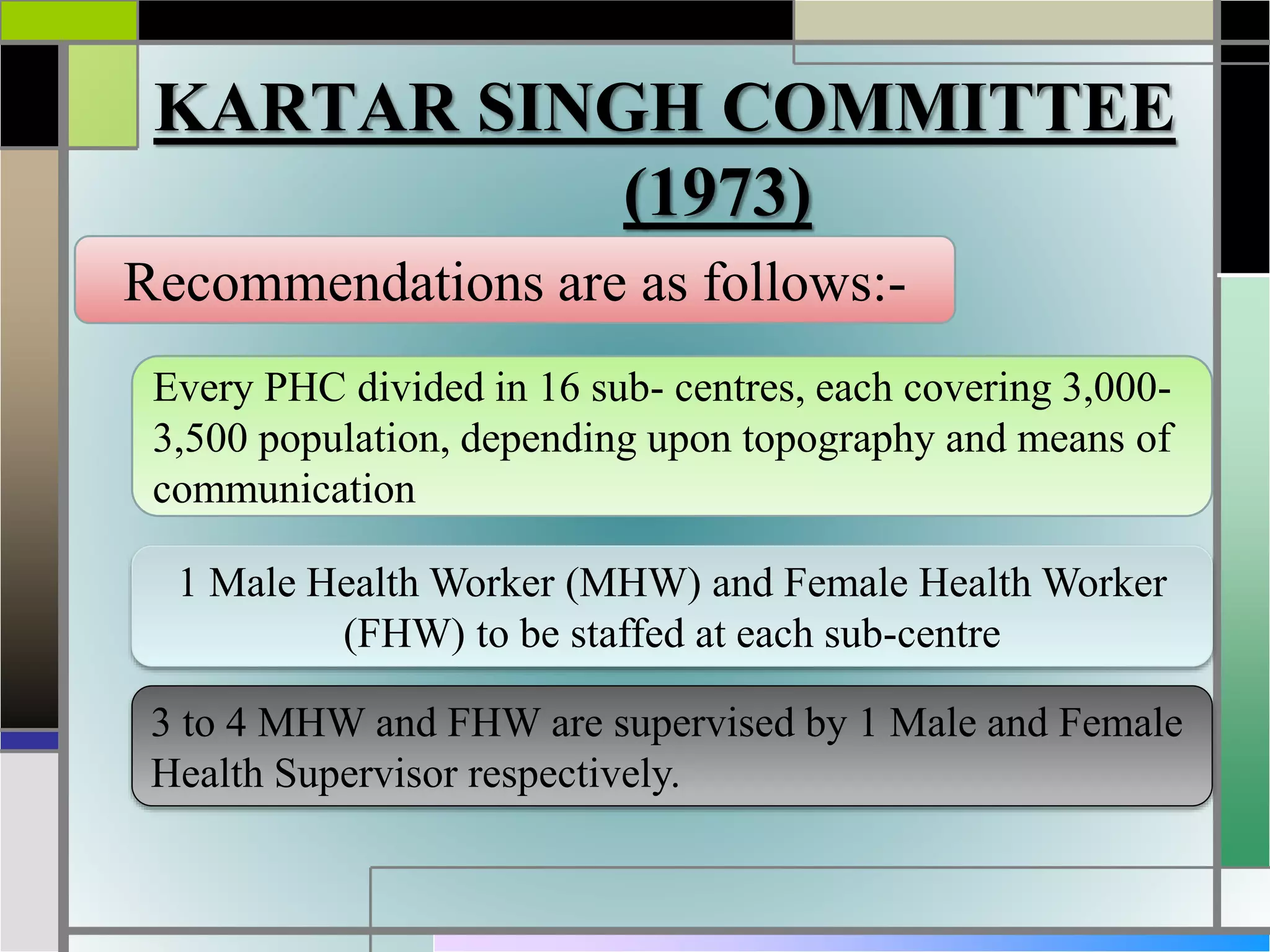
KARTAR SINGH COMMITTEE
(1973)
Every PHC divided in 16 sub- centres, each covering 3,000-
3,500 population, depending upon topography and means of
communication
1 Male Health Worker (MHW) and Female Health Worker
(FHW) to be staffed at each sub-centre
3 to 4 MHW and FHW are supervised by 1 Male and Female
Health Supervisor respectively.
Recommendations are as follows:-
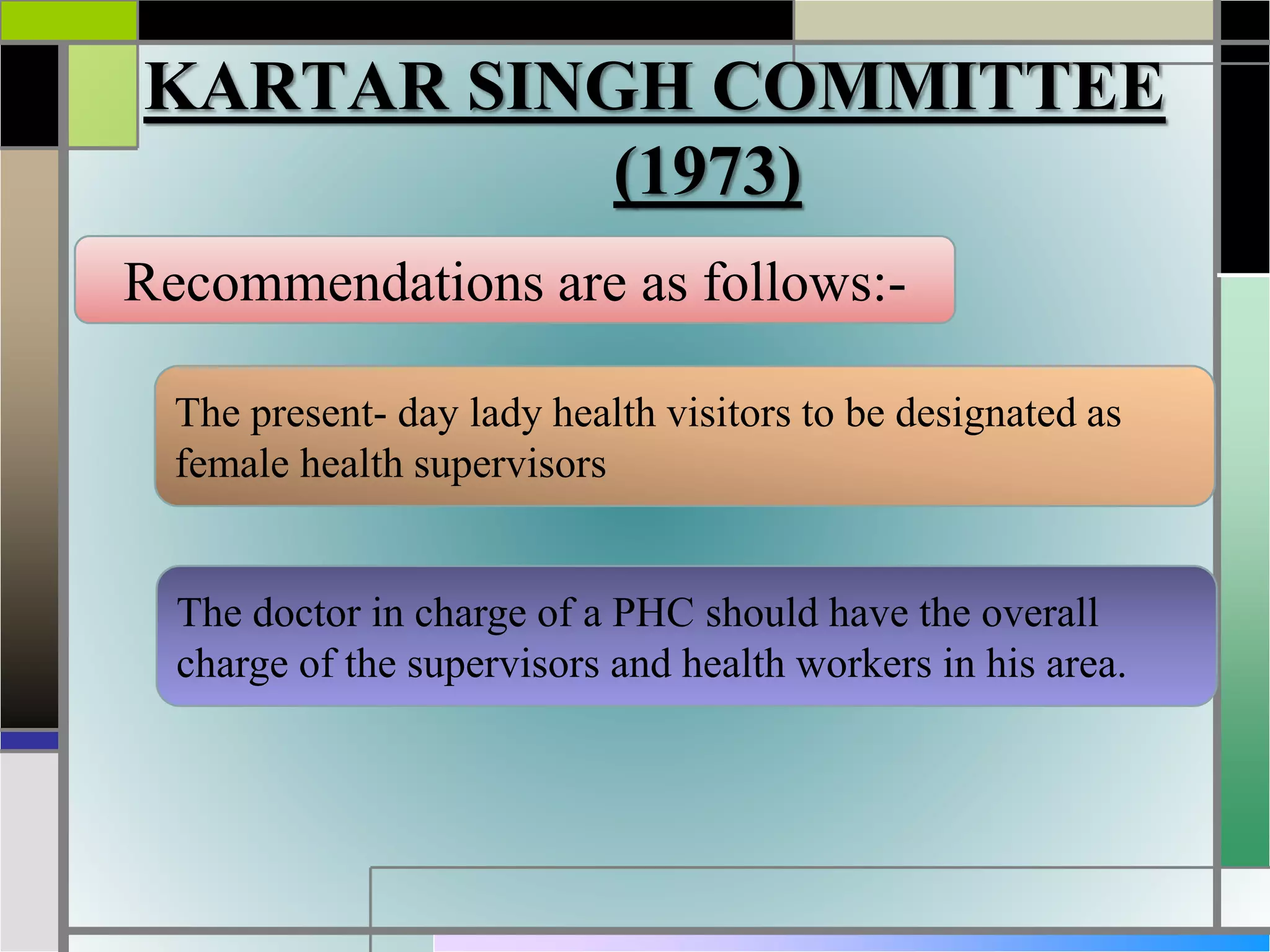
KARTAR SINGH COMMITTEE
(1973)
The present- day lady health visitors to be designated as
female health supervisors
The doctor in charge of a PHC should have the overall
charge of the supervisors and health workers in his area.
Recommendations are as follows:-
SHRIVASTAV
COMMITTEE
(1975)
SHRIVASTAV COMMITTEE
(1975)
Also known as
“Group on
Medical
Education and
Support
Manpower”
Headed by Dr J B
Shrivastav, the then
, Director General of
Health Services.
SHRIVASTAV COMMITTEE
(1975)
This committee was set up to determine steps needed to-
(a.) Reorient medical education in accordance with
national needs & priorities
(b.) to suggest steps for improving the existing medical
educational processes as to provide due to emphasis on
the problems particularly relevant to national
requirements
(c.) to make any other suggestions to realise the above
objectives and matters incidental thereto.
SHRIVASTAV COMMITTEE
(1975)
It recommended immediate action for:-
1. Creation of bonds of paraprofessional and semi-
professional health workers from within the
community itself.
2. Establishment of 3 cadres of health workers
namely– multipurpose health workers and health
assistants between the community level workers and
doctors at PHC.
3. Development of a “Referral Services Complex”
SHRIVASTAV COMMITTEE
(1975)
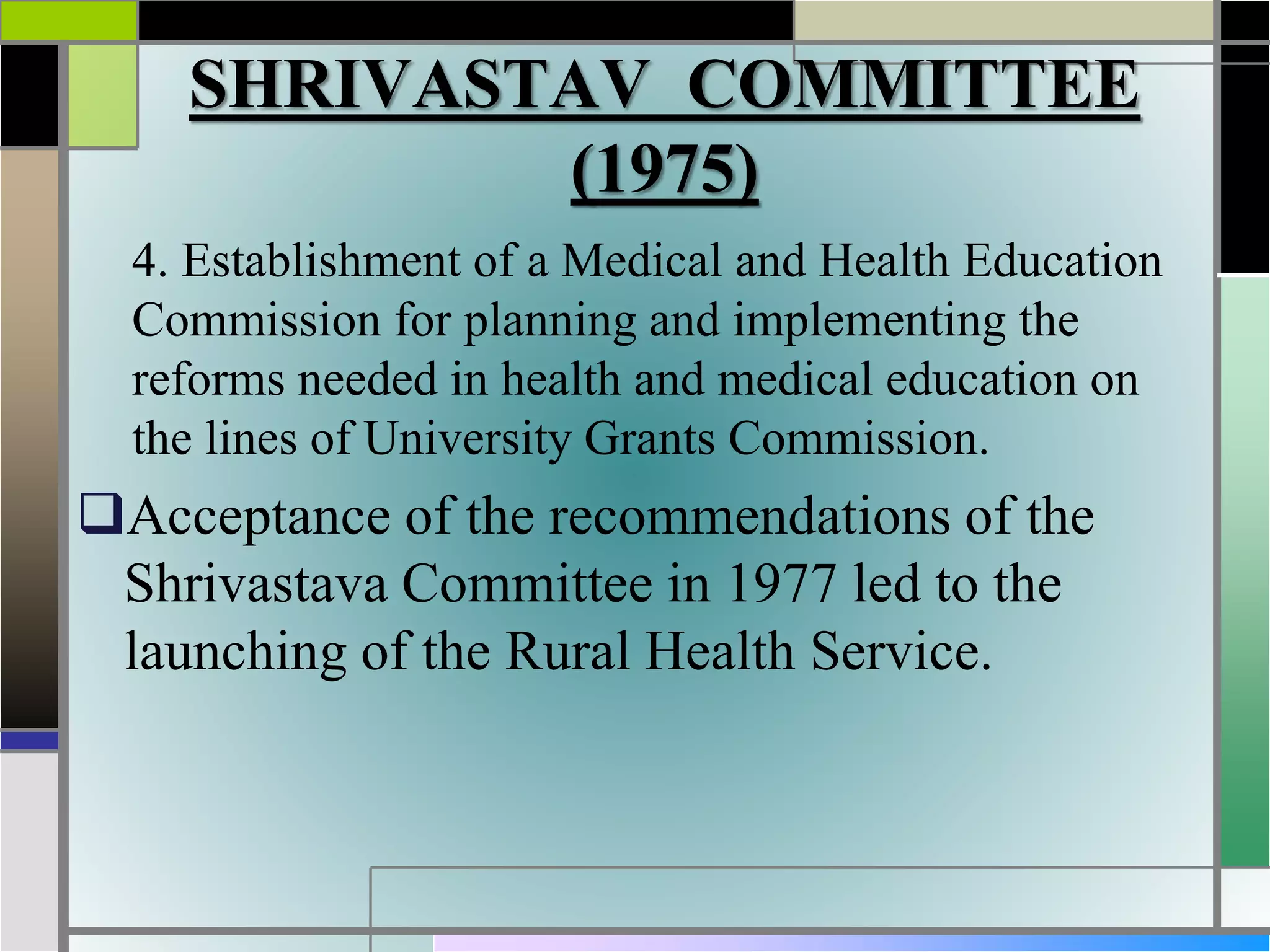
4. Establishment of a Medical and Health Education
Commission for planning and implementing the
reforms needed in health and medical education on
the lines of University Grants Commission.
Acceptance of the recommendations of the
Shrivastava Committee in 1977 led to the
launching of the Rural Health Service.
RURAL HELTH SCHEME
(1977)
The basic recommendations of the Committee were
accepted by the Govt. in 1977, which led to the
launching of the Rural Health Scheme.
The Programme of training of community health
workers was initiated during 1977-78.
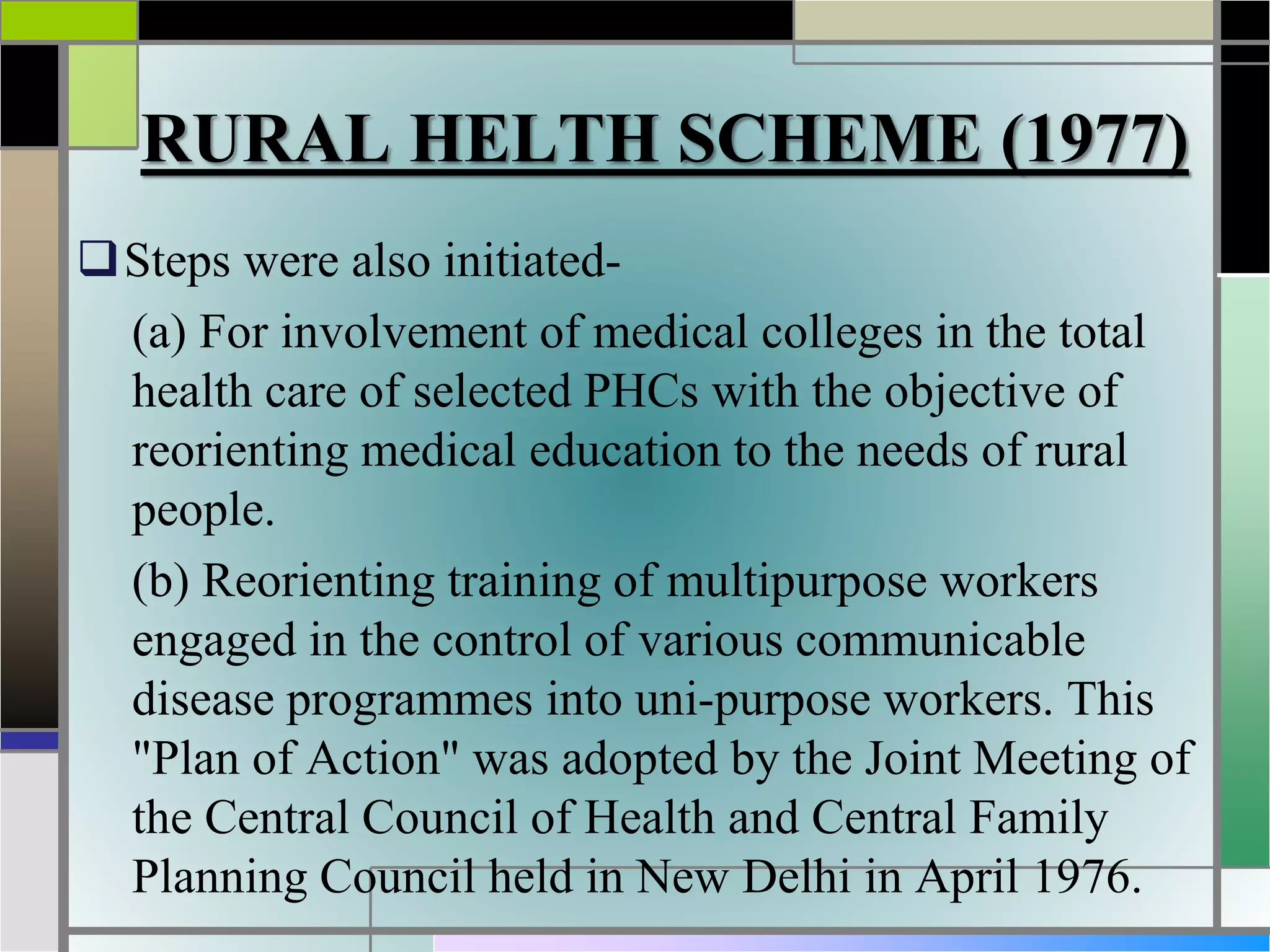
RURAL HELTH SCHEME (1977)
Steps were also initiated-
(a) For involvement of medical colleges in the total
health care of selected PHCs with the objective of
reorienting medical education to the needs of rural
people.
(b) Reorienting training of multipurpose workers
engaged in the control of various communicable
disease programmes into uni-purpose workers. This
"Plan of Action" was adopted by the Joint Meeting of
the Central Council of Health and Central Family
Planning Council held in New Delhi in April 1976.
Shivaraman Committee (1979)
A Committee on Basic Rural Doctors was framed under
the guidance of Shri Shivaraman, the then Member of
Planning Commission. The committee recommended
establishment of countrywide cadre of basic rural
doctors consisting of trained paraprofessionals to extend
comprehensive health care delivery to rural community.
Ramalingaswamy Committee
(1980)
This committee under the chairmanship of Dr V
Ramalingaswamy, the then DGHS, recommended:
•Involvement of community for health planning and
health program implementation
•30 bedded hospital for every 1 lakh population
•Integration of health services at all levels
•Redefined the role of doctor in the community
•Recommended that PHC and District Health Centers
should be under the control of three tier Panchayat Raj
System.
Bajaj Committee (1986)
An expert committee for ‘health manpower planning,
production and management’ is constituted under the
Chairmanship of Dr JS Bajaj, the then Member of
Planning Commission, to tackle the problem of health
manpower planning, production and management.
"Important recommendations of the Bajaj committee
are:
•Recommended for Formulation of National Health
Manpower planning based on realistic survey.
•Educational Commission for health sciences should
be developed on the lines of UGC.
Bajaj Committee (1986)
• Recommended for National and Medical education
policies in which teachers are trained in health
education science technology.
• Uniform standard of medical and health
science education by establishing universities
of health sciences in all states.
• Establishment of health manpower cells both
at state and central levels.
• Vocational courses in paramedical sciences to
get more health manpower.
Krishnan Committee (1992)
The committee under the chairmanship of Dr Krishnan
reviewed the achievements and progress of previous
health committee reports and also made comments on
shortfalls. The committee addresses the problems of
urban health and devised the health post-scheme for
urban slum areas.
Krishnan Committee (1992)
"The committee had recommended :-
one voluntary health worker (VHW) per 2,000 population.
 Its report specifically outlines which services have to be
provided by the health post.
 These services have been divided into outreach,
preventive, family planning, curative, support (referral)
services and reporting and recordkeeping.
 Outreach services include population education,
motivation for family planning, and health education.
In the present context, a very few outreach services are
being provided to urban slums.
HEALTH FOR ALL by 2000AD-
Report of the working group,
1981
A working group on Health was constituted by the
Planning Commission in 1980 with the Secretary,
Ministry of Health and Family Welfare, as its
Chairman, to outline with that perspective, the
specific programmes for the sixth Five Year Plan.
The Working Group, besides identifying and setting
out the broad approach to health planning during the
sixth
Five Year Plan, has also evolved fairly specific
indices and targets to be achieved in the country by
CONCLUSION
These committees are appointed from time to
time to look in to the issues of the health care
administration.
Recommendations made by these committees
were very helpful to make an excellent change
in our health care delivery system.
SUMMARY
 Introduction
 Various health and welfare committees
Bhore committee
Mudaliar committee
Chadha committee
Mukherji committee
Jungalwalla
committee
Kartar Singh
committee
Shrivastav committee
Rural Health Scheme
Shivaraman
Committee
Ramalingaswamy
Committee
Bajaj Committee
Krishnan Committee
Health For All
ASSIGNMENT
Ques. Enlist all the health committees
and their objectives.
REFERENCES
□ K. Park, Park’s Textbook of Preventive and Social Medicine, 23rd
Edition, Health Planning and Management(873-875)
□ K.K.Gulani , Community Health Nursing (Principles & Practices),
2nd Edition, Health Care Administration in India(627-628)
□ Ghosh J.M., Community Health Nursing, Planning Committees in
India(Chapter-18)
□ Health Planning in India. Last updated on 4/28/2011.
http://business.mapsofindia.com/india-planning/health.html.
□ Health for All. World Health Organization Belarus,
http://undp.by/en/who/healthforall/
Health committees ppt

Health committees ppt

  • 1.
  • 2.
    OUTLINE Introduction Various health andwelfare committees Bhore committee Mudaliar committee Chadha committee Mukherji committee Jungalwalla committee Kartar Singh committee
  • 3.
    OUTLINE Shrivastav committee Rural HealthScheme Shivaraman Committee Ramalingaswamy Committee Bajaj Committee Krishnan Committee Health For All
  • 4.
    INTRODUCTION Health planning inIndia is an integral part of national socio-economic planning. The guidelines for national health planning were provided by a number of Committees dating back to the Bhore Committee in 1946. These Committees were appointed by the Government of India from time to time to review the existing health situation and recommend measures for further action.
  • 5.
    INTRODUCTION More recently theAlma Ata Declaration on primary health care and the National Health Policy of the Government gave a new direction to health planning in India, making primary health care the central function and main focus of its national health system. The goal of national health planning in India was to attain Health for ALL by the year 2000.
  • 6.
    VARIOUS HEALTH COMMITTEES BHORE COMMITTEE (1946) MUDALIAR COMMITTEE (1962) CHADHACOMMITTEE (1963) MUKERJI COMMITTEE (1965) MUKERJI COMMITTEE (1966)
  • 7.
  • 8.
    VARIOUS HEALTH COMMITTEES HEALTH FORALL by 2000AD- Report of the working group, 1981 Krishnan Committee (1992) Ramalingaswamy Committee (1980) Bajaj Committee (1986)
  • 10.
    BHORE COMMITTEE (1946) □This committee, known as the Health Survey & Development Committee, was appointed in 1943 with Sir Joseph Bhore as its Chairman. □ It laid emphasis on integration of curative and preventive medicine at all levels. Comprehensive recommendations were made by him for remodelling of health services in India.
  • 11.
    BHORE COMMITTEE (1946) □The committee observed: “ if the nation’s health is to be built, the health programme should be developed on a foundation of preventive health work and that such activities should proceed side by side with those concerned with the treatment of patients”.
  • 12.
    Comprehensive healthcare comprising a packageof:- • Medical Relief, • Communicable Disease Control • Environmental Sanitation • Maternal and Child Health Care • School Health Services • Health Education • Vital Statistics
  • 13.
    BHORE COMMITTEE (1946) Thereport, submitted in 1946, had some important recommendations like :- 1.) Integration of preventive and curative services of all administrative levels. 2.) Development of Primary Health Centres in 2 stages: Short-term measures Long-term measures
  • 14.
    DEVELOPMENT OF PHCIN TWO STAGES: Short term measures long term measures Government should establish 1 primary health centre for every 40,000 population staffed by • 2 doctors, • 1 nurse, • 4 public health nurses, • 4 midwives, • 4 trained dais, • 2 sanitary inspectors, • 2 health assistants • 1 pharmacist. Government should setup the following (termed as ‘3 million plan’) • 75 bedded primary health centre for 10,000-20,000 rural population. • 65 bedded regional hospital. • 2,500 bedded hospital at the district level.
  • 15.
    BHORE COMMITTEE (1946) 3)Major changes in medical education which includes 3 - month training in preventive and social medicine to prepare “social physicians”. The committee’s Report continues to be a major national document, and has provided guidelines for national health planning in India.
  • 17.
    MUDALIAR COMMITTEE(1962) This committeeknown as the “Health Survey and Planning Committee”, headed by Dr. A.L. Mudaliar, was appointed in 1959 to assess the performance in health sector since the submission of Bhore Committee report and to make recommendations for future development and expansion of health services. This committee found the conditions in PHCs to be unsatisfactory and suggested that the PHC, already established should be strengthened before new ones are opened. Strengthening of sub divisional and district hospitals
  • 18.
    Medical Care PublicCare Control of Communicable Disease Population Control Professional education and research Indigenous system of medicine Drugs and Medical supplies Legislation Health Administration Medical Research The Committee was sub-divided into different sub- committees to deal with different subjects like:
  • 19.
    MUDALIAR COMMITTEE (1962) The mainrecommendations of the Mudaliar Committee were: Consolidation of advances made in the first two five year plans Strengthening of the district hospitals with specialist services to serve as central base of regional services Regional organizations in each state is placed between the headquarter organization and the district as Regional Deputy or Assistant Directors to supervise 2-3 District Medical and Health Officer.
  • 20.
    MUDALIAR COMMITTEE (1962) Integration ofmedical and health services as recommended by Bhore Committee It was emphasized that a PHC should not be made to serve to more than 40,000 populations and that the curative, preventive and promotive services should be all provided at the PHC. The Mudaliar Committee also recommended that an All India Health service should be created to replace the erstwhile Indian Medical service.
  • 21.
  • 22.
    CHADHA COMMITTEE (1963) Thiscommittee was appointed under the chairmanship of Dr. M.S. Chadha, the then Director General of Health Services, in 1963, to advise about the necessary arrangements for the maintenance phase of National Malaria Eradication Programme. The committee suggested that the vigilance activity in the NMEP should be carried out by primary health centres at block level
  • 23.
    CHADHA COMMITTEE (1963) Thecommittee also recommended that vigilance operations through monthly home visits should be implemented through basic health workers. One basic health worker per 10,000 populations, also function as “multipurpose workers” and would perform, in addition to malaria work, the duties of family planning and vital statistics data collection under supervision of family planning health assistants. The Family Planning Health Assistants were to supervise 3 to 4 of these basic health workers.
  • 24.
  • 25.
    MUKERJI COMMITTEE (1965) Therecommendations of the Chadha Committee, when implemented, were found to be impracticable because the basic health workers, with their multiple functions could do justice neither to malaria work nor to family planning work. The Mukherjee committee headed by then Secretary of Health Shri Mukerji, was appointed in 1965, to review the performance in the area of family planning. The committee recommended separate staff for the family planning programme
  • 26.
    MUKERJI COMMITTEE (1965) Aftercommittee recommendation, the family planning assistants were to undertake family planning duties only. The basic health workers were to be utilized for purposes other than family planning. The committee also recommended delinking the malaria activities from family planning so that the latter would receive undivided attention of its staff.
  • 27.
    MUKERJI COMMITTEE (1966) Multipleactivities of the mass programmes like family planning, small pox, leprosy, trachoma, NMEP (maintenance phase), etc. was making it difficult for the states to undertake these effectively because of shortage of funds. A committee of state health secretaries, headed by the Union Health Secretary, Shri Mukherjee, was set up to look into this problem. The committee worked out the details of the BASIC HEALTH SERVICES which should be provided at the Block level, and some consequential strengthening required at higher levels of
  • 28.
    MUKERJI COMMITTEE (1966) Makefamily planning a vertical program. Fix targets for contraceptives distribution and for sterilizations. Provide incentives to the acceptors of contraceptives /sterilization.
  • 31.
    JUNGALWALLA COMMITTEE (1967) This committee,known as the “Committee on Integration of Health Services” was set up in 1964 under the chairmanship of Dr. N. Jungalwalla, the then Director of National Institute of Health Administration and Education, New Delhi (currently NIHFW). It was asked to look into various problems related to integration of health services, abolition of private practice by doctors in government services, and the service conditions of Doctors.
  • 32.
    JUNGALWALLA COMMITTEE (1967) The committeedefined “integrated health services” as:- (a.) A service with a unified approach for all problems instead of a segmented approach for different problems. (b.) Medical care and public health programmes should be put under charge of a single administrator at all levels of hierarchy with due priority for each programme obtaining at a point of time.
  • 33.
    JUNGALWALLA COMMITTEE (1967) Following stepswere recommended for the integration at all levels of health organization in the country- Unified Cadre Common Seniority Recognition of extra qualifications Equal pay for equal work Special pay for special work Abolition of private practice by government doctors Improvement in their service conditions The committee stated that “integration should be a process of logical evaluation rather than revolution.”
  • 34.
  • 35.
    It is called“Committee on multipurpose worker under health and F.P.”. In the year 1972, the government of India constituted a committee under the chairmanship of Kartar Singh, Additional Secretary, Ministry of Health and Family Planning, to study the structure for integrated services at the peripheral and supervisory levels, and the feasibility of having multipurpose workers in the field. This committee report is a milestone in the history of public health nursing service administration.
  • 36.
    KARTAR SINGH COMMITTEE (1973) Referencesof the committee are as follows: The structure for integrated services at the peripheral and supervisory levels The feasibility of having multipurpose, bipurpose workers in the field The training requirements for such workers Utilization of mobile service unit which is set-up under Family Welfare Programme
  • 37.
    KARTAR SINGH COMMITTEE (1973) Recommendationsare as follows:- The present Auxillary Nurse Midwives to be replaced by newly designated “Female Health Workers” Multipurpose workers to be first introduced in areas where Malaria is in maintenance phase and small pox has been controlled and later to areas where malaria passes into maintenance phase or small pox controlled. 1 PHC cover 50,000 population.
  • 38.
    KARTAR SINGH COMMITTEE (1973) EveryPHC divided in 16 sub- centres, each covering 3,000- 3,500 population, depending upon topography and means of communication 1 Male Health Worker (MHW) and Female Health Worker (FHW) to be staffed at each sub-centre 3 to 4 MHW and FHW are supervised by 1 Male and Female Health Supervisor respectively. Recommendations are as follows:-
  • 39.
    KARTAR SINGH COMMITTEE (1973) Thepresent- day lady health visitors to be designated as female health supervisors The doctor in charge of a PHC should have the overall charge of the supervisors and health workers in his area. Recommendations are as follows:-
  • 40.
  • 41.
    SHRIVASTAV COMMITTEE (1975) Also knownas “Group on Medical Education and Support Manpower” Headed by Dr J B Shrivastav, the then , Director General of Health Services.
  • 42.
    SHRIVASTAV COMMITTEE (1975) This committeewas set up to determine steps needed to- (a.) Reorient medical education in accordance with national needs & priorities (b.) to suggest steps for improving the existing medical educational processes as to provide due to emphasis on the problems particularly relevant to national requirements (c.) to make any other suggestions to realise the above objectives and matters incidental thereto.
  • 43.
    SHRIVASTAV COMMITTEE (1975) It recommendedimmediate action for:- 1. Creation of bonds of paraprofessional and semi- professional health workers from within the community itself. 2. Establishment of 3 cadres of health workers namely– multipurpose health workers and health assistants between the community level workers and doctors at PHC. 3. Development of a “Referral Services Complex”
  • 44.
    SHRIVASTAV COMMITTEE (1975) 4. Establishmentof a Medical and Health Education Commission for planning and implementing the reforms needed in health and medical education on the lines of University Grants Commission. Acceptance of the recommendations of the Shrivastava Committee in 1977 led to the launching of the Rural Health Service.
  • 45.
    RURAL HELTH SCHEME (1977) Thebasic recommendations of the Committee were accepted by the Govt. in 1977, which led to the launching of the Rural Health Scheme. The Programme of training of community health workers was initiated during 1977-78.
  • 46.
    RURAL HELTH SCHEME(1977) Steps were also initiated- (a) For involvement of medical colleges in the total health care of selected PHCs with the objective of reorienting medical education to the needs of rural people. (b) Reorienting training of multipurpose workers engaged in the control of various communicable disease programmes into uni-purpose workers. This "Plan of Action" was adopted by the Joint Meeting of the Central Council of Health and Central Family Planning Council held in New Delhi in April 1976.
  • 47.
    Shivaraman Committee (1979) ACommittee on Basic Rural Doctors was framed under the guidance of Shri Shivaraman, the then Member of Planning Commission. The committee recommended establishment of countrywide cadre of basic rural doctors consisting of trained paraprofessionals to extend comprehensive health care delivery to rural community.
  • 48.
    Ramalingaswamy Committee (1980) This committeeunder the chairmanship of Dr V Ramalingaswamy, the then DGHS, recommended: •Involvement of community for health planning and health program implementation •30 bedded hospital for every 1 lakh population •Integration of health services at all levels •Redefined the role of doctor in the community •Recommended that PHC and District Health Centers should be under the control of three tier Panchayat Raj System.
  • 49.
    Bajaj Committee (1986) Anexpert committee for ‘health manpower planning, production and management’ is constituted under the Chairmanship of Dr JS Bajaj, the then Member of Planning Commission, to tackle the problem of health manpower planning, production and management. "Important recommendations of the Bajaj committee are: •Recommended for Formulation of National Health Manpower planning based on realistic survey. •Educational Commission for health sciences should be developed on the lines of UGC.
  • 50.
    Bajaj Committee (1986) •Recommended for National and Medical education policies in which teachers are trained in health education science technology. • Uniform standard of medical and health science education by establishing universities of health sciences in all states. • Establishment of health manpower cells both at state and central levels. • Vocational courses in paramedical sciences to get more health manpower.
  • 51.
    Krishnan Committee (1992) Thecommittee under the chairmanship of Dr Krishnan reviewed the achievements and progress of previous health committee reports and also made comments on shortfalls. The committee addresses the problems of urban health and devised the health post-scheme for urban slum areas.
  • 52.
    Krishnan Committee (1992) "Thecommittee had recommended :- one voluntary health worker (VHW) per 2,000 population.  Its report specifically outlines which services have to be provided by the health post.  These services have been divided into outreach, preventive, family planning, curative, support (referral) services and reporting and recordkeeping.  Outreach services include population education, motivation for family planning, and health education. In the present context, a very few outreach services are being provided to urban slums.
  • 53.
    HEALTH FOR ALLby 2000AD- Report of the working group, 1981 A working group on Health was constituted by the Planning Commission in 1980 with the Secretary, Ministry of Health and Family Welfare, as its Chairman, to outline with that perspective, the specific programmes for the sixth Five Year Plan. The Working Group, besides identifying and setting out the broad approach to health planning during the sixth Five Year Plan, has also evolved fairly specific indices and targets to be achieved in the country by
  • 54.
    CONCLUSION These committees areappointed from time to time to look in to the issues of the health care administration. Recommendations made by these committees were very helpful to make an excellent change in our health care delivery system.
  • 55.
    SUMMARY  Introduction  Varioushealth and welfare committees Bhore committee Mudaliar committee Chadha committee Mukherji committee Jungalwalla committee Kartar Singh committee Shrivastav committee Rural Health Scheme Shivaraman Committee Ramalingaswamy Committee Bajaj Committee Krishnan Committee Health For All
  • 57.
    ASSIGNMENT Ques. Enlist allthe health committees and their objectives.
  • 58.
    REFERENCES □ K. Park,Park’s Textbook of Preventive and Social Medicine, 23rd Edition, Health Planning and Management(873-875) □ K.K.Gulani , Community Health Nursing (Principles & Practices), 2nd Edition, Health Care Administration in India(627-628) □ Ghosh J.M., Community Health Nursing, Planning Committees in India(Chapter-18) □ Health Planning in India. Last updated on 4/28/2011. http://business.mapsofindia.com/india-planning/health.html. □ Health for All. World Health Organization Belarus, http://undp.by/en/who/healthforall/