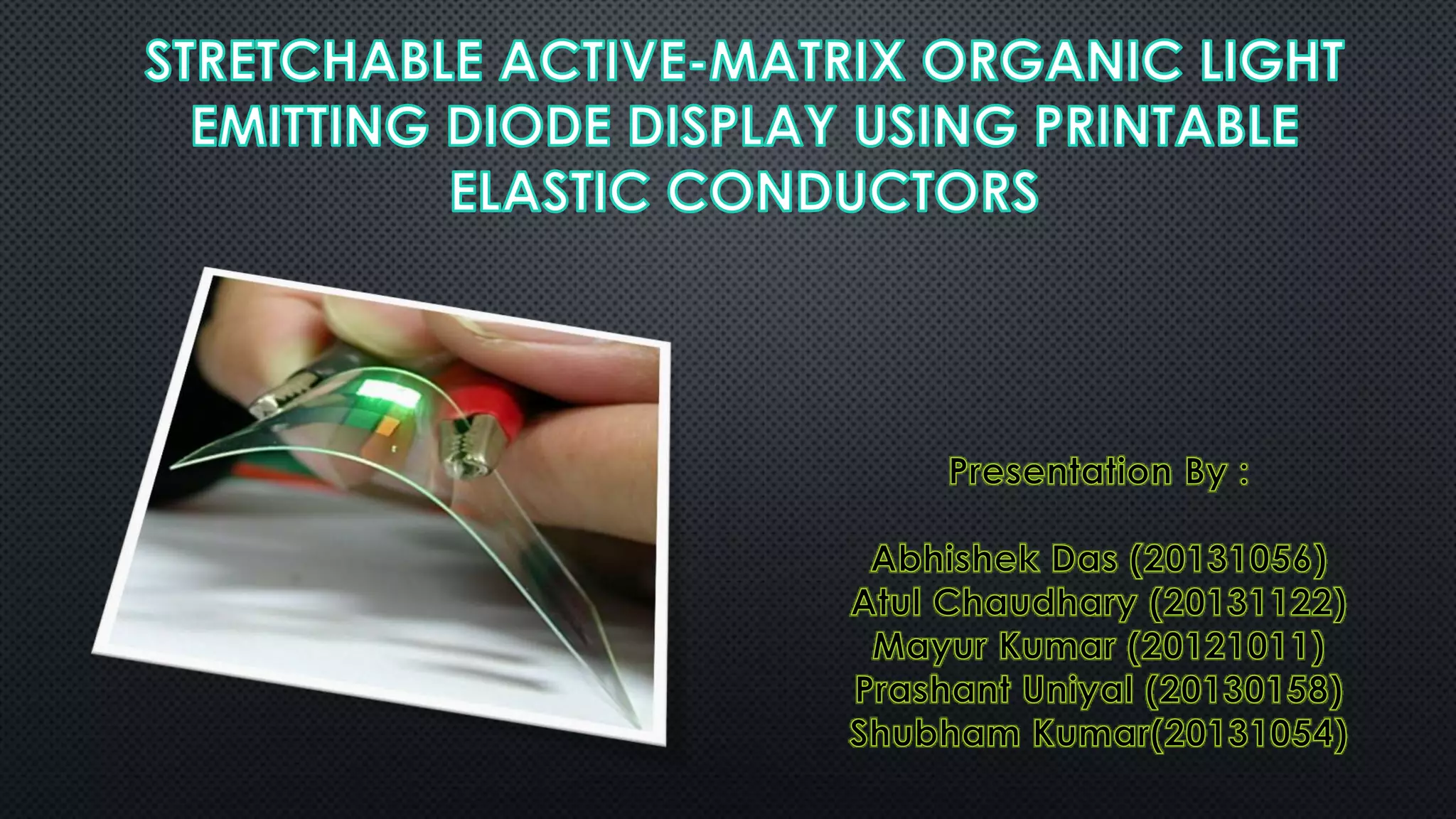
Based on a review article written by: Tsuyoshi Sekitani, Hiroyoshi Nakajima, Hiroki
Maeda, Takanori Fukushima, Takuzo Aida, Kenji Hata and Takao Someya which was
published on 10th May, 2009 in Nature Material this presentation aims at introducing
what printable elastic conductors are and how they can be used in the varied field of
semiconductors for the better use of humanity.

 Stretchability will significantly expand the applications scope of electronics,
particularly for large-area electronic displays, sensors and actuators. Unlike for
conventional devices, stretchable electronics can cover arbitrary surfaces and
movable parts.However, a large hurdle is the manufacture of large-area highly
stretchable electrical wirings with high conductivity. Here, we describe the
manufacture of stretchable active matrix OLED display using printable elastic
conductors.
 Active-matrix is basically a type of addressing scheme (pixel state) used in flat panel
displays like LCD TV screens.
 Recently new technologies have been emerging in the field of “stretchable”
electronics like the development of elastic electrical wiring that is both highly
conductive and highly stretchable . Although there have been examples of these kind
of materials been made like graphene films coated with metal; problem that has arose
is to find a procedure to make such materials larger in size. One solution to this
problem that has been provided by the authors in this article is to develop printed
elastic conductors which are extraordinarily conductive and use that to construct a
rubber-like stretchable active-matrix display.
 What do one exactly mean by a printed elastic conductor?
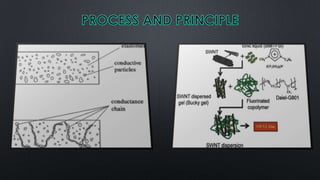
 The authors provide a technique of producing stretchable OLED’s by using the principle of
direct printing technologies i.e. printable inks that have high conductivity and stretchability
to make printed elastic conductors which consists of fine SWNT bundles uniformly
dispersed in a highly elastic fluorinated rubber matrix which is quite viscous. The
chemically stable SWNTs (high purity) act as highly conductive dopants and help in
forming well developed conducting networks in rubber.
 Advantages of printed elastic conductors
 No requirement of any kind of extra coating of metal unlike other conductors (e.g.
graphene films)
 No requirement of any huge mechanical process unlike others like wavy thin metals
 It can stretch by a huge margin (118%)
 Has an extraordinarily high conductivity (102 S/cm)
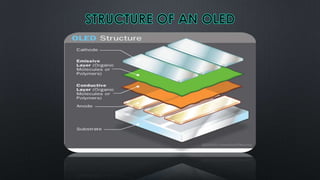
 Basic idea of organic light emitting diode
 After making the elastic conductors the authors explains a process of manufacturing
Organic LEDs and organic driving cells separately on PDMS sheets which are then
joined together to form a highly stretchable display.
 An active matrix was then fabricated on a flexible polyimide film using a special process
called vacuum evaporation.
 By integrating the active matrix and organic LEDs using printed elastic conductors a
stretchable active-matrix Organic LED display was finally manufactured.
 Bending or crumpling causes no mechanical or electrical damage because of the
excellent conductivity and mechanical durability of the printed elastic conductors ,
organic transistors organic LEDs manufactured on the special rubber.(PDMS rubber)
The stretchable materials and manufacturing technology like printed
electronics used in this study can also be used to create other types of
useful electronics such as rubber-like electrical artificial skin with a
stretchable active matrix and pressure sensors. The combination of
stretchable sensors and displays can be used to create real, tangible
displays and user-friendly human-machine interfaces on all kinds of
surfaces and of shapes. Active research is still being done in this regard
by many international electronic companies like Visionox and Samsung.
Research on finding materials regarding these types of printed
conductors is going on in full flow by well-known scientists in major
universities like Stanford University , Yale University etc.
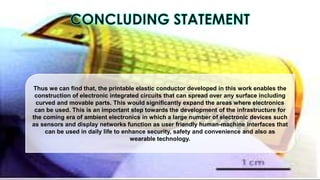
Thus we can find that, the printable elastic conductor developed in this work enables the
construction of electronic integrated circuits that can spread over any surface including
curved and movable parts. This would significantly expand the areas where electronics
can be used. This is an important step towards the development of the infrastructure for
the coming era of ambient electronics in which a large number of electronic devices such
as sensors and display networks function as user friendly human-machine interfaces that
can be used in daily life to enhance security, safety and convenience and also as
wearable technology.
REFERENCE WEBSITES
www.nanowork.com
www.cse.whk.edu.hk
www.ftp.priceton.edu
www.en.wikipedia.org
www.86wiki.com
www.ncbi.nim.gov/pubmed
www.m.wisegreek.com/whatisjetmilling
www.users.wfu.edu
www.fredlake.com
www.ieexplore.ieee.all
www.rubberworld.com
www.freedictionary.com
www.rsc.com
www.vipsmail.1.blogspot.in

1. Khang, D. Y., Jiang, H. Q., Huang, Y. & Rogers, J.
A. A stretchable form of
single-crystal silicon for high-performance electronics
on rubber substrates.
Science 311, 208212 (2006).
2. Sun, Y. G. et al. Controlled buckling of
semiconductor nanoribbons for
stretchable electronics. Nature Nanotech. 1, 201207
(2006).
3. Kim, D. H. et al. Stretchable and foldable silicon
integrated circuits. Science
320, 507511 (2008).
4. Kim, D. H. et al. Materials and noncoplanar mesh
designs for integrated
circuits with linear elastic responses to extreme
mechanical deformations.
Proc. Natl Acad. Sci. USA. 105, 1867518680 (2008).
5. Ko, H. C. et al. A hemispherical electronic eye
camera based on compressible
silicon optoelectronics. Nature 454, 748753 (2008).
Semiconductor presentation revised us

Semiconductor presentation revised us

  • 2.
    Based on areview article written by: Tsuyoshi Sekitani, Hiroyoshi Nakajima, Hiroki Maeda, Takanori Fukushima, Takuzo Aida, Kenji Hata and Takao Someya which was published on 10th May, 2009 in Nature Material this presentation aims at introducing what printable elastic conductors are and how they can be used in the varied field of semiconductors for the better use of humanity.  Stretchability will significantly expand the applications scope of electronics, particularly for large-area electronic displays, sensors and actuators. Unlike for conventional devices, stretchable electronics can cover arbitrary surfaces and movable parts.However, a large hurdle is the manufacture of large-area highly stretchable electrical wirings with high conductivity. Here, we describe the manufacture of stretchable active matrix OLED display using printable elastic conductors.
  • 3.
     Active-matrix isbasically a type of addressing scheme (pixel state) used in flat panel displays like LCD TV screens.  Recently new technologies have been emerging in the field of “stretchable” electronics like the development of elastic electrical wiring that is both highly conductive and highly stretchable . Although there have been examples of these kind of materials been made like graphene films coated with metal; problem that has arose is to find a procedure to make such materials larger in size. One solution to this problem that has been provided by the authors in this article is to develop printed elastic conductors which are extraordinarily conductive and use that to construct a rubber-like stretchable active-matrix display.
  • 4.
     What doone exactly mean by a printed elastic conductor?  The authors provide a technique of producing stretchable OLED’s by using the principle of direct printing technologies i.e. printable inks that have high conductivity and stretchability to make printed elastic conductors which consists of fine SWNT bundles uniformly dispersed in a highly elastic fluorinated rubber matrix which is quite viscous. The chemically stable SWNTs (high purity) act as highly conductive dopants and help in forming well developed conducting networks in rubber.  Advantages of printed elastic conductors  No requirement of any kind of extra coating of metal unlike other conductors (e.g. graphene films)  No requirement of any huge mechanical process unlike others like wavy thin metals  It can stretch by a huge margin (118%)  Has an extraordinarily high conductivity (102 S/cm)
  • 6.
     Basic ideaof organic light emitting diode  After making the elastic conductors the authors explains a process of manufacturing Organic LEDs and organic driving cells separately on PDMS sheets which are then joined together to form a highly stretchable display.  An active matrix was then fabricated on a flexible polyimide film using a special process called vacuum evaporation.  By integrating the active matrix and organic LEDs using printed elastic conductors a stretchable active-matrix Organic LED display was finally manufactured.  Bending or crumpling causes no mechanical or electrical damage because of the excellent conductivity and mechanical durability of the printed elastic conductors , organic transistors organic LEDs manufactured on the special rubber.(PDMS rubber)
  • 8.
    The stretchable materialsand manufacturing technology like printed electronics used in this study can also be used to create other types of useful electronics such as rubber-like electrical artificial skin with a stretchable active matrix and pressure sensors. The combination of stretchable sensors and displays can be used to create real, tangible displays and user-friendly human-machine interfaces on all kinds of surfaces and of shapes. Active research is still being done in this regard by many international electronic companies like Visionox and Samsung. Research on finding materials regarding these types of printed conductors is going on in full flow by well-known scientists in major universities like Stanford University , Yale University etc.
  • 10.
    Thus we canfind that, the printable elastic conductor developed in this work enables the construction of electronic integrated circuits that can spread over any surface including curved and movable parts. This would significantly expand the areas where electronics can be used. This is an important step towards the development of the infrastructure for the coming era of ambient electronics in which a large number of electronic devices such as sensors and display networks function as user friendly human-machine interfaces that can be used in daily life to enhance security, safety and convenience and also as wearable technology.
  • 11.
    REFERENCE WEBSITES www.nanowork.com www.cse.whk.edu.hk www.ftp.priceton.edu www.en.wikipedia.org www.86wiki.com www.ncbi.nim.gov/pubmed www.m.wisegreek.com/whatisjetmilling www.users.wfu.edu www.fredlake.com www.ieexplore.ieee.all www.rubberworld.com www.freedictionary.com www.rsc.com www.vipsmail.1.blogspot.in 1. Khang,D. Y., Jiang, H. Q., Huang, Y. & Rogers, J. A. A stretchable form of single-crystal silicon for high-performance electronics on rubber substrates. Science 311, 208212 (2006). 2. Sun, Y. G. et al. Controlled buckling of semiconductor nanoribbons for stretchable electronics. Nature Nanotech. 1, 201207 (2006). 3. Kim, D. H. et al. Stretchable and foldable silicon integrated circuits. Science 320, 507511 (2008). 4. Kim, D. H. et al. Materials and noncoplanar mesh designs for integrated circuits with linear elastic responses to extreme mechanical deformations. Proc. Natl Acad. Sci. USA. 105, 1867518680 (2008). 5. Ko, H. C. et al. A hemispherical electronic eye camera based on compressible silicon optoelectronics. Nature 454, 748753 (2008).