7.MADHAVA-GREGORY SERIES.
Part 1: Quotes from four admirers.
Part 2: Sanskrit verses and meanings.
FOUR ADMIRERS
 1.Charles M.Whish.
 2.Kim Plofker.
 3.Frits Staal.
 4.George Joseph.
CHARLES M.WHISH
 English civil servant in the Madras Establishment of
East India company.
 Article on “Hindu quadrature of the circle and the
infinite series”.
QUOTE
 “Kerala mathematicians had laid the foundation for
a complete system of fluxions and their works
abound with fluxional forms and series to be found
in no work of foreign countries”.
QUOTE
 “The mathematical heritage of the Indian
subcontinent has long been recognized as
extraordinarily rich. For well over 2500 years
Sanskrit texts have recorded the mathematical
interests and achievements of Indian scholars,
scientists, priests and merchants. Hundreds and
thousands of manuscripts in India and elsewhere
attest to this tradition. . . . Power series in the
Kerala school have become standard episodes in
the story told by general histories of mathematics”-
Kim Plofker.
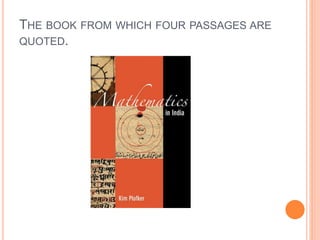
THE BOOK FROM WHICH FOUR PASSAGES ARE
QUOTED.
CHAPTER 7. THE SCHOOL OF MADHAVA IN
KERALA.
 “The crest-jewel of the Kerala school is generally
considered to be the infinite series for trigonometric
quantities discovered by its founder Madhava.” –
Kim Plofker, page 222.
ABOUT THE AUTHOR KIM PLOFKER
 Trained by David Pingree.
 Born in 1964.
 American historian of mathematics, specializing in
Indian mathematics.
 She is currently a visiting professor at Union
College in Schenectady.
QUOTE
 “Probably the most famous school in Indian
mathematics, and the one that produced many of
its most remarkable discoveries, is the
guruparampara or chain of teachers originating with
Madhava in the late 14th century and continuing at
least into the beginning of the 17th.”- page 217.
QUOTE
 “Madhava was a Brahmana of the caste known as
Emprantiri, his home was in Sangamagrama,
modern Irinjalakuda. His most famous
mathematical achievements are the Madhava-
Leibnitz series for pi/4 and the Madhava-Newton
power series for the sine and cosine”. – page 218.
QUOTES
“Infinite power series that are expansions of pi and the Trigonometric functions
sine,cosine and so forth were discovered by Madhava in the late 14th century
almost three centuries before they were discovered in Europe by Gregory”
“India’s strength lies in abstract theory as is evident from her Mathematics and
Linguistics” – Frits Staal.
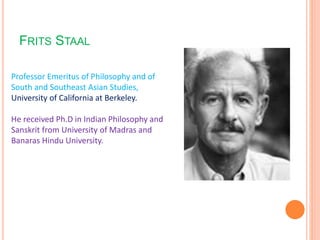
FRITS STAAL
Professor Emeritus of Philosophy and of
South and Southeast Asian Studies,
University of California at Berkeley.
He received Ph.D in Indian Philosophy and
Sanskrit from University of Madras and
Banaras Hindu University.
SOME BOOKS AUTHORED BY FRITS STAAL
 Ritual and Mantras, Rules without neaning.
 Universals: Studies in Indian logic & linguistics.
 Discovering Vedas: Origins, Mantras, Rituals…
 A Reader on the Sanskrit Grammarians.
 The fidelity of oral tradition and the origins of
science.
QUOTE
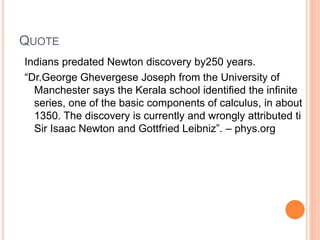
Indians predated Newton discovery by250 years.
“Dr.George Ghevergese Joseph from the University of
Manchester says the Kerala school identified the infinite
series, one of the basic components of calculus, in about
1350. The discovery is currently and wrongly attributed ti
Sir Isaac Newton and Gottfried Leibniz”. – phys.org
FIRST PART ENDS.
Second part starts.
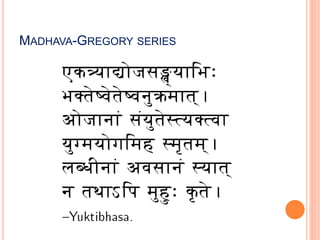
MADHAVA-GREGORY SERIES
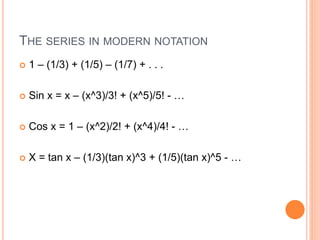
THE SERIES IN MODERN NOTATION
 1 – (1/3) + (1/5) – (1/7) + . . .
 Sin x = x – (x^3)/3! + (x^5)/5! - …
 Cos x = 1 – (x^2)/2! + (x^4)/4! - …
 X = tan x – (1/3)(tan x)^3 + (1/5)(tan x)^5 - …
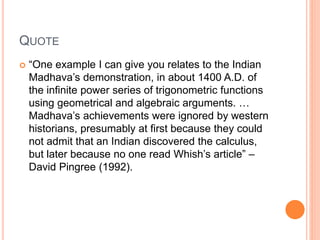
QUOTE
 “One example I can give you relates to the Indian
Madhava’s demonstration, in about 1400 A.D. of
the infinite power series of trigonometric functions
using geometrical and algebraic arguments. …
Madhava’s achievements were ignored by western
historians, presumably at first because they could
not admit that an Indian discovered the calculus,
but later because no one read Whish’s article” –
David Pingree (1992).
DAVID PINGREE
 America’s foremost historian of exact sciences in
antiquity.
 1933-2005.
EDMUND FREDERICK ROBERTSON
• Edmund Frederick Robertson FRSE B.Sc M.Sc
Ph.D., born on 1 June 1943, St Andrews, Scotland,
is a Professor emeritus of pure mathematics at the
University of St Andrews.
• He is one of the creators of the noted MacTutor
History of Mathematics Archive along with John J.
O'Connor. He has written over one hundred
research articles, mainly in the theory of groups and
semigroups. He is the author or co-author of
seventeen textbooks.
• In 1998 he was elected a fellow of the Royal
Society of Edinburgh.
QUOTE
 “Madhava was far more innovative than any other
Indian mathematician producing a totally new
perspective on mathematics”. – Canner &
Robertson.

History of Mathematics in India

  • 1.
    7.MADHAVA-GREGORY SERIES. Part 1:Quotes from four admirers. Part 2: Sanskrit verses and meanings.
  • 2.
    FOUR ADMIRERS  1.CharlesM.Whish.  2.Kim Plofker.  3.Frits Staal.  4.George Joseph.
  • 3.
    CHARLES M.WHISH  Englishcivil servant in the Madras Establishment of East India company.  Article on “Hindu quadrature of the circle and the infinite series”.
  • 4.
    QUOTE  “Kerala mathematicianshad laid the foundation for a complete system of fluxions and their works abound with fluxional forms and series to be found in no work of foreign countries”.
  • 5.
    QUOTE  “The mathematicalheritage of the Indian subcontinent has long been recognized as extraordinarily rich. For well over 2500 years Sanskrit texts have recorded the mathematical interests and achievements of Indian scholars, scientists, priests and merchants. Hundreds and thousands of manuscripts in India and elsewhere attest to this tradition. . . . Power series in the Kerala school have become standard episodes in the story told by general histories of mathematics”- Kim Plofker.
  • 6.
    THE BOOK FROMWHICH FOUR PASSAGES ARE QUOTED.
  • 7.
    CHAPTER 7. THESCHOOL OF MADHAVA IN KERALA.  “The crest-jewel of the Kerala school is generally considered to be the infinite series for trigonometric quantities discovered by its founder Madhava.” – Kim Plofker, page 222.
  • 8.
    ABOUT THE AUTHORKIM PLOFKER  Trained by David Pingree.  Born in 1964.  American historian of mathematics, specializing in Indian mathematics.  She is currently a visiting professor at Union College in Schenectady.
  • 9.
    QUOTE  “Probably themost famous school in Indian mathematics, and the one that produced many of its most remarkable discoveries, is the guruparampara or chain of teachers originating with Madhava in the late 14th century and continuing at least into the beginning of the 17th.”- page 217.
  • 10.
    QUOTE  “Madhava wasa Brahmana of the caste known as Emprantiri, his home was in Sangamagrama, modern Irinjalakuda. His most famous mathematical achievements are the Madhava- Leibnitz series for pi/4 and the Madhava-Newton power series for the sine and cosine”. – page 218.
  • 11.
    QUOTES “Infinite power seriesthat are expansions of pi and the Trigonometric functions sine,cosine and so forth were discovered by Madhava in the late 14th century almost three centuries before they were discovered in Europe by Gregory” “India’s strength lies in abstract theory as is evident from her Mathematics and Linguistics” – Frits Staal.
  • 12.
    FRITS STAAL Professor Emeritusof Philosophy and of South and Southeast Asian Studies, University of California at Berkeley. He received Ph.D in Indian Philosophy and Sanskrit from University of Madras and Banaras Hindu University.
  • 13.
    SOME BOOKS AUTHOREDBY FRITS STAAL  Ritual and Mantras, Rules without neaning.  Universals: Studies in Indian logic & linguistics.  Discovering Vedas: Origins, Mantras, Rituals…  A Reader on the Sanskrit Grammarians.  The fidelity of oral tradition and the origins of science.
  • 14.
    QUOTE Indians predated Newtondiscovery by250 years. “Dr.George Ghevergese Joseph from the University of Manchester says the Kerala school identified the infinite series, one of the basic components of calculus, in about 1350. The discovery is currently and wrongly attributed ti Sir Isaac Newton and Gottfried Leibniz”. – phys.org
  • 16.
  • 17.
  • 18.
    THE SERIES INMODERN NOTATION  1 – (1/3) + (1/5) – (1/7) + . . .  Sin x = x – (x^3)/3! + (x^5)/5! - …  Cos x = 1 – (x^2)/2! + (x^4)/4! - …  X = tan x – (1/3)(tan x)^3 + (1/5)(tan x)^5 - …
  • 19.
    QUOTE  “One exampleI can give you relates to the Indian Madhava’s demonstration, in about 1400 A.D. of the infinite power series of trigonometric functions using geometrical and algebraic arguments. … Madhava’s achievements were ignored by western historians, presumably at first because they could not admit that an Indian discovered the calculus, but later because no one read Whish’s article” – David Pingree (1992).
  • 20.
    DAVID PINGREE  America’sforemost historian of exact sciences in antiquity.  1933-2005.
  • 21.
    EDMUND FREDERICK ROBERTSON •Edmund Frederick Robertson FRSE B.Sc M.Sc Ph.D., born on 1 June 1943, St Andrews, Scotland, is a Professor emeritus of pure mathematics at the University of St Andrews. • He is one of the creators of the noted MacTutor History of Mathematics Archive along with John J. O'Connor. He has written over one hundred research articles, mainly in the theory of groups and semigroups. He is the author or co-author of seventeen textbooks. • In 1998 he was elected a fellow of the Royal Society of Edinburgh.
  • 22.
    QUOTE  “Madhava wasfar more innovative than any other Indian mathematician producing a totally new perspective on mathematics”. – Canner & Robertson.