
Semantic Web (Web 3.0)
Big Data for Business
1/30/2014
Presented by: John dougherty
It’s big
Web 3.0 Definitions
Definition: The predicted third generation of
the World Wide Web, usually conjectured to
include semantic tagging of content

• Who’s in charge?
• W3C has consolidated the resources

• Value add positions, and platforms
• PaaS
• Structured design, implementations

• OORDBMS
• Object Oriented Relational Database Management System
Web 3.0 Definitions (cont.)
• RDF – Resource Description Framework (RDFS: RDF Schema)
• General method for describing information

• Simple Knowledge Organization System
• Its main objective is to enable easy publication and use of such vocabularies as linked data

• SPARQL – Recursive Acronym, SPARQL and RDF Query Language
• Allows for a query to consist of triple patterns (triple-stores holds these), conjunctions (logic), disjunctions (logic), and
optional patterns

• Triple Store – A purpose built database for the storage and retrievel of triples (triple patterns)
• These are ancillary to the idea of Web 3.0 and have been provided by many vendors

• OWL – Web Ontology Language
• OWL is a collection of ontology languages for authoring ontologies or vocabularies

• Vocabularies – Definition of concepts and relationships on the Semantic Web
• No clear division between what is referred to as a vocabulary, or an ontology
• Per the W3C: “The trend is to use the word “ontology” for more complex, and possibly quite formal collection of terms,
whereas “vocabulary” is used when such strict formalism is not necessarily used or only in a very loose sense.”
Web 3.0 Definitions – Vocabulary (or Ontology)
An example of the use of a vocabulary, or ontology:
A bookseller may want to integrate data coming from different publishers.
The data can be imported into a common RDF model, eg, by using converters to the
publishers’ databases. However, one database may use the term “author”, whereas
the other may use the term “creator”.
To make the integration complete, an extra definition should be added to the RDF
data, describing the fact that the relationship described as “author” is the same as
“creator”. This extra piece of information is, in fact, a vocabulary (or an ontology),
albeit an extremely simple one.
Web 3.0 – OORDBMS
Object Oriented Relational Database Management System
• Some debate as to what constitutes an ODBMS
• A basic support for classes of objects and the inheritance properties
and methods by subclasses and their objects
• An easier way (for a programmer/DBA) to understand what you’re
doing to the data.
Web 3.0 – Platforms
Vendors have found a marketplace

Salesforce
PaaS concepts and use cases

The Future Now
Has great descriptions and reviews for existing platforms

ZUEBOX
Linked data and consulting service to implement Web 3.0

FANGGLE
Vertical cloud product utilizing Web 3.0 concepts
Web 3.0 – Tools
Software solutions have been created

FacetApp
PaaS along with OntoApp as a modeling tool/solution

Oracle
Complete tools from modeling to production

IBM
Their best product has to be Watson, just spun off last year as a
business division

Salesforce
Consulting and programmer services augment their PaaS
Web 3.0 – Contentions

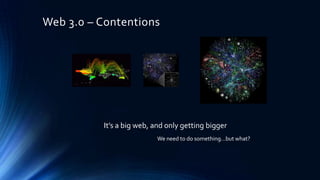
It’s a big web, and only getting bigger
We need to do something…but what?
Web 3.0 – Contentions (cont.)

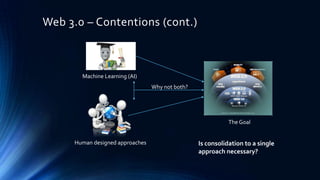
Machine Learning (AI)
Why not both?

The Goal
Human designed approaches

Is consolidation to a single
approach necessary?
Web 3.0 – Challenges
Vastness
• Very large landscape

• Duplication, outlining what constitutes the same data

Vagueness
• Fuzzy logic will prevail

Uncertainty, Inconsistency
• Difficult to define/classify/ingest data

• Logical contradictions in ontologies/vocabularies
• Deductive reasoning falls apart; defeasible and paraconsistent seem to stand
Wrap-Up

Question everything

Thank you for your time.
John Dougherty, CIO - Viriton
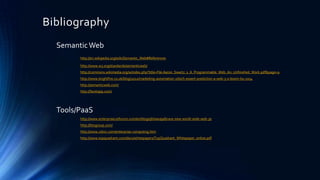
Bibliography
Semantic Web
http://en.wikipedia.org/wiki/Semantic_Web#References
http://www.w3.org/standards/semanticweb/
http://commons.wikimedia.org/w/index.php?title=File:Aaron_Swartz_s_A_Programmable_Web_An_Unfinished_Work.pdf&page=9
http://www.brightfire.co.uk/blog/2012/marketing-automation-2/tech-expert-prediction-a-web-3-0-boom-by-2014
http://semanticweb.com/
http://facetapp.com/

Tools/PaaS
http://www.enterprisecioforum.com/en/blogs/jkhawaja/brave-new-world-wide-web-30
http://btogroup.com/
http://www.zslinc.com/enterprise-computing.htm
http://www.topquadrant.com/docs/whitepapers/TopQuadrant_Whitepaper_online.pdf

Semantic Web (Web 3.0)

  • 1.
    Semantic Web (Web3.0) Big Data for Business 1/30/2014 Presented by: John dougherty
  • 2.
  • 3.
    Web 3.0 Definitions Definition:The predicted third generation of the World Wide Web, usually conjectured to include semantic tagging of content • Who’s in charge? • W3C has consolidated the resources • Value add positions, and platforms • PaaS • Structured design, implementations • OORDBMS • Object Oriented Relational Database Management System
  • 4.
    Web 3.0 Definitions(cont.) • RDF – Resource Description Framework (RDFS: RDF Schema) • General method for describing information • Simple Knowledge Organization System • Its main objective is to enable easy publication and use of such vocabularies as linked data • SPARQL – Recursive Acronym, SPARQL and RDF Query Language • Allows for a query to consist of triple patterns (triple-stores holds these), conjunctions (logic), disjunctions (logic), and optional patterns • Triple Store – A purpose built database for the storage and retrievel of triples (triple patterns) • These are ancillary to the idea of Web 3.0 and have been provided by many vendors • OWL – Web Ontology Language • OWL is a collection of ontology languages for authoring ontologies or vocabularies • Vocabularies – Definition of concepts and relationships on the Semantic Web • No clear division between what is referred to as a vocabulary, or an ontology • Per the W3C: “The trend is to use the word “ontology” for more complex, and possibly quite formal collection of terms, whereas “vocabulary” is used when such strict formalism is not necessarily used or only in a very loose sense.”
  • 5.
    Web 3.0 Definitions– Vocabulary (or Ontology) An example of the use of a vocabulary, or ontology: A bookseller may want to integrate data coming from different publishers. The data can be imported into a common RDF model, eg, by using converters to the publishers’ databases. However, one database may use the term “author”, whereas the other may use the term “creator”. To make the integration complete, an extra definition should be added to the RDF data, describing the fact that the relationship described as “author” is the same as “creator”. This extra piece of information is, in fact, a vocabulary (or an ontology), albeit an extremely simple one.
  • 6.
    Web 3.0 –OORDBMS Object Oriented Relational Database Management System • Some debate as to what constitutes an ODBMS • A basic support for classes of objects and the inheritance properties and methods by subclasses and their objects • An easier way (for a programmer/DBA) to understand what you’re doing to the data.
  • 7.
    Web 3.0 –Platforms Vendors have found a marketplace Salesforce PaaS concepts and use cases The Future Now Has great descriptions and reviews for existing platforms ZUEBOX Linked data and consulting service to implement Web 3.0 FANGGLE Vertical cloud product utilizing Web 3.0 concepts
  • 8.
    Web 3.0 –Tools Software solutions have been created FacetApp PaaS along with OntoApp as a modeling tool/solution Oracle Complete tools from modeling to production IBM Their best product has to be Watson, just spun off last year as a business division Salesforce Consulting and programmer services augment their PaaS
  • 9.
    Web 3.0 –Contentions It’s a big web, and only getting bigger We need to do something…but what?
  • 10.
    Web 3.0 –Contentions (cont.) Machine Learning (AI) Why not both? The Goal Human designed approaches Is consolidation to a single approach necessary?
  • 11.
    Web 3.0 –Challenges Vastness • Very large landscape • Duplication, outlining what constitutes the same data Vagueness • Fuzzy logic will prevail Uncertainty, Inconsistency • Difficult to define/classify/ingest data • Logical contradictions in ontologies/vocabularies • Deductive reasoning falls apart; defeasible and paraconsistent seem to stand
  • 13.
    Wrap-Up Question everything Thank youfor your time. John Dougherty, CIO - Viriton
  • 14.