SEMANTIC WEB
                                    1AbhijitC. Manepatil.                                   2Prof. P. R. Barapatre

                                    Student, 1st year M.E.( Computer Engineering)             Seminar Guide
                                    E-mail: abhimanepatil@gmail.com
                                    SKN Sinhgad Institute Of Technology, Kusgaon (bk.), Lonavala.

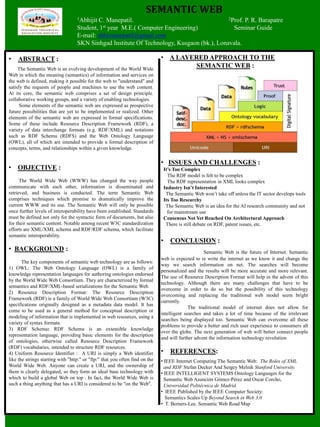
 •   ABSTRACT :                                                                • A LAYERED APPROACH TO THE
      The Semantic Web is an evolving development of the World Wide
                                                                                       SEMANTIC WEB :
 Web in which the meaning (semantics) of information and services on
 the web is defined, making it possible for the web to "understand" and
 satisfy the requests of people and machines to use the web content.
 At its core, the semantic web comprises a set of design principle.
 collaborative working groups, and a variety of enabling technologies.
       Some elements of the semantic web are expressed as prospective
 future possibilities that are yet to be implemented or realized. Other
 elements of the semantic web are expressed in formal specifications.
 Some of these include Resource Description Framework (RDF), a
 variety of data interchange formats (e.g. RDF/XML) and notations
 such as RDF Schema (RDFS) and the Web Ontology Language
 (OWL), all of which are intended to provide a formal description of
 concepts, terms, and relationships within a given knowledge.

                                                                               • ISSUES AND CHALLENGES :
 • OBJECTIVE :                                                                     It’s Too Complex
                                                                                     The RDF model is felt to be complex
       The World Wide Web (WWW) has changed the way people                           The RDF representation in XML looks complex
Bvbnll……………………………………………………………………………………………………
 communicate with each other, information is disseminated and
 retrieved, and business is conducted. The term Semantic Web
                                                                                   Industry Isn’t Interested
                                                                                    The Semantic Web won’t take off unless the IT sector develops tools
………………………………………………………………………………………………………………
 comprises techniques which promise to dramatically improve the
 current WWW and its use. The Semantic Web will only be possible
                                                                                   Its Too Researchy
                                                                                    The Semantic Web is an idea for the AI research community and not
………………………………………………………………………………………………………………
 once further levels of interoperability have been established. Standards
 must be defined not only for the syntactic form of documents, but also
                                                                                     for mainstream use
                                                                                   Consensus Not Yet Reached On Architectural Approach
 for their semantic content. Notable among recent W3C standardization
………………………………………………………………………………………………………………
 efforts are XML/XML schema and RDF/RDF schema, which facilitate
                                                                                    There is still debate on RDF, patent issues, etc.

 semantic interoperability.
………………………………………………………………………………………………………………                           • CONCLUSION :
• BACKGROUND :
………………………………………………………………………………………………………………                                               Semantic Web is the future of Internet. Semantic
                                                                     web is expected to re write the internet as we know it and change the
………………………………………………………………………………………………………………
      The key components of semantic web technology are as follows:
1) OWL: The Web Ontology Language (OWL) is a family of
                                                                     way we search information on net. The searches will become
                                                                     personalized and the results will be more accurate and more relevant.
knowledge representation languages for authoring ontologies endorsed
                                                               ....gftfgf of Resource Description Format will help in the advent of this
by the World Wide Web Consortium. They are characterized by formal
                                                                     The use
                                                                     technology. Although there are many challenges that have to be
 semantics and RDF/XML-based serializations for the Semantic Web.
                                                                               overcome in order to do so but the possibility of this technology
 2) Resource Description Format: The Resource Description
                                                                               overcoming and replacing the traditional web model seem bright
 Framework (RDF) is a family of World Wide Web Consortium (W3C)
                                                                               currently.
 specifications originally designed as a metadata data model. It has
                                                                                             The traditional model of internet does not allow for
 come to be used as a general method for conceptual description or
                                                                               intelligent searches and takes a lot of time because of the irrelevant
 modeling of information that is implemented in web resources, using a
                                                                               searches being displayed too. Semantic Web can overcome all these
 variety of syntax formats.
                                                                               problems to provide a better and rich user experience to consumers all
 3) RDF Schema: RDF Schema is an extensible knowledge
                                                                               over the globe. The next generation of web will better connect people
 representation language, providing basic elements for the description
                                                                               and will further advent the information technology revolution
 of ontologies, otherwise called Resource Description Framework
                                                                               .
 (RDF) vocabularies, intended to structure RDF resources.
 4) Uniform Resource Identifier : A URI is simply a Web identifier             •      REFERENCES:
 like the strings starting with "http:" or "ftp:" that you often find on the   • IEEE Internet Computing The Semantic Web: The Roles of XML
 World Wide Web. Anyone can create a URI, and the ownership of                   and RDF Stefan Decker And Sergey Melnik Stanford University.
 them is clearly delegated, so they form an ideal base technology with         • IEEE INTELLIGENT SYSTEMS Ontology Languages for the
 which to build a global Web on top . In fact, the World Wide Web is             Semantic Web Asunción Gómez-Pérez and Oscar Corcho,
 such a thing anything that has a URI is considered to be "on the Web".          Universidad Politécnica de Madrid.
                                                                               • IEEE Published by the IEEE Computer Society:
                                                                                  Semantics Scales Up Beyond Search in Web 3.0
                                                                               • T. Berners-Lee. Semantic Web Road Map

Poster Semantic Web - Abhijit Chandrasen Manepatil

  • 1.
    SEMANTIC WEB 1AbhijitC. Manepatil. 2Prof. P. R. Barapatre Student, 1st year M.E.( Computer Engineering) Seminar Guide E-mail: abhimanepatil@gmail.com SKN Sinhgad Institute Of Technology, Kusgaon (bk.), Lonavala. • ABSTRACT : • A LAYERED APPROACH TO THE The Semantic Web is an evolving development of the World Wide SEMANTIC WEB : Web in which the meaning (semantics) of information and services on the web is defined, making it possible for the web to "understand" and satisfy the requests of people and machines to use the web content. At its core, the semantic web comprises a set of design principle. collaborative working groups, and a variety of enabling technologies. Some elements of the semantic web are expressed as prospective future possibilities that are yet to be implemented or realized. Other elements of the semantic web are expressed in formal specifications. Some of these include Resource Description Framework (RDF), a variety of data interchange formats (e.g. RDF/XML) and notations such as RDF Schema (RDFS) and the Web Ontology Language (OWL), all of which are intended to provide a formal description of concepts, terms, and relationships within a given knowledge. • ISSUES AND CHALLENGES : • OBJECTIVE : It’s Too Complex The RDF model is felt to be complex The World Wide Web (WWW) has changed the way people The RDF representation in XML looks complex Bvbnll…………………………………………………………………………………………………… communicate with each other, information is disseminated and retrieved, and business is conducted. The term Semantic Web Industry Isn’t Interested The Semantic Web won’t take off unless the IT sector develops tools ……………………………………………………………………………………………………………… comprises techniques which promise to dramatically improve the current WWW and its use. The Semantic Web will only be possible Its Too Researchy The Semantic Web is an idea for the AI research community and not ……………………………………………………………………………………………………………… once further levels of interoperability have been established. Standards must be defined not only for the syntactic form of documents, but also for mainstream use Consensus Not Yet Reached On Architectural Approach for their semantic content. Notable among recent W3C standardization ……………………………………………………………………………………………………………… efforts are XML/XML schema and RDF/RDF schema, which facilitate There is still debate on RDF, patent issues, etc. semantic interoperability. ……………………………………………………………………………………………………………… • CONCLUSION : • BACKGROUND : ……………………………………………………………………………………………………………… Semantic Web is the future of Internet. Semantic web is expected to re write the internet as we know it and change the ……………………………………………………………………………………………………………… The key components of semantic web technology are as follows: 1) OWL: The Web Ontology Language (OWL) is a family of way we search information on net. The searches will become personalized and the results will be more accurate and more relevant. knowledge representation languages for authoring ontologies endorsed ....gftfgf of Resource Description Format will help in the advent of this by the World Wide Web Consortium. They are characterized by formal The use technology. Although there are many challenges that have to be semantics and RDF/XML-based serializations for the Semantic Web. overcome in order to do so but the possibility of this technology 2) Resource Description Format: The Resource Description overcoming and replacing the traditional web model seem bright Framework (RDF) is a family of World Wide Web Consortium (W3C) currently. specifications originally designed as a metadata data model. It has The traditional model of internet does not allow for come to be used as a general method for conceptual description or intelligent searches and takes a lot of time because of the irrelevant modeling of information that is implemented in web resources, using a searches being displayed too. Semantic Web can overcome all these variety of syntax formats. problems to provide a better and rich user experience to consumers all 3) RDF Schema: RDF Schema is an extensible knowledge over the globe. The next generation of web will better connect people representation language, providing basic elements for the description and will further advent the information technology revolution of ontologies, otherwise called Resource Description Framework . (RDF) vocabularies, intended to structure RDF resources. 4) Uniform Resource Identifier : A URI is simply a Web identifier • REFERENCES: like the strings starting with "http:" or "ftp:" that you often find on the • IEEE Internet Computing The Semantic Web: The Roles of XML World Wide Web. Anyone can create a URI, and the ownership of and RDF Stefan Decker And Sergey Melnik Stanford University. them is clearly delegated, so they form an ideal base technology with • IEEE INTELLIGENT SYSTEMS Ontology Languages for the which to build a global Web on top . In fact, the World Wide Web is Semantic Web Asunción Gómez-Pérez and Oscar Corcho, such a thing anything that has a URI is considered to be "on the Web". Universidad Politécnica de Madrid. • IEEE Published by the IEEE Computer Society: Semantics Scales Up Beyond Search in Web 3.0 • T. Berners-Lee. Semantic Web Road Map