Planning for
Successful Medicaid
Expansion Advocacy
 in South Carolina

 Charles Stephens
 AIDS United
 Southern Regional Organizer
 Tuesday, October 16, 2012
Agenda
• Why is Medicaid
  expansion important for
  people living with HIV?
• Essential Health
  Benefits
• What’s happening now?
• Messaging
• Mapping Out Next
  Steps
Why Medicaid Expansion is Critical

Expanded Medicaid
eligibility in 2014 will
result in greater access
to care for people
living with HIV.
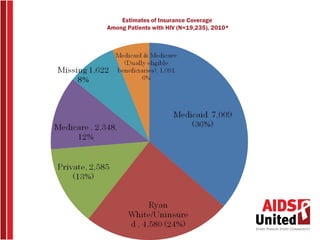
Estimates of Insurance Coverage
Among Patients with HIV (N=19,235), 2010*
Why Medicaid Expansion is
                Critical
• Offers the greatest
  promise to ending the
  United States HIV/AIDS
  epidemic.
• Wider and more reliable
  access to HIV treatment
  and care through
  Medicaid expansion
• Will reduce health
  disparities and new
  infections.
REMEMBER!!!!
By expanding health coverage to
     tens of thousands of HIV
   positive individuals who are
uninsured or under insured, the
   ACA can have an important
      impact on treatment as
 prevention. Focus on Medicaid
expansion and on Essential Health
    Benefits will be important.
Also, remember…
 Medicaid expansion will help
more HIV-positive Americans
receive a diagnosis and will help
ensure linkage to care, access
to drugs, and help in effectively
managing adherence to
maintain their own health and
that of their partners.
Essential Health Benefits
• Essential health benefits
  must include coverage of
  services and items in all
  10 statutory categories.
• The health law lists 10
  broad categories of
  essential benefits,
  including preventive care,
  emergency services,
  maternity care, hospital
  and doctors’ services, and
  prescription drugs.  
Essential Health Benefits
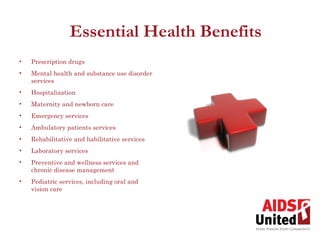
•   Prescription drugs
•   Mental health and substance use disorder
    services
•   Hospitalization
•   Maternity and newborn care
•   Emergency services
•   Ambulatory patients services
•   Rehabilitative and habilitative services
•   Laboratory services
•   Preventive and wellness services and
    chronic disease management
•   Pediatric services, including oral and
    vision care
Essential Health Benefits
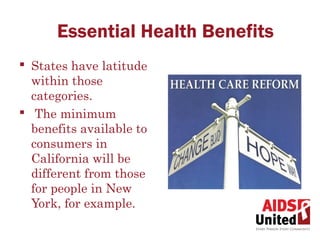
 States have latitude
  within those
  categories.
 The minimum
  benefits available to
  consumers in
  California will be
  different from those
  for people in New
  York, for example.
South Carolina
•   Over 15,000 South Carolinians are living with
    HIV/AIDS,
•   43% of those who know their status are not in
    treatment.
•    Expanding Medicaid would significantly
    alleviate the state’s HIV epidemic.
•   If South Carolina does not expand Medicaid,
    hospitals will face severe deficits and be forced to
    close or pass costs onto consumers of private
    health insurance, inflating premiums.
•   Federal dollars will pay for 90-100% of the cost of
    covering newly eligibles across the nation,
    making South Carolina one of the biggest
    potential beneficiaries of the funds associated
    with the expansion (nearly 20% of South
    Carolinians are uninsured).
•    Increased federal funding contributes to the
    economy – creating jobs and spurring consumer
    spending.
Also…
  •   Moreover, if South Carolina does not
      expand Medicaid, South Carolinians
      will ultimately subsidize the cost of
      coverage in states that do, via federal
      taxation.
  •   Net Savings – South Carolina’s
      spending on newly eligibles will be
      offset by the savings realized in
      reduced spending on uncompensated
      care.
  •    In the first five years of expanding
      Medicaid, South Carolina would
      realize net savings of $678 million.
What’s happening now in SC…
•   The Department of Insurance is accepting comments regarding the
    selection of a South Carolina essential health benefits (EHB)
    benchmark plan for health insurance coverage under the federal
    Affordable Care Act by September 25 according to South Carolina
    Healthcare Voices and the South Carolina Department of Insurance
    Site.
•   There was a September 25th hearing that was rescheduled but did
    not include a date.
•   As of October 10th , according to
    http://www.statereforum.org/state-progress-on-essential-
    health-benefits a working group on Essential Health Care
    Benefits was formed but no benchmark plan was recommended.
What’s happening now, cont…
To facilitate an effective state-
level implementation, the South
Carolina Institute of Medicine
and Public Health and  South
Carolina Healthcare Voices, is
convening stakeholders from the
non-profit sector and state
agencies to explore the various
state-specific elements of the
legislation and examine possible
approaches to implementation. 
What’s happening now, cont…
This initiative will include
the creation of open, non-
discriminatory, educational
workgroups to help the state
prepare for and implement
health reform.  By bringing
diverse stakeholders around
the table we will develop a
plan that is best for the state
What’s happening now, cont…
              This effort, with honorary co-
              chairs Doug Bryant, a former
              Commissioner of the SC
              Department of Health and
              Environmental Control, and
              Robby Kerr, a former Director of
              the SC Department of Health
              and Human Services, will focus
              on building linkages with key
              state agencies to provide a
              neutral forum for collaborative
              decision-making and expand the
              collective public capacity to
              address the implementation of
              this legislation.
In short, the goal of this
initiative is to create a
public-private
collaborative so that South
Carolina can most
successfully implement
health care reform and take
advantage of the funding
opportunities that are
available to our state. 
Advocacy next steps
• How do you identify
  which coalitions to be
  apart of?
• Which coalitions should
  you join?
• How do you identify
  stakeholders,
  champions, and
  grasstops?
• Where are decisions
  being made, and how do
  you get a seat at those
  tables?
Advocacy next steps, cont…

- Setting up meetings
  with elected
  representatives
- Sign-on Letters
- Meet with agency
  directors
- Voter
  mobilization!!!!!
Messaging, pt 1
You are meeting with a
  South Carolina State
  Legislator about
  ACA expansion. You
  have 10 minutes to
  make your case.
  Take 5 minutes to
  develop three
  speaking points. Use
  materials if you
  need.
Messaging, pt 2
Break off in small groups, and take the
 next 15 minutes practicing your
 talking points.
Messaging, pt 3

What talking points can
 we use to take to elected
 officials and key decision
 makers?
Lets create a plan!!!!!!

What needs to
  happen in the
  next 90 days?
-sign-on letters
-meetings with
  representatives
- State lobby days
Examples of talking points
• Before health care reform…
  – health insurance companies could legally
    discriminate against me
  – I had to be disabled by AIDS before I could get the
    care that would prevent me from progressing to
    AIDS
•
Educate Yourself
• Get the facts on health care reform and what it means for
  people living with HIV
• Take advantage of available resources
   –   HIV Health Reform www.HIVHealthReform.org
   –   Families USA www.FamiliesUSA.org
   –   Community Catalyst www.CommunityCatalyst.org
   –   Treatment Access Expansion Project www.TAEP-USA.org
   –   AIDS United www.AIDSUnited.org
   –   White House www.whitehouse.gov/healthreform
• Factsheets/Talking points
• Webinars
• Policy Updates

Aca advocacy

  • 1.
    Planning for Successful Medicaid ExpansionAdvocacy in South Carolina Charles Stephens AIDS United Southern Regional Organizer Tuesday, October 16, 2012
  • 2.
    Agenda • Why isMedicaid expansion important for people living with HIV? • Essential Health Benefits • What’s happening now? • Messaging • Mapping Out Next Steps
  • 3.
    Why Medicaid Expansionis Critical Expanded Medicaid eligibility in 2014 will result in greater access to care for people living with HIV.
  • 4.
    Estimates of InsuranceCoverage Among Patients with HIV (N=19,235), 2010*
  • 5.
    Why Medicaid Expansionis Critical • Offers the greatest promise to ending the United States HIV/AIDS epidemic. • Wider and more reliable access to HIV treatment and care through Medicaid expansion • Will reduce health disparities and new infections.
  • 6.
    REMEMBER!!!! By expanding healthcoverage to tens of thousands of HIV positive individuals who are uninsured or under insured, the ACA can have an important impact on treatment as prevention. Focus on Medicaid expansion and on Essential Health Benefits will be important.
  • 7.
    Also, remember… Medicaidexpansion will help more HIV-positive Americans receive a diagnosis and will help ensure linkage to care, access to drugs, and help in effectively managing adherence to maintain their own health and that of their partners.
  • 8.
    Essential Health Benefits •Essential health benefits must include coverage of services and items in all 10 statutory categories. • The health law lists 10 broad categories of essential benefits, including preventive care, emergency services, maternity care, hospital and doctors’ services, and prescription drugs.  
  • 9.
    Essential Health Benefits • Prescription drugs • Mental health and substance use disorder services • Hospitalization • Maternity and newborn care • Emergency services • Ambulatory patients services • Rehabilitative and habilitative services • Laboratory services • Preventive and wellness services and chronic disease management • Pediatric services, including oral and vision care
  • 10.
    Essential Health Benefits States have latitude within those categories.  The minimum benefits available to consumers in California will be different from those for people in New York, for example.
  • 11.
    South Carolina • Over 15,000 South Carolinians are living with HIV/AIDS, • 43% of those who know their status are not in treatment. • Expanding Medicaid would significantly alleviate the state’s HIV epidemic. • If South Carolina does not expand Medicaid, hospitals will face severe deficits and be forced to close or pass costs onto consumers of private health insurance, inflating premiums. • Federal dollars will pay for 90-100% of the cost of covering newly eligibles across the nation, making South Carolina one of the biggest potential beneficiaries of the funds associated with the expansion (nearly 20% of South Carolinians are uninsured). • Increased federal funding contributes to the economy – creating jobs and spurring consumer spending.
  • 12.
    Also… • Moreover, if South Carolina does not expand Medicaid, South Carolinians will ultimately subsidize the cost of coverage in states that do, via federal taxation. • Net Savings – South Carolina’s spending on newly eligibles will be offset by the savings realized in reduced spending on uncompensated care. • In the first five years of expanding Medicaid, South Carolina would realize net savings of $678 million.
  • 13.
    What’s happening nowin SC… • The Department of Insurance is accepting comments regarding the selection of a South Carolina essential health benefits (EHB) benchmark plan for health insurance coverage under the federal Affordable Care Act by September 25 according to South Carolina Healthcare Voices and the South Carolina Department of Insurance Site. • There was a September 25th hearing that was rescheduled but did not include a date. • As of October 10th , according to http://www.statereforum.org/state-progress-on-essential- health-benefits a working group on Essential Health Care Benefits was formed but no benchmark plan was recommended.
  • 14.
    What’s happening now,cont… To facilitate an effective state- level implementation, the South Carolina Institute of Medicine and Public Health and  South Carolina Healthcare Voices, is convening stakeholders from the non-profit sector and state agencies to explore the various state-specific elements of the legislation and examine possible approaches to implementation. 
  • 15.
    What’s happening now,cont… This initiative will include the creation of open, non- discriminatory, educational workgroups to help the state prepare for and implement health reform.  By bringing diverse stakeholders around the table we will develop a plan that is best for the state
  • 16.
    What’s happening now,cont… This effort, with honorary co- chairs Doug Bryant, a former Commissioner of the SC Department of Health and Environmental Control, and Robby Kerr, a former Director of the SC Department of Health and Human Services, will focus on building linkages with key state agencies to provide a neutral forum for collaborative decision-making and expand the collective public capacity to address the implementation of this legislation.
  • 17.
    In short, thegoal of this initiative is to create a public-private collaborative so that South Carolina can most successfully implement health care reform and take advantage of the funding opportunities that are available to our state. 
  • 18.
    Advocacy next steps •How do you identify which coalitions to be apart of? • Which coalitions should you join? • How do you identify stakeholders, champions, and grasstops? • Where are decisions being made, and how do you get a seat at those tables?
  • 19.
    Advocacy next steps,cont… - Setting up meetings with elected representatives - Sign-on Letters - Meet with agency directors - Voter mobilization!!!!!
  • 20.
    Messaging, pt 1 Youare meeting with a South Carolina State Legislator about ACA expansion. You have 10 minutes to make your case. Take 5 minutes to develop three speaking points. Use materials if you need.
  • 21.
    Messaging, pt 2 Breakoff in small groups, and take the next 15 minutes practicing your talking points.
  • 22.
    Messaging, pt 3 Whattalking points can we use to take to elected officials and key decision makers?
  • 23.
    Lets create aplan!!!!!! What needs to happen in the next 90 days? -sign-on letters -meetings with representatives - State lobby days
  • 24.
    Examples of talkingpoints • Before health care reform… – health insurance companies could legally discriminate against me – I had to be disabled by AIDS before I could get the care that would prevent me from progressing to AIDS •
  • 25.
    Educate Yourself • Getthe facts on health care reform and what it means for people living with HIV • Take advantage of available resources – HIV Health Reform www.HIVHealthReform.org – Families USA www.FamiliesUSA.org – Community Catalyst www.CommunityCatalyst.org – Treatment Access Expansion Project www.TAEP-USA.org – AIDS United www.AIDSUnited.org – White House www.whitehouse.gov/healthreform • Factsheets/Talking points • Webinars • Policy Updates

Editor's Notes

  • #4 Eligibility is expanded to being income based Better health outcomes
  • #12 From TAEP
  • #14 S.C. Gov. Nikki Haley has been clear: she does not support the expansion and would not sign it into law. But Democrats and some moderate Republicans want to expand Medicaid – setting up what is sure to be one of the major fights of the legislative session that begins in January. Read more here: http://www.heraldonline.com/2012/10/02/4306146/sc-has-6-billion-a-year-at-stake.html#storylink=cpy