Online and Social Media Management
Santhosh N Basavarajappa
04/04/2017
1
Online and Social Media Management
Santhosh N Basavarajappa
09/05/2017
2
Semantic Web
Web of Data
Giant Global Graph
Data Web
Web 3.0
Linked Data Web
Semantic Data Web
Enterprise Information Web
Topic for discussion3
Structure for Discussion
1.0 Evolution of the Web
2.0 Web 1.0 and Web 2.0
3.0 Semantic Web
4.0 Sematic Web building blocks
5.0 Conclusion
6.0 References
4
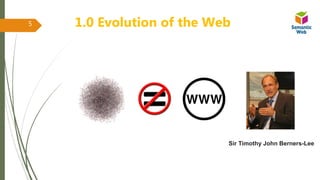
Sir Timothy John Berners-Lee
1.0 Evolution of the Web5
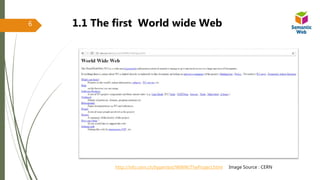
6 1.1 The first World wide Web
http://info.cern.ch/hypertext/WWW/TheProject.html Image Source : CERN
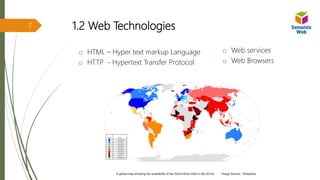
1.2 Web Technologies
A global map showing the availability of the World Wide Web in the 2010s Image Source ; Wikipedia
 HTML – Hyper text markup Language
 HTTP - Hypertext Transfer Protocol
 Web services
 Web Browsers
7
2.0 Web 1.0 (Static web – One Way)
 Started a linking web pages and hyperlink on a world wide web
 Used as “ Information sharing portal"
 Dividing the world wide web into usable directories
 Concept was based on theme of “Put the content together”
 Everyone has their personal own little corner in the cyberspace
 Media companies put content in the web and pushes it to user. using
web 1.0 Companies Like BBC,CNN able to get online.
8
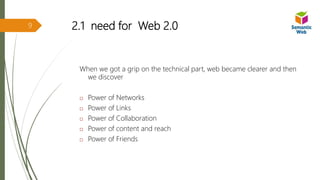
2.1 need for Web 2.0
When we got a grip on the technical part, web became clearer and then
we discover
 Power of Networks
 Power of Links
 Power of Collaboration
 Power of content and reach
 Power of Friends
9
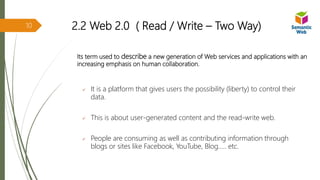
2.2 Web 2.0 ( Read / Write – Two Way)
Its term used to describe a new generation of Web services and applications with an
increasing emphasis on human collaboration.
 It is a platform that gives users the possibility (liberty) to control their
data.
 This is about user-generated content and the read-write web.
 People are consuming as well as contributing information through
blogs or sites like Facebook, YouTube, Blog….. etc.
10
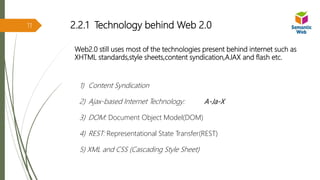
2.2.1 Technology behind Web 2.0
Web2.0 still uses most of the technologies present behind internet such as
XHTML standards,style sheets,content syndication,AJAX and flash etc.
1) Content Syndication
2) Ajax-based Internet Technology: A-Ja-X
3) DOM: Document Object Model(DOM)
4) REST: Representational State Transfer(REST)
5) XML and CSS (Cascading Style Sheet)
11
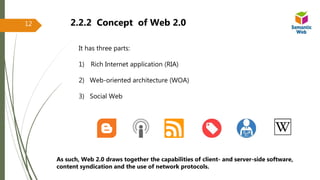
It has three parts:
1) Rich Internet application (RIA)
2) Web-oriented architecture (WOA)
3) Social Web
2.2.2 Concept of Web 2.0
As such, Web 2.0 draws together the capabilities of client- and server-side software,
content syndication and the use of network protocols.
12
2.2.3 Vulnerabilities in Web 2.0
1) Cross Site Scripting
2) Cross Site Request Forgery.
3) SQL Injection.
4) Authentication and Authorization Flaws.
XSS Worms
Mashups
5) Information Leakage.
13
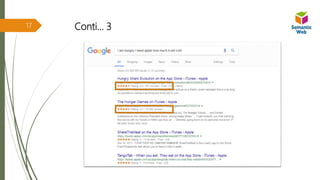
2.3.4 Example for a Search in Web
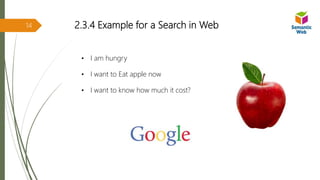
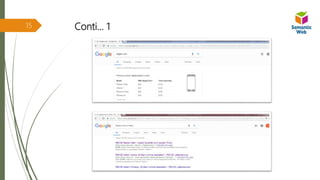
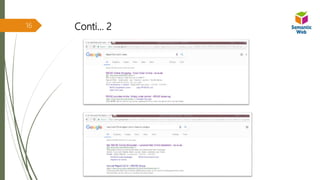
• I am hungry
• I want to Eat apple now
• I want to know how much it cost?
14
Conti… 115
Conti… 216
Conti… 317
Conti… 3
Lets see what Jarvis can do ??
Source : https://www.youtube.com/watch?v=8yubRtNYnZQ
18
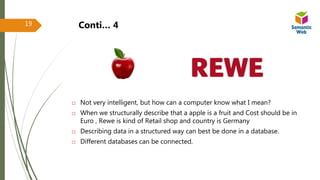
 Not very intelligent, but how can a computer know what I mean?
 When we structurally describe that a apple is a fruit and Cost should be in
Euro , Rewe is kind of Retail shop and country is Germany
 Describing data in a structured way can best be done in a database.
 Different databases can be connected.
Conti… 419
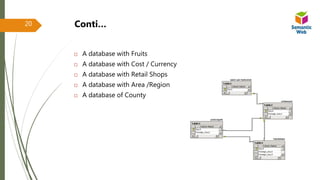
 A database with Fruits
 A database with Cost / Currency
 A database with Retail Shops
 A database with Area /Region
 A database of County
Conti…20
3.0 Semantic Web – What is about ??
 1969: paper Semantic Information Processing by Ross Quillial
 1980s: CYC and WordNet
 mid- to late 1990s: Tim Berners-Lee coins the term Semantic Web
 Semantics = meaning (from Greek)
 Set of practices and standards
 Allowing machines to understand data
 Ease sharing and mixing data
 Extend the World Wide Web rather than replace it
21
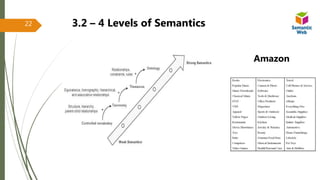
22 3.2 – 4 Levels of Semantics
Amazon
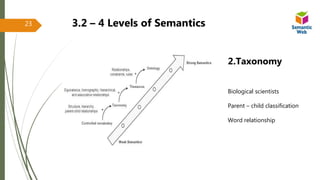
23 3.2 – 4 Levels of Semantics
Biological scientists
Parent – child classification
Word relationship
2.Taxonomy
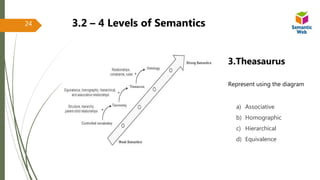
24 3.2 – 4 Levels of Semantics
3.Theasaurus
a) Associative
b) Homographic
c) Hierarchical
d) Equivalence
Represent using the diagram
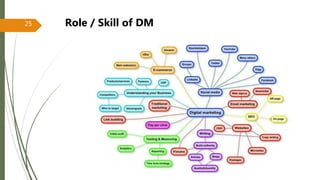
25 Role / Skill of DM
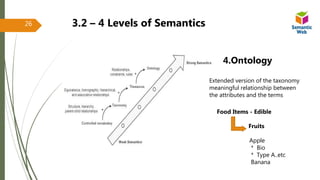
26 3.2 – 4 Levels of Semantics
4.Ontology
Extended version of the taxonomy
meaningful relationship between
the attributes and the terms
Food Items - Edible
Fruits
Apple
* Bio
* Type A..etc
Banana
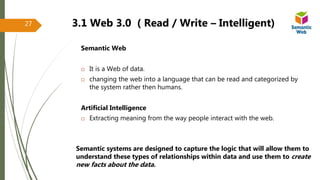
3.1 Web 3.0 ( Read / Write – Intelligent)
Semantic Web
 It is a Web of data.
 changing the web into a language that can be read and categorized by
the system rather then humans.
Artificial Intelligence
 Extracting meaning from the way people interact with the web.
27
Semantic systems are designed to capture the logic that will allow them to
understand these types of relationships within data and use them to create
new facts about the data.
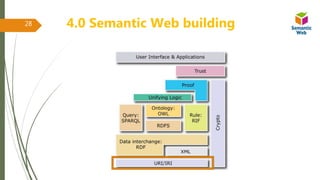
4.0 Semantic Web building28
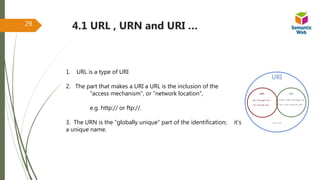
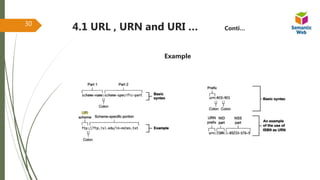
1. URL is a type of URI
2. The part that makes a URI a URL is the inclusion of the
“access mechanism”, or “network location”,
e.g. http:// or ftp://.
3. The URN is the “globally unique” part of the identification; it’s
a unique name.
4.1 URL , URN and URI …29
30
Example
4.1 URL , URN and URI … Conti…
HOW DO MACHINES KNOW WHAT DATA ?
Identity + Definition + Structure
4.2 Resource Description Framework
Data – Is the set of information
Metadata – is "data [information] that provides
information about other data"
31
IDENTITY + DEFINITION + STRUCTURE
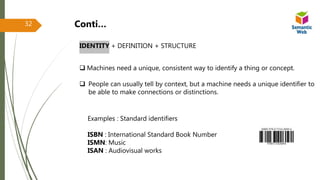
 Machines need a unique, consistent way to identify a thing or concept.
 People can usually tell by context, but a machine needs a unique identifier to
be able to make connections or distinctions.
Examples : Standard identifiers
ISBN : International Standard Book Number
ISMN: Music
ISAN : Audiovisual works
Conti…32
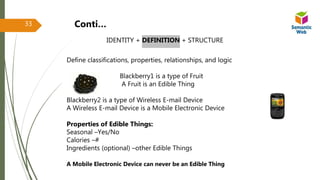
Define classifications, properties, relationships, and logic
Blackberry1 is a type of Fruit
A Fruit is an Edible Thing
Blackberry2 is a type of Wireless E-mail Device
A Wireless E-mail Device is a Mobile Electronic Device
Properties of Edible Things:
Seasonal –Yes/No
Calories –#
Ingredients (optional) –other Edible Things
A Mobile Electronic Device can never be an Edible Thing
IDENTITY + DEFINITION + STRUCTURE
Conti…33
MicroFormats–uses XHTML & HTML markup to embed meaning in a webpage
hCard for contact information hCalendar for events
<span class="vevent">
<span class="summary">This presentation was given</span>
on <span class="dtstart">2017-04-04</span>
at the Cologne Business School
in <span class="location">Cologne, Germany</span>.
</span >
Machine Tags (folksonomy) –definition added to simple user tagging
flora:tree=coniferous
upcoming:event=81334
IDENTITY + DEFINITION + STRUCTURE
Conti…34
A simple data model for –
Formally describing the semantics of information in a machine accessible way
– representing meta-data (data about data)
• A set of representation syntaxes
– XML (standard) but also N3, Turtle, …
• Building blocks
–Resources (with unique identifiers)
– Literals
– Named relations between pairs of resources
(or a resource and a literal)
A language for representing information about resources in the World
Wide Web”
4.3 Resource Description Framework35
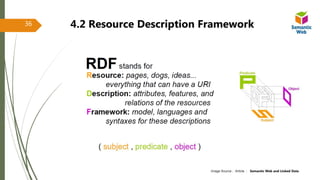
36 4.2 Resource Description Framework
Image Source ; Article : Semantic Web and Linked Data
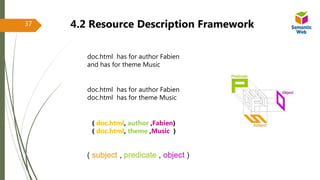
doc.html has for author Fabien
and has for theme Music
doc.html has for author Fabien
doc.html has for theme Music
( doc.html, author ,Fabien)
( doc.html, theme ,Music )
37 4.2 Resource Description Framework
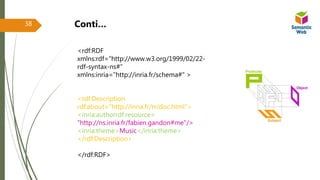
<rdf:RDF
xmlns:rdf="http://www.w3.org/1999/02/22-
rdf-syntax-ns#”
xmlns:inria="http://inria.fr/schema#" >
<rdf:Description
rdf:about="http://inria.fr/rr/doc.html">
<inria:authorrdf:resource=
"http://ns.inria.fr/fabien.gandon#me"/>
<inria:theme>Music</inria:theme>
</rdf:Description>
</rdf:RDF>
Conti…38
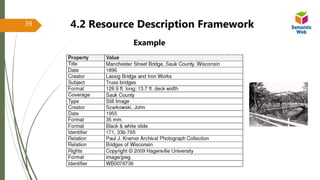
39 4.2 Resource Description Framework
Example
40
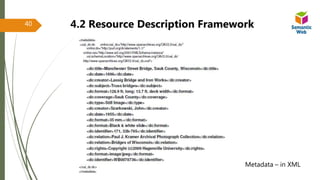
Metadata – in XML
4.2 Resource Description Framework
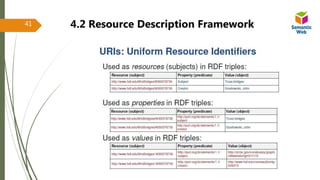
41 4.2 Resource Description Framework
• Simple but expressive data model
• Global identifiers of all resources (URIs)
– Reduces ambiguity
• Easier incremental data integration
– Can handle incomplete information (Open World Assumption)
• Schema agility
• Graph structure
– Suitable for a large class of tasks
– Data merging is easier
42 4.3 RDF - Advantages
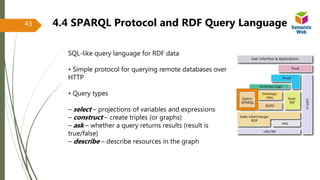
4.4 SPARQL Protocol and RDF Query Language
SQL-like query language for RDF data
• Simple protocol for querying remote databases over
HTTP
• Query types
– select – projections of variables and expressions
– construct – create triples (or graphs)
– ask – whether a query returns results (result is
true/false)
– describe – describe resources in the graph
43
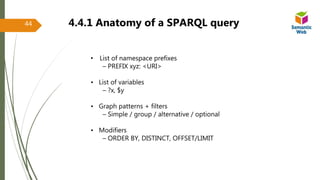
• List of namespace prefixes
– PREFIX xyz: <URI>
• List of variables
– ?x, $y
• Graph patterns + filters
– Simple / group / alternative / optional
• Modifiers
– ORDER BY, DISTINCT, OFFSET/LIMIT
4.4.1 Anatomy of a SPARQL query44
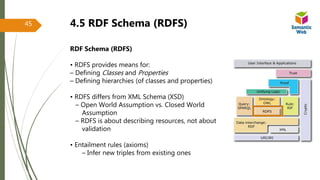
RDF Schema (RDFS)
• RDFS provides means for:
– Defining Classes and Properties
– Defining hierarchies (of classes and properties)
• RDFS differs from XML Schema (XSD)
– Open World Assumption vs. Closed World
Assumption
– RDFS is about describing resources, not about
validation
• Entailment rules (axioms)
– Infer new triples from existing ones
4.5 RDF Schema (RDFS)45
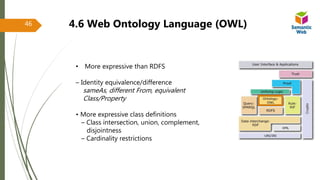
4.6 Web Ontology Language (OWL)
• More expressive than RDFS
– Identity equivalence/difference
sameAs, different From, equivalent
Class/Property
• More expressive class definitions
– Class intersection, union, complement,
disjointness
– Cardinality restrictions
46
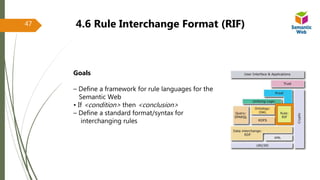
4.6 Rule Interchange Format (RIF)
Goals
– Define a framework for rule languages for the
Semantic Web
• If <condition> then <conclusion>
– Define a standard format/syntax for
interchanging rules
47
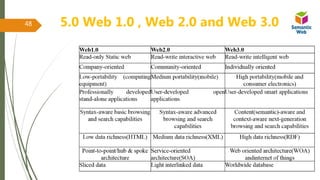
5.0 Web 1.0 , Web 2.0 and Web 3.048
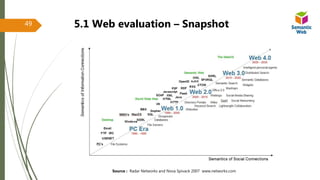
5.1 Web evaluation – Snapshot49
Source : Radar Networks and Nova Spivack 2007 www.networks.com
50

Semantic web Santhosh N Basavarajappa

  • 1.
    Online and SocialMedia Management Santhosh N Basavarajappa 04/04/2017 1
  • 2.
    Online and SocialMedia Management Santhosh N Basavarajappa 09/05/2017 2
  • 3.
    Semantic Web Web ofData Giant Global Graph Data Web Web 3.0 Linked Data Web Semantic Data Web Enterprise Information Web Topic for discussion3
  • 4.
    Structure for Discussion 1.0Evolution of the Web 2.0 Web 1.0 and Web 2.0 3.0 Semantic Web 4.0 Sematic Web building blocks 5.0 Conclusion 6.0 References 4
  • 5.
    Sir Timothy JohnBerners-Lee 1.0 Evolution of the Web5
  • 6.
    6 1.1 Thefirst World wide Web http://info.cern.ch/hypertext/WWW/TheProject.html Image Source : CERN
  • 7.
    1.2 Web Technologies Aglobal map showing the availability of the World Wide Web in the 2010s Image Source ; Wikipedia  HTML – Hyper text markup Language  HTTP - Hypertext Transfer Protocol  Web services  Web Browsers 7
  • 8.
    2.0 Web 1.0(Static web – One Way)  Started a linking web pages and hyperlink on a world wide web  Used as “ Information sharing portal"  Dividing the world wide web into usable directories  Concept was based on theme of “Put the content together”  Everyone has their personal own little corner in the cyberspace  Media companies put content in the web and pushes it to user. using web 1.0 Companies Like BBC,CNN able to get online. 8
  • 9.
    2.1 need forWeb 2.0 When we got a grip on the technical part, web became clearer and then we discover  Power of Networks  Power of Links  Power of Collaboration  Power of content and reach  Power of Friends 9
  • 10.
    2.2 Web 2.0( Read / Write – Two Way) Its term used to describe a new generation of Web services and applications with an increasing emphasis on human collaboration.  It is a platform that gives users the possibility (liberty) to control their data.  This is about user-generated content and the read-write web.  People are consuming as well as contributing information through blogs or sites like Facebook, YouTube, Blog….. etc. 10
  • 11.
    2.2.1 Technology behindWeb 2.0 Web2.0 still uses most of the technologies present behind internet such as XHTML standards,style sheets,content syndication,AJAX and flash etc. 1) Content Syndication 2) Ajax-based Internet Technology: A-Ja-X 3) DOM: Document Object Model(DOM) 4) REST: Representational State Transfer(REST) 5) XML and CSS (Cascading Style Sheet) 11
  • 12.
    It has threeparts: 1) Rich Internet application (RIA) 2) Web-oriented architecture (WOA) 3) Social Web 2.2.2 Concept of Web 2.0 As such, Web 2.0 draws together the capabilities of client- and server-side software, content syndication and the use of network protocols. 12
  • 13.
    2.2.3 Vulnerabilities inWeb 2.0 1) Cross Site Scripting 2) Cross Site Request Forgery. 3) SQL Injection. 4) Authentication and Authorization Flaws. XSS Worms Mashups 5) Information Leakage. 13
  • 14.
    2.3.4 Example fora Search in Web • I am hungry • I want to Eat apple now • I want to know how much it cost? 14
  • 15.
  • 16.
  • 17.
  • 18.
    Conti… 3 Lets seewhat Jarvis can do ?? Source : https://www.youtube.com/watch?v=8yubRtNYnZQ 18
  • 19.
     Not veryintelligent, but how can a computer know what I mean?  When we structurally describe that a apple is a fruit and Cost should be in Euro , Rewe is kind of Retail shop and country is Germany  Describing data in a structured way can best be done in a database.  Different databases can be connected. Conti… 419
  • 20.
     A databasewith Fruits  A database with Cost / Currency  A database with Retail Shops  A database with Area /Region  A database of County Conti…20
  • 21.
    3.0 Semantic Web– What is about ??  1969: paper Semantic Information Processing by Ross Quillial  1980s: CYC and WordNet  mid- to late 1990s: Tim Berners-Lee coins the term Semantic Web  Semantics = meaning (from Greek)  Set of practices and standards  Allowing machines to understand data  Ease sharing and mixing data  Extend the World Wide Web rather than replace it 21
  • 22.
    22 3.2 –4 Levels of Semantics Amazon
  • 23.
    23 3.2 –4 Levels of Semantics Biological scientists Parent – child classification Word relationship 2.Taxonomy
  • 24.
    24 3.2 –4 Levels of Semantics 3.Theasaurus a) Associative b) Homographic c) Hierarchical d) Equivalence Represent using the diagram
  • 25.
    25 Role /Skill of DM
  • 26.
    26 3.2 –4 Levels of Semantics 4.Ontology Extended version of the taxonomy meaningful relationship between the attributes and the terms Food Items - Edible Fruits Apple * Bio * Type A..etc Banana
  • 27.
    3.1 Web 3.0( Read / Write – Intelligent) Semantic Web  It is a Web of data.  changing the web into a language that can be read and categorized by the system rather then humans. Artificial Intelligence  Extracting meaning from the way people interact with the web. 27 Semantic systems are designed to capture the logic that will allow them to understand these types of relationships within data and use them to create new facts about the data.
  • 28.
    4.0 Semantic Webbuilding28
  • 29.
    1. URL isa type of URI 2. The part that makes a URI a URL is the inclusion of the “access mechanism”, or “network location”, e.g. http:// or ftp://. 3. The URN is the “globally unique” part of the identification; it’s a unique name. 4.1 URL , URN and URI …29
  • 30.
    30 Example 4.1 URL ,URN and URI … Conti…
  • 31.
    HOW DO MACHINESKNOW WHAT DATA ? Identity + Definition + Structure 4.2 Resource Description Framework Data – Is the set of information Metadata – is "data [information] that provides information about other data" 31
  • 32.
    IDENTITY + DEFINITION+ STRUCTURE  Machines need a unique, consistent way to identify a thing or concept.  People can usually tell by context, but a machine needs a unique identifier to be able to make connections or distinctions. Examples : Standard identifiers ISBN : International Standard Book Number ISMN: Music ISAN : Audiovisual works Conti…32
  • 33.
    Define classifications, properties,relationships, and logic Blackberry1 is a type of Fruit A Fruit is an Edible Thing Blackberry2 is a type of Wireless E-mail Device A Wireless E-mail Device is a Mobile Electronic Device Properties of Edible Things: Seasonal –Yes/No Calories –# Ingredients (optional) –other Edible Things A Mobile Electronic Device can never be an Edible Thing IDENTITY + DEFINITION + STRUCTURE Conti…33
  • 34.
    MicroFormats–uses XHTML &HTML markup to embed meaning in a webpage hCard for contact information hCalendar for events <span class="vevent"> <span class="summary">This presentation was given</span> on <span class="dtstart">2017-04-04</span> at the Cologne Business School in <span class="location">Cologne, Germany</span>. </span > Machine Tags (folksonomy) –definition added to simple user tagging flora:tree=coniferous upcoming:event=81334 IDENTITY + DEFINITION + STRUCTURE Conti…34
  • 35.
    A simple datamodel for – Formally describing the semantics of information in a machine accessible way – representing meta-data (data about data) • A set of representation syntaxes – XML (standard) but also N3, Turtle, … • Building blocks –Resources (with unique identifiers) – Literals – Named relations between pairs of resources (or a resource and a literal) A language for representing information about resources in the World Wide Web” 4.3 Resource Description Framework35
  • 36.
    36 4.2 ResourceDescription Framework Image Source ; Article : Semantic Web and Linked Data
  • 37.
    doc.html has forauthor Fabien and has for theme Music doc.html has for author Fabien doc.html has for theme Music ( doc.html, author ,Fabien) ( doc.html, theme ,Music ) 37 4.2 Resource Description Framework
  • 38.
  • 39.
    39 4.2 ResourceDescription Framework Example
  • 40.
    40 Metadata – inXML 4.2 Resource Description Framework
  • 41.
    41 4.2 ResourceDescription Framework
  • 42.
    • Simple butexpressive data model • Global identifiers of all resources (URIs) – Reduces ambiguity • Easier incremental data integration – Can handle incomplete information (Open World Assumption) • Schema agility • Graph structure – Suitable for a large class of tasks – Data merging is easier 42 4.3 RDF - Advantages
  • 43.
    4.4 SPARQL Protocoland RDF Query Language SQL-like query language for RDF data • Simple protocol for querying remote databases over HTTP • Query types – select – projections of variables and expressions – construct – create triples (or graphs) – ask – whether a query returns results (result is true/false) – describe – describe resources in the graph 43
  • 44.
    • List ofnamespace prefixes – PREFIX xyz: <URI> • List of variables – ?x, $y • Graph patterns + filters – Simple / group / alternative / optional • Modifiers – ORDER BY, DISTINCT, OFFSET/LIMIT 4.4.1 Anatomy of a SPARQL query44
  • 45.
    RDF Schema (RDFS) •RDFS provides means for: – Defining Classes and Properties – Defining hierarchies (of classes and properties) • RDFS differs from XML Schema (XSD) – Open World Assumption vs. Closed World Assumption – RDFS is about describing resources, not about validation • Entailment rules (axioms) – Infer new triples from existing ones 4.5 RDF Schema (RDFS)45
  • 46.
    4.6 Web OntologyLanguage (OWL) • More expressive than RDFS – Identity equivalence/difference sameAs, different From, equivalent Class/Property • More expressive class definitions – Class intersection, union, complement, disjointness – Cardinality restrictions 46
  • 47.
    4.6 Rule InterchangeFormat (RIF) Goals – Define a framework for rule languages for the Semantic Web • If <condition> then <conclusion> – Define a standard format/syntax for interchanging rules 47
  • 48.
    5.0 Web 1.0, Web 2.0 and Web 3.048
  • 49.
    5.1 Web evaluation– Snapshot49 Source : Radar Networks and Nova Spivack 2007 www.networks.com
  • 50.