The Rhetorical
     Situation
                      The What?

ENC 3241 Day 3: Clayton Benjamin
What is Rhetoric?
 “The art of persuasion.”
 More broadly: “The newer sense of
  “rhetoric” implies that whenever humans
  communicate with other humans, they
  seek to elicit any number of responses
  ranging from understanding to emotional
  reaction to agreement to enlightenment
  or any one of almost limitless
  reactions,”OWL Purdue
What is the “Rhetorical
Situation?”
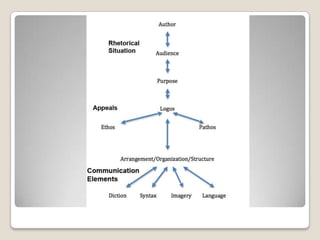
   Elements:
    ◦   Author:
    ◦   Text
    ◦   Context
    ◦   Audience
Author
   Someone who uses communication for a
    purpose.
    ◦ Eg: entertain, perform, persuade, educate,
      instruct, sadden, punish...

   Factors of authorship:
    ◦   Age
    ◦   Income
    ◦   Expertise
    ◦   Location
Text
   The medium/media used to disseminate
    the author’s intention.
    ◦ Eg: TV commercial, instruction manual,
      speech, email, letter, book, YouTube video,
      Prezi, PowerPoint, etc.
Context
   The situation in which the “writing” is
    taking place.
    ◦ Eg: Time, Place, Culture, Online/Offline,
      Current Events…
Audience
   The people who will see or hear the
    message.

   Audience factors
    ◦ Socio-Economic Status
    ◦ Knowledge/Expertise/Education/Subject
      Familiarity
    ◦ Political/Religious views
    ◦ Age
    ◦ Language
    ◦ Expectations
Applying Rhet Situation In Tech
Comm
   User Centered Design: design your
    documents around your user (audience)!
   Who is your audience?
   What prompted the need for the
    information you need to communicate?
    (purpose)
   Who are you? (author)
   Which medium should be used to
    effectively communicate? (text)
Due Next Time:
   Read Chapter 2!

Enc lecture day3

  • 1.
    The Rhetorical Situation The What? ENC 3241 Day 3: Clayton Benjamin
  • 2.
    What is Rhetoric? “The art of persuasion.”  More broadly: “The newer sense of “rhetoric” implies that whenever humans communicate with other humans, they seek to elicit any number of responses ranging from understanding to emotional reaction to agreement to enlightenment or any one of almost limitless reactions,”OWL Purdue
  • 3.
    What is the“Rhetorical Situation?”  Elements: ◦ Author: ◦ Text ◦ Context ◦ Audience
  • 4.
    Author  Someone who uses communication for a purpose. ◦ Eg: entertain, perform, persuade, educate, instruct, sadden, punish...  Factors of authorship: ◦ Age ◦ Income ◦ Expertise ◦ Location
  • 5.
    Text  The medium/media used to disseminate the author’s intention. ◦ Eg: TV commercial, instruction manual, speech, email, letter, book, YouTube video, Prezi, PowerPoint, etc.
  • 6.
    Context  The situation in which the “writing” is taking place. ◦ Eg: Time, Place, Culture, Online/Offline, Current Events…
  • 7.
    Audience  The people who will see or hear the message.  Audience factors ◦ Socio-Economic Status ◦ Knowledge/Expertise/Education/Subject Familiarity ◦ Political/Religious views ◦ Age ◦ Language ◦ Expectations
  • 9.
    Applying Rhet SituationIn Tech Comm  User Centered Design: design your documents around your user (audience)!  Who is your audience?  What prompted the need for the information you need to communicate? (purpose)  Who are you? (author)  Which medium should be used to effectively communicate? (text)
  • 10.
    Due Next Time:  Read Chapter 2!