Linked Library Data Jindřich Mynarz [email_address]
What is this talk about? In terms of  Polythematic Structured Subject Heading System , it will be about: „ libraries“ (PSH6536) „ type of data“ (PSH6591)
Knowledge technologies 1. System Meaning of a concept is identical with its place in the system. Systematic knowledge is complete, closed and invariant. Example: library
Knowledge technologies 2. Structure Meaning is defined by the  relationships  between concepts. Example: dictionary
Knowledge technologies 3. Net Meaning is created in the process of interpretation of an  actual configuration  of the net. Example: the Web Source: PETŘÍČEK, Miroslav. Síť čili tělo bez orgánů.  Filosofický časopis , r. 46, č. 1, 1998.
Linked data „ Linked data is the pragmatic implementation of the semantic web.“ (Richard Wallis)
Linked data means for achieving the semantic web vision web-native data model based on Web standards (HTTP) and semantic web technologies (RDF, RDFS, OWL) ecosystem of structured data – the Web of Data
Linked data principles Use  URIs  as names for things. Use  HTTP  URIs so that people can look up those names. When someone looks up a URI,  provide useful information , using the standards (RDF, SPARQL). Include  links to other URIs . so that they can discover more things.
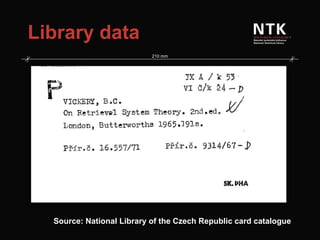
Library data Source: National Library of the Czech Republic card catalogue
Library data Libraries are about  documents  (information resources), not about data. And, of course,  libraries 2.0  are all about  people  (users).
Library data Bibliographic records are  black-boxes . They are not easily machine-readable. Low data granularity.
Library data Library data is: rather  text  than data (data buried in text) dumb  data alive  only within library software, on the Web it is  dead  data
Library data Contains duplicate data –  redundancy Once necessary for unreliable transport mechanisms to ensure consistency  is now not needed . Some data needs to be entered multiple times, so mistakes can be made in the process of data entry. Makes updates difficult.  Uncontrolled redundancy (as opposed to intentional replication) wastes disk space.
Library data Library-specific access protocols. library:// Z39.50 OAI-PMH
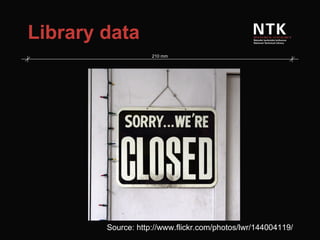
Library data Source: http://www.flickr.com/photos/lwr/144004119/
MARC Machine-readable cataloging MARC for mark-up Mark-up around text
MARC MARC is conceived as a data interchange format. But it is way more than just exchange format. It is also often used as a default view (interface) for catalogers.
MARC Data model – traditional catalog card field & subfield granularity „ packages“ of metadata in the form of records   (record paradigm)
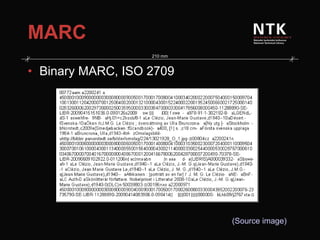
MARC Binary MARC, ISO 2709 (Source image)
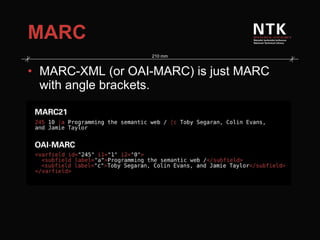
MARC MARC-XML (or OAI-MARC) is just MARC with angle brackets.
MARC Over  40  years old. Should be a dead language, just like Latin. IE6 of libraries.
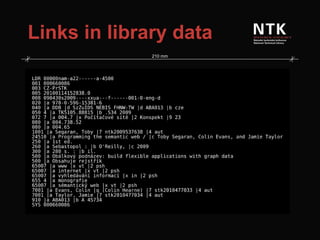
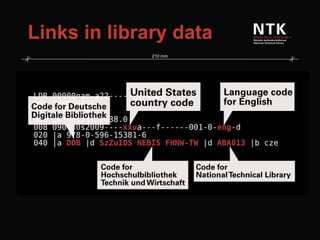
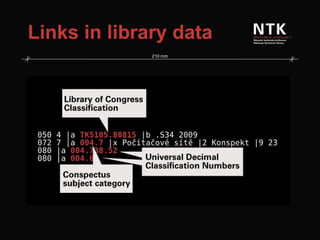
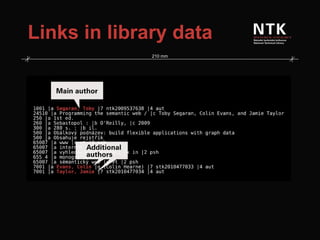
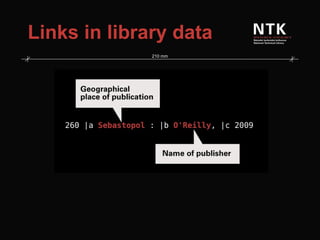
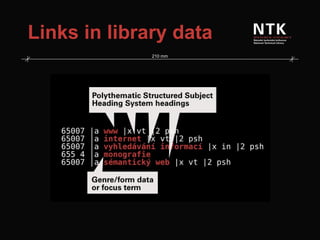
Links in library data There already are links in library data. Rather  implicit  than explicit.
Links in library data
Links in library data Links use  words  as identifiers. bound to a natural language ambiguous,  informationally incomplete (many concept require more words; e.g., balloon flying),  differences and errors in spelling partial non-unique, non-universal
Links in library data Can URIs be used as identifiers? Hacking MARC to accept URIs. Is RDFa hacking HTML? using newly added subfields New standards - RDA: Resource Description and Access
Linked library data What does it mean for library data to exist within the capabilities and constraints of the Web architecture? Linked data as a  single, unified interface  for library data. Web-compatible  data carrier.
Legacy data to linked data 1. Choosing datasets interesting for other parties machine-readable distributed with an open licence
Legacy data to linked data 2. Choosing the way of description  established and popular ontologies controlled vocabularies code lists
Legacy data to linked data 3. Creating mapping internal and external identity resolution based on partial identifiers
Legacy data to linked data 4. Storing data RDF triple store
Legacy data to linked data 5. Lightweight access API URI patterns design Content negotiation SPARQL endpoint
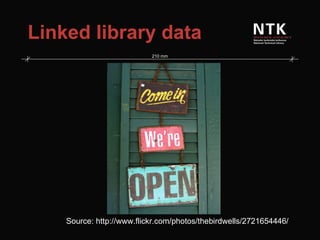
Linked library data Source: http://www.flickr.com/photos/thebirdwells/2721654446/
Linked library data at National Technical Library Polythematic Structured Subject Heading System http://psh.techlib.cz/skos data.techlib.cz ? ISSN database Bibliographic records Name authority records
Benefits of linked data for libraries „ Future for bibliographic control will be collaborative, decentralized, international at scope, and Web-based.“  (On the Record, 2008)
Benefits of linked data for libraries Multiple distribution channels Interoperability Data integration Decentralization of the cataloging process
Benefits of linked data for libraries Linked  library data: resource discovery navigation interface for library users (data as a navigation tool) explicit paths from vague to precise queries „ outsourcing” library authorities to external datasets (e.g., DBPedia) labeled links are amenable to manipulation by computers explicit bibliographic relations
Benefits of linked data for libraries Linkable  library data: incoming links search engine visibility
Benefits of libraries for linked data „ We appreciate libraries, we can not live without them, but we take them for granted.“ (Alex Iskold)
Benefits of libraries for linked data Brand of quality and trustworthiness Vast experience in managing information resources and services But, this knowledge may not be useful any longer under current circumstances. Bibliographic vocabularies as domain ontologies
Barriers to innovation Libraries long-established library processes out-of-date library standards Library software vendors libraries are often bound by long-lasting contracts use of MARC eliminates the possibility to use standard business software
Barriers to innovation Technological determinism: can the linked data technology drive the change and innovation? Chicken-egg problem without the necessary technology backing it is not possible to re-structure library processes to produce more linked data, and without the library's demand, there will be no software solution that enable that.
Consequences of maintaining the status quo Navigation restrictions. Coo peration restrictions. Standardization is a requirement to cooperation. Elimination of „local practices“ in favour  of standards. Cost of maintenance. Quality of data influences the quality of services, that can be built upon them. Library as „a book museum”. Need for internationalization puts new requirements on bibliographic data.
What is happening? RDA: Resource Description and Access Metadata Registry Project http://metadataregistry.org
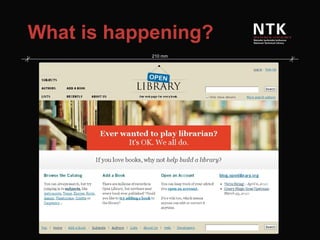
What is happening? OpenLibrary  http://www.openlibrary.org „ One web page for every book.“
What is happening?
What is happening? German National Library has released its linked data prototype for authority data. http://d-nb.info/gnd
What is happening? National Technical Library http://data.techlib.cz (?)
Summary „ Libraries must transition to the Web future without delay in regard to retain their significance as information providers.“ (On the Record, 2008)
Summary Interact with data from other information ecologies. Machine applications are also users of the data libraries produce. Becoming a part of the data supply chain.
Thank you! Jindřich Mynarz  E-mail: jindrich.mynarz@techlib.cz  Twitter: @jindrichmynarz

Linked library data

  • 1.
    Linked Library DataJindřich Mynarz [email_address]
  • 2.
    What is thistalk about? In terms of Polythematic Structured Subject Heading System , it will be about: „ libraries“ (PSH6536) „ type of data“ (PSH6591)
  • 3.
    Knowledge technologies 1.System Meaning of a concept is identical with its place in the system. Systematic knowledge is complete, closed and invariant. Example: library
  • 4.
    Knowledge technologies 2.Structure Meaning is defined by the relationships between concepts. Example: dictionary
  • 5.
    Knowledge technologies 3.Net Meaning is created in the process of interpretation of an actual configuration of the net. Example: the Web Source: PETŘÍČEK, Miroslav. Síť čili tělo bez orgánů. Filosofický časopis , r. 46, č. 1, 1998.
  • 6.
    Linked data „Linked data is the pragmatic implementation of the semantic web.“ (Richard Wallis)
  • 7.
    Linked data meansfor achieving the semantic web vision web-native data model based on Web standards (HTTP) and semantic web technologies (RDF, RDFS, OWL) ecosystem of structured data – the Web of Data
  • 8.
    Linked data principlesUse URIs as names for things. Use HTTP URIs so that people can look up those names. When someone looks up a URI, provide useful information , using the standards (RDF, SPARQL). Include links to other URIs . so that they can discover more things.
  • 9.
    Library data Source:National Library of the Czech Republic card catalogue
  • 10.
    Library data Librariesare about documents (information resources), not about data. And, of course, libraries 2.0 are all about people (users).
  • 11.
    Library data Bibliographicrecords are black-boxes . They are not easily machine-readable. Low data granularity.
  • 12.
    Library data Librarydata is: rather text than data (data buried in text) dumb data alive only within library software, on the Web it is dead data
  • 13.
    Library data Containsduplicate data – redundancy Once necessary for unreliable transport mechanisms to ensure consistency is now not needed . Some data needs to be entered multiple times, so mistakes can be made in the process of data entry. Makes updates difficult. Uncontrolled redundancy (as opposed to intentional replication) wastes disk space.
  • 14.
    Library data Library-specificaccess protocols. library:// Z39.50 OAI-PMH
  • 15.
    Library data Source:http://www.flickr.com/photos/lwr/144004119/
  • 16.
    MARC Machine-readable catalogingMARC for mark-up Mark-up around text
  • 17.
    MARC MARC isconceived as a data interchange format. But it is way more than just exchange format. It is also often used as a default view (interface) for catalogers.
  • 18.
    MARC Data model– traditional catalog card field & subfield granularity „ packages“ of metadata in the form of records (record paradigm)
  • 19.
    MARC Binary MARC,ISO 2709 (Source image)
  • 20.
    MARC MARC-XML (orOAI-MARC) is just MARC with angle brackets.
  • 21.
    MARC Over 40 years old. Should be a dead language, just like Latin. IE6 of libraries.
  • 22.
    Links in librarydata There already are links in library data. Rather implicit than explicit.
  • 23.
  • 24.
  • 25.
  • 26.
  • 27.
  • 28.
  • 29.
    Links in librarydata Links use words as identifiers. bound to a natural language ambiguous, informationally incomplete (many concept require more words; e.g., balloon flying), differences and errors in spelling partial non-unique, non-universal
  • 30.
    Links in librarydata Can URIs be used as identifiers? Hacking MARC to accept URIs. Is RDFa hacking HTML? using newly added subfields New standards - RDA: Resource Description and Access
  • 31.
    Linked library dataWhat does it mean for library data to exist within the capabilities and constraints of the Web architecture? Linked data as a single, unified interface for library data. Web-compatible data carrier.
  • 32.
    Legacy data tolinked data 1. Choosing datasets interesting for other parties machine-readable distributed with an open licence
  • 33.
    Legacy data tolinked data 2. Choosing the way of description established and popular ontologies controlled vocabularies code lists
  • 34.
    Legacy data tolinked data 3. Creating mapping internal and external identity resolution based on partial identifiers
  • 35.
    Legacy data tolinked data 4. Storing data RDF triple store
  • 36.
    Legacy data tolinked data 5. Lightweight access API URI patterns design Content negotiation SPARQL endpoint
  • 37.
    Linked library dataSource: http://www.flickr.com/photos/thebirdwells/2721654446/
  • 38.
    Linked library dataat National Technical Library Polythematic Structured Subject Heading System http://psh.techlib.cz/skos data.techlib.cz ? ISSN database Bibliographic records Name authority records
  • 39.
    Benefits of linkeddata for libraries „ Future for bibliographic control will be collaborative, decentralized, international at scope, and Web-based.“ (On the Record, 2008)
  • 40.
    Benefits of linkeddata for libraries Multiple distribution channels Interoperability Data integration Decentralization of the cataloging process
  • 41.
    Benefits of linkeddata for libraries Linked library data: resource discovery navigation interface for library users (data as a navigation tool) explicit paths from vague to precise queries „ outsourcing” library authorities to external datasets (e.g., DBPedia) labeled links are amenable to manipulation by computers explicit bibliographic relations
  • 42.
    Benefits of linkeddata for libraries Linkable library data: incoming links search engine visibility
  • 43.
    Benefits of librariesfor linked data „ We appreciate libraries, we can not live without them, but we take them for granted.“ (Alex Iskold)
  • 44.
    Benefits of librariesfor linked data Brand of quality and trustworthiness Vast experience in managing information resources and services But, this knowledge may not be useful any longer under current circumstances. Bibliographic vocabularies as domain ontologies
  • 45.
    Barriers to innovationLibraries long-established library processes out-of-date library standards Library software vendors libraries are often bound by long-lasting contracts use of MARC eliminates the possibility to use standard business software
  • 46.
    Barriers to innovationTechnological determinism: can the linked data technology drive the change and innovation? Chicken-egg problem without the necessary technology backing it is not possible to re-structure library processes to produce more linked data, and without the library's demand, there will be no software solution that enable that.
  • 47.
    Consequences of maintainingthe status quo Navigation restrictions. Coo peration restrictions. Standardization is a requirement to cooperation. Elimination of „local practices“ in favour of standards. Cost of maintenance. Quality of data influences the quality of services, that can be built upon them. Library as „a book museum”. Need for internationalization puts new requirements on bibliographic data.
  • 48.
    What is happening?RDA: Resource Description and Access Metadata Registry Project http://metadataregistry.org
  • 49.
    What is happening?OpenLibrary http://www.openlibrary.org „ One web page for every book.“
  • 50.
  • 51.
    What is happening?German National Library has released its linked data prototype for authority data. http://d-nb.info/gnd
  • 52.
    What is happening?National Technical Library http://data.techlib.cz (?)
  • 53.
    Summary „ Librariesmust transition to the Web future without delay in regard to retain their significance as information providers.“ (On the Record, 2008)
  • 54.
    Summary Interact withdata from other information ecologies. Machine applications are also users of the data libraries produce. Becoming a part of the data supply chain.
  • 55.
    Thank you! JindřichMynarz E-mail: jindrich.mynarz@techlib.cz Twitter: @jindrichmynarz