By: Saurabh S Shendge [email_address]
What is web 3.0 ? Is a Range of Developments:~ Semantic web [meaning of data]. SaaS [Software as a Service]. DaaS[Data as a Service]. Artificial Intelligence. Faster broadband connection, always, anywhere.
First lets look at…… Before looking into the details of web 3.0 , lets first go in past and see what we have experienced web as………
Our Experience for web… 1989 ;Tim Berner Lee , made a definition of world wide web.  Internet was born. People then started putting data on web. E-mail Data to show E-Commerce E-Business Company E-Brochures
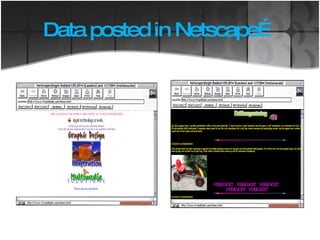
Data posted in Netscape…
This period was called as Web 1.0 Web 1.0 was all about searches for online content. When we got a grip on the technical part, the real possibilities of the web became more clear. We discovered the power of  networks.
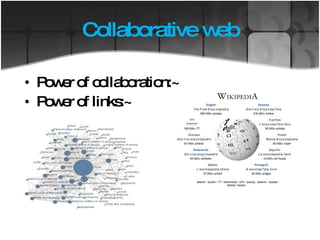
Collaborative web Power of collaboration:~ Power of links:~
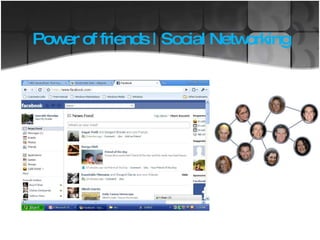
Power of friends | Social Networking
This is WEB 2.0 ,we call it as.. Web 2. is all about power of networks. Basically, web 2.0 is a  social  change. The technical part of the web hasn’t changed very much. Web 2.0 draw web to a different platform from what it was previously.  Web became a platform for applications.
Web 3.0 preliminaries… Web 2.0 was a social change applied on web. Where as , web 3.0 will be driven by  technological  changes.  Web 3.0 is a network where the data contend has meaning. First aspect in web 3.0 is to develop a semantic web.
Web 3.0 : Semantic web What is semantic web? A layer of meaning on the top of the current web content. Less of a catalog Enrich the structure of web Transform Web from fileserver to database ?
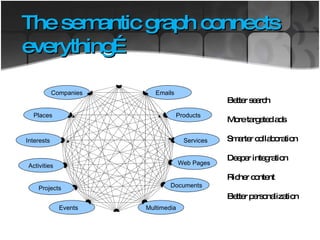
Better search More targeted ads Smarter collaboration Deeper integration Richer content Better personalization The semantic graph connects everything… Emails Companies Products Services Web Pages Multimedia Documents Events Projects Activities Interests Places
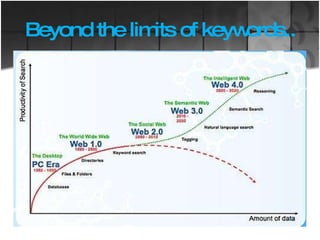
Beyond the limits of keywords..
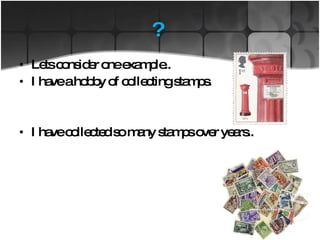
?  Lets consider one example.. I have a hobby of collecting stamps. I have collected so many stamps over years..
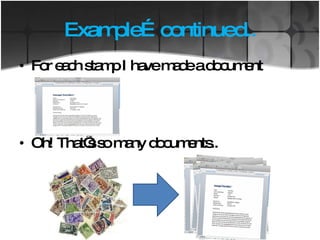
Example…continued.. For each stamp I have made a document Oh! That’s so many documents..
But.. How I will find those documents? Ah ! Of course  This is what current web is. Lots of document in the form of indexed keywords to search. Where we get random results. Not very intelligent. Obviously how a computer will get to know what human means? Solution?
Structuring the web.. Solution to the problem we face while searching is to structurally describe that Stamp is a STAMP and red is a COLOR. Describing the data in Databases.
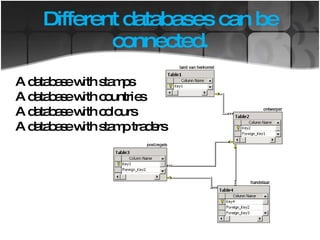
Different databases can be connected. A database with stamps A database with countries A database with colours A database with stamp traders
Components that will make web a semantic web Identifiers:  Uniform Resource Identifier [URI] Documents:  Extensible Markup Language Statements:  Resource Description Framework Provides a formal description of concepts , terms and relationships
Identifiers : Uniform Resource Identifier Used to indentify items on web Each item considered as resource Each resource has URI Just gives identification not location unlike URLs Name to a resource Decentralized
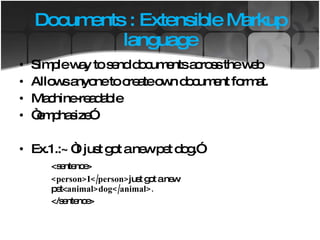
Documents : Extensible Markup language Simple way to send documents across the web Allows anyone to create own document format. Machine-readable “ emphasize” Ex.1.:~ “I just got a new pet dog.” <sentence> <person>I</person> just got a new  pet< animal>dog</animal>. </sentence>
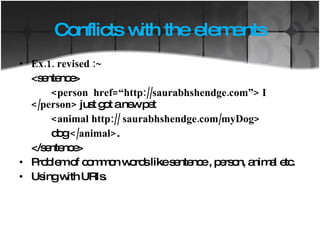
Conflicts with the elements Ex.1. revised :~ <sentence> <person  href=“http://saurabhshendge.com”> I  </person>  just got a new pet  <animal http:// saurabhshendge.com/myDog> dog  </animal> . </sentence> Problem of common words like sentence , person, animal etc. Using with URIs.
Statements : Resource Description Framework [RDF] RDF is a markup language to describe information and resource available on web. Putting in RDF makes it possible to get it on web. Simple model based Designed to be read and understood by computers RDF statement is lot like simple sentence , except almost all words are URI.  .Subject .Predicate .Object Ex.2. :~ “Aaron really likes Berner-Lee's weaving the web” <http://aaron.com> <http://love.example.org/terms/reallyLikes>  <http://w3.org/People/berners-Lee/Weaving the web>
RDF queries… Why use RDF rather than XML? Directly and unambiguously into Model Decentralized Generic parsers available Part of semantic web Do we use XML schema in conjunction with RDF? Language that restricts XML syntax RDF has its own Normalization Forms  No [partially] possibly
Web 3.0 : cloud  No need to  purchase application servers a small army to fine tune maintain them Software developers won’t have to  build a security and sharing model.  The cloud provides these items Ease of deployment, and depth of functionality More time given to functionality & meeting client needs
Web 3.0 : cloud  Software as a Service Data as a Service Resource as a Service Every developer around the world can access the same powerful cloud infrastructures Because code lives in the cloud, global talent pools can contribute to it Because it runs in the cloud, a truly global market can subscribe to it as a service
Web 3.0 : Artificial Intelligence  An extension of the Semantic web concept Academic research is being conducted to develop software for reasoning, based on description logic and intelligent agents, for example, the ''World Wide Mind'' project Companies such as IBM and Google are implementing new technologies that are yielding surprising information
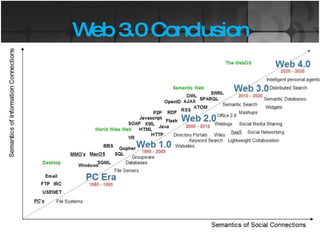
Web 3.0 Conclusion
Request to all…
Thank you all..

Web 3.0

  • 1.
    By: Saurabh SShendge [email_address]
  • 2.
    What is web3.0 ? Is a Range of Developments:~ Semantic web [meaning of data]. SaaS [Software as a Service]. DaaS[Data as a Service]. Artificial Intelligence. Faster broadband connection, always, anywhere.
  • 3.
    First lets lookat…… Before looking into the details of web 3.0 , lets first go in past and see what we have experienced web as………
  • 4.
    Our Experience forweb… 1989 ;Tim Berner Lee , made a definition of world wide web. Internet was born. People then started putting data on web. E-mail Data to show E-Commerce E-Business Company E-Brochures
  • 5.
    Data posted inNetscape…
  • 6.
    This period wascalled as Web 1.0 Web 1.0 was all about searches for online content. When we got a grip on the technical part, the real possibilities of the web became more clear. We discovered the power of networks.
  • 7.
    Collaborative web Powerof collaboration:~ Power of links:~
  • 8.
    Power of friends| Social Networking
  • 9.
    This is WEB2.0 ,we call it as.. Web 2. is all about power of networks. Basically, web 2.0 is a social change. The technical part of the web hasn’t changed very much. Web 2.0 draw web to a different platform from what it was previously. Web became a platform for applications.
  • 10.
    Web 3.0 preliminaries…Web 2.0 was a social change applied on web. Where as , web 3.0 will be driven by technological changes. Web 3.0 is a network where the data contend has meaning. First aspect in web 3.0 is to develop a semantic web.
  • 11.
    Web 3.0 :Semantic web What is semantic web? A layer of meaning on the top of the current web content. Less of a catalog Enrich the structure of web Transform Web from fileserver to database ?
  • 12.
    Better search Moretargeted ads Smarter collaboration Deeper integration Richer content Better personalization The semantic graph connects everything… Emails Companies Products Services Web Pages Multimedia Documents Events Projects Activities Interests Places
  • 13.
    Beyond the limitsof keywords..
  • 14.
    ? Letsconsider one example.. I have a hobby of collecting stamps. I have collected so many stamps over years..
  • 15.
    Example…continued.. For eachstamp I have made a document Oh! That’s so many documents..
  • 16.
    But.. How Iwill find those documents? Ah ! Of course This is what current web is. Lots of document in the form of indexed keywords to search. Where we get random results. Not very intelligent. Obviously how a computer will get to know what human means? Solution?
  • 17.
    Structuring the web..Solution to the problem we face while searching is to structurally describe that Stamp is a STAMP and red is a COLOR. Describing the data in Databases.
  • 18.
    Different databases canbe connected. A database with stamps A database with countries A database with colours A database with stamp traders
  • 19.
    Components that willmake web a semantic web Identifiers: Uniform Resource Identifier [URI] Documents: Extensible Markup Language Statements: Resource Description Framework Provides a formal description of concepts , terms and relationships
  • 20.
    Identifiers : UniformResource Identifier Used to indentify items on web Each item considered as resource Each resource has URI Just gives identification not location unlike URLs Name to a resource Decentralized
  • 21.
    Documents : ExtensibleMarkup language Simple way to send documents across the web Allows anyone to create own document format. Machine-readable “ emphasize” Ex.1.:~ “I just got a new pet dog.” <sentence> <person>I</person> just got a new pet< animal>dog</animal>. </sentence>
  • 22.
    Conflicts with theelements Ex.1. revised :~ <sentence> <person href=“http://saurabhshendge.com”> I </person> just got a new pet <animal http:// saurabhshendge.com/myDog> dog </animal> . </sentence> Problem of common words like sentence , person, animal etc. Using with URIs.
  • 23.
    Statements : ResourceDescription Framework [RDF] RDF is a markup language to describe information and resource available on web. Putting in RDF makes it possible to get it on web. Simple model based Designed to be read and understood by computers RDF statement is lot like simple sentence , except almost all words are URI. .Subject .Predicate .Object Ex.2. :~ “Aaron really likes Berner-Lee's weaving the web” <http://aaron.com> <http://love.example.org/terms/reallyLikes> <http://w3.org/People/berners-Lee/Weaving the web>
  • 24.
    RDF queries… Whyuse RDF rather than XML? Directly and unambiguously into Model Decentralized Generic parsers available Part of semantic web Do we use XML schema in conjunction with RDF? Language that restricts XML syntax RDF has its own Normalization Forms No [partially] possibly
  • 25.
    Web 3.0 :cloud No need to purchase application servers a small army to fine tune maintain them Software developers won’t have to build a security and sharing model. The cloud provides these items Ease of deployment, and depth of functionality More time given to functionality & meeting client needs
  • 26.
    Web 3.0 :cloud Software as a Service Data as a Service Resource as a Service Every developer around the world can access the same powerful cloud infrastructures Because code lives in the cloud, global talent pools can contribute to it Because it runs in the cloud, a truly global market can subscribe to it as a service
  • 27.
    Web 3.0 :Artificial Intelligence An extension of the Semantic web concept Academic research is being conducted to develop software for reasoning, based on description logic and intelligent agents, for example, the ''World Wide Mind'' project Companies such as IBM and Google are implementing new technologies that are yielding surprising information
  • 28.
  • 29.
  • 30.

Editor's Notes