VOTING PROCEDURES WITH INCOMPLETE
PREFERENCES
BY KATHRIN KONCZAK AND JEROME LANG


Presented by Scott Ames, Steven Frink, and Ellis Mitchell
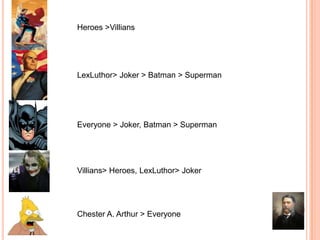
Heroes >Villians


LexLuthor> Joker > Batman > Superman


Everyone > Joker, Batman > Superman


Villians> Heroes, LexLuthor> Joker
INCOMPLETE PREFERENCES
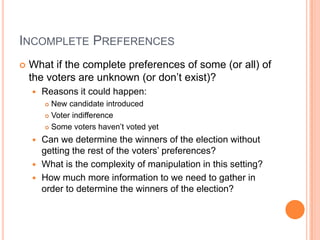
   What if the complete preferences of some (or all) of
    the voters are unknown (or don’t exist)?
       Reasons it could happen:
         New candidate introduced
         Voter indifference

         Some voters haven’t voted yet

       Can we determine the winners of the election without
        getting the rest of the voters’ preferences?
       What is the complexity of manipulation in this setting?
       How much more information to we need to gather in
        order to determine the winners of the election?
Heroes >Villians


LexLuthor> Joker > Batman > Superman


Everyone > Joker, Batman > Superman


Villians> Heroes, LexLuthor> Joker


Chester A. Arthur > Everyone
PREFERENCE RELATIONS
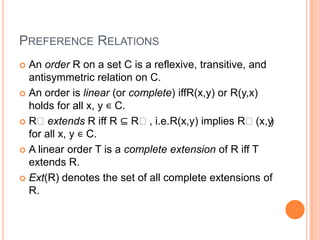
 An order R on a set C is a reflexive, transitive, and
  antisymmetric relation on C.
 An order is linear (or complete) iffR(x,y) or R(y,x)
  holds for all x, y ∊ C.
 Rʹ extends R iff R ⊆ Rʹ, i.e. R(x,y) implies Rʹ(x,y   )
  for all x, y ∊ C.
 A linear order T is a complete extension of R iff T
  extends R.
 Ext(R) denotes the set of all complete extensions of
  R.
EXAMPLES
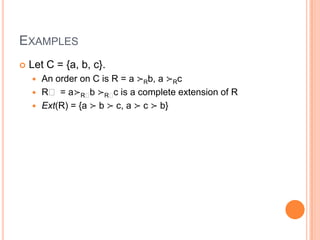
   Let C = {a, b, c}.
     An order on C is R = a ≻Rb, a ≻Rc
     Rʹ = a ≻Rʹ ≻Rʹ is a complete extension of R
                  b    c
     Ext(R) = {a ≻ b ≻ c, a ≻ c ≻ b}
VOTING PROCEDURES
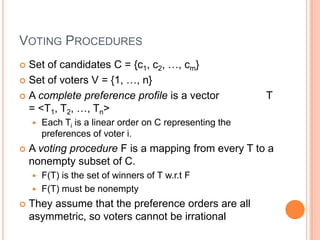
 Set of candidates C = {c1, c2, …, cm}
 Set of voters V = {1, …, n}

 A complete preference profile is a vector               T
  = <T1, T2, …, Tn>
       Each Ti is a linear order on C representing the
        preferences of voter i.
   A voting procedure F is a mapping from every T to a
    nonempty subset of C.
     F(T) is the set of winners of T w.r.t F
     F(T) must be nonempty

   They assume that the preference orders are all
    asymmetric, so voters cannot be irrational
EXTENDING VOTING PROCEDURES TO
INCOMPLETE PREFERENCES

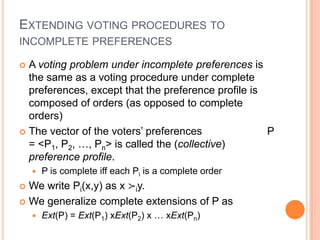
 A voting problem under incomplete preferences is
  the same as a voting procedure under complete
  preferences, except that the preference profile is
  composed of orders (as opposed to complete
  orders)
 The vector of the voters’ preferences              P
  = <P1, P2, …, Pn> is called the (collective)
  preference profile.
       P is complete iff each Pi is a complete order
 We write Pi(x,y) as x ≻iy.
 We generalize complete extensions of P as
       Ext(P) = Ext(P1) xExt(P2) x … xExt(Pn)
EXTENDING VOTING PROCEDURES
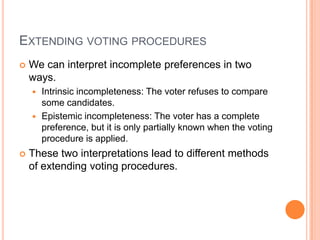
   We can interpret incomplete preferences in two
    ways.
     Intrinsic incompleteness: The voter refuses to compare
      some candidates.
     Epistemic incompleteness: The voter has a complete
      preference, but it is only partially known when the voting
      procedure is applied.
   These two interpretations lead to different methods
    of extending voting procedures.
EXTENDING VOTING PROCEDURES
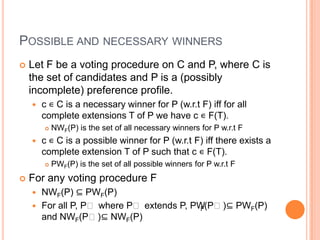
 We can look at all possible results.
 We can look at some subset of the results.

 We can redefine F to work with partial preferences.

 They look at the first approach.
POSSIBLE AND NECESSARY WINNERS
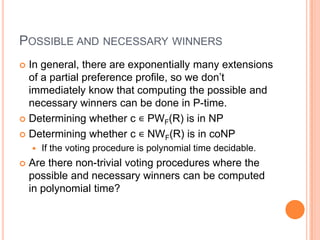
   Let F be a voting procedure on C and P, where C is
    the set of candidates and P is a (possibly
    incomplete) preference profile.
       c ∊ C is a necessary winner for P (w.r.t F) iff for all
        complete extensions T of P we have c ∊ F(T).
           NWF(P) is the set of all necessary winners for P w.r.t F
       c ∊ C is a possible winner for P (w.r.t F) iff there exists a
        complete extension T of P such that c ∊ F(T).
           PWF(P) is the set of all possible winners for P w.r.t F
   For any voting procedure F
       NWF(P) ⊆ PWF(P)
       For all P, Pʹ where Pʹ extends P, PW(Pʹ)⊆ PWF(P)
                                            F
        and NWF(Pʹ) ⊆ NWF(P)
Heroes >Villians


LexLuthor> Joker > Batman > Superman


Everyone > Joker, Batman > Superman


Villians> Heroes, LexLuthor> Joker
POSSIBLE AND NECESSARY WINNERS
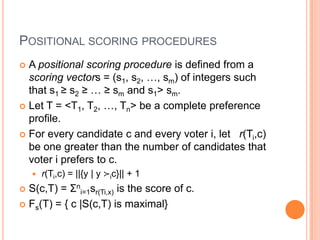
 In general, there are exponentially many extensions
  of a partial preference profile, so we don’t
  immediately know that computing the possible and
  necessary winners can be done in P-time.
 Determining whether c ∊ PWF(R) is in NP

 Determining whether c ∊ NWF(R) is in coNP
       If the voting procedure is polynomial time decidable.
   Are there non-trivial voting procedures where the
    possible and necessary winners can be computed
    in polynomial time?
POSITIONAL SCORING PROCEDURES
 A positional scoring procedure is defined from a
  scoring vectors = (s1, s2, …, sm) of integers such
  that s1 ≥ s2 ≥ … ≥ sm and s1> sm.
 Let T = <T1, T2, …, Tn> be a complete preference
  profile.
 For every candidate c and every voter i, let r(Ti,c)
  be one greater than the number of candidates that
  voter i prefers to c.
       r(Ti,c) = ||{y | y ≻ic}|| + 1
 S(c,T) = Σni=1sr(Ti,x) is the score of c.
 Fs(T) = { c |S(c,T) is maximal}
MINIMAL AND MAXIMAL RANK
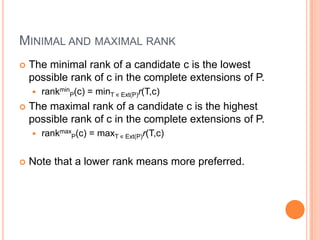
   The minimal rank of a candidate c is the lowest
    possible rank of c in the complete extensions of P.
       rankminP(c) = minT ∊ Ext(P)r(T,c)
   The maximal rank of a candidate c is the highest
    possible rank of c in the complete extensions of P.
       rankmaxP(c) = maxT ∊ Ext(P)r(T,c)


   Note that a lower rank means more preferred.
PROPOSITION 1
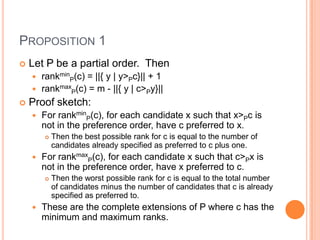
   Let P be a partial order. Then
     rankminP(c) = ||{ y | y>Pc}|| + 1
     rankmaxP(c) = m - ||{ y | c>Py}||
   Proof sketch:
       For rankminP(c), for each candidate x such that x>Pc is
        not in the preference order, have c preferred to x.
           Then the best possible rank for c is equal to the number of
            candidates already specified as preferred to c plus one.
       For rankmaxP(c), for each candidate x such that c>Px is
        not in the preference order, have x preferred to c.
           Then the worst possible rank for c is equal to the total number
            of candidates minus the number of candidates that c is already
            specified as preferred to.
       These are the complete extensions of P where c has the
        minimum and maximum ranks.
PROPOSITION 2
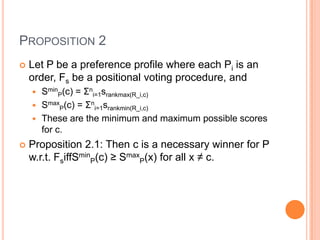
   Let P be a preference profile where each Pi is an
    order, Fs be a positional voting procedure, and
     SminP(c) = Σni=1srankmax(R_i,c)
     SmaxP(c) = Σni=1srankmin(R_i,c)
     These are the minimum and maximum possible scores
      for c.
   Proposition 2.1: Then c is a necessary winner for P
    w.r.t. FsiffSminP(c) ≥ SmaxP(x) for all x ≠ c.
PROOF
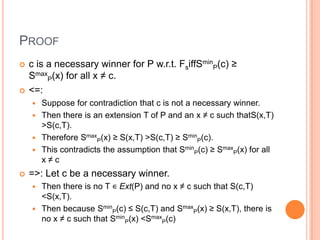
   c is a necessary winner for P w.r.t. FsiffSminP(c) ≥
    SmaxP(x) for all x ≠ c.
   <=:
     Suppose for contradiction that c is not a necessary winner.
     Then there is an extension T of P and an x ≠ c such thatS(x,T)
      >S(c,T).
     Therefore SmaxP(x) ≥ S(x,T) >S(c,T) ≥ SminP(c).
     This contradicts the assumption that SminP(c) ≥ SmaxP(x) for all
      x≠c
   =>: Let c be a necessary winner.
     Then there is no T ∊ Ext(P) and no x ≠ c such that S(c,T)
      <S(x,T).
     Then because SminP(c) ≤ S(c,T) and SmaxP(x) ≥ S(x,T), there is
      no x ≠ c such that SminP(x) <SmaxP(c)
PART 2 OF PROPOSITION 2
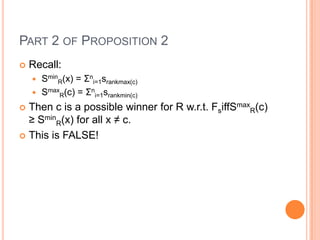
   Recall:
     SminR(x) = Σni=1srankmax(c)
     SmaxR(c) = Σni=1srankmin(c)

 Then c is a possible winner for R w.r.t. FsiffSmaxR(c)
  ≥ SminR(x) for all x ≠ c.
 This is FALSE!
COUNTEREXAMPLE
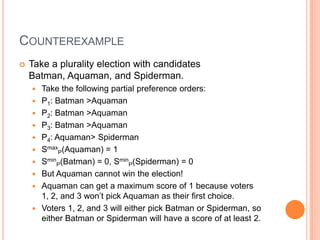
   Take a plurality election with candidates
    Batman, Aquaman, and Spiderman.
       Take the following partial preference orders:
       P1: Batman >Aquaman
       P2: Batman >Aquaman
       P3: Batman >Aquaman
       P4: Aquaman> Spiderman
       SmaxP(Aquaman) = 1
       SminP(Batman) = 0, SminP(Spiderman) = 0
       But Aquaman cannot win the election!
       Aquaman can get a maximum score of 1 because voters
        1, 2, and 3 won’t pick Aquaman as their first choice.
       Voters 1, 2, and 3 will either pick Batman or Spiderman, so
        either Batman or Spiderman will have a score of at least 2.
COROLLARY
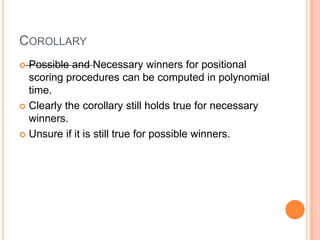
 Possible and Necessary winners for positional
  scoring procedures can be computed in polynomial
  time.
 Clearly the corollary still holds true for necessary
  winners.
 Unsure if it is still true for possible winners.
CONDORCET WINNERS
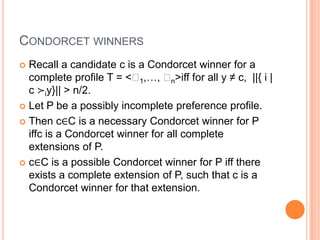
 Recall a candidate c is a Condorcet winner for a
  complete profile T = <ʹ ,…, ʹ >iff for all y ≠ c, ||{ i |
                          1       n
  c ≻iy}|| > n/2.
 Let P be a possibly incomplete preference profile.

 Then c∈C is a necessary Condorcet winner for P
  iffc is a Condorcet winner for all complete
  extensions of P.
 c∈C is a possible Condorcet winner for P iff there
  exists a complete extension of P, such that c is a
  Condorcet winner for that extension.
CONDORCET WINNERS
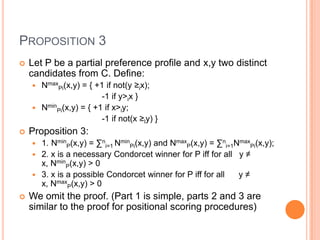
 Define NT(x,y) = ||{ i | x>iy}|| - ||{ i |y>ix}||
 Then
       NminP(x,y) = minT∈Ext(P)NT(x,y)
           NminP(x,y) corresponds to the worst case for x among
            extensions of P.
       NmaxP(x,y) = maxT∈Ext(P)NT(x,y)
           NmaxP(x,y) corresponds to the best case for x among
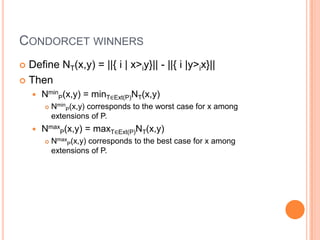
            extensions of P.
PROPOSITION 3
   Let P be a partial preference profile and x,y two distinct
    candidates from C. Define:
     NmaxPi(x,y) = { +1 if not(y ≥ix);
                        -1 if y>ix }
     NminPi(x,y) = { +1 if x>iy;
                        -1 if not(x ≥Iy) }
   Proposition 3:
     1. NminP(x,y) = ∑ni=1 NminPi(x,y) and NmaxP(x,y) = ∑ni=1NmaxPi(x,y);
     2. x is a necessary Condorcet winner for P iff for all y ≠
      x, NminP(x,y) > 0
     3. x is a possible Condorcet winner for P iff for all    y≠
      x, NmaxP(x,y) > 0
   We omit the proof. (Part 1 is simple, parts 2 and 3 are
    similar to the proof for positional scoring procedures)
COROLLARY
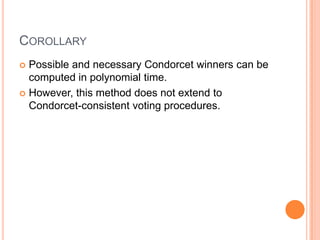
 Possible and necessary Condorcet winners can be
  computed in polynomial time.
 However, this method does not extend to
  Condorcet-consistent voting procedures.
MANIPULATION
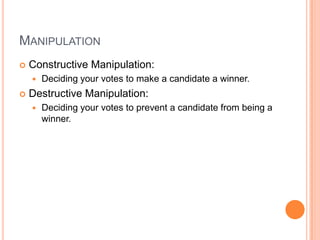
   Constructive Manipulation:
       Deciding your votes to make a candidate a winner.
   Destructive Manipulation:
       Deciding your votes to prevent a candidate from being a
        winner.
PROPOSITION 4
 There is a constructive manipulation for ciffc is a
  possible winner of the preference profile where the
  members of the coalition have completely
  unspecified preferences.
 There is a destructive manipulation for ciffc is not a
  necessary winner of the same preference profile.
ELICITATION
 Determining whether the outcome of the election
  can be determined with the information you have
  about each voter’s preferences, and if not, what
  information you need.
 Proposition 5:
       The elicitation task is over iff the set of possible winners
        is equal to the set of necessary winners.
CONCLUSION
 Even with incomplete preferences we can
  sometimes compute the winners of an election.
 Can be used for voter manipulation.
     If you can determine possible winners, then you can do
      constructive manipulation.
     If you can determine necessary winners, then you can
      do destructive manipulation.
   Combine the results based on the maximum and
    minimum rank that each voter could give to each
    candidate.
FUTURE WORK
 Extend to more voting protocols.
 Count the number of extensions that make a
  candidate a winner.
 If the voting procedure is probabilistic, is it possible
  or necessary for a candidate to win based on the
  voting system?
 Can possible winners be computed efficiently for
  positional scoring procedures?

Presentation1

  • 1.
    VOTING PROCEDURES WITHINCOMPLETE PREFERENCES BY KATHRIN KONCZAK AND JEROME LANG Presented by Scott Ames, Steven Frink, and Ellis Mitchell
  • 2.
    Heroes >Villians LexLuthor> Joker> Batman > Superman Everyone > Joker, Batman > Superman Villians> Heroes, LexLuthor> Joker
  • 3.
    INCOMPLETE PREFERENCES  What if the complete preferences of some (or all) of the voters are unknown (or don’t exist)?  Reasons it could happen:  New candidate introduced  Voter indifference  Some voters haven’t voted yet  Can we determine the winners of the election without getting the rest of the voters’ preferences?  What is the complexity of manipulation in this setting?  How much more information to we need to gather in order to determine the winners of the election?
  • 4.
    Heroes >Villians LexLuthor> Joker> Batman > Superman Everyone > Joker, Batman > Superman Villians> Heroes, LexLuthor> Joker Chester A. Arthur > Everyone
  • 5.
    PREFERENCE RELATIONS  Anorder R on a set C is a reflexive, transitive, and antisymmetric relation on C.  An order is linear (or complete) iffR(x,y) or R(y,x) holds for all x, y ∊ C.  Rʹ extends R iff R ⊆ Rʹ, i.e. R(x,y) implies Rʹ(x,y ) for all x, y ∊ C.  A linear order T is a complete extension of R iff T extends R.  Ext(R) denotes the set of all complete extensions of R.
  • 6.
    EXAMPLES  Let C = {a, b, c}.  An order on C is R = a ≻Rb, a ≻Rc  Rʹ = a ≻Rʹ ≻Rʹ is a complete extension of R b c  Ext(R) = {a ≻ b ≻ c, a ≻ c ≻ b}
  • 7.
    VOTING PROCEDURES  Setof candidates C = {c1, c2, …, cm}  Set of voters V = {1, …, n}  A complete preference profile is a vector T = <T1, T2, …, Tn>  Each Ti is a linear order on C representing the preferences of voter i.  A voting procedure F is a mapping from every T to a nonempty subset of C.  F(T) is the set of winners of T w.r.t F  F(T) must be nonempty  They assume that the preference orders are all asymmetric, so voters cannot be irrational
  • 8.
    EXTENDING VOTING PROCEDURESTO INCOMPLETE PREFERENCES  A voting problem under incomplete preferences is the same as a voting procedure under complete preferences, except that the preference profile is composed of orders (as opposed to complete orders)  The vector of the voters’ preferences P = <P1, P2, …, Pn> is called the (collective) preference profile.  P is complete iff each Pi is a complete order  We write Pi(x,y) as x ≻iy.  We generalize complete extensions of P as  Ext(P) = Ext(P1) xExt(P2) x … xExt(Pn)
  • 9.
    EXTENDING VOTING PROCEDURES  We can interpret incomplete preferences in two ways.  Intrinsic incompleteness: The voter refuses to compare some candidates.  Epistemic incompleteness: The voter has a complete preference, but it is only partially known when the voting procedure is applied.  These two interpretations lead to different methods of extending voting procedures.
  • 10.
    EXTENDING VOTING PROCEDURES We can look at all possible results.  We can look at some subset of the results.  We can redefine F to work with partial preferences.  They look at the first approach.
  • 11.
    POSSIBLE AND NECESSARYWINNERS  Let F be a voting procedure on C and P, where C is the set of candidates and P is a (possibly incomplete) preference profile.  c ∊ C is a necessary winner for P (w.r.t F) iff for all complete extensions T of P we have c ∊ F(T).  NWF(P) is the set of all necessary winners for P w.r.t F  c ∊ C is a possible winner for P (w.r.t F) iff there exists a complete extension T of P such that c ∊ F(T).  PWF(P) is the set of all possible winners for P w.r.t F  For any voting procedure F  NWF(P) ⊆ PWF(P)  For all P, Pʹ where Pʹ extends P, PW(Pʹ)⊆ PWF(P) F and NWF(Pʹ) ⊆ NWF(P)
  • 12.
    Heroes >Villians LexLuthor> Joker> Batman > Superman Everyone > Joker, Batman > Superman Villians> Heroes, LexLuthor> Joker
  • 13.
    POSSIBLE AND NECESSARYWINNERS  In general, there are exponentially many extensions of a partial preference profile, so we don’t immediately know that computing the possible and necessary winners can be done in P-time.  Determining whether c ∊ PWF(R) is in NP  Determining whether c ∊ NWF(R) is in coNP  If the voting procedure is polynomial time decidable.  Are there non-trivial voting procedures where the possible and necessary winners can be computed in polynomial time?
  • 14.
    POSITIONAL SCORING PROCEDURES A positional scoring procedure is defined from a scoring vectors = (s1, s2, …, sm) of integers such that s1 ≥ s2 ≥ … ≥ sm and s1> sm.  Let T = <T1, T2, …, Tn> be a complete preference profile.  For every candidate c and every voter i, let r(Ti,c) be one greater than the number of candidates that voter i prefers to c.  r(Ti,c) = ||{y | y ≻ic}|| + 1  S(c,T) = Σni=1sr(Ti,x) is the score of c.  Fs(T) = { c |S(c,T) is maximal}
  • 15.
    MINIMAL AND MAXIMALRANK  The minimal rank of a candidate c is the lowest possible rank of c in the complete extensions of P.  rankminP(c) = minT ∊ Ext(P)r(T,c)  The maximal rank of a candidate c is the highest possible rank of c in the complete extensions of P.  rankmaxP(c) = maxT ∊ Ext(P)r(T,c)  Note that a lower rank means more preferred.
  • 16.
    PROPOSITION 1  Let P be a partial order. Then  rankminP(c) = ||{ y | y>Pc}|| + 1  rankmaxP(c) = m - ||{ y | c>Py}||  Proof sketch:  For rankminP(c), for each candidate x such that x>Pc is not in the preference order, have c preferred to x.  Then the best possible rank for c is equal to the number of candidates already specified as preferred to c plus one.  For rankmaxP(c), for each candidate x such that c>Px is not in the preference order, have x preferred to c.  Then the worst possible rank for c is equal to the total number of candidates minus the number of candidates that c is already specified as preferred to.  These are the complete extensions of P where c has the minimum and maximum ranks.
  • 17.
    PROPOSITION 2  Let P be a preference profile where each Pi is an order, Fs be a positional voting procedure, and  SminP(c) = Σni=1srankmax(R_i,c)  SmaxP(c) = Σni=1srankmin(R_i,c)  These are the minimum and maximum possible scores for c.  Proposition 2.1: Then c is a necessary winner for P w.r.t. FsiffSminP(c) ≥ SmaxP(x) for all x ≠ c.
  • 18.
    PROOF  c is a necessary winner for P w.r.t. FsiffSminP(c) ≥ SmaxP(x) for all x ≠ c.  <=:  Suppose for contradiction that c is not a necessary winner.  Then there is an extension T of P and an x ≠ c such thatS(x,T) >S(c,T).  Therefore SmaxP(x) ≥ S(x,T) >S(c,T) ≥ SminP(c).  This contradicts the assumption that SminP(c) ≥ SmaxP(x) for all x≠c  =>: Let c be a necessary winner.  Then there is no T ∊ Ext(P) and no x ≠ c such that S(c,T) <S(x,T).  Then because SminP(c) ≤ S(c,T) and SmaxP(x) ≥ S(x,T), there is no x ≠ c such that SminP(x) <SmaxP(c)
  • 19.
    PART 2 OFPROPOSITION 2  Recall:  SminR(x) = Σni=1srankmax(c)  SmaxR(c) = Σni=1srankmin(c)  Then c is a possible winner for R w.r.t. FsiffSmaxR(c) ≥ SminR(x) for all x ≠ c.  This is FALSE!
  • 20.
    COUNTEREXAMPLE  Take a plurality election with candidates Batman, Aquaman, and Spiderman.  Take the following partial preference orders:  P1: Batman >Aquaman  P2: Batman >Aquaman  P3: Batman >Aquaman  P4: Aquaman> Spiderman  SmaxP(Aquaman) = 1  SminP(Batman) = 0, SminP(Spiderman) = 0  But Aquaman cannot win the election!  Aquaman can get a maximum score of 1 because voters 1, 2, and 3 won’t pick Aquaman as their first choice.  Voters 1, 2, and 3 will either pick Batman or Spiderman, so either Batman or Spiderman will have a score of at least 2.
  • 21.
    COROLLARY  Possible andNecessary winners for positional scoring procedures can be computed in polynomial time.  Clearly the corollary still holds true for necessary winners.  Unsure if it is still true for possible winners.
  • 22.
    CONDORCET WINNERS  Recalla candidate c is a Condorcet winner for a complete profile T = <ʹ ,…, ʹ >iff for all y ≠ c, ||{ i | 1 n c ≻iy}|| > n/2.  Let P be a possibly incomplete preference profile.  Then c∈C is a necessary Condorcet winner for P iffc is a Condorcet winner for all complete extensions of P.  c∈C is a possible Condorcet winner for P iff there exists a complete extension of P, such that c is a Condorcet winner for that extension.
  • 23.
    CONDORCET WINNERS  DefineNT(x,y) = ||{ i | x>iy}|| - ||{ i |y>ix}||  Then  NminP(x,y) = minT∈Ext(P)NT(x,y)  NminP(x,y) corresponds to the worst case for x among extensions of P.  NmaxP(x,y) = maxT∈Ext(P)NT(x,y)  NmaxP(x,y) corresponds to the best case for x among extensions of P.
  • 24.
    PROPOSITION 3  Let P be a partial preference profile and x,y two distinct candidates from C. Define:  NmaxPi(x,y) = { +1 if not(y ≥ix); -1 if y>ix }  NminPi(x,y) = { +1 if x>iy; -1 if not(x ≥Iy) }  Proposition 3:  1. NminP(x,y) = ∑ni=1 NminPi(x,y) and NmaxP(x,y) = ∑ni=1NmaxPi(x,y);  2. x is a necessary Condorcet winner for P iff for all y ≠ x, NminP(x,y) > 0  3. x is a possible Condorcet winner for P iff for all y≠ x, NmaxP(x,y) > 0  We omit the proof. (Part 1 is simple, parts 2 and 3 are similar to the proof for positional scoring procedures)
  • 25.
    COROLLARY  Possible andnecessary Condorcet winners can be computed in polynomial time.  However, this method does not extend to Condorcet-consistent voting procedures.
  • 26.
    MANIPULATION  Constructive Manipulation:  Deciding your votes to make a candidate a winner.  Destructive Manipulation:  Deciding your votes to prevent a candidate from being a winner.
  • 27.
    PROPOSITION 4  Thereis a constructive manipulation for ciffc is a possible winner of the preference profile where the members of the coalition have completely unspecified preferences.  There is a destructive manipulation for ciffc is not a necessary winner of the same preference profile.
  • 28.
    ELICITATION  Determining whetherthe outcome of the election can be determined with the information you have about each voter’s preferences, and if not, what information you need.  Proposition 5:  The elicitation task is over iff the set of possible winners is equal to the set of necessary winners.
  • 29.
    CONCLUSION  Even withincomplete preferences we can sometimes compute the winners of an election.  Can be used for voter manipulation.  If you can determine possible winners, then you can do constructive manipulation.  If you can determine necessary winners, then you can do destructive manipulation.  Combine the results based on the maximum and minimum rank that each voter could give to each candidate.
  • 30.
    FUTURE WORK  Extendto more voting protocols.  Count the number of extensions that make a candidate a winner.  If the voting procedure is probabilistic, is it possible or necessary for a candidate to win based on the voting system?  Can possible winners be computed efficiently for positional scoring procedures?

Editor's Notes

  • #6 Antisymmetric:R(x,y) and R(y,x) =&gt; x=y
  • #11 2nd bullet: using some completion process on the preferences
  • #13 Possible Winners: Batman, LexLuthorNecessary Winners: LexLuthor
  • #14 PW in NP -&gt; Need to check that there exists an extensionNW in coNP -&gt; Need to check allpossible extensions (also, NW are the losers of the complement of the voting procedure)
  • #15 +1 in r(Ti,c) -&gt; first place (rank) has 0 candidates beating it, etc.
  • #16 P is a single ordering of the candidates, not the preference profile
  • #18 rankmax(Ri,c) = rankmaxRi (due to subscript stuff)F is the positional scoring procedure with scoring vector s