By the early 1990's, Japan has developed and used SCC.
Self compacted concrete is highly engineered concrete
with much higher fluidity without segregation and is
capable of filling every corner of formwork under its self
weight .

Thus SCC eliminates the vibration for the compaction of
concrete without affecting its engineering properties.
 As of the year 2000, SCC used for prefabricated
products (precast members) and ready mixed concrete
(cast-in-situ) in JAPAN, USA and later on INDIA etc.
DEVELOPMENT OF SCC
 In 1983, the problem of the durability of the concrete structures
was a major topic of interest in Japan.

 The creation of durable concrete structures requires adequate
compaction by skilled workers.
 Solution for the achievement of durable concrete structures
independent of the quality construction work is the use of SCC.
 The necessity of this type of concrete was proposed by Okamura in
1986.
 Studies to develop SCC have been carried out by Ozawa and Melawi
at the university of Tokyo.
 Present-day SCC can be classified as an advanced construction
material.
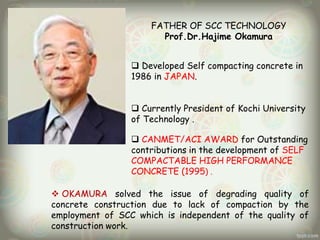
FATHER OF SCC TECHNOLOGY
Prof.Dr.Hajime Okamura
 Developed Self compacting concrete in
1986 in JAPAN.
 Currently President of Kochi University
of Technology .

 CANMET/ACI AWARD for Outstanding
contributions in the development of SELF
COMPACTABLE HIGH PERFORMANCE
CONCRETE (1995) .
 OKAMURA solved the issue of degrading quality of
concrete construction due to lack of compaction by the
employment of SCC which is independent of the quality of
construction work.
CONSTITUENTS OF SCC
With regard to its composition, SCC consists of the
same components as conventionally vibrated
concrete, which are
 Cement
 Aggregates
 Water
 Chemical Admixtures i.e. Super plasticizers and
Viscosity Modifying Agents
 Mineral Admixtures i.e., Fly ash, Silica
Fume, GGBFS etc.
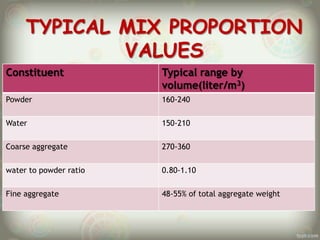
TYPICAL MIX PROPORTION
VALUES
Constituent

Typical range by
volume(liter/m3)

Powder

160-240

Water

150-210

Coarse aggregate

270-360

water to powder ratio

0.80-1.10

Fine aggregate

48-55% of total aggregate weight
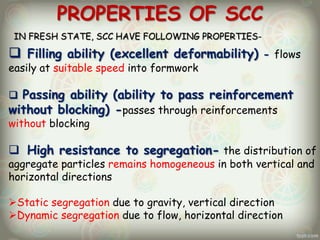
PROPERTIES OF SCC
IN FRESH STATE, SCC HAVE FOLLOWING PROPERTIES-

 Filling ability (excellent deformability)
easily at suitable speed into formwork

- flows

 Passing ability (ability to pass reinforcement
without blocking) -passes through reinforcements
without blocking

 High resistance to segregation- the distribution of
aggregate particles remains homogeneous in both vertical and
horizontal directions
Static segregation due to gravity, vertical direction
Dynamic segregation due to flow, horizontal direction
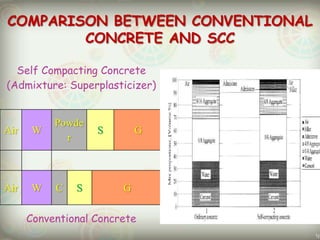
COMPARISON BETWEEN CONVENTIONAL
CONCRETE AND SCC
Self Compacting Concrete
(Admixture: Superplasticizer)

Air

W

Powde
r

Air

W

C

S

S

G

G

Conventional Concrete
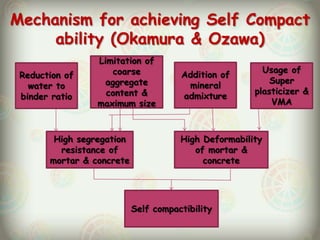
Mechanism for achieving Self Compact
ability (Okamura & Ozawa)
Reduction of
water to
binder ratio

Limitation of
coarse
aggregate
content &
maximum size

High segregation
resistance of
mortar & concrete

Addition of
mineral
admixture

Usage of
Super
plasticizer &
VMA

High Deformability
of mortar &
concrete

Self compactibility
MEASUREMENT OF SCC FLOW
PROPERTIES
IN FRESH STATE
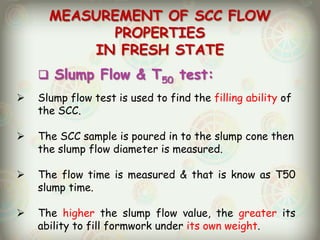
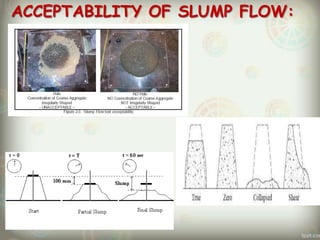
 Slump Flow & T50 test:


Slump flow test is used to find the filling ability of
the SCC.



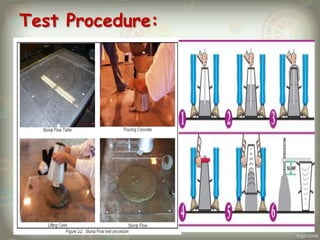
The SCC sample is poured in to the slump cone then
the slump flow diameter is measured.



The flow time is measured & that is know as T50
slump time.



The higher the slump flow value, the greater its
ability to fill formwork under its own weight.
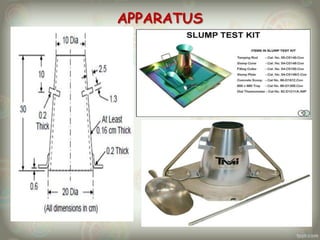
APPARATUS
Test Procedure:
ACCEPTABILITY OF SLUMP FLOW:
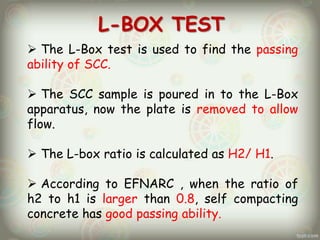
L-BOX TEST
 The L-Box test is used to find the passing
ability of SCC.
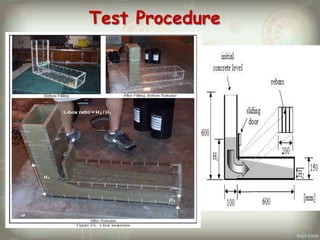
 The SCC sample is poured in to the L-Box
apparatus, now the plate is removed to allow
flow.
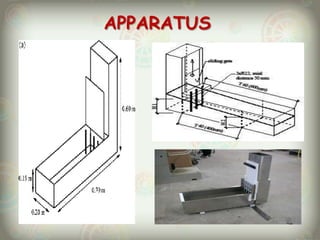
 The L-box ratio is calculated as H2/ H1.
 According to EFNARC , when the ratio of
h2 to h1 is larger than 0.8, self compacting
concrete has good passing ability.
APPARATUS
Test Procedure
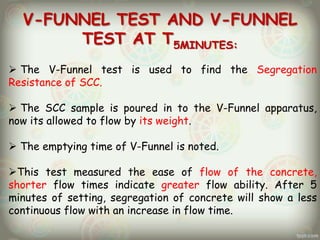
V-FUNNEL TEST AND V-FUNNEL
TEST AT T5MINUTES:
 The V-Funnel test is used to find the Segregation
Resistance of SCC.
 The SCC sample is poured in to the V-Funnel apparatus,
now its allowed to flow by its weight.
 The emptying time of V-Funnel is noted.
This test measured the ease of flow of the concrete,
shorter flow times indicate greater flow ability. After 5
minutes of setting, segregation of concrete will show a less
continuous flow with an increase in flow time.
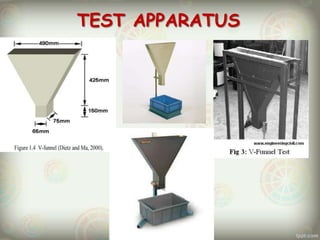
TEST APPARATUS
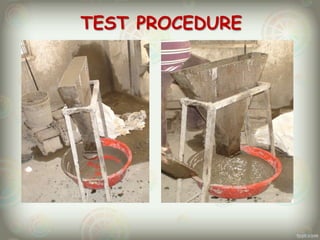
TEST PROCEDURE
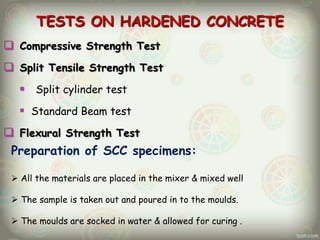
TESTS ON HARDENED CONCRETE
 Compressive Strength Test
 Split Tensile Strength Test

 Split cylinder test
 Standard Beam test
 Flexural Strength Test
Preparation of SCC specimens:
 All the materials are placed in the mixer & mixed well
 The sample is taken out and poured in to the moulds.
 The moulds are socked in water & allowed for curing .
ACCEPTANCE CRITERIA FOR SCC IN FREE STATE
Test Results on Fresh Concrete and Acceptance Criteria for SCC
S. No

Method

1

Slump
Flow
Test

Unit

Water/Cement Ratio
0.23

0.24

0.25

0.26

EFNARC[3]
0.27

Specification

Remarks

SF1: 550-650
mm

655

660

665

680

700

SF2: 660-750

SF2

SF3: 760-850
VS1: T500 ≤ 2

2

T500

sec

3.94

3.88

3.82

3.32

2.50

3

V-Funnel

sec

8.50

8.35

8.10

7.95

6.89

VF1: ≤ 8

4

T5min

sec

11.89

10.92

10.66

10.23

9.95

VF2: 9-25

5

L-Box

h2/h1

0.950

0.959

0.969

6

U-Box

mm

9

7

6

0.975 0.980

5

4

VS2: T500 > 2

PA1: > 0.8
(2 rebars)
PA2: > 0.8
(3 rebars)
0-30 [23]

VS2

VF2

PA2

OK
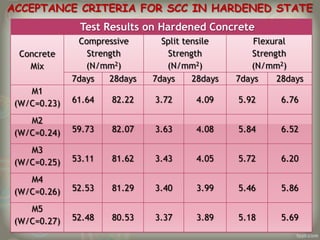
ACCEPTANCE CRITERIA FOR SCC IN HARDENED STATE
Test Results on Hardened Concrete
Compressive
Strength
(N/mm2)
7days
28days

Split tensile
Strength
(N/mm2)
7days
28days

Flexural
Strength
(N/mm2)
7days
28days

M1
(W/C=0.23)

61.64

82.22

3.72

4.09

5.92

6.76

M2
(W/C=0.24)

59.73

82.07

3.63

4.08

5.84

6.52

M3
(W/C=0.25)

53.11

81.62

3.43

4.05

5.72

6.20

M4
(W/C=0.26)

52.53

81.29

3.40

3.99

5.46

5.86

M5
(W/C=0.27)

52.48

80.53

3.37

3.89

5.18

5.69

Concrete
Mix
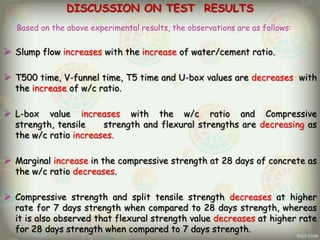
DISCUSSION ON TEST RESULTS
Based on the above experimental results, the observations are as follows:

 Slump flow increases with the increase of water/cement ratio.

 T500 time, V-funnel time, T5 time and U-box values are decreases with
the increase of w/c ratio.

 L-box

value increases with the w/c ratio and Compressive
strength, tensile
strength and flexural strengths are decreasing as
the w/c ratio increases.

 Marginal increase in the compressive strength at 28 days of concrete as
the w/c ratio decreases.

 Compressive strength and split tensile strength decreases at higher

rate for 7 days strength when compared to 28 days strength, whereas
it is also observed that flexural strength value decreases at higher rate
for 28 days strength when compared to 7 days strength.
ADVANTAGES OF SCC
 Elimination of problems associated with vibration.
 Faster construction
 Improves working conditions and productivity

in

construction industry.
 Greater freedom in design.
 Less noise from vibrators and reduced danger from
hand-arm vibration syndrome (HAVS).
 Ease of placement results in cost savings through
reduced equipment and labour requirement.
 Improves the quality, durability, and reliability of
concrete structures due to better compaction and
homogeneity of concrete.

 Reduced wear and tear on forms from vibration.
 Reduced permeability.
DISADVANTAGES OF SCC
 More precise measurement and monitoring
of the constituent materials.
 Requires more trial batches at laboratory
as well as at ready-mixed concrete plants.
 Costlier than conventional concrete based
on concrete material cost (exception to
placement cost).
 Lack of globally accepted test standards
and mix designs
 More stringent
requirements on the
selection of materials .
CONCLUSION
SCC has high potential for greater acceptance and wider applications in highway
bridge construction in the all over world. An NCHRP Research Project has been
initiated to develop design and construction specifications to supplement the
AASHTO LRFD Bridge Design and Construction Specifications.

Based on above results
conclusions are drawn-

and

discussions

the

following

Self Compacting Concrete (SCC) technology can save
time, cost, enhance quality, durability and Moreover it is a
green concept.
Since the concrete is capable of self-consolidating and
reaching the difficult areas in moulds, manual variables in
terms of placing and compacting concrete is nil. This factor
ultimately yields defect less, better-quality concrete
structures.
Cast-in-place concrete construction in tight space and
congested reinforcement, such as, drilled shafts, columns and
earth retaining systems, can be accelerated by using SCC.
REFERENCES
1.

Brain Paulson. EFNARC, Secretary General, „Specifications and Guidelines for
Self-Compacting Concrete”, February 2002.

2.

Nan Su, K.C. Hsu, H.W. Chai. A Simple mix design method for self-compacting
concrete, cement and concrete Research 2001.

3.

3.Okamura.H.„Self-Compacting
High
Performance
International, Vol. 19, No.7, pp. 50-54, July 1997

4.

4. M.S. Shetty. “Concrete technology (theory and practice), S. Chand & Company
LTD. 2002

5.

IS 456-2000 Code of practice for plain and reinforced concrete (3rd

6.

16. IS 516-1959 Method of test for strength of concrete

7.

SK Singh “Self Compacting Concrete - A Paradigm Shift”, Journal of New Building
Materials & Construction World, Vol. 15, No. 3, pp 164-180,September , 2009.

Concrete‟,

Concrete

revision)
self compacting concrete

self compacting concrete

  • 2.
    By the early1990's, Japan has developed and used SCC. Self compacted concrete is highly engineered concrete with much higher fluidity without segregation and is capable of filling every corner of formwork under its self weight . Thus SCC eliminates the vibration for the compaction of concrete without affecting its engineering properties.  As of the year 2000, SCC used for prefabricated products (precast members) and ready mixed concrete (cast-in-situ) in JAPAN, USA and later on INDIA etc.
  • 3.
    DEVELOPMENT OF SCC In 1983, the problem of the durability of the concrete structures was a major topic of interest in Japan.  The creation of durable concrete structures requires adequate compaction by skilled workers.  Solution for the achievement of durable concrete structures independent of the quality construction work is the use of SCC.  The necessity of this type of concrete was proposed by Okamura in 1986.  Studies to develop SCC have been carried out by Ozawa and Melawi at the university of Tokyo.  Present-day SCC can be classified as an advanced construction material.
  • 4.
    FATHER OF SCCTECHNOLOGY Prof.Dr.Hajime Okamura  Developed Self compacting concrete in 1986 in JAPAN.  Currently President of Kochi University of Technology .  CANMET/ACI AWARD for Outstanding contributions in the development of SELF COMPACTABLE HIGH PERFORMANCE CONCRETE (1995) .  OKAMURA solved the issue of degrading quality of concrete construction due to lack of compaction by the employment of SCC which is independent of the quality of construction work.
  • 5.
    CONSTITUENTS OF SCC Withregard to its composition, SCC consists of the same components as conventionally vibrated concrete, which are  Cement  Aggregates  Water  Chemical Admixtures i.e. Super plasticizers and Viscosity Modifying Agents  Mineral Admixtures i.e., Fly ash, Silica Fume, GGBFS etc.
  • 6.
    TYPICAL MIX PROPORTION VALUES Constituent Typicalrange by volume(liter/m3) Powder 160-240 Water 150-210 Coarse aggregate 270-360 water to powder ratio 0.80-1.10 Fine aggregate 48-55% of total aggregate weight
  • 7.
    PROPERTIES OF SCC INFRESH STATE, SCC HAVE FOLLOWING PROPERTIES-  Filling ability (excellent deformability) easily at suitable speed into formwork - flows  Passing ability (ability to pass reinforcement without blocking) -passes through reinforcements without blocking  High resistance to segregation- the distribution of aggregate particles remains homogeneous in both vertical and horizontal directions Static segregation due to gravity, vertical direction Dynamic segregation due to flow, horizontal direction
  • 8.
    COMPARISON BETWEEN CONVENTIONAL CONCRETEAND SCC Self Compacting Concrete (Admixture: Superplasticizer) Air W Powde r Air W C S S G G Conventional Concrete
  • 9.
    Mechanism for achievingSelf Compact ability (Okamura & Ozawa) Reduction of water to binder ratio Limitation of coarse aggregate content & maximum size High segregation resistance of mortar & concrete Addition of mineral admixture Usage of Super plasticizer & VMA High Deformability of mortar & concrete Self compactibility
  • 10.
    MEASUREMENT OF SCCFLOW PROPERTIES IN FRESH STATE  Slump Flow & T50 test:  Slump flow test is used to find the filling ability of the SCC.  The SCC sample is poured in to the slump cone then the slump flow diameter is measured.  The flow time is measured & that is know as T50 slump time.  The higher the slump flow value, the greater its ability to fill formwork under its own weight.
  • 11.
  • 12.
  • 13.
  • 14.
    L-BOX TEST  TheL-Box test is used to find the passing ability of SCC.  The SCC sample is poured in to the L-Box apparatus, now the plate is removed to allow flow.  The L-box ratio is calculated as H2/ H1.  According to EFNARC , when the ratio of h2 to h1 is larger than 0.8, self compacting concrete has good passing ability.
  • 15.
  • 16.
  • 17.
    V-FUNNEL TEST ANDV-FUNNEL TEST AT T5MINUTES:  The V-Funnel test is used to find the Segregation Resistance of SCC.  The SCC sample is poured in to the V-Funnel apparatus, now its allowed to flow by its weight.  The emptying time of V-Funnel is noted. This test measured the ease of flow of the concrete, shorter flow times indicate greater flow ability. After 5 minutes of setting, segregation of concrete will show a less continuous flow with an increase in flow time.
  • 18.
  • 19.
  • 20.
    TESTS ON HARDENEDCONCRETE  Compressive Strength Test  Split Tensile Strength Test  Split cylinder test  Standard Beam test  Flexural Strength Test Preparation of SCC specimens:  All the materials are placed in the mixer & mixed well  The sample is taken out and poured in to the moulds.  The moulds are socked in water & allowed for curing .
  • 21.
    ACCEPTANCE CRITERIA FORSCC IN FREE STATE Test Results on Fresh Concrete and Acceptance Criteria for SCC S. No Method 1 Slump Flow Test Unit Water/Cement Ratio 0.23 0.24 0.25 0.26 EFNARC[3] 0.27 Specification Remarks SF1: 550-650 mm 655 660 665 680 700 SF2: 660-750 SF2 SF3: 760-850 VS1: T500 ≤ 2 2 T500 sec 3.94 3.88 3.82 3.32 2.50 3 V-Funnel sec 8.50 8.35 8.10 7.95 6.89 VF1: ≤ 8 4 T5min sec 11.89 10.92 10.66 10.23 9.95 VF2: 9-25 5 L-Box h2/h1 0.950 0.959 0.969 6 U-Box mm 9 7 6 0.975 0.980 5 4 VS2: T500 > 2 PA1: > 0.8 (2 rebars) PA2: > 0.8 (3 rebars) 0-30 [23] VS2 VF2 PA2 OK
  • 22.
    ACCEPTANCE CRITERIA FORSCC IN HARDENED STATE Test Results on Hardened Concrete Compressive Strength (N/mm2) 7days 28days Split tensile Strength (N/mm2) 7days 28days Flexural Strength (N/mm2) 7days 28days M1 (W/C=0.23) 61.64 82.22 3.72 4.09 5.92 6.76 M2 (W/C=0.24) 59.73 82.07 3.63 4.08 5.84 6.52 M3 (W/C=0.25) 53.11 81.62 3.43 4.05 5.72 6.20 M4 (W/C=0.26) 52.53 81.29 3.40 3.99 5.46 5.86 M5 (W/C=0.27) 52.48 80.53 3.37 3.89 5.18 5.69 Concrete Mix
  • 23.
    DISCUSSION ON TESTRESULTS Based on the above experimental results, the observations are as follows:  Slump flow increases with the increase of water/cement ratio.  T500 time, V-funnel time, T5 time and U-box values are decreases with the increase of w/c ratio.  L-box value increases with the w/c ratio and Compressive strength, tensile strength and flexural strengths are decreasing as the w/c ratio increases.  Marginal increase in the compressive strength at 28 days of concrete as the w/c ratio decreases.  Compressive strength and split tensile strength decreases at higher rate for 7 days strength when compared to 28 days strength, whereas it is also observed that flexural strength value decreases at higher rate for 28 days strength when compared to 7 days strength.
  • 24.
    ADVANTAGES OF SCC Elimination of problems associated with vibration.  Faster construction  Improves working conditions and productivity in construction industry.  Greater freedom in design.  Less noise from vibrators and reduced danger from hand-arm vibration syndrome (HAVS).  Ease of placement results in cost savings through reduced equipment and labour requirement.  Improves the quality, durability, and reliability of concrete structures due to better compaction and homogeneity of concrete.  Reduced wear and tear on forms from vibration.  Reduced permeability.
  • 25.
    DISADVANTAGES OF SCC More precise measurement and monitoring of the constituent materials.  Requires more trial batches at laboratory as well as at ready-mixed concrete plants.  Costlier than conventional concrete based on concrete material cost (exception to placement cost).  Lack of globally accepted test standards and mix designs  More stringent requirements on the selection of materials .
  • 26.
    CONCLUSION SCC has highpotential for greater acceptance and wider applications in highway bridge construction in the all over world. An NCHRP Research Project has been initiated to develop design and construction specifications to supplement the AASHTO LRFD Bridge Design and Construction Specifications. Based on above results conclusions are drawn- and discussions the following Self Compacting Concrete (SCC) technology can save time, cost, enhance quality, durability and Moreover it is a green concept. Since the concrete is capable of self-consolidating and reaching the difficult areas in moulds, manual variables in terms of placing and compacting concrete is nil. This factor ultimately yields defect less, better-quality concrete structures. Cast-in-place concrete construction in tight space and congested reinforcement, such as, drilled shafts, columns and earth retaining systems, can be accelerated by using SCC.
  • 27.
    REFERENCES 1. Brain Paulson. EFNARC,Secretary General, „Specifications and Guidelines for Self-Compacting Concrete”, February 2002. 2. Nan Su, K.C. Hsu, H.W. Chai. A Simple mix design method for self-compacting concrete, cement and concrete Research 2001. 3. 3.Okamura.H.„Self-Compacting High Performance International, Vol. 19, No.7, pp. 50-54, July 1997 4. 4. M.S. Shetty. “Concrete technology (theory and practice), S. Chand & Company LTD. 2002 5. IS 456-2000 Code of practice for plain and reinforced concrete (3rd 6. 16. IS 516-1959 Method of test for strength of concrete 7. SK Singh “Self Compacting Concrete - A Paradigm Shift”, Journal of New Building Materials & Construction World, Vol. 15, No. 3, pp 164-180,September , 2009. Concrete‟, Concrete revision)