Fibre
reinforced
concrete
o Generally, plain concrete possesses a very low
tensile strength, limited ductility and little
resistance to cracking.
o Attempts have been made to impart
improvement in tensile properties of concrete
members by way of conventional
reinforcements.
o Although steel bars are used as reinforcements,
they provide tensile strength to the concrete
members. However, do not increase the ‘inherent
tensile strength’ of concrete itself.
o Thus, there is a need for multidirectional and
closely spaced reinforcement for concrete arises.
o Then it has been recognized that the addition
of small, closely spaced and uniformly dispersed
fibres to concrete would act as a crack arrester,
substantially increasing it’s static and dynamic
properties.
This concrete is known as Fibre Reinforced Concrete
(FIBRECON).
 Fibre reinforced concrete can be defined as a
composite material consisting of mixtures of
cement , mortar or concrete with more or less
randomly distributed fibres.
o Fibre is a small piece of reinforcing material which
increases the structural integrity of concrete.
o These short discrete fibers that are uniformly
distributed and randomly oriented provide strength
and toughness.
Fibres are usually used in concrete
to control cracking due to plastic shrinkage and
drying shrinkage.
They also reduce the permeability of concrete
and thus reduce bleeding of water.
They increase the ductility of concrete
elements.
Some types of fibres produce greater abrasion
and shatter resistance in concrete.
They impart more resistance to impact loads.
Offers toughness mechanism and fracture
resistance when material is stressed.
The above graph shows the stress-strain relation
between FRC and Plain concrete.
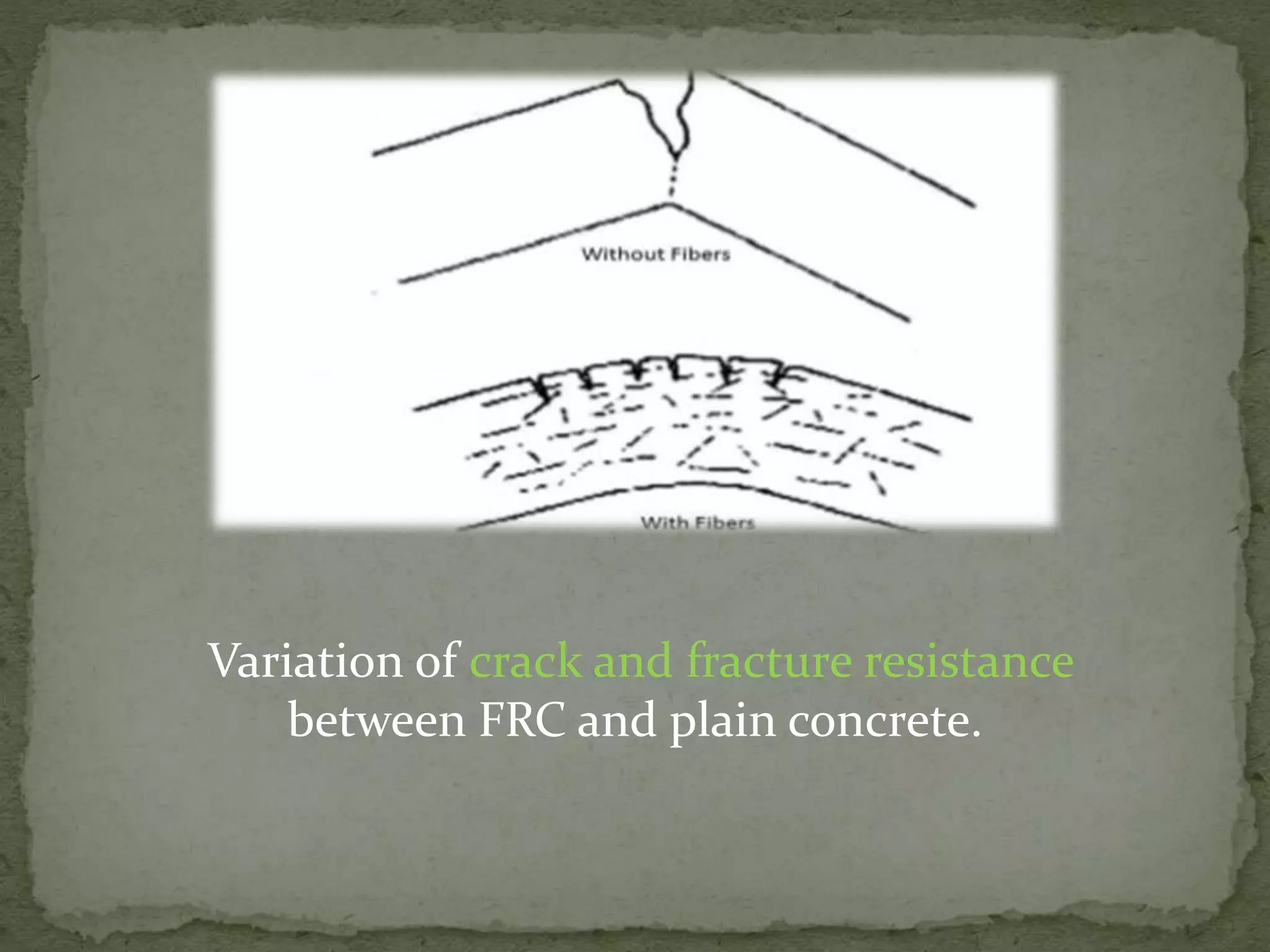
Variation of crack and fracture resistance
between FRC and plain concrete.
 Steel Fibre Reinforced Concrete(SFRC)
 Glass Fibre Reinforced Concrete(GFRC)
 Asbestos Fibres
 Synthetic Fibres
 Natural Fibres
 Carbon and Cellulose Fibres
Steel fibres have an aspect ratios of 30 to 250.
Diameters vary from 0.25 mm to 0.75 mm.
High structural strength.
Control crack widths tightly, thus improving
durability.
Used in pre-cast and structural applications,
highway and airport pavements, canal linings,
industrial flooring, bridge decks, etc.
SFRC distributes localized stresses.
Provides tough and durable surfaces.
Reduces surface permeability, dusting and wear.
They act as crack arrestor.
Increases tensile strength and toughness.
Resistance to impact and abrasion.
Resistance to freezing and thawing
High tensile strength, 1020 to 4080 N/mm^2.
Generally, fibres of length 25 mm are used.
Improvement in impact strength.
Increase in flexural strength, ductility, and
resistance to thermal shock.
Used in formwork, swimming pools, sewers
linings, etc.
Highly durable and safe.
Requires very low maintenance.
Installation is quick and cost effective.
Weather and fire resistant.
Economical.
Energy efficient.
Tensile strength varies from 560 to 980 N/mm^2.
Higher flexural strength and low impact strength.
Thermal, Mechanical & Chemical resistant.
Suitable for sheet product pipes, tiles and
corrugated roofing elements.
Man-made fibres from petrochemicals and textile
industries.
Cheap and abundantly available.
High chemical resistance.
High melting point.
Types: Acrylic, Aramid, Polyester, Polythene,
Polyproplene, Nylon, etc.
Increase resistance to plastic shrinkage during
curing.
Improve structural strength.
Improve ductility.
Reduce steel reinforcement requirements.
Improve impact resistance and abrasion
resistance.
Improves ductility.
Improve freeze-thaw effect.
Reduce crack widths and control the crack
widths tightly, thus improving durability.
Improve mix cohesion, improving pump ability
over long distances
coir hay
jute bamboo
Obtained at low cost and low energy level.
Jute, coir and bamboo are some examples.
Low modulus of elasticity.
High Impact Strength.
Free-thaw resistance.
Reduces permeability.
May undergo organic decay.
Carbon Cellulose
Carbon fibres are mostly used for repair purposes
of old structural element against shear and flexure
failure.
More durable and corrosion free.
Higher tensile strength when compared with steel.
High abrasion resistance.
Addition of cellulose fibres decreases
compressive and flexural strength of the element.
Not advantage for mechanical properties.
Reduces Shrinkage and Cracking Effects.
Higher durability.
Uneconomical.
Without fibres With fibres
Volume of fibres.
Aspect ratio of fibre.
Orientation of fibre.
Relative fibre matrix stiffness.
Low volume fraction(less than 1%)
Used in slabs and pavements to reduce
shrinkage and cracking.
Moderate volume fraction(b/w 1-2 %)
Used in shotcrete and structures which
requires improved capacity against spalling and
fatigue
High volume fraction(greater than 2%)
Used in making high performance
fibre reinforced composites.
Effect of volume of fibres in flexure
Effect of volume of fibres in tension
It is defined as the ratio of length of fibre to it’s
diameter (L/D)
Up to a ratio 75, relative strength and
toughness increase.
Beyond 75, there is decrease in relative strength
and toughness.
Aligned in the direction of load.
Aligned perpendicular to the direction of load.
Randomly distributed fibres.
Fibres alligned parallel to applied load offer
more tensile strength and toughness than
randomly distributed or perpendicularly alligned.
Modulus of Elasticity of matrix must be less than
that of fibres.
Low modulus fibres impart energy absorption
while high modulus fibres impart strength and
toughness.
Nylons and Polyproplene are low modulus fibres.
Steel and Glass are high modulus fibres.
Compressive strength- Improves(0-15 %).
1% increase in fibre content increases 3% of M.E.
Addition of 4% of fibres report 2.5 times more
increase in flexural strength.
Presence of 3% of fibres develop 2.5 times more
splitting tensile strength.
Toughness is about 20-40 times that of plain
concrete.
Addition of fibres increase fatigue strength of
about 90%.
Impact strength is 5 to 10 times of plain concrete
and improves wear and tear.
Shear strength increases to 100%.
Randomly Distributed fibres develop shear-
friction and ultimate strength.
Use of fibres produce ductility, tensile strength,
moment capacity and stiffness.
 High modulus of elasticity.
 Does not rust nor corrode.
 Ideal Aspect Ratio makes them excellent.
 Easily placed, cast and sprayed.
 Possesses enough plasticity to undergo large
deformation.
 Cost savings of 10% to 30% on conventional
concrete.
 Greater reduction of workability.
 High aspect ratio also effect workability.
 Distribution of fibres effect the engineering
properties.
 Over laying of air fields, road pavements,
bridge decks, etc.
 canal linings, tunnel linings, refractory linings.
 fabrication of precast pipes, boats, beams, wall
panels, roof panels, man-hole covers, etc.
 blast resistant.
 dams and hydraulic structures.
Fibre Reinforced concrete

Fibre Reinforced concrete

  • 1.
  • 2.
    o Generally, plainconcrete possesses a very low tensile strength, limited ductility and little resistance to cracking. o Attempts have been made to impart improvement in tensile properties of concrete members by way of conventional reinforcements.
  • 3.
    o Although steelbars are used as reinforcements, they provide tensile strength to the concrete members. However, do not increase the ‘inherent tensile strength’ of concrete itself. o Thus, there is a need for multidirectional and closely spaced reinforcement for concrete arises.
  • 4.
    o Then ithas been recognized that the addition of small, closely spaced and uniformly dispersed fibres to concrete would act as a crack arrester, substantially increasing it’s static and dynamic properties. This concrete is known as Fibre Reinforced Concrete (FIBRECON).
  • 5.
     Fibre reinforcedconcrete can be defined as a composite material consisting of mixtures of cement , mortar or concrete with more or less randomly distributed fibres.
  • 6.
    o Fibre isa small piece of reinforcing material which increases the structural integrity of concrete. o These short discrete fibers that are uniformly distributed and randomly oriented provide strength and toughness.
  • 7.
    Fibres are usuallyused in concrete to control cracking due to plastic shrinkage and drying shrinkage. They also reduce the permeability of concrete and thus reduce bleeding of water. They increase the ductility of concrete elements.
  • 8.
    Some types offibres produce greater abrasion and shatter resistance in concrete. They impart more resistance to impact loads. Offers toughness mechanism and fracture resistance when material is stressed.
  • 9.
    The above graphshows the stress-strain relation between FRC and Plain concrete.
  • 10.
    Variation of crackand fracture resistance between FRC and plain concrete.
  • 11.
     Steel FibreReinforced Concrete(SFRC)  Glass Fibre Reinforced Concrete(GFRC)  Asbestos Fibres  Synthetic Fibres  Natural Fibres  Carbon and Cellulose Fibres
  • 13.
    Steel fibres havean aspect ratios of 30 to 250. Diameters vary from 0.25 mm to 0.75 mm. High structural strength. Control crack widths tightly, thus improving durability. Used in pre-cast and structural applications, highway and airport pavements, canal linings, industrial flooring, bridge decks, etc.
  • 14.
    SFRC distributes localizedstresses. Provides tough and durable surfaces. Reduces surface permeability, dusting and wear. They act as crack arrestor. Increases tensile strength and toughness. Resistance to impact and abrasion. Resistance to freezing and thawing
  • 16.
    High tensile strength,1020 to 4080 N/mm^2. Generally, fibres of length 25 mm are used. Improvement in impact strength. Increase in flexural strength, ductility, and resistance to thermal shock. Used in formwork, swimming pools, sewers linings, etc.
  • 17.
    Highly durable andsafe. Requires very low maintenance. Installation is quick and cost effective. Weather and fire resistant. Economical. Energy efficient.
  • 19.
    Tensile strength variesfrom 560 to 980 N/mm^2. Higher flexural strength and low impact strength. Thermal, Mechanical & Chemical resistant. Suitable for sheet product pipes, tiles and corrugated roofing elements.
  • 21.
    Man-made fibres frompetrochemicals and textile industries. Cheap and abundantly available. High chemical resistance. High melting point. Types: Acrylic, Aramid, Polyester, Polythene, Polyproplene, Nylon, etc.
  • 26.
    Increase resistance toplastic shrinkage during curing. Improve structural strength. Improve ductility. Reduce steel reinforcement requirements. Improve impact resistance and abrasion resistance.
  • 27.
    Improves ductility. Improve freeze-thaweffect. Reduce crack widths and control the crack widths tightly, thus improving durability. Improve mix cohesion, improving pump ability over long distances
  • 29.
  • 30.
    Obtained at lowcost and low energy level. Jute, coir and bamboo are some examples. Low modulus of elasticity. High Impact Strength. Free-thaw resistance. Reduces permeability. May undergo organic decay.
  • 32.
  • 33.
    Carbon fibres aremostly used for repair purposes of old structural element against shear and flexure failure. More durable and corrosion free. Higher tensile strength when compared with steel. High abrasion resistance.
  • 34.
    Addition of cellulosefibres decreases compressive and flexural strength of the element. Not advantage for mechanical properties. Reduces Shrinkage and Cracking Effects. Higher durability. Uneconomical.
  • 37.
  • 38.
    Volume of fibres. Aspectratio of fibre. Orientation of fibre. Relative fibre matrix stiffness.
  • 39.
    Low volume fraction(lessthan 1%) Used in slabs and pavements to reduce shrinkage and cracking. Moderate volume fraction(b/w 1-2 %) Used in shotcrete and structures which requires improved capacity against spalling and fatigue High volume fraction(greater than 2%) Used in making high performance fibre reinforced composites.
  • 40.
    Effect of volumeof fibres in flexure
  • 41.
    Effect of volumeof fibres in tension
  • 42.
    It is definedas the ratio of length of fibre to it’s diameter (L/D) Up to a ratio 75, relative strength and toughness increase. Beyond 75, there is decrease in relative strength and toughness.
  • 43.
    Aligned in thedirection of load. Aligned perpendicular to the direction of load. Randomly distributed fibres. Fibres alligned parallel to applied load offer more tensile strength and toughness than randomly distributed or perpendicularly alligned.
  • 45.
    Modulus of Elasticityof matrix must be less than that of fibres. Low modulus fibres impart energy absorption while high modulus fibres impart strength and toughness. Nylons and Polyproplene are low modulus fibres. Steel and Glass are high modulus fibres.
  • 46.
    Compressive strength- Improves(0-15%). 1% increase in fibre content increases 3% of M.E. Addition of 4% of fibres report 2.5 times more increase in flexural strength. Presence of 3% of fibres develop 2.5 times more splitting tensile strength. Toughness is about 20-40 times that of plain concrete.
  • 47.
    Addition of fibresincrease fatigue strength of about 90%. Impact strength is 5 to 10 times of plain concrete and improves wear and tear. Shear strength increases to 100%. Randomly Distributed fibres develop shear- friction and ultimate strength. Use of fibres produce ductility, tensile strength, moment capacity and stiffness.
  • 49.
     High modulusof elasticity.  Does not rust nor corrode.  Ideal Aspect Ratio makes them excellent.  Easily placed, cast and sprayed.  Possesses enough plasticity to undergo large deformation.  Cost savings of 10% to 30% on conventional concrete.
  • 50.
     Greater reductionof workability.  High aspect ratio also effect workability.  Distribution of fibres effect the engineering properties.
  • 51.
     Over layingof air fields, road pavements, bridge decks, etc.  canal linings, tunnel linings, refractory linings.  fabrication of precast pipes, boats, beams, wall panels, roof panels, man-hole covers, etc.  blast resistant.  dams and hydraulic structures.