S U B M I T T E D B Y :
M O H A M E D S A B E R
A H M E D H A M D Y
Self Compacting Concrete
( SCC )
What is Self Compacting Concrete ( SCC )?
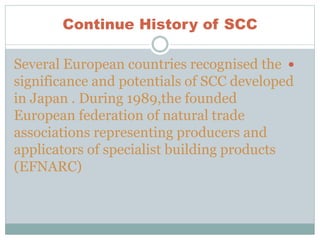
It's very flowable concrete with high workability that
has ability to flow under it's own weight with no
need of vibration and no segregation and without the
separation of the constituent materials until it sets .
History Of SCC
Researchers at the University of Tokyo ,
Japan , Started in late 1980's to develop SCC
. By the early 1990's , Japan has developed
and used SCC that doesn't require vibration
to achieve full compaction . By the year
2000,the SCC has become popular in Japan
for prefabricated products and ready mixed
concrete .
Continue History of SCC
Several European countries recognised the
significance and potentials of SCC developed
in Japan . During 1989,the founded
European federation of natural trade
associations representing producers and
applicators of specialist building products
(EFNARC)
Continue History of SCC
Self Compacting Concrete has been
described as " the most
revolutionary development in
concrete construction for several
decades " .
SCC originally in Japan to offset a
growing shortage of skilled labour .
Benefits of SCC
1- No effect on the setting and hardening of the concrete
2- overall cost saving 20-25% including labour costs
3- labour saving (no compaction needed)
4- Less site supervision needed
5- faster casting of the concrete
6- Reduction in the construction period
7- no need for access windows in either reinforcement or
formwork
Continue Benefits of SCC
8- less noise pollution (no vibration needed to compact
the concrete)
9- Health and safety for the workers is improved
10- Green and environment friendly form of construction
11- ease of pumping and less wear on equipments
12- more intricate designs and shapes can be cast
13- High quality concrete finishes
14- color consistency
Materials for SCC
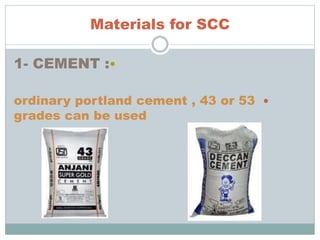
•1- CEMENT :
ordinary portland cement , 43 or 53
grades can be used
Continue Materials for SCC
2- Aggregates :
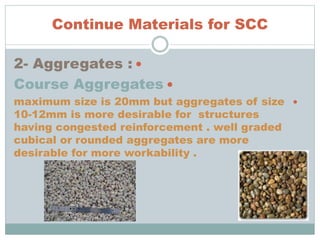
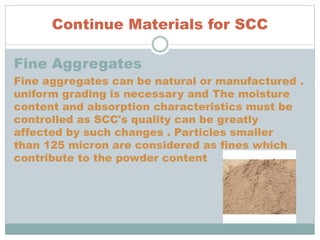
Course Aggregates
maximum size is 20mm but aggregates of size
10-12mm is more desirable for structures
having congested reinforcement . well graded
cubical or rounded aggregates are more
desirable for more workability .
Continue Materials for SCC
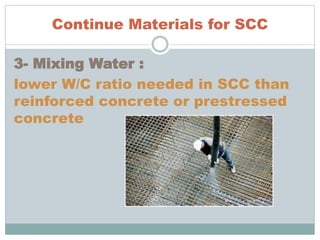
Fine Aggregates
Fine aggregates can be natural or manufactured .
uniform grading is necessary and The moisture
content and absorption characteristics must be
controlled as SCC's quality can be greatly
affected by such changes . Particles smaller
than 125 micron are considered as fines which
contribute to the powder content
Continue Materials for SCC
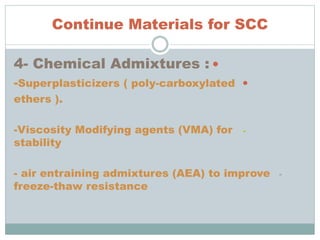
3- Mixing Water :
lower W/C ratio needed in SCC than
reinforced concrete or prestressed
concrete
Continue Materials for SCC
4- Chemical Admixtures :
-Superplasticizers ( poly-carboxylated
ethers ).
--Viscosity Modifying agents (VMA) for
stability
-- air entraining admixtures (AEA) to improve
freeze-thaw resistance
Continue Materials for SCC
5- Miniral Admixtures :
- Fly ash to improve quality and Durability
-Ground Granulated Blast Furnace Slag ( GGBFS
) acts as pore filler
- Silica Fume to improve mechanical properties
- Fibers to enhance the properties of SCC
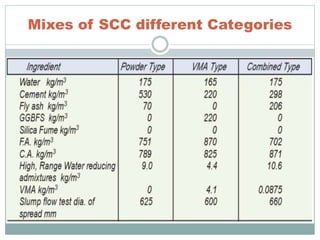
Different SCC Categories
1- Powder type :
Made by Increasing the power content
2- VMA type :
Made by viscosity modifying admixtures
•3- COMBINED TYPE :
Made by increasing power content and by VMA
admixtures
Mixes of SCC different Categories
Requirements for SCC
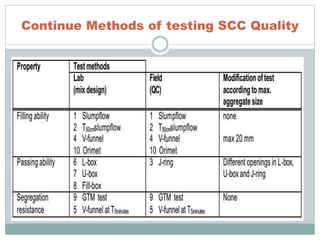
1- Filling ability :
It's the ability of concrete to fill formwork under it's
own weight only without the need of compaction
•2- PASSING ABILITY :
The ability of concrete to pass between congested
reinforcement bars or any other obstacles
•3- SEGREGATION RESISTANCE:
It's the stability of the concrete through mixing and
placing without segregation or bleeding
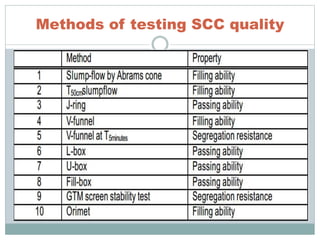
Methods of testing SCC quality
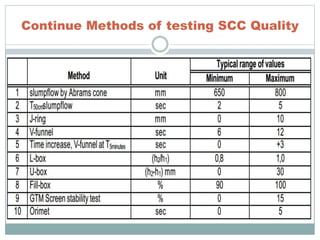
Continue Methods of testing SCC Quality
Questions
Thanks for your
attention
Prepared by :
Mohamed Saber
Ahmed Hamdy

Self compacting concrete

  • 1.
    S U BM I T T E D B Y : M O H A M E D S A B E R A H M E D H A M D Y Self Compacting Concrete ( SCC )
  • 2.
    What is SelfCompacting Concrete ( SCC )? It's very flowable concrete with high workability that has ability to flow under it's own weight with no need of vibration and no segregation and without the separation of the constituent materials until it sets .
  • 3.
    History Of SCC Researchersat the University of Tokyo , Japan , Started in late 1980's to develop SCC . By the early 1990's , Japan has developed and used SCC that doesn't require vibration to achieve full compaction . By the year 2000,the SCC has become popular in Japan for prefabricated products and ready mixed concrete .
  • 4.
    Continue History ofSCC Several European countries recognised the significance and potentials of SCC developed in Japan . During 1989,the founded European federation of natural trade associations representing producers and applicators of specialist building products (EFNARC)
  • 5.
    Continue History ofSCC Self Compacting Concrete has been described as " the most revolutionary development in concrete construction for several decades " . SCC originally in Japan to offset a growing shortage of skilled labour .
  • 6.
    Benefits of SCC 1-No effect on the setting and hardening of the concrete 2- overall cost saving 20-25% including labour costs 3- labour saving (no compaction needed) 4- Less site supervision needed 5- faster casting of the concrete 6- Reduction in the construction period 7- no need for access windows in either reinforcement or formwork
  • 7.
    Continue Benefits ofSCC 8- less noise pollution (no vibration needed to compact the concrete) 9- Health and safety for the workers is improved 10- Green and environment friendly form of construction 11- ease of pumping and less wear on equipments 12- more intricate designs and shapes can be cast 13- High quality concrete finishes 14- color consistency
  • 8.
    Materials for SCC •1-CEMENT : ordinary portland cement , 43 or 53 grades can be used
  • 9.
    Continue Materials forSCC 2- Aggregates : Course Aggregates maximum size is 20mm but aggregates of size 10-12mm is more desirable for structures having congested reinforcement . well graded cubical or rounded aggregates are more desirable for more workability .
  • 10.
    Continue Materials forSCC Fine Aggregates Fine aggregates can be natural or manufactured . uniform grading is necessary and The moisture content and absorption characteristics must be controlled as SCC's quality can be greatly affected by such changes . Particles smaller than 125 micron are considered as fines which contribute to the powder content
  • 11.
    Continue Materials forSCC 3- Mixing Water : lower W/C ratio needed in SCC than reinforced concrete or prestressed concrete
  • 12.
    Continue Materials forSCC 4- Chemical Admixtures : -Superplasticizers ( poly-carboxylated ethers ). --Viscosity Modifying agents (VMA) for stability -- air entraining admixtures (AEA) to improve freeze-thaw resistance
  • 13.
    Continue Materials forSCC 5- Miniral Admixtures : - Fly ash to improve quality and Durability -Ground Granulated Blast Furnace Slag ( GGBFS ) acts as pore filler - Silica Fume to improve mechanical properties - Fibers to enhance the properties of SCC
  • 14.
    Different SCC Categories 1-Powder type : Made by Increasing the power content 2- VMA type : Made by viscosity modifying admixtures •3- COMBINED TYPE : Made by increasing power content and by VMA admixtures
  • 15.
    Mixes of SCCdifferent Categories
  • 16.
    Requirements for SCC 1-Filling ability : It's the ability of concrete to fill formwork under it's own weight only without the need of compaction •2- PASSING ABILITY : The ability of concrete to pass between congested reinforcement bars or any other obstacles •3- SEGREGATION RESISTANCE: It's the stability of the concrete through mixing and placing without segregation or bleeding
  • 17.
    Methods of testingSCC quality
  • 18.
    Continue Methods oftesting SCC Quality
  • 19.
    Continue Methods oftesting SCC Quality
  • 20.
  • 21.
    Thanks for your attention Preparedby : Mohamed Saber Ahmed Hamdy