

SELF COMPACTING
CONCRETE
BY:-
SONA.S
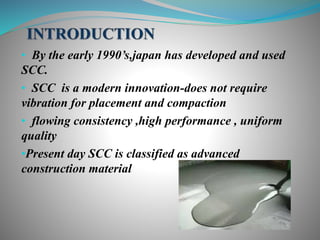
• By the early 1990’s,japan has developed and used
SCC.
• SCC is a modern innovation-does not require
vibration for placement and compaction
• flowing consistency ,high performance , uniform
quality
•Present day SCC is classified as advanced
construction material
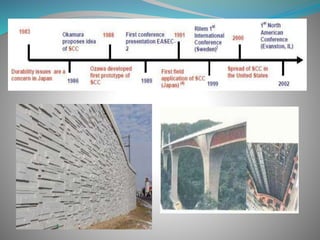
• In 1983, the problem of the durabity of the concrete
structures was a major topic of interest in Japan.
• The creation of durable concrete structures
requires adequate compaction by skilled workers
Solution :-
- to achieve a durable concrete
- dense compaction is needed in every nooks and
corners(to avoid honeycombs )
- self compacting concrete
concrete degrades due to lack of compaction-by the
employment of SCC –it can be avoided.
Present day SCC is classified as advanced
construction material
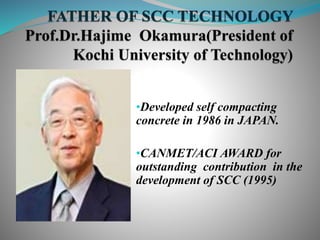
•Developed self compacting
concrete in 1986 in JAPAN.
•CANMET/ACI AWARD for
outstanding contribution in the
development of SCC (1995)
CONSTITUENTS OF SCC
SCC consists of the same components as
conventionally vibrated concrete has
1. Cement
2. Aggregates
3. Water
4. Chemical admixtures(super plasticizers ,viscosity
modifying agents)
5. Mineral admixtures (fly ash, silica fumes,GGBS)
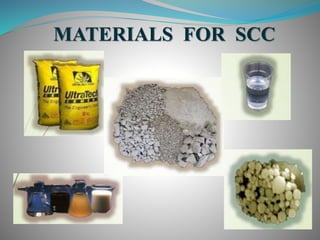
MATERIALS FOR SCC
CEMENT
Ordinary portland cement of 43 or 53 grade can
used.
COARSE AGGREGATE
Crushed granite aggregate with nominal size
<12.5mm and specific gravity 2.56
FINE AGGREGATE
Zone III sand passing through 4.75 mm sieve of
specific gravity 2.56
CHEMICAL ADMIXTURES
Super plasticizers :-
provide necessary workability
Viscosity Modifying Agents(VMA):-
provide stability
Air entraining agents :-
improve freezing and thawing resistanc
MINERALADMIXTURES
Fly ash :-
improve the quality and durability
Ground Granulated Blast Furnace Slag(GGBFS)
Silica fume:-
improve mechanical properties of SCC
Stone powder:-
finely crushed lime stone,dolomite or
granite(improves by 20%)
30%-GGBS and 15% of limestone gives maximum
compressive strength
Fibre:-
enhances the properties of SCC
MIXING WATER
ordinary potable water of ph ranging
from 7 to 8.5
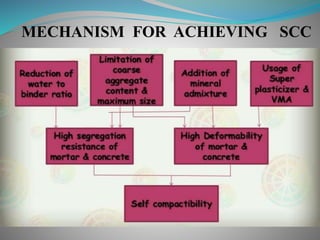
MECHANISM FOR ACHIEVING SCC
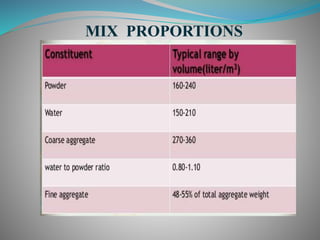
MIX PROPORTIONS
PROPERTIES OF SCC
In fresh state ,SCC has
Filling ability(excellent deformability)-
flows easily at suitable speed into formwork
Passing ability –
ability to pass reinforcement without blocking
High resistance to segregation-
the distribution of aggregate particles
remains homogenous in both vertical and horizontal
directions
THE REQUIREMENT OF SCC
SCC should have
*low coarse aggregate content
*increased paste content
*low water powder ratio
*increased super plasticizer dosage
*viscosity modifying agents
SELF COMPACTING CONCRETE CAN BE
DISTINGUISHED
Powder type
Increased the powder content
Viscosity Modifying agents type
Adding viscosity modifying admixtures
Combined type
Increased the powder content and using VMA
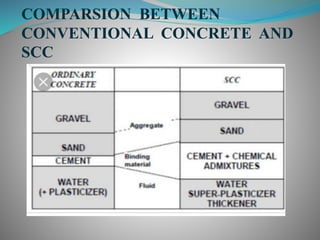
COMPARSION BETWEEN
CONVENTIONAL CONCRETE AND
SCC
TEST METHODS FOR
COMPACTIBILITY
Filling Ability:-
Slump flow test,T50 cm slump flow test , v-
funnel test
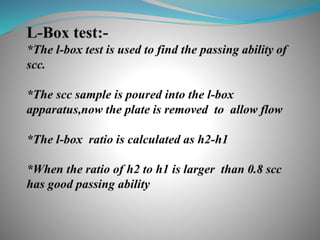
Passing ability:-
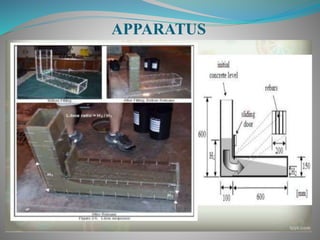
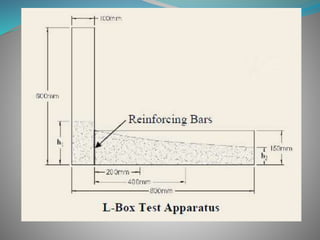
j-ring test, u-box test, l-box test
Segregation potential:-
settlement column test , sieve stability test ,
penetration test
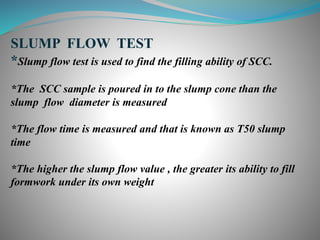
SLUMP FLOW TEST
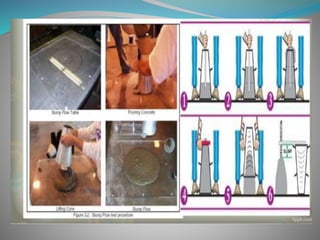
*Slump flow test is used to find the filling ability of SCC.
*The SCC sample is poured in to the slump cone than the
slump flow diameter is measured
*The flow time is measured and that is known as T50 slump
time
*The higher the slump flow value , the greater its ability to fill
formwork under its own weight
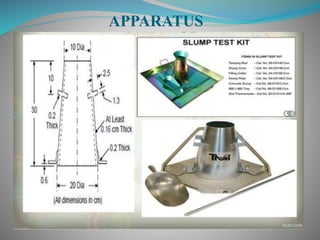
APPARATUS
APPARATUS
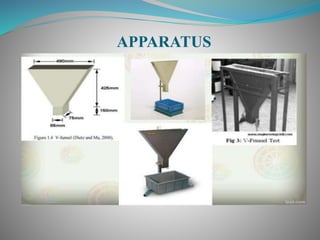
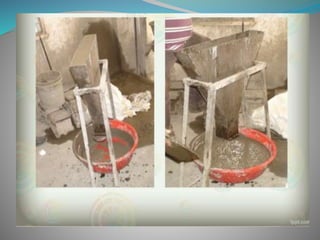
V-funnel test:-
*The v-funnel is used to find the segregation resistance
of SCC.
*The SCC sample is poured into the v-funnel
apparatus, now its allowed to flow by its weight
*The emptying time of v-funnel is noted
*This test measured the ease of flow of the concrete,
shorter flow times indicate greater flow ability.
*After 5 minutes of setting,segregation of concrete will
show a less continuous flow with an increase in flow
time
APPARATUS
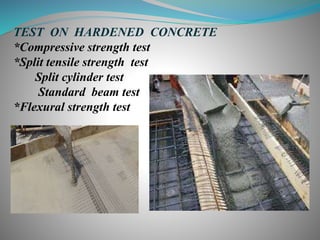
TEST ON HARDENED CONCRETE
*Compressive strength test
*Split tensile strength test
Split cylinder test
Standard beam test
*Flexural strength test
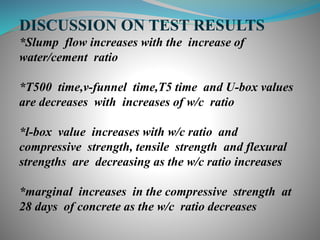
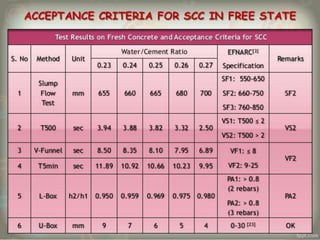
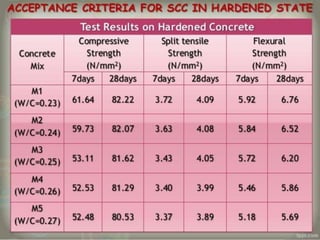
DISCUSSION ON TEST RESULTS
*Slump flow increases with the increase of
water/cement ratio
*T500 time,v-funnel time,T5 time and U-box values
are decreases with increases of w/c ratio
*l-box value increases with w/c ratio and
compressive strength, tensile strength and flexural
strengths are decreasing as the w/c ratio increases
*marginal increases in the compressive strength at
28 days of concrete as the w/c ratio decreases
ADVANTAGES OF SCC
*Elimination of problems associated with vibration
*Faster construction
*Greater freedom in designs
*Less noise from vibrators and reduced danger from
hand-arm vibration syndrome(HAVS)
*Ease of placement results in cost savings through
reduced equipment and labour requirement
*Improves the quality,durability and reliability
of concrete structures due to better compaction
and homogeneity of concrete
*Reduced wear and tear on forms of vibrations
*Reduced permeability
*Better surface finish
*Reduced site man power
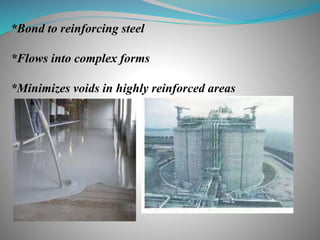
*Bond to reinforcing steel
*Flows into complex forms
*Minimizes voids in highly reinforced areas
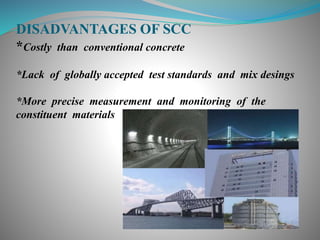
DISADVANTAGES OF SCC
*Costly than conventional concrete
*Lack of globally accepted test standards and mix desings
*More precise measurement and monitoring of the
constituent materials
OUR ROLE
As an engineer:
*Maximum application of self compacting concrete
*Learning and guiding workers to implement the
self compacting concrete
As a researcher:
*To identify test methods for SCC to improve its
workability
*Forming IS codes for the self compacting concrete
Self compacting concrete

Self compacting concrete

  • 1.
  • 2.
    • By theearly 1990’s,japan has developed and used SCC. • SCC is a modern innovation-does not require vibration for placement and compaction • flowing consistency ,high performance , uniform quality •Present day SCC is classified as advanced construction material
  • 3.
    • In 1983,the problem of the durabity of the concrete structures was a major topic of interest in Japan. • The creation of durable concrete structures requires adequate compaction by skilled workers Solution :- - to achieve a durable concrete - dense compaction is needed in every nooks and corners(to avoid honeycombs ) - self compacting concrete concrete degrades due to lack of compaction-by the employment of SCC –it can be avoided. Present day SCC is classified as advanced construction material
  • 5.
    •Developed self compacting concretein 1986 in JAPAN. •CANMET/ACI AWARD for outstanding contribution in the development of SCC (1995)
  • 6.
    CONSTITUENTS OF SCC SCCconsists of the same components as conventionally vibrated concrete has 1. Cement 2. Aggregates 3. Water 4. Chemical admixtures(super plasticizers ,viscosity modifying agents) 5. Mineral admixtures (fly ash, silica fumes,GGBS)
  • 7.
  • 8.
    CEMENT Ordinary portland cementof 43 or 53 grade can used. COARSE AGGREGATE Crushed granite aggregate with nominal size <12.5mm and specific gravity 2.56 FINE AGGREGATE Zone III sand passing through 4.75 mm sieve of specific gravity 2.56
  • 9.
    CHEMICAL ADMIXTURES Super plasticizers:- provide necessary workability Viscosity Modifying Agents(VMA):- provide stability Air entraining agents :- improve freezing and thawing resistanc MINERALADMIXTURES Fly ash :- improve the quality and durability Ground Granulated Blast Furnace Slag(GGBFS) Silica fume:- improve mechanical properties of SCC
  • 10.
    Stone powder:- finely crushedlime stone,dolomite or granite(improves by 20%) 30%-GGBS and 15% of limestone gives maximum compressive strength Fibre:- enhances the properties of SCC MIXING WATER ordinary potable water of ph ranging from 7 to 8.5
  • 11.
  • 12.
  • 13.
    PROPERTIES OF SCC Infresh state ,SCC has Filling ability(excellent deformability)- flows easily at suitable speed into formwork Passing ability – ability to pass reinforcement without blocking High resistance to segregation- the distribution of aggregate particles remains homogenous in both vertical and horizontal directions
  • 14.
    THE REQUIREMENT OFSCC SCC should have *low coarse aggregate content *increased paste content *low water powder ratio *increased super plasticizer dosage *viscosity modifying agents SELF COMPACTING CONCRETE CAN BE DISTINGUISHED Powder type Increased the powder content Viscosity Modifying agents type Adding viscosity modifying admixtures Combined type Increased the powder content and using VMA
  • 15.
  • 16.
    TEST METHODS FOR COMPACTIBILITY FillingAbility:- Slump flow test,T50 cm slump flow test , v- funnel test Passing ability:- j-ring test, u-box test, l-box test Segregation potential:- settlement column test , sieve stability test , penetration test
  • 17.
    SLUMP FLOW TEST *Slumpflow test is used to find the filling ability of SCC. *The SCC sample is poured in to the slump cone than the slump flow diameter is measured *The flow time is measured and that is known as T50 slump time *The higher the slump flow value , the greater its ability to fill formwork under its own weight
  • 18.
  • 21.
  • 23.
    V-funnel test:- *The v-funnelis used to find the segregation resistance of SCC. *The SCC sample is poured into the v-funnel apparatus, now its allowed to flow by its weight *The emptying time of v-funnel is noted *This test measured the ease of flow of the concrete, shorter flow times indicate greater flow ability. *After 5 minutes of setting,segregation of concrete will show a less continuous flow with an increase in flow time
  • 24.
  • 26.
    TEST ON HARDENEDCONCRETE *Compressive strength test *Split tensile strength test Split cylinder test Standard beam test *Flexural strength test
  • 27.
    DISCUSSION ON TESTRESULTS *Slump flow increases with the increase of water/cement ratio *T500 time,v-funnel time,T5 time and U-box values are decreases with increases of w/c ratio *l-box value increases with w/c ratio and compressive strength, tensile strength and flexural strengths are decreasing as the w/c ratio increases *marginal increases in the compressive strength at 28 days of concrete as the w/c ratio decreases
  • 30.
    ADVANTAGES OF SCC *Eliminationof problems associated with vibration *Faster construction *Greater freedom in designs *Less noise from vibrators and reduced danger from hand-arm vibration syndrome(HAVS) *Ease of placement results in cost savings through reduced equipment and labour requirement
  • 31.
    *Improves the quality,durabilityand reliability of concrete structures due to better compaction and homogeneity of concrete *Reduced wear and tear on forms of vibrations *Reduced permeability *Better surface finish *Reduced site man power
  • 32.
    *Bond to reinforcingsteel *Flows into complex forms *Minimizes voids in highly reinforced areas
  • 33.
    DISADVANTAGES OF SCC *Costlythan conventional concrete *Lack of globally accepted test standards and mix desings *More precise measurement and monitoring of the constituent materials
  • 34.
    OUR ROLE As anengineer: *Maximum application of self compacting concrete *Learning and guiding workers to implement the self compacting concrete As a researcher: *To identify test methods for SCC to improve its workability *Forming IS codes for the self compacting concrete