SHRI SHANKARPRASAD AGNIHOTRI COLLEGE
OF ENGINEERING, WARDHA
PRESENTATION ON
MIX DESIGN PROCEDURE OF READY MIX CONCRETE
DEPT. OF CIVIL ENGG.
PRESENTED BY :-
 ASHWAJIT WAGDE
 KAILASH HAGAWANE
 SURENDRA KHAIRKAR
 RAHUL BORKAR
 AKASH KUMBHALWAR
GUIDANCE BY:-
 MISS. MINAL LONKAR MAM
 MISS. HARSHALI KOPARKAR
MAM
INTRODUCTION
Ready-mix concrete (RMC) is a ready-to-use
material, with predetermined mixture of Cement,
sand, aggregates and water.
 The Idea of Ready Mix Concrete (RMC) was first
introduced by Architect Jurgen Heinrich Magens, he
got his patent of RMC in Germany in 1903.
In 1907, he discovered that the available time for
transportation could be prolonged not only by cooling
fresh concrete but also by vibrating it during
transportation.
The first concrete mixed off site and delivered to a
construction site was effectively done in Baltimore,
United States in 1913, just before the First World
War.
The first concept of transit mixer was also born in
1926 in the United States. In 1939, the first RMC
plant was installed in United Kingdom and in 1933.
Between the years 1950 and 1980 considerable
growth of RMC took place in the United States.
In India RMC was first initially was used in 1950
during the construction sites of Dams like Bhakra
Nangal, Koyna.
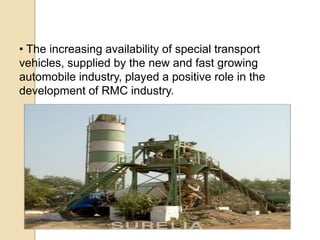
• The increasing availability of special transport
vehicles, supplied by the new and fast growing
automobile industry, played a positive role in the
development of RMC industry.
OBJECTIVE
 Better quality concrete is produced.
 Elimination of storage space for basic
materials at site.
 Elimination of Procurement / Hiring of
plant and machinery.
 Wastage of basic materials is avoided.
MATERIALS REQUIRED FOR RMC
1. AGGREGATE :
Aggregates are the important constituents in
concrete. They give body to the concrete,
reduce shrinkage and effect economy. The
mere fact that the aggregates occupy 70-80 per
cent of the volume of concrete.
Aggregates are divided into two categories from
the consideration of size
• Coarse aggregate
• Fine aggregate
The size of the aggregate bigger than
4.75 mm is considered as coarse aggregate and
aggregate whose size is 4.75 mm and less is
considered as fine aggregate.
2. CEMENT :
Cement is a binder material which
sets and hardens independently, and can bind
other materials together.
Cement is made up of four main
compounds,
 dicalcium Silicate (2CaO SiO2),
tricalcium silicate (3CaO SiO2),
 tricalcium acuminate (3CaO Al2O3),
tetra-calcium aluminoferrite (4CaO Al2O3
Fe2O3).
these compounds are designated as C2S,
C3S, C3A, and C4AF.
where C stands for calcium oxide (lime), S for
silica and A for alumina, and F for iron oxide.
Small amounts of uncombined lime and
magnesia also are present, along with alkalis
and minor amounts of other elements.
3. ADMIXTURE:
• Air-entraining admixtures (mainly used in
concrete exposed to freezing)
• Water-reducing admixtures, plasticizers
(reduce the dosage of water while maintaining
the workability)
• Retarding admixtures (mainly used in hot
weather to retard the reaction of hydration)
• Accelerating admixtures (mainly used in cold
weather to accelerate the reaction of hydration)
• Super plasticizer or high range water-reducer
(significantly reduce the dosage of water while
maintaining the workability)
• Miscellaneous admixtures such as corrosion
inhibiting, shrinkage reducing, coloring, pumping
etc.
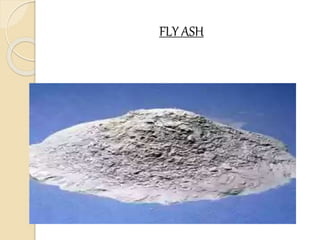
FLY ASH:
Fly ash is a by-product from coal-fired
electricity generating power plants.
The fly ash is generally used in the
concrete in the following ways.
As partial replace for cement.
As partial replacement for sand.
As simultaneous replacement for both
cement and sand.
FLY ASH
WATER :
The pH value of water should be in
between 6.0 and 8.0 according to IS
456-2000.
rice husk / hull ash (RHA)
 Today, rice is grown and harvested on
every continent except Antarctica.
 The majority of all rice is produced in
India, China, Japan, Indonesia, Thailand,
Burma, and Bangladesh. Asian farmers’
accounts for 92-percent of the world's total
rice production.
 More than 550 million tons of rice is
produced annually around the globe.
 That rice husk are used in RMC to
EQUIPMENTS REQUIRED:
Storage of materials - Silos, containers
and bins
Batching arrangement
Measuring and recording equipment
Mixing equipment
Control systems
Electrical, hydraulic and pneumatic
drives
Conveying systems (belt / screw
conveyors)
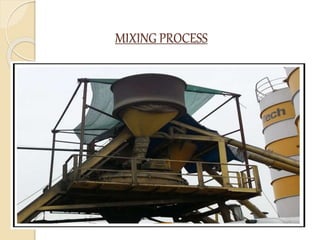
MIXING PROCESS:
Thorough mixing of the materials is essential
for the production of uniform concrete. The
mixing should ensure that the mass
becomes homogeneous, uniform in colour
and consistency. There are three methods
adopted for mixing Ready Mix Concrete.
 Following are the three types of mixing
process of RMC
 1. Transit Mixed (or "truck-mixed") Concrete
 2. Shrink Mixed Concrete
 3. Central Mixed Concrete
MIXING PROCESS
TRANSIT MIXED(OR "TRUCK-MIXED") CONCRETE:-
While ready mixed concrete can be delivered to the
point of placement the overwhelming majority of it is
brought to the construction site in truck-mounted,
rotating drum mixers.
Truck mixers have a revolving drum with the axis
inclined to the horizontal.
Inside the shell of the mixer drum are a pair of blades
or fins that wrap in a helical (spiral) configuration from
the head to the opening of the drum.
The concrete is loaded and mixed, it is normally
hauled to the job site with the drum turning at a speed
of less than 2 rpm.
NEEDS TO BE SPECIFIED BY CONSUMER FOR RMC
 Characteristic strength or grade (N/mm2)
 Target workability or slump in mm required
at site
 Exposure conditions for durability
requirements
Maximum water to cement ratio
 Minimum cement content
 Maximum aggregate size
 Type of cement
 Mineral admixture and its proportion
(Kg/m3)
CHECKS BY CONSUMER BEFORE ORDERING THE RMC
 Calibrations of all measuring devices and
their accuracy.
 Mode of operation of plant should
preferably be fully automatic and not
manual.
 Quality of materials proposed to be used.
 Adequacy of quantity of materials used.
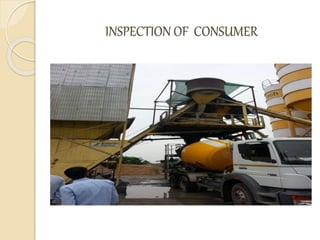
INSPECTION OF CONSUMER
Conclusion:
 The concrete quality produced in RMC
plant is highly consistent with low
deviation order.
 It provides a high degree of overall
strength of hardened concrete and the
performance of the structure at a later
date.
 RMC operations are highly mechanized
and fully controlled through electronic
controls and hence reduce the
REFERANCE:
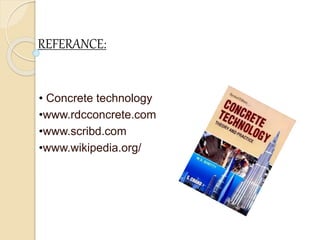
• Concrete technology
•www.rdcconcrete.com
•www.scribd.com
•www.wikipedia.org/
THANK YOU

Ready mix concrete project ppt

  • 1.
    SHRI SHANKARPRASAD AGNIHOTRICOLLEGE OF ENGINEERING, WARDHA PRESENTATION ON MIX DESIGN PROCEDURE OF READY MIX CONCRETE DEPT. OF CIVIL ENGG. PRESENTED BY :-  ASHWAJIT WAGDE  KAILASH HAGAWANE  SURENDRA KHAIRKAR  RAHUL BORKAR  AKASH KUMBHALWAR GUIDANCE BY:-  MISS. MINAL LONKAR MAM  MISS. HARSHALI KOPARKAR MAM
  • 2.
    INTRODUCTION Ready-mix concrete (RMC)is a ready-to-use material, with predetermined mixture of Cement, sand, aggregates and water.  The Idea of Ready Mix Concrete (RMC) was first introduced by Architect Jurgen Heinrich Magens, he got his patent of RMC in Germany in 1903. In 1907, he discovered that the available time for transportation could be prolonged not only by cooling fresh concrete but also by vibrating it during transportation.
  • 3.
    The first concretemixed off site and delivered to a construction site was effectively done in Baltimore, United States in 1913, just before the First World War. The first concept of transit mixer was also born in 1926 in the United States. In 1939, the first RMC plant was installed in United Kingdom and in 1933. Between the years 1950 and 1980 considerable growth of RMC took place in the United States. In India RMC was first initially was used in 1950 during the construction sites of Dams like Bhakra Nangal, Koyna.
  • 4.
    • The increasingavailability of special transport vehicles, supplied by the new and fast growing automobile industry, played a positive role in the development of RMC industry.
  • 5.
    OBJECTIVE  Better qualityconcrete is produced.  Elimination of storage space for basic materials at site.  Elimination of Procurement / Hiring of plant and machinery.  Wastage of basic materials is avoided.
  • 6.
    MATERIALS REQUIRED FORRMC 1. AGGREGATE : Aggregates are the important constituents in concrete. They give body to the concrete, reduce shrinkage and effect economy. The mere fact that the aggregates occupy 70-80 per cent of the volume of concrete.
  • 7.
    Aggregates are dividedinto two categories from the consideration of size • Coarse aggregate • Fine aggregate The size of the aggregate bigger than 4.75 mm is considered as coarse aggregate and aggregate whose size is 4.75 mm and less is considered as fine aggregate.
  • 8.
    2. CEMENT : Cementis a binder material which sets and hardens independently, and can bind other materials together. Cement is made up of four main compounds,  dicalcium Silicate (2CaO SiO2), tricalcium silicate (3CaO SiO2),  tricalcium acuminate (3CaO Al2O3), tetra-calcium aluminoferrite (4CaO Al2O3 Fe2O3). these compounds are designated as C2S, C3S, C3A, and C4AF.
  • 9.
    where C standsfor calcium oxide (lime), S for silica and A for alumina, and F for iron oxide. Small amounts of uncombined lime and magnesia also are present, along with alkalis and minor amounts of other elements.
  • 10.
    3. ADMIXTURE: • Air-entrainingadmixtures (mainly used in concrete exposed to freezing) • Water-reducing admixtures, plasticizers (reduce the dosage of water while maintaining the workability) • Retarding admixtures (mainly used in hot weather to retard the reaction of hydration) • Accelerating admixtures (mainly used in cold weather to accelerate the reaction of hydration)
  • 11.
    • Super plasticizeror high range water-reducer (significantly reduce the dosage of water while maintaining the workability) • Miscellaneous admixtures such as corrosion inhibiting, shrinkage reducing, coloring, pumping etc.
  • 12.
    FLY ASH: Fly ashis a by-product from coal-fired electricity generating power plants. The fly ash is generally used in the concrete in the following ways. As partial replace for cement. As partial replacement for sand. As simultaneous replacement for both cement and sand.
  • 13.
  • 14.
    WATER : The pHvalue of water should be in between 6.0 and 8.0 according to IS 456-2000.
  • 15.
    rice husk /hull ash (RHA)  Today, rice is grown and harvested on every continent except Antarctica.  The majority of all rice is produced in India, China, Japan, Indonesia, Thailand, Burma, and Bangladesh. Asian farmers’ accounts for 92-percent of the world's total rice production.  More than 550 million tons of rice is produced annually around the globe.  That rice husk are used in RMC to
  • 16.
    EQUIPMENTS REQUIRED: Storage ofmaterials - Silos, containers and bins Batching arrangement Measuring and recording equipment Mixing equipment Control systems Electrical, hydraulic and pneumatic drives Conveying systems (belt / screw conveyors)
  • 17.
    MIXING PROCESS: Thorough mixingof the materials is essential for the production of uniform concrete. The mixing should ensure that the mass becomes homogeneous, uniform in colour and consistency. There are three methods adopted for mixing Ready Mix Concrete.  Following are the three types of mixing process of RMC  1. Transit Mixed (or "truck-mixed") Concrete  2. Shrink Mixed Concrete  3. Central Mixed Concrete
  • 18.
  • 19.
    TRANSIT MIXED(OR "TRUCK-MIXED")CONCRETE:- While ready mixed concrete can be delivered to the point of placement the overwhelming majority of it is brought to the construction site in truck-mounted, rotating drum mixers. Truck mixers have a revolving drum with the axis inclined to the horizontal. Inside the shell of the mixer drum are a pair of blades or fins that wrap in a helical (spiral) configuration from the head to the opening of the drum. The concrete is loaded and mixed, it is normally hauled to the job site with the drum turning at a speed of less than 2 rpm.
  • 20.
    NEEDS TO BESPECIFIED BY CONSUMER FOR RMC  Characteristic strength or grade (N/mm2)  Target workability or slump in mm required at site  Exposure conditions for durability requirements Maximum water to cement ratio  Minimum cement content  Maximum aggregate size  Type of cement  Mineral admixture and its proportion (Kg/m3)
  • 21.
    CHECKS BY CONSUMERBEFORE ORDERING THE RMC  Calibrations of all measuring devices and their accuracy.  Mode of operation of plant should preferably be fully automatic and not manual.  Quality of materials proposed to be used.  Adequacy of quantity of materials used.
  • 22.
  • 23.
    Conclusion:  The concretequality produced in RMC plant is highly consistent with low deviation order.  It provides a high degree of overall strength of hardened concrete and the performance of the structure at a later date.  RMC operations are highly mechanized and fully controlled through electronic controls and hence reduce the
  • 24.
  • 25.