


Good morning
Public Private Partnership
Introduction
The Department of Economic Affairs
(DEA) defines PPP as:
“PPP means an arrangement between a
government or statutory entity or government
owned entity on one side and a private sector
entity on the other, for the provision of public
assets and/ or related services for public
benefit, through investments being made by
and/or management undertaken by the private
sector entity for a specified time period’’.
Public-Private Partnership or PPP in the
context of the health sector is an instrument for
improving the health of the population. PPP is
to be seen in the context of viewing the whole
medical sector as a national asset with health
promotion as goal of all health providers,
private or public.
The Private and Non-profit sectors are
also very much accountable to overall health
systems and services of the country.
Therefore, synergies where all the
stakeholders feel they are part of the system
and do everything possible to strengthen
national policies and programmes needs to be
emphasized with a proactive role from the
Government.
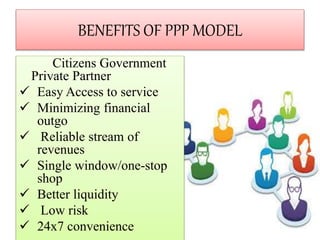
BENEFITS OF PPP MODEL
Citizens Government
Private Partner
 Easy Access to service
 Minimizing financial
outgo
 Reliable stream of
revenues
 Single window/one-stop
shop
 Better liquidity
 Low risk
 24x7 convenience
 Protection against technology
 Creation of employment
 Flexibility in access methods
 Speedier implementation
 Capturing business from related sectors
 Saving of indirect cost and hardship
 Efficiency in management
 Invoking private sector skills, experience, access
to technology, and innovation
principles for PPP
Return on Investment (ROI).
Minimizing brain drain .
Create realistic business models for e-
Governance projects.
Find the strength of each partner
Develop formal policies on outsourcing
Role of Government in PPP
Set policy, identify opportunities, and define
objectives.
Ensure transparency and probity in the
procurement process.
Safeguard the interests of customers and the
general public.
According to Weimer and Vining, "
A P3 typically involves a private entity
financing, constructing, or managing a project
in return for a promised stream of payments
directly from government or indirectly from
users over the projected life of the project or
some other specified period of time".
PPP at the global level
• At the Global Level Partnerships are usually
between a multinational company and a donor
mostly research organizations.
Example:- of this is a drug donation program
where drugs for a specific purpose is given for
free or at a subsidized rate to some international
organizations
• The growing importance of international private
health foundations with their strong ties to the
private sector
• There will be a substantial increase in the
number of such partnerships in the future.
PPP at the national level
The most prominent and commonly used PPP
model in the health sector is known as
‘Contracting’.
Level 1: The Government hands over the physical
infrastructure, equipment, budget and personnel
of a health unit to a private organization.
Level 2:-Equipment and budget but gives the
agency the option of selecting the personnel as
per their terms and conditions but subject to
Government norms such as one ANM per
5,000/3,000 population.
Level 3: freedom to the agency to adopt their
own service delivery models without following
fixed prescribed pattern.
Level 4: service delivery models, freedom to
expand types of services provided and freedom
to introduce user fee and recover some
proportion of cost.
Example
Arogya Raksha Scheme in Andhra Pradesh Student
teacher giving lecture writing notes and discussing
Yeshasvini Health scheme in Karnataka
Contracting in Sawai Man Singh Hospital, Jaipur
Rajiv Gandhi Super-specialty Hospital, Raichur,
Karnataka
IL&FS Education with RCM Reddy
PPP models in the Indian States
 Chiranjeevi Yojana Scheme Project Partner Mode Details
Project
 Tamil Nadu Emergency ambulance service Seva Nilyam
NGO O & M NGO operated Government Ambulances.
 Karnataka Health Insurance National Health Insurance
Company NA Health Insurance Scheme cost shared
between Government and Private Players.
 Andhra Pradesh Aarogyaraksha National Health Insurance
Company NA Health Insurance Scheme cost shared
between Government and Private Players Andhra Pradesh
Rajiv Aarogyasri Different vendors NA Vendor services to
sponsored patients; refunded the costs.

Maharashtra Seven Hills Hospital Seven Hills
DBFOT Government Land free of cost.
 Gujarat Chiranjeevi Yojana Network of
Practitioners NA Practitioners reimbursed by
Government.
 Gujarat Multispecialty Hospital Narayana
Hridalaya DBFOT Multi- Specialty Hospital.
 Punjab Multi Specialty Hospital, Bhatinda,
Mohali Max Health Care DBFOT Revenue Share.
 Delhi Indraprastha Hospitals Apollo Hospital
DBFOT Government land free of cost.
PPP disadvantages
Infrastructure or services delivered could be
more expensive
PPP project public sector payments obligations
postponed for the later periods can negatively
reflect future public sector fiscal indicators;
PPP service procurement procedure is longer
and more costly in comparison with traditional
public procurement;
PPP project agreements are long-term,
complicated and comparatively inflexible
because of impossibility to envisage and
evaluate all particular events that could
influence the future activity.
Thank you

Public Private Partnership

  • 1.
  • 2.
  • 3.
    Introduction The Department ofEconomic Affairs (DEA) defines PPP as: “PPP means an arrangement between a government or statutory entity or government owned entity on one side and a private sector entity on the other, for the provision of public assets and/ or related services for public benefit, through investments being made by and/or management undertaken by the private sector entity for a specified time period’’.
  • 4.
    Public-Private Partnership orPPP in the context of the health sector is an instrument for improving the health of the population. PPP is to be seen in the context of viewing the whole medical sector as a national asset with health promotion as goal of all health providers, private or public.
  • 5.
    The Private andNon-profit sectors are also very much accountable to overall health systems and services of the country. Therefore, synergies where all the stakeholders feel they are part of the system and do everything possible to strengthen national policies and programmes needs to be emphasized with a proactive role from the Government.
  • 6.
    BENEFITS OF PPPMODEL Citizens Government Private Partner  Easy Access to service  Minimizing financial outgo  Reliable stream of revenues  Single window/one-stop shop  Better liquidity  Low risk  24x7 convenience
  • 7.
     Protection againsttechnology  Creation of employment  Flexibility in access methods  Speedier implementation  Capturing business from related sectors  Saving of indirect cost and hardship  Efficiency in management  Invoking private sector skills, experience, access to technology, and innovation
  • 8.
    principles for PPP Returnon Investment (ROI). Minimizing brain drain . Create realistic business models for e- Governance projects. Find the strength of each partner Develop formal policies on outsourcing
  • 9.
    Role of Governmentin PPP Set policy, identify opportunities, and define objectives. Ensure transparency and probity in the procurement process. Safeguard the interests of customers and the general public.
  • 10.
    According to Weimerand Vining, " A P3 typically involves a private entity financing, constructing, or managing a project in return for a promised stream of payments directly from government or indirectly from users over the projected life of the project or some other specified period of time".
  • 11.
    PPP at theglobal level • At the Global Level Partnerships are usually between a multinational company and a donor mostly research organizations. Example:- of this is a drug donation program where drugs for a specific purpose is given for free or at a subsidized rate to some international organizations • The growing importance of international private health foundations with their strong ties to the private sector • There will be a substantial increase in the number of such partnerships in the future.
  • 12.
    PPP at thenational level The most prominent and commonly used PPP model in the health sector is known as ‘Contracting’.
  • 13.
    Level 1: TheGovernment hands over the physical infrastructure, equipment, budget and personnel of a health unit to a private organization. Level 2:-Equipment and budget but gives the agency the option of selecting the personnel as per their terms and conditions but subject to Government norms such as one ANM per 5,000/3,000 population.
  • 14.
    Level 3: freedomto the agency to adopt their own service delivery models without following fixed prescribed pattern. Level 4: service delivery models, freedom to expand types of services provided and freedom to introduce user fee and recover some proportion of cost.
  • 15.
    Example Arogya Raksha Schemein Andhra Pradesh Student teacher giving lecture writing notes and discussing Yeshasvini Health scheme in Karnataka Contracting in Sawai Man Singh Hospital, Jaipur Rajiv Gandhi Super-specialty Hospital, Raichur, Karnataka IL&FS Education with RCM Reddy
  • 16.
    PPP models inthe Indian States  Chiranjeevi Yojana Scheme Project Partner Mode Details Project  Tamil Nadu Emergency ambulance service Seva Nilyam NGO O & M NGO operated Government Ambulances.  Karnataka Health Insurance National Health Insurance Company NA Health Insurance Scheme cost shared between Government and Private Players.  Andhra Pradesh Aarogyaraksha National Health Insurance Company NA Health Insurance Scheme cost shared between Government and Private Players Andhra Pradesh Rajiv Aarogyasri Different vendors NA Vendor services to sponsored patients; refunded the costs. 
  • 17.
    Maharashtra Seven HillsHospital Seven Hills DBFOT Government Land free of cost.  Gujarat Chiranjeevi Yojana Network of Practitioners NA Practitioners reimbursed by Government.  Gujarat Multispecialty Hospital Narayana Hridalaya DBFOT Multi- Specialty Hospital.  Punjab Multi Specialty Hospital, Bhatinda, Mohali Max Health Care DBFOT Revenue Share.  Delhi Indraprastha Hospitals Apollo Hospital DBFOT Government land free of cost.
  • 18.
    PPP disadvantages Infrastructure orservices delivered could be more expensive PPP project public sector payments obligations postponed for the later periods can negatively reflect future public sector fiscal indicators; PPP service procurement procedure is longer and more costly in comparison with traditional public procurement;
  • 19.
    PPP project agreementsare long-term, complicated and comparatively inflexible because of impossibility to envisage and evaluate all particular events that could influence the future activity.
  • 20.