Portfolio
Assessment
Neslee M. Infante
What are Portfolio Assessments?
Portfolio assessments are not a
type of assessment item, but
rather a compilation of students’
work. Portfolio assessments ask
students or teachers to collect
work products that show growth
over a specific period of time.
• to show growth (process
of learning)
• to showcase current
abilities (product of
learning)
Purpose:
• to evaluate cumulative
achievement (progress of
learning)
Two Main Types of Portfolio
Instructional Portfolio
Instructional or working portfolios
are formative in nature. They
allow a student to demonstrate
his or her ability to perform a
particular skill.
Showcase Portfolio
Showcase portfolios are summative in nature. They include samples of a
student’s best work to demonstrate mastery at the end of a unit of study,
semester or school year. A showcase portfolio may include several drafts of an
essay with comments that indicate how each draft improves upon the last, with
the most polished draft on the topic demonstrating a student’s mastery of the
relevant skills.
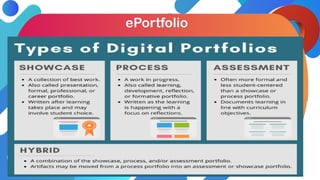
ePortfolio
Showcase Portfolio:
Highlighting Best Work
Collection of Best
Work
Created after learning
takes place. Focuses on
portfolio as a product.
Audience Connection
Follows "collect, select,
reflect, connect"
approach. Actively seeks
feedback.
Professional Presentation
Assists with self-marketing and building positive digital footprint.
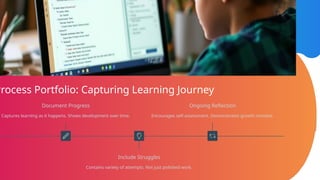
Process Portfolio: Capturing Learning Journey
Document Progress
Captures learning as it happens. Shows development over time.
Include Struggles
Contains variety of attempts. Not just polished work.
Ongoing Reflection
Encourages self-assessment. Demonstrates growth mindset.
Assessment Portfolio:
Demonstrating Mastery
Curriculum Alignment
Documents mastery of
specific learning objectives.
Reflections focus on
curriculum connections.
Formal Structure
More structured than other
portfolio types. Often follows
specific requirements.
Accountability Focus
Provides evidence for teachers and administrators. Common in
certification programs.
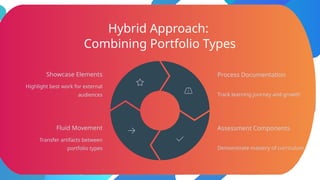
Hybrid Approach:
Combining Portfolio Types
Showcase Elements
Highlight best work for external
audiences
Process Documentation
Track learning journey and growth
Assessment Components
Demonstrate mastery of curriculum
Fluid Movement
Transfer artifacts between
portfolio types
1. Portfolios are a rich source of information about
student learning
2. Portfolios are versatile.
3. Portfolio assessments can build students’ self-
confidence and “self-appraisal” skills through the
opportunity they provide for students to reflect on
and celebrate their accomplishments
4. It can develop reflective learning.
5. It can foster teacher-student/parent-child
collaboration in the teaching learning process.
Benefits:
1. Portfolio assessments can be time consuming to design and
score in a consistent and unbiased manner.
2. Portfolio assessments also involve a great deal of logistical
planning and organization.
Challenges:
FRAMEWORK TO
DESIGN PORTFOLIO
ASSESSMENT
Step 1: Determine the
primary purpose of the
portfolio.
Step 2: Identify the
standard(s) you will
assess.
 What is the purpose in making the
portfolio?
 Who should make the portfolio?
 How long will it take to assemble the
entries in a portfolio?
 How will it take to assemble the
entries in a portfolio?
QUESTIONS IN
PORTFOLIO MAKING
 What entries will be included in the
portfolio?
 What criteria should be used to
evaluate a portfolio?
 What conclusions can be made as he
result the construction of the
portfolio?
 How can we summarize evaluative
data in a portfolio?
QUESTIONS IN
PORTFOLIO MAKING
Set Goals
Collect
Select
Reflect
Exhibit
Confer
Reflect
Portfolio Process
References:
http://portfolio.ascollege.wa.edu.au/blog/2021/03/26/typ
es-of-portfolios/
Slideshare.net/slideshow/portfolio-assessment-
61364093/61364093
https://csaa/wested.org
Peer & Self
Assessment
Neslee M. Infante
 Self-assessment “is the involvement of
students in identifying standards and/
or criteria to apply to their work, and
making judgments about the extent to
which they have met these criteria and
standards…..[it] means more than
students grading their own work; it
means involving them in the process of
determining what is ‘good work’.
 Boud, D. (1995) Enhancing Learning
through Self-Assessment; Kogan Page;
London
Self Assessment
Steps to Conduct a Self-
Assessment
1. Identify the purpose
2. Collect Data
3. Reflect
4. Identify goals
5. Be honest
6. Develop an action plan
7. Evaluate progress
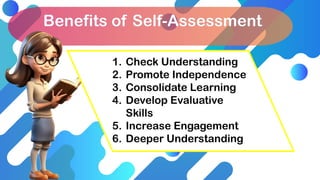
Benefits of Self-Assessment
1. Check Understanding
2. Promote Independence
3. Consolidate Learning
4. Develop Evaluative
Skills
5. Increase Engagement
6. Deeper Understanding
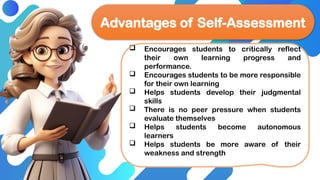
 Encourages students to critically reflect
their own learning progress and
performance.
 Encourages students to be more responsible
for their own learning
 Helps students develop their judgmental
skills
 There is no peer pressure when students
evaluate themselves
 Helps students become autonomous
learners
 Helps students be more aware of their
weakness and strength
Advantages of Self-Assessment
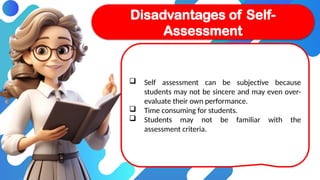
 Self assessment can be subjective because
students may not be sincere and may even over-
evaluate their own performance.
 Time consuming for students.
 Students may not be familiar with the
assessment criteria.
Disadvantages of Self-
Assessment
Self Assessment Forms
 Students use criteria and apply standards to
the work of their peers in order to judge that
work. Both self and peer assessment are
“formative, in that it has beneficial effects on
learning, but may also be summative, either in
the sense of learners deciding that they have
learned as much as they wished to do in a
given area, or ….it may contribute to the
grades awarded to the students”.
 Boud and Falchikov (1989) in Falchikov, N.
(2005) Improving Assessment Through
Student Involvement: Routledge Falmer; Oxon
Peer Assessment
1. Peer assessment is a good way for learners to get familiar with
constructive criticism.
2. They can provide meaningful insights into each other’s behaviors,
competencies, and experiences.
3. It improves the skills and output of the evaluator.
4. It helps develop critical thinking and assessment skills.
5. It can improve team bonding.
6. It promotes deep learning.
Importance of Peer
Assessment
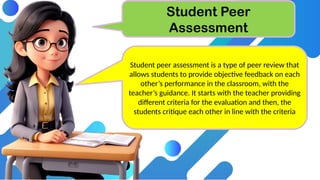
Student Peer
Assessment
Student peer assessment is a type of peer review that
allows students to provide objective feedback on each
other’s performance in the classroom, with the
teacher’s guidance. It starts with the teacher providing
different criteria for the evaluation and then, the
students critique each other in line with the criteria
PROs of Student Peer
Assessment
 By getting the students involved in the assessment
process, the teacher can improve their cognitive
skills and understanding of the course.
 It serves as a bridge between the teaching and
learning process.
 It helps knowledge exchange and knowledge
diffusion in the classroom.
PROs of Student Peer
Assessment
 Encourages students to critically reflect each others' work
 Encourages students to be involved in the assessment process
 Helps students develop their judgmental skills when they assess the
work of other group members
 More feedback can be generated by students compared to one or
two teachers
 Reduces the time and workload of marking for teachers
 Discourages the problem of 'free rider' because students tend to put
extra effort to perform better in front of their peers
 Maintains the fairness of assessment because everyone has the
chance to assess each other
 Students learn how to criticize, evaluate and apply other generic skills
during the process
 Students learn more from each others' work
CONs of Student Peer
Assessment
 It can lead to subjective criticism due to hate or
jealousy between students.
 Due to a lack of experience in assessment and
evaluation, the feedback provided by students
during peer assessment cannot be relied on.
 Peer assessment can negatively affect the
relationship between students; especially when
negative feedback is given.
CONs of Student Peer
Assessment
 Peer pressure and friendship can influence the
reliability of grades given by students
 Students may have a tendency to give everyone
the same mark (for example, there may be
collusion in return for good grades)
 Students are not experienced in assessing each
other
 Students may cheat in collaboration for group
assignments
 Fairness may not be maintained because
extroverted students can be usually be marked
higher and quieter students got marked down
1. Create a well-defined peer assessment guideline
that highlights your assessment criteria. This
allows for a standardized assessment process
2. Allocate enough time for the assessment and
communicate this to all the parties involved. If
you’re using an online form for your peer
assessment, you can share the form with the
reviewer well ahead of time.
How to Conduct
Peer
Assessment
3. Ensure that all the parties involved get familiar
with the assessment parameters. This keeps the
process transparent and impartial.
Your peer assessment process should encourage
honest feedback. If you’re using a survey for the
assessment, avoid bad survey questions like leading
and loaded questions that can communicate huge
biases in your review process.
Key Benefits of Peer and Self-
Assessment
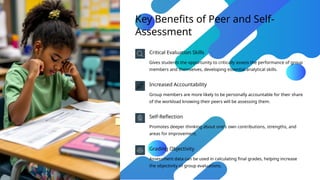
Critical Evaluation Skills
Gives students the opportunity to critically assess the performance of group
members and themselves, developing essential analytical skills.
Increased Accountability
Group members are more likely to be personally accountable for their share
of the workload knowing their peers will be assessing them.
Self-Reflection
Promotes deeper thinking about one's own contributions, strengths, and
areas for improvement.
Grading Objectivity
Assessment data can be used in calculating final grades, helping increase
the objectivity of group evaluations.
Potential Concerns and Challenges
Assessment Capability
Some students may struggle to assess peers and themselves objectively, giving
inappropriate negative feedback or inflated positive feedback.
"Hitchhiking" Problem
Some students may rely on others' work while appearing to have completed their portion
of the project, creating inequity in workload distribution.
Grading Distortion
Misleading high or low marks and comments could inappropriately raise or lower final
grades, affecting accuracy of assessment.
Student Collusion
Students might collaborate to manipulate assessment outcomes, undermining the
integrity of the evaluation process.
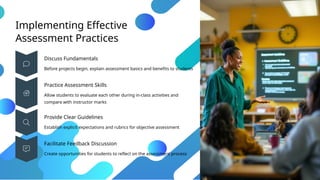
Implementing Effective
Assessment Practices
Discuss Fundamentals
Before projects begin, explain assessment basics and benefits to students
Practice Assessment Skills
Allow students to evaluate each other during in-class activities and
compare with instructor marks
Provide Clear Guidelines
Establish explicit expectations and rubrics for objective assessment
Facilitate Feedback Discussion
Create opportunities for students to reflect on the assessment process
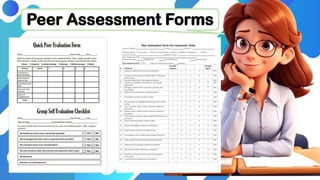
Peer Assessment Forms
References:
https://slideplayer.com/slide/16917795/
https://www.niu.edu/citl/resources/guides/instructional
-guide/peer-and-self-assessment.shtml
https://www.teachwithmrst.com/post/peer-and-self-ass
essment

Portfolio-Assessment language testing.pptx

  • 1.
  • 2.
    What are PortfolioAssessments? Portfolio assessments are not a type of assessment item, but rather a compilation of students’ work. Portfolio assessments ask students or teachers to collect work products that show growth over a specific period of time.
  • 3.
    • to showgrowth (process of learning) • to showcase current abilities (product of learning) Purpose: • to evaluate cumulative achievement (progress of learning)
  • 4.
    Two Main Typesof Portfolio Instructional Portfolio Instructional or working portfolios are formative in nature. They allow a student to demonstrate his or her ability to perform a particular skill. Showcase Portfolio Showcase portfolios are summative in nature. They include samples of a student’s best work to demonstrate mastery at the end of a unit of study, semester or school year. A showcase portfolio may include several drafts of an essay with comments that indicate how each draft improves upon the last, with the most polished draft on the topic demonstrating a student’s mastery of the relevant skills.
  • 5.
  • 6.
    Showcase Portfolio: Highlighting BestWork Collection of Best Work Created after learning takes place. Focuses on portfolio as a product. Audience Connection Follows "collect, select, reflect, connect" approach. Actively seeks feedback. Professional Presentation Assists with self-marketing and building positive digital footprint.
  • 7.
    Process Portfolio: CapturingLearning Journey Document Progress Captures learning as it happens. Shows development over time. Include Struggles Contains variety of attempts. Not just polished work. Ongoing Reflection Encourages self-assessment. Demonstrates growth mindset.
  • 8.
    Assessment Portfolio: Demonstrating Mastery CurriculumAlignment Documents mastery of specific learning objectives. Reflections focus on curriculum connections. Formal Structure More structured than other portfolio types. Often follows specific requirements. Accountability Focus Provides evidence for teachers and administrators. Common in certification programs.
  • 9.
    Hybrid Approach: Combining PortfolioTypes Showcase Elements Highlight best work for external audiences Process Documentation Track learning journey and growth Assessment Components Demonstrate mastery of curriculum Fluid Movement Transfer artifacts between portfolio types
  • 10.
    1. Portfolios area rich source of information about student learning 2. Portfolios are versatile. 3. Portfolio assessments can build students’ self- confidence and “self-appraisal” skills through the opportunity they provide for students to reflect on and celebrate their accomplishments 4. It can develop reflective learning. 5. It can foster teacher-student/parent-child collaboration in the teaching learning process. Benefits:
  • 11.
    1. Portfolio assessmentscan be time consuming to design and score in a consistent and unbiased manner. 2. Portfolio assessments also involve a great deal of logistical planning and organization. Challenges:
  • 12.
    FRAMEWORK TO DESIGN PORTFOLIO ASSESSMENT Step1: Determine the primary purpose of the portfolio. Step 2: Identify the standard(s) you will assess.
  • 13.
     What isthe purpose in making the portfolio?  Who should make the portfolio?  How long will it take to assemble the entries in a portfolio?  How will it take to assemble the entries in a portfolio? QUESTIONS IN PORTFOLIO MAKING
  • 14.
     What entrieswill be included in the portfolio?  What criteria should be used to evaluate a portfolio?  What conclusions can be made as he result the construction of the portfolio?  How can we summarize evaluative data in a portfolio? QUESTIONS IN PORTFOLIO MAKING
  • 15.
  • 16.
  • 17.
  • 18.
     Self-assessment “isthe involvement of students in identifying standards and/ or criteria to apply to their work, and making judgments about the extent to which they have met these criteria and standards…..[it] means more than students grading their own work; it means involving them in the process of determining what is ‘good work’.  Boud, D. (1995) Enhancing Learning through Self-Assessment; Kogan Page; London Self Assessment
  • 19.
    Steps to Conducta Self- Assessment 1. Identify the purpose 2. Collect Data 3. Reflect 4. Identify goals 5. Be honest 6. Develop an action plan 7. Evaluate progress
  • 20.
    Benefits of Self-Assessment 1.Check Understanding 2. Promote Independence 3. Consolidate Learning 4. Develop Evaluative Skills 5. Increase Engagement 6. Deeper Understanding
  • 21.
     Encourages studentsto critically reflect their own learning progress and performance.  Encourages students to be more responsible for their own learning  Helps students develop their judgmental skills  There is no peer pressure when students evaluate themselves  Helps students become autonomous learners  Helps students be more aware of their weakness and strength Advantages of Self-Assessment
  • 22.
     Self assessmentcan be subjective because students may not be sincere and may even over- evaluate their own performance.  Time consuming for students.  Students may not be familiar with the assessment criteria. Disadvantages of Self- Assessment
  • 23.
  • 24.
     Students usecriteria and apply standards to the work of their peers in order to judge that work. Both self and peer assessment are “formative, in that it has beneficial effects on learning, but may also be summative, either in the sense of learners deciding that they have learned as much as they wished to do in a given area, or ….it may contribute to the grades awarded to the students”.  Boud and Falchikov (1989) in Falchikov, N. (2005) Improving Assessment Through Student Involvement: Routledge Falmer; Oxon Peer Assessment
  • 25.
    1. Peer assessmentis a good way for learners to get familiar with constructive criticism. 2. They can provide meaningful insights into each other’s behaviors, competencies, and experiences. 3. It improves the skills and output of the evaluator. 4. It helps develop critical thinking and assessment skills. 5. It can improve team bonding. 6. It promotes deep learning. Importance of Peer Assessment
  • 26.
    Student Peer Assessment Student peerassessment is a type of peer review that allows students to provide objective feedback on each other’s performance in the classroom, with the teacher’s guidance. It starts with the teacher providing different criteria for the evaluation and then, the students critique each other in line with the criteria
  • 27.
    PROs of StudentPeer Assessment  By getting the students involved in the assessment process, the teacher can improve their cognitive skills and understanding of the course.  It serves as a bridge between the teaching and learning process.  It helps knowledge exchange and knowledge diffusion in the classroom.
  • 28.
    PROs of StudentPeer Assessment  Encourages students to critically reflect each others' work  Encourages students to be involved in the assessment process  Helps students develop their judgmental skills when they assess the work of other group members  More feedback can be generated by students compared to one or two teachers  Reduces the time and workload of marking for teachers  Discourages the problem of 'free rider' because students tend to put extra effort to perform better in front of their peers  Maintains the fairness of assessment because everyone has the chance to assess each other  Students learn how to criticize, evaluate and apply other generic skills during the process  Students learn more from each others' work
  • 29.
    CONs of StudentPeer Assessment  It can lead to subjective criticism due to hate or jealousy between students.  Due to a lack of experience in assessment and evaluation, the feedback provided by students during peer assessment cannot be relied on.  Peer assessment can negatively affect the relationship between students; especially when negative feedback is given.
  • 30.
    CONs of StudentPeer Assessment  Peer pressure and friendship can influence the reliability of grades given by students  Students may have a tendency to give everyone the same mark (for example, there may be collusion in return for good grades)  Students are not experienced in assessing each other  Students may cheat in collaboration for group assignments  Fairness may not be maintained because extroverted students can be usually be marked higher and quieter students got marked down
  • 31.
    1. Create awell-defined peer assessment guideline that highlights your assessment criteria. This allows for a standardized assessment process 2. Allocate enough time for the assessment and communicate this to all the parties involved. If you’re using an online form for your peer assessment, you can share the form with the reviewer well ahead of time. How to Conduct Peer Assessment 3. Ensure that all the parties involved get familiar with the assessment parameters. This keeps the process transparent and impartial. Your peer assessment process should encourage honest feedback. If you’re using a survey for the assessment, avoid bad survey questions like leading and loaded questions that can communicate huge biases in your review process.
  • 32.
    Key Benefits ofPeer and Self- Assessment Critical Evaluation Skills Gives students the opportunity to critically assess the performance of group members and themselves, developing essential analytical skills. Increased Accountability Group members are more likely to be personally accountable for their share of the workload knowing their peers will be assessing them. Self-Reflection Promotes deeper thinking about one's own contributions, strengths, and areas for improvement. Grading Objectivity Assessment data can be used in calculating final grades, helping increase the objectivity of group evaluations.
  • 33.
    Potential Concerns andChallenges Assessment Capability Some students may struggle to assess peers and themselves objectively, giving inappropriate negative feedback or inflated positive feedback. "Hitchhiking" Problem Some students may rely on others' work while appearing to have completed their portion of the project, creating inequity in workload distribution. Grading Distortion Misleading high or low marks and comments could inappropriately raise or lower final grades, affecting accuracy of assessment. Student Collusion Students might collaborate to manipulate assessment outcomes, undermining the integrity of the evaluation process.
  • 34.
    Implementing Effective Assessment Practices DiscussFundamentals Before projects begin, explain assessment basics and benefits to students Practice Assessment Skills Allow students to evaluate each other during in-class activities and compare with instructor marks Provide Clear Guidelines Establish explicit expectations and rubrics for objective assessment Facilitate Feedback Discussion Create opportunities for students to reflect on the assessment process
  • 35.
  • 36.